
Every industry faces its own challenges when it comes to base plate design. Let's take a look at the top five most common:
- Buildings - Base plates with cast-in place anchors
- Telecommunications - Plates with grout or gaps
- Architectural details - Embedded plates
- Retrofit projects - Plates with post-installed anchors
- Large infrastructure projects - Plates on edges or corners of concrete blocks
1. Base Plates with Cast-in Place Anchors
Common in new construction, base plates with cast-in anchors rely on pre-positioned anchors that are poured together with the foundation. These are straightforward to install, but they require accurate checks for anchor tension, shear, and concrete breakout, as per ACI 318. These plates are typically used in commercial buildings, multi-story frames, warehouse columns, pipe racks, and equipment supports.

source: Smart Steel building
In IDEA StatiCa Connection, you can model the column, plate, anchors, and concrete block as a unified system. The software evaluates anchor tension and shear, plate stresses, and force distribution under realistic loading. When reinforcement detailing or breakout geometry becomes critical, the model can be exported to Detail 3D, where full anchor-reinforcement interaction and concrete checks are performed.

2. Plates with Grout or Gaps
Plates installed over grout or with gaps are commonly used to level and adjust column elevations. Even small gaps can alter bearing contact and load transfer, often increasing demands on anchors if contact is partial. These configurations are frequently found in lighting poles, traffic and highway signs, communication towers, and power transmission monopole projects.

In Connection, the user can define a gap or mortar layer directly under the base plate. IDEA StatiCa automatically simulates the plate-to-concrete contact and adjusts anchor checks based on your desired parameters.
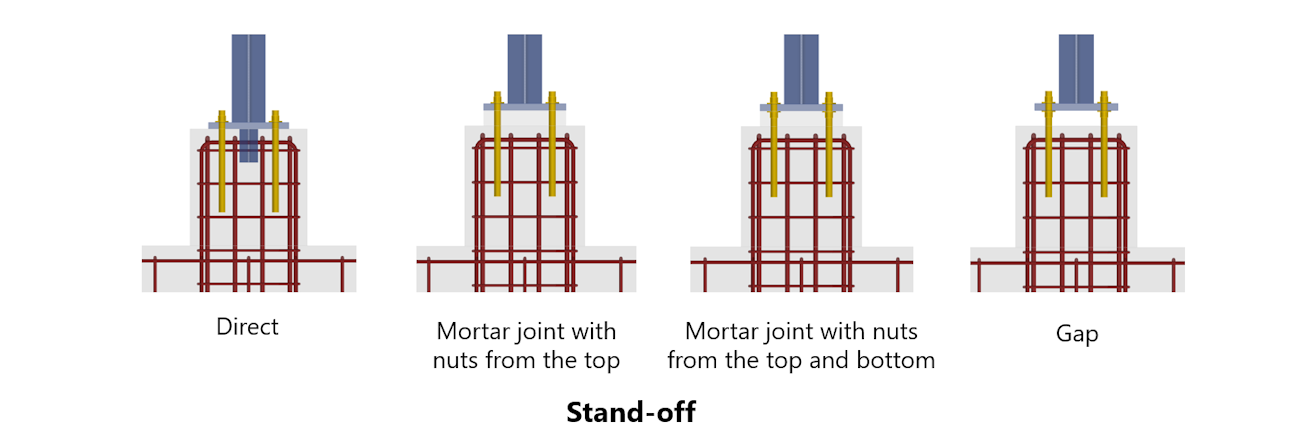
If the design fails under unreinforced concrete assumptions or in more complex situations, the connection can be modeled directly in Detail 3D to include reinforcement and advanced concrete behavior.
3. Embedded Plates
Embedded plates are used in both structural and architectural design, connecting steel framing to concrete structures, façade systems, elevator rails, stair stringers, and MEP (mechanical, electrical, and plumbing) supports. These connections transfer loads through welds or studs embedded in concrete and often include reinforcing bars tied into the structure.


In IDEA StatiCa Connection, embed plates can be modeled with welded steel elements and anchors fully integrated into the concrete block. The load transfer between steel and concrete is simulated automatically, capturing both plate stresses and anchor load distribution.
When the plate is tied to reinforcement or complex load paths exist within the concrete, exporting to Detail 3D enables full-depth modeling of the embedment, reinforcement anchorage, and surrounding concrete stress fields.
4. Plates with Post-Installed Adhesive Anchors
Base plates using adhesive anchors are frequently applied when connecting to existing foundations. They are especially used during retrofits, platform upgrades, equipment installations, industrial modification projects, and RFI's. These require careful consideration of bond strength, spacing, and edge distances to ensure safe load transfer.
In Connection, users can assign post-installed anchors during the installation process. While the bond strength itself is not evaluated within Connection, all other anchor checks are performed.

In Detail 3D, engineers can define the adhesive bond strength and add reinforcement in the concrete block to perform a complete analysis check, including bond failure and concrete cone check. This functionality is fully supported in the Connection–Detail 3D integration, allowing engineers to design adhesive anchor plates efficiently and accurately.
5. Plates on Edges or Corners of Concrete Blocks
Designing plates positioned along concrete edges or corners can be a challenging task. Uneven load transfer and stress concentrations near edges often lead to conservative designs or the need for custom reinforcement layouts. Common applications include Infrastructure projects, column bases near edges or openings, and mechanical equipment.
In IDEA StatiCa Connection, engineers can model these multi-surface plates and define the geometry of the concrete block, including edge distances and plate orientation.

For detailed reinforcement and multi-plane concrete stress analysis, the model can be exported to Detail 3D, which provides a complete 3D representation of both concrete faces, ensuring accurate simulation of combined bearing and breakout effects.
Summary of Base Plate Design Capabilities in IDEA StatiCa
The table below provides an overview of all the base plate configurations currently supported in IDEA StatiCa, ranging from modeling in Connection or Detail 3D only to full Connection–Detail 3D integration. This table serves as a quick reference for understanding which tool or combination of tools best suits each type of connection and the level of analysis currently possible. Keep an eye on this table as IDEA StatiCa continues to expand its capabilities!

