Idea Statica
  • Acier
  • Béton
  • Liens BIM
  • Assistance et formation
  • Tarifs
  • Entreprise
  • Aperçu de l'acier
  • Conception d'assemblages
  • Conception d’éléments en acier
  • Conception paramétrique
  • Études de cas sur l'acier
  • Aperçu concret
  • Voiles et details
  • Conception d’éléments en béton
  • Ancrage
  • Membre & Section transversale
  • Études de cas en béton
  • Aperçu du BIM
  • Intégrations supportées
  • Checkbot
  • Viewer
  • API
  • Centre d'assistance
  • Campus - Formation en ligne
  • Blog
  • À télécharger
  • Plans
  • Outil communautaire gratuit
  • Étudiants et universités
  • Calculatrices de valeur
  • Contact
  • Career
  • Partners
  • Projects clients
  • Études de cas
  • Acier
    Aperçu de l'acierConception d'assemblagesConception d’éléments en acierConception paramétriqueÉtudes de cas sur l'acier
  • Béton
    Aperçu concretVoiles et detailsConception d’éléments en bétonAncrageMembre & Section transversaleÉtudes de cas en béton
  • Liens BIM
    Aperçu du BIMIntégrations supportéesCheckbotViewerAPI
  • Assistance et formation
    Centre d'assistanceCampus - Formation en ligneBlogÀ télécharger
  • Tarifs
    PlansOutil communautaire gratuitÉtudiants et universitésCalculatrices de valeur
  • Entreprise
    ContactCareerPartnersProjects clientsÉtudes de cas
Essai de 14 jours
Essai de 14 jours
  • Acier
  • Béton
  • Liens BIM
  • Assistance et formation
  • Tarifs
  • Entreprise

Abonnez-vous à notre newsletter

Société

  • À propos de nous
  • Partenariats
  • Carrières
  • Technologie brevetée pour les ingénieurs structure

Ressources

  • Projets clients
  • Études de cas
  • IDEA StatiCa Bibliothèque des assemblages
  • Livrets de vérification

Juridique

  • IDEA StatiCa CONTRAT DE LICENCE UTILISATEUR FINAL
  • Politique de confidentialité globale
  • Conditions d'utilisation – IDEA StatiCa Viewer
  • Licences

Aide

  • Contact
  • Demande de devis
  • Revendeurs
  • Téléchargements
FacebookInstagramLinkedInYouTube

© IDEA StatiCa 2009-2026

Approuvé et utilisé dans le monde entier par des ingénieurs, des fabricants et des consultants.

Centre d'assistanceExemples de vérificationTraduction de l'essai - Rupture par traction
Traduction de l'essai - Rupture par traction
SteelConnection designVerificationsCBFEMPlates

Traduction de l'essai - Rupture par traction

Cet article est également disponible en
CZDEFRNL

A report dealing with plate strength has been prepared by the University of Tennessee authored by Mark D. Denavit and Kayla Truman-Jarrell. In this report plastic strain limit and mesh sensitivity are discussed in comparison to experiments and AISC traditional methods.

Connections are critical in structural steel buildings for transferring forces from member to member. Connections must be designed for safety and to ensure they serve their intended function. 

Test call-to-action button

This button is here to test the abilities of translator

Press this button to demolish the world

Many resources are available to engineers for designing connections with common configurations and loads. However, connection designers often encounter configurations and loading conditions for which there is little guidance. In these cases, design by advanced inelastic analysis can be particularly advantageous. 

IDEA StatiCa is a steel connection design software for design by advanced inelastic analysis. In this software, some limit states are captured in the same manner as standard strength equations, while others are not. 

The net-section tensile rupture limit state is among the most basic limit states not captured using standard strength equations. It is not necessary to use standard strength equations in design by advanced inelastic analysis if the analysis provides a comparable or higher level of reliability. 

To date, no rigorous reliability analysis has been performed to show IDEA StatiCa, and the underlying component-based finite element method, provide a comparable or higher level of reliability than provided by the standard strength equations. Such a reliability analysis is performed in this work for the limit state of tensile rupture. 
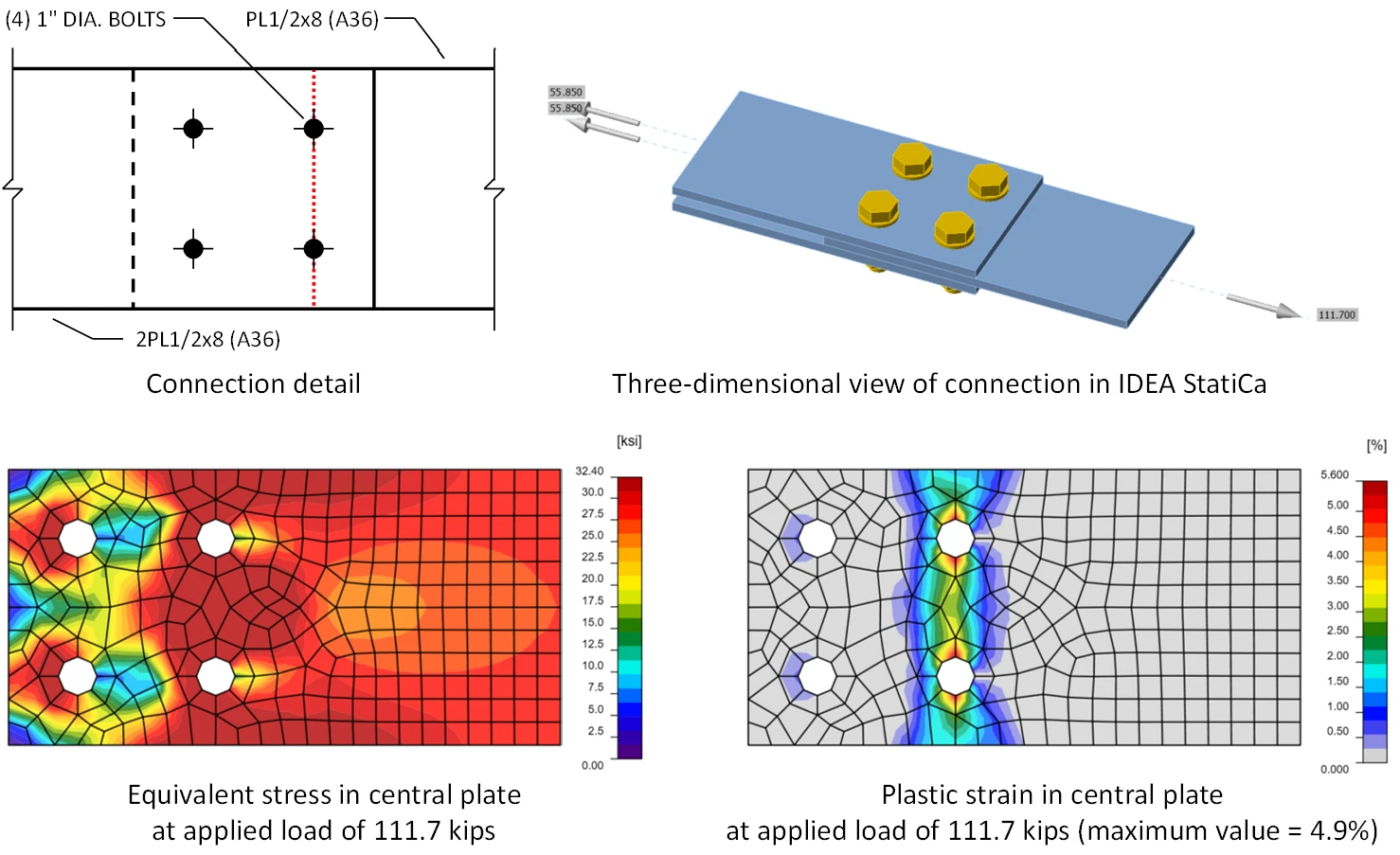
Data from hundreds of previously published experimental results exhibiting tensile rupture in a variety of connection types were examined and analyzed. Strengths from both standard equations and IDEA StatiCa were compared to the experimentally obtained strengths and to each other. A reliability analysis based on Monte Carlo simulations was conducted using results from the strength comparisons. Additionally, the sensitivity of the IDEA StatiCa strength to mesh parameters and plastic strain limit was quantified. 

Summary

The results indicate that IDEA StatiCa does, in most cases, provide a comparable or higher level of reliability than the standard strength equations. Cases where it does not are identified, and options for modifications are recommended. 

Documentation of the level of safety provided by IDEA StatiCa for the tensile rupture limit state presented in this work will bring confidence to the overall approach and enable the wider use of this helpful tool.

Téléchargements joints

  • Structural steel connection design for tensile rupture.pdf (PDF, 9.9 MB)