


IDEA StatiCa Connection software is primarily dedicated to the assessment of connections of hot-rolled members which are not significantly affected by buckling. The geometrically linear and materially non-linear analysis is performed because of its fast and stable calculation. However, this type of analysis does not take into account the loss of stability. If you need to investigate the stability behavior, performing of a linear buckling analysis can help you detect dangerous areas and provide the factor for Euler’s bifurcation point.
If you still want to use IDEA StatiCa Connection to check the connection of thin-walled (cold-formed) members and if you are experienced user of the software you have to be careful and use the engineering judgment, then you should:
- Perform linear buckling analysis and carefully evaluate each buckling shape; the first 5 presented buckling shapes might not be enough.
- Do not rely on the plasticity of thin-walled members and instead limit the von Mises stress to yield strength or even lower. (However, do not limit plastic strain to zero – singularities would be dominant. Also, localized plastic strain, e.g. near bolt holes may be fine)
- Be aware that local buckling, which is not taken into account, can redistribute internal forces in components differently.
- Be aware that stiffness of components may be different due to different failure modes or their combination.
- Be aware that presented checks and detailing of components (e.g. bolts, welds) are following guides for standard members. The code checks of thin-walled members may vary, and then the provided tests are not correct.
Generally the IDEA StatiCa Connection can be used for modeling thin-walled (cold-formed) connection behavior but for the whole code check other tools have to be used, and the final decision has to be made as a conclusion of several used methods and procedures.
For example, let’s take a look at the following joint:
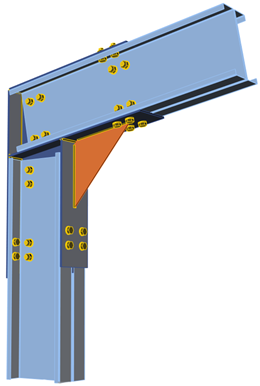
Even though linear buckling analysis was performed, it will not help us to decide if the connection is safe. The model has to be created in a way that we can explore the buckling modes of the connection components (e.g. stiffener, plates, haunches) and decide if the buckling factor of the connected components is higher than the limit value in the code.
Webinar: Focus on buckling
The issue with buckling is a general problem for thin-walled cross-sections. Find some useful hints and limitations for thin-walled sections in the attached video from one of our webinars.
Watch the webinar part dedicated to buckling issues, where you can get information about the buckling factor and the impact on the stability by the really low factors. Moreover, see how the workflow with different stiffeners helps you to improve the stability and increase the buckling factor.


