
- Setting up a capacity design for seismic applications
- Code-checks for SCBF connections
- Modeling techniques
- Verification studies
WebinarSteelConnection designConnectionSeismicityAISC (USA)
Special Concentric Braced Frame Connections
This webinar is also available in


Streamed on
August 27, 2025 / 16:00
(in your local time, 24-hour format)
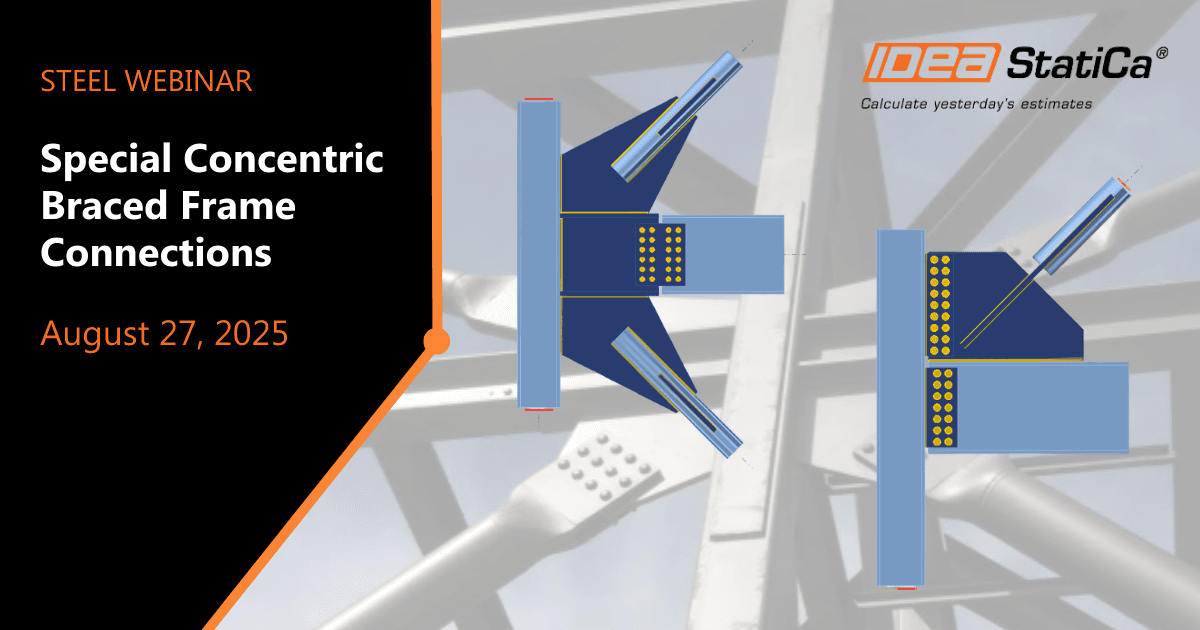
During this webinar, we will demonstrate how you can use IDEA StatiCa to analyze and design SCBFs. An example from the AISC Seismic Design Manual will be used. Also, we will discuss the verification studies provided by The University of Illinois Chicago.
Join the webinar and learn about



The design of Special Concentrated Braced Frame connections has detailed requirements from the AISC 341 Seismic provisions, especially for detailing the brace connection to the gusset, where AISC 341 recommends different ways to accommodate the brace buckling.
In IDEA StatiCa, it is possible to model and design the recommended details and use capacity design analysis where the user can select a dissipative item (fuse element) and apply the brace expected strength. The beam-to-column connection should be strong enough to resist the overstrength forces.
The design of the brace end condition, to maintain its integrity as the brace buckles, is solved by two options: "Connections with sufficient flexural resistance such that the end rotation due to brace flexural buckling occurs in the brace itself [AISC Seismic Provisions F2.6c.3(a)], or providing gusset detailing such that the end rotation occurs in the connection without loss of strength.[AISC Seismic Provisions F2.6c.3(b)]"
During the live session, we will review the process of modeling these connections using one example from the AISC Seismic Design Manual. We will also discuss the software's capacity design capabilities and review the software's verifications regarding this topic.