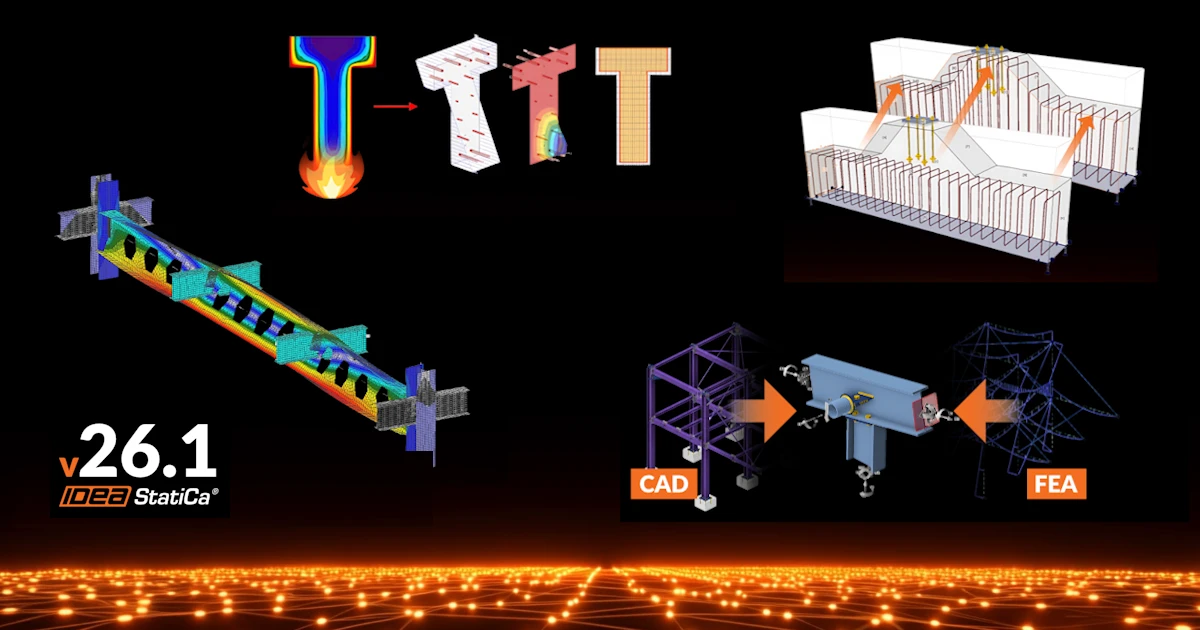


Version 26.1 Highlights
Version 26.1 - More engineering possibilities, less manual work
From complex steel-to-concrete connections to stability-sensitive structures and automated connection design, version 26.1 helps engineers solve more challenging tasks with fewer assumptions and less repetitive work.
Complete anchoring design – from steel to concrete
With version 26.1, IDEA StatiCa completes its anchoring solution, covering the entire steel-to-concrete interface, from conventional base plates and post-installed anchors to cast-in plates and complex reinforced concrete details.
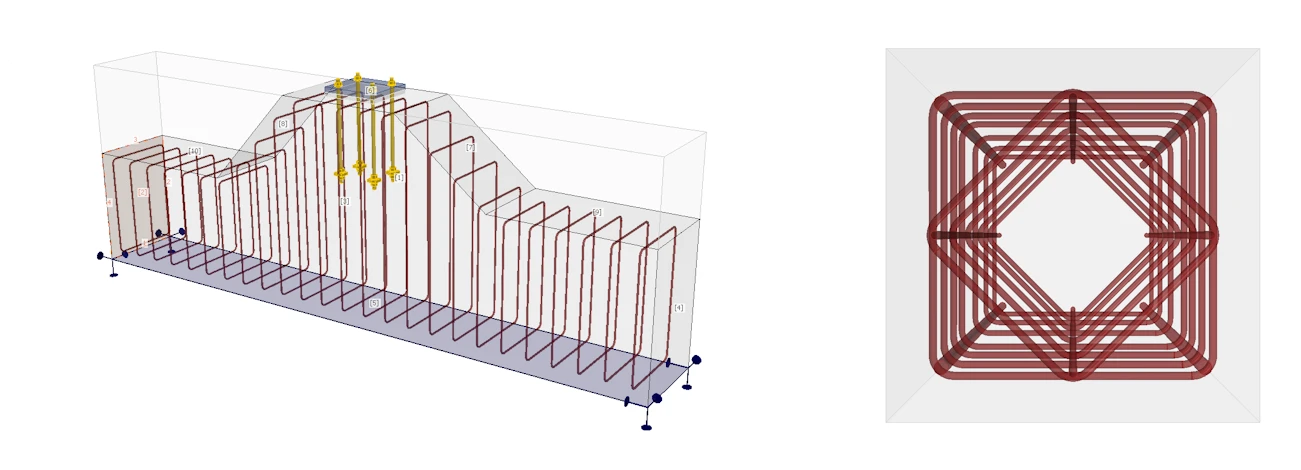
The latest improvements in IDEA StatiCa Detail 3D make reinforcement modeling faster and more flexible. Engineers can use reinforcement templates, model complex geometries, and analyze interactions among anchors, reinforcement, and concrete using 3D CSFM.
What's new in 26.1:
- More intuitive reinforcement modeling and reusable reinforcement templates
- Transparent, equation-based anchor checks with intermediate calculation steps
- Bill of materials for reinforced concrete models
- Support for CSA A23.3:24 and additional regional requirements
Together with the capabilities introduced in 26.0, these improvements provide a consistent workflow between IDEA StatiCa Connection and Detail, reducing the need to switch between different calculation tools.
Explore the complete anchoring workflow →
Stability – calculate instead of guessing
What is the correct buckling length of a steel member? For structures with semi-rigid connections, irregular geometry, or complex boundary conditions, the answer is rarely straightforward.
The new IDEA StatiCa Stability application addresses this challenge through advanced analysis rather than estimated buckling lengths and simplified assumptions.
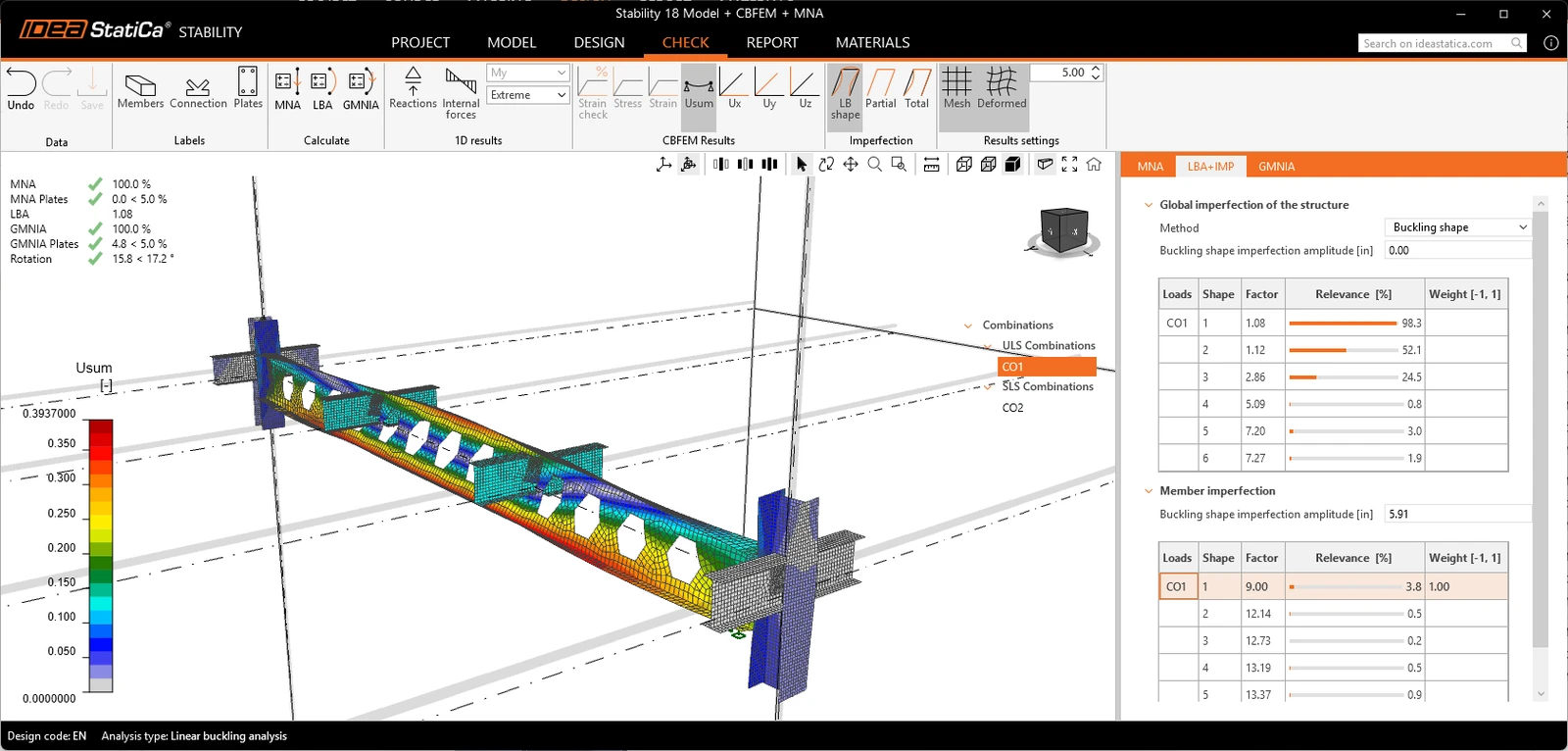
Engineers can model the surrounding structure, include the actual stiffness of connections, and perform Linear Buckling Analysis (LBA) or Geometrically and Materially Nonlinear Analysis with Imperfections (GMNIA).
The application helps engineers:
- Determine critical buckling loads and buckling modes
- Account for connection stiffness and structural restraints
- Analyze stability-sensitive members with complex geometry
- Visualize structural behavior and optimize steel sections
This is particularly valuable for slender steel members, trusses, frames, and existing structures where conservative assumptions can lead to unnecessary strengthening or excessive material consumption.
Discover IDEA StatiCa Stability →
Model Coordinator – connecting CAD and FEA models
Structural analysis and detailing models often describe the same structure but contain different information. Matching them manually, particularly in large projects, is time-consuming and error-prone.
Model Coordinator (BETA) is a new functionality within IDEA StatiCa Checkbot that connects these two worlds.
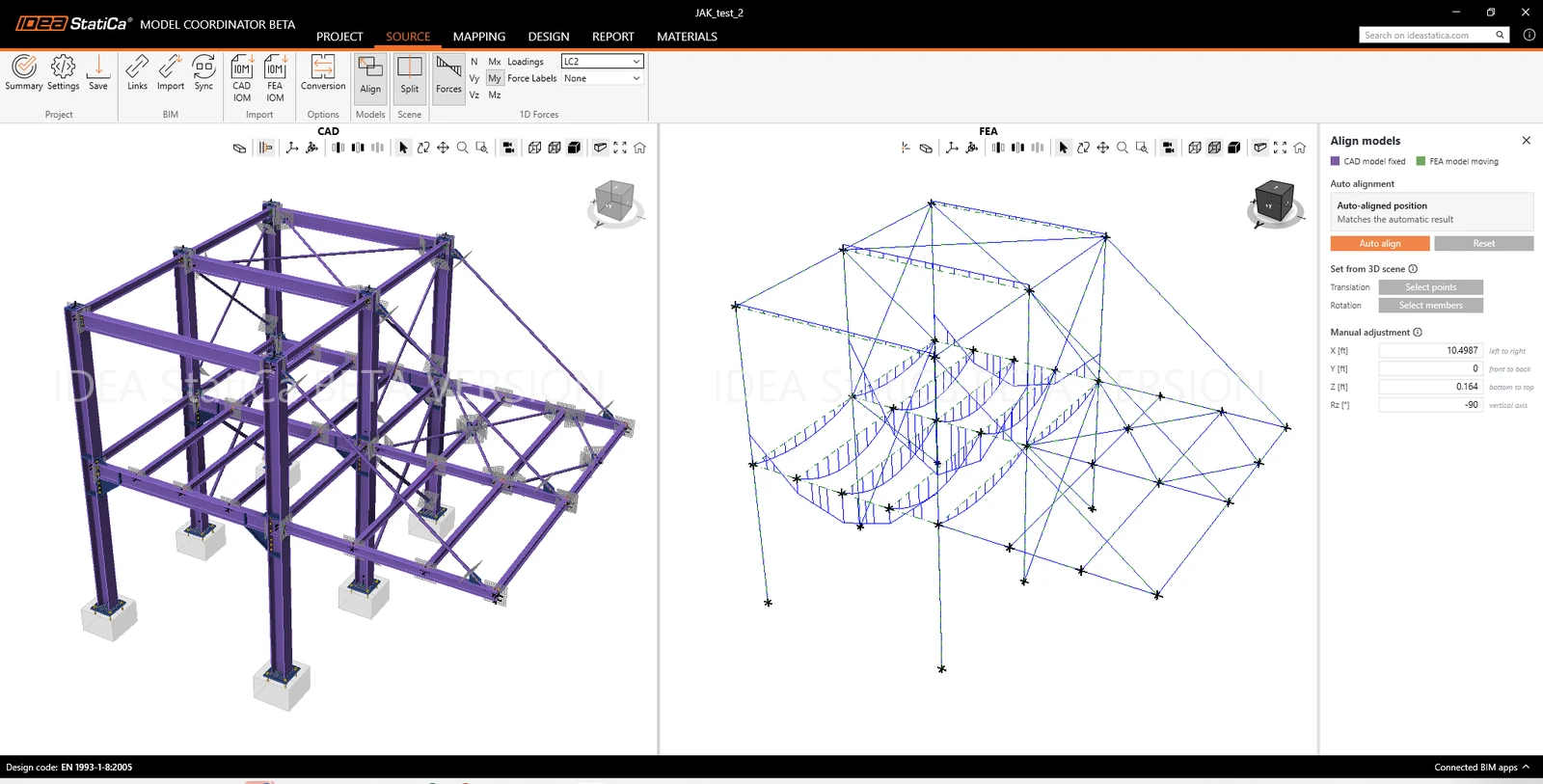
Engineers can import an analytical FEA model alongside a CAD model of the same structure. Model Coordinator automatically matches corresponding members and transfers internal forces from the analytical model to the detailing model.
This provides a more reliable starting point for connection design without manually transferring loads or recreating geometry.
Combined with existing Checkbot workflows for managing multiple connections, generating reports, and sharing projects, Model Coordinator helps engineers handle connection design across entire structures more efficiently.
See how Model Coordinator works →
Section (BETA) – reinforced concrete design for the new Eurocodes
The second generation of Eurocodes introduces updated requirements for reinforced concrete design, including serviceability and fire resistance.
The new IDEA StatiCa Section (BETA) application brings these checks into a modern, transparent calculation environment.
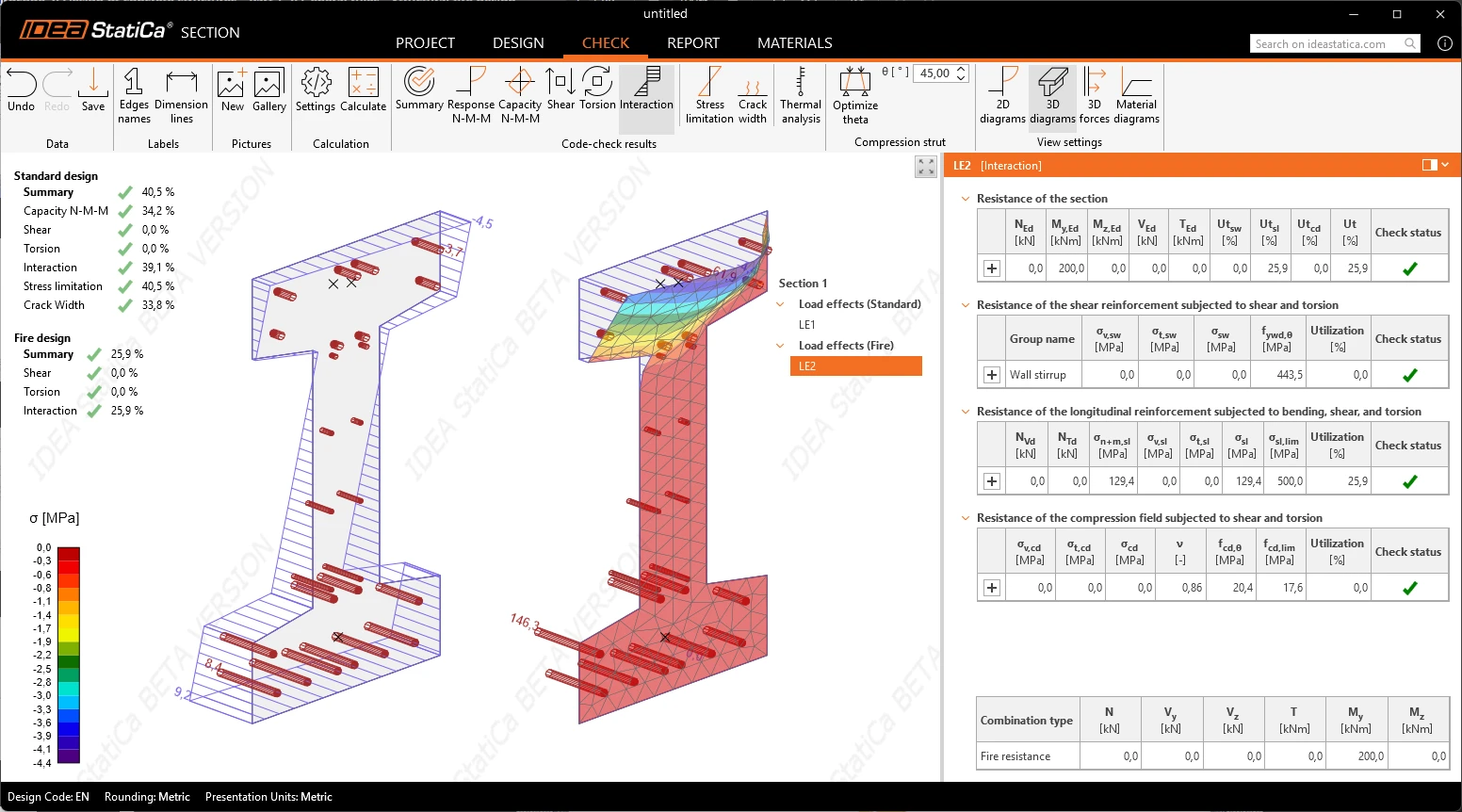
One of its key capabilities is advanced thermal analysis of reinforced concrete cross-sections. Instead of relying solely on conservative tabulated methods, engineers can calculate the temperature distribution within a section, determine temperature-dependent material properties, and verify the section's resistance under fire conditions.
Version 26.1 introduces:
- Thermal analysis and fire resistance checks according to EN 1992-1-2:2023
- Serviceability limit state checks, including stress limitations and crack width
- A modern interface with transparent, code-based calculations
- Reinforcement modeling and reusable templates
The result is a more detailed assessment of reinforced concrete sections, particularly valuable for non-standard geometries and the verification of existing structures.
Explore the new Section application →
Connection API – automate the entire connection design process
Designing and checking hundreds of connections should not require hundreds of repetitive manual operations.
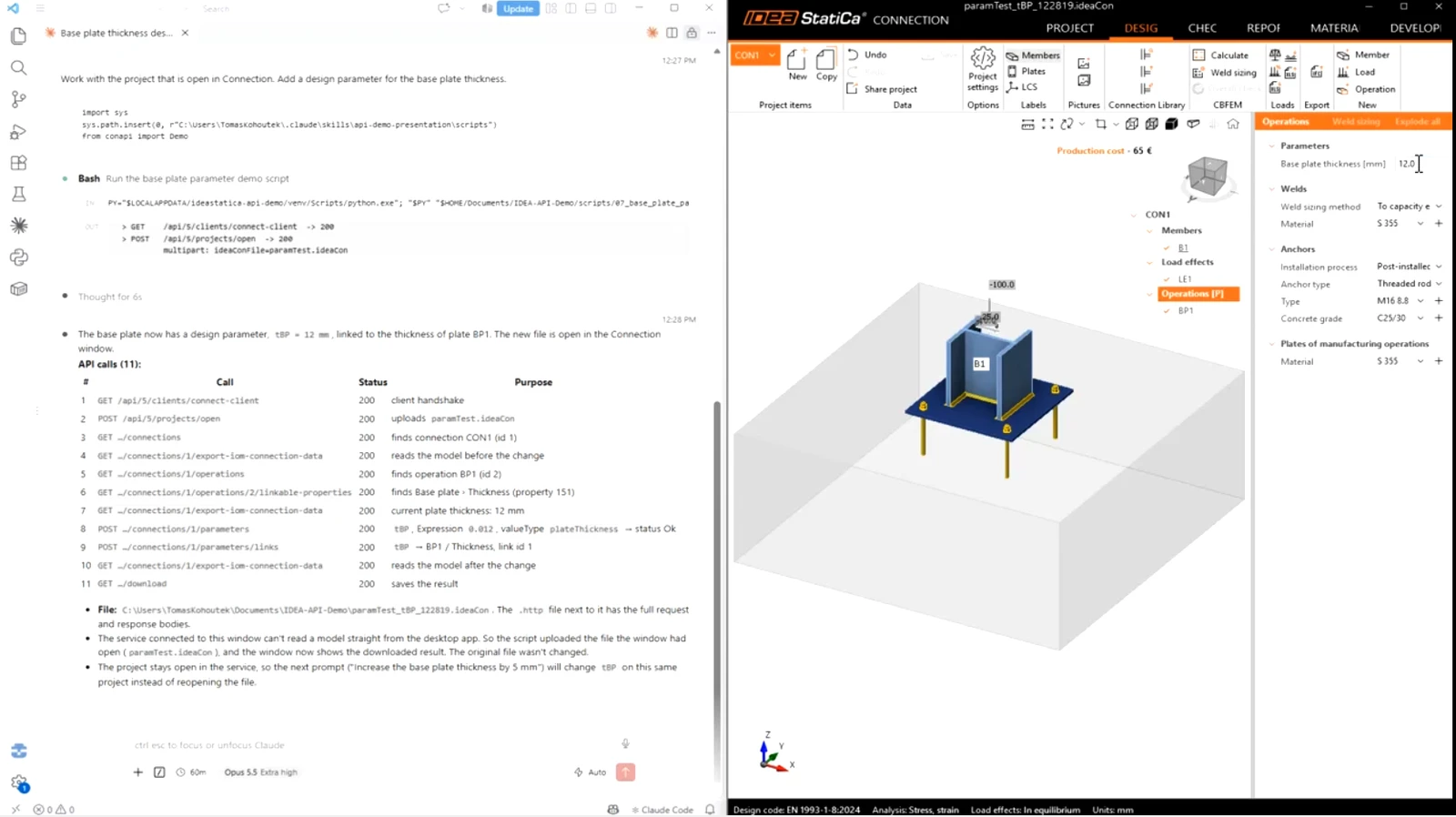
Version 26.1 significantly extends the IDEA StatiCa Connection API, enabling engineers and developers to create, modify, calculate, and evaluate steel connections programmatically.
The API now supports connection assembly and manufacturing operations, including plates, cuts, bolts, and welds. Users can build complete connections without opening the desktop application.
Further improvements include:
- Direct modification of model properties, including plate dimensions and bolt positions
- Calculation progress tracking and selective analysis of critical load cases
- Reusable parametric connection templates
- Extended Grasshopper integration for automated connection design
These capabilities open new possibilities for large-scale connection checking, automated design iterations, and integration with company-specific engineering workflows.
Discover Connection API automation →
More improvements across IDEA StatiCa
Version 26.1 also includes updates across steel and concrete design, BIM interoperability, and regional design standards.
Second-generation Eurocodes: IDEA StatiCa Connection introduces checks according to EN 1993-1-8:2024, enabling engineers to prepare for the upcoming transition and compare results across code editions.
BIM interoperability: Faster imports from Autodesk Robot, improved integration with RFEM/RSTAB, and updates to SCIA Engineer and MIDAS workflows reduce the effort required to transfer structural models.
Parametric design: Improvements to connection templates and Grasshopper integration make it easier to create, reuse, and automate connection models.
Regional standards: Additional national annexes and code updates extend support for engineering practices in different markets.
For the complete overview of new features, improvements, and supported integrations, see the IDEA StatiCa 26.1 Release Notes.
Get started with IDEA StatiCa 26.1
Whether you are designing complex anchorages, checking stability-sensitive steel structures, preparing for the next generation of Eurocodes, or automating connection design, IDEA StatiCa 26.1 provides new tools to handle these tasks with greater efficiency and confidence.
Check out the release notes, download the latest version, and try it out for yourself using the link below. Please do not forget to share your feedback through your local reseller or branch!
You can also sign up for our release webinar to hear a more in-depth guide to the new release from some of the team behind bringing you this latest version.