
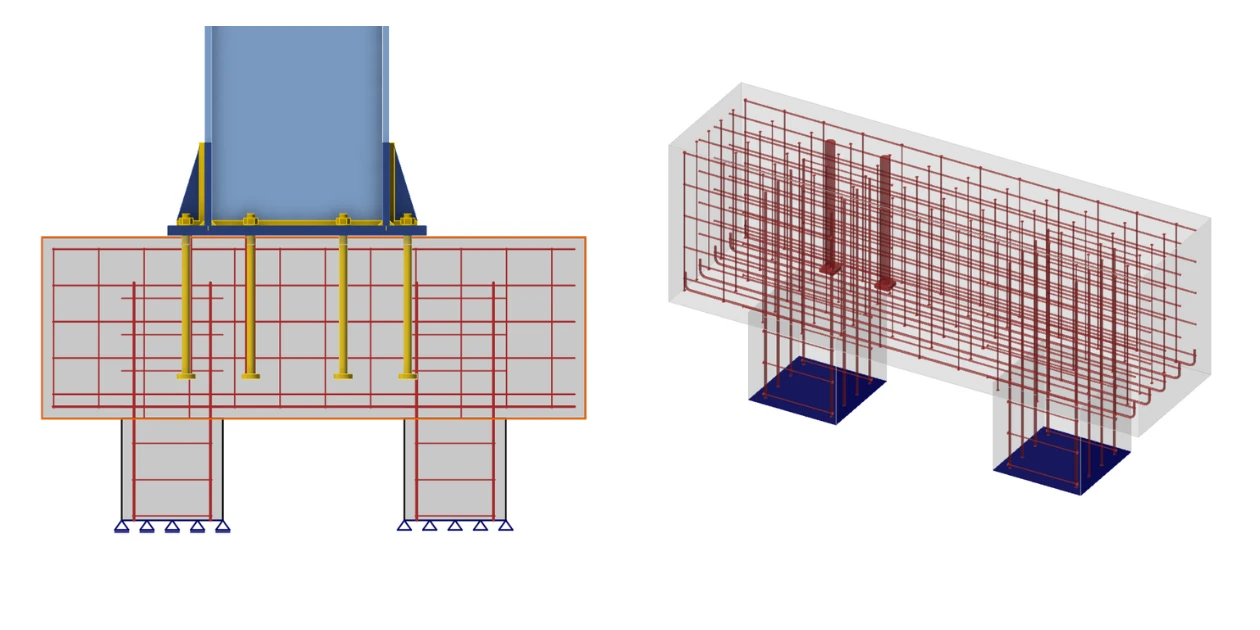


เมื่อทำการยึดเหล็กกับคอนกรีต โดยทั่วไปจะใช้สลักยึดหรือพุกเคมีเพื่อให้มั่นใจในความมั่นคงของโครงสร้างและความสามารถในการรับน้ำหนักในโครงการก่อสร้าง โดยแบบจำลองจะถูกวิเคราะห์ใน IDEA StatiCa Detail app
Widget #NaN: widget_content_image_collapse_item
Name: IDEA StatiCa Detail
ID: b3110a59-a173-4dde-81ac-e4d2ed554ff5
Show Raw Data
{
"title": {
"name": "Title",
"type": "text",
"value": "IDEA StatiCa Detail"
},
"description": {
"images": [],
"linkedItemCodenames": [],
"linkedItems": [],
"links": [],
"name": "Description",
"type": "rich_text",
"value": "<p>เหมาะสำหรับชิ้นส่วนที่มีบริเวณ D (บริเวณไม่ต่อเนื่อง) ช่องเปิด และส่วนเสริมคาน รวมถึงชิ้นส่วน 2D ที่มีรูปทรงทั่วไป </p>\n<ul>\n <li>วิธี CSFM แบบไม่เชิงเส้น </li>\n <li>ความเค้นและความเครียดของ Concrete และเหล็กเสริมทั้งหมด</li>\n <li>การตรวจสอบความกว้างรอยแตก</li>\n <li>การตรวจสอบขีดจำกัดความเค้น</li>\n <li>การโก่งตัวแบบไม่เชิงเส้น</li>\n <li>นำเข้าข้อมูลจาก Beam application</li>\n</ul>"
},
"link_text": {
"name": "Link text",
"type": "text",
"value": "อ่านเพิ่มเติมเกี่ยวกับการคำนวณ"
},
"link_url": {
"name": "Link URL",
"type": "text",
"value": ""
},
"content_item_link": {
"name": "Content item link",
"type": "modular_content",
"value": [
"detail_theoretical_background"
],
"linkedItems": [
{
"elements": {
"title": {
"name": "Main headline (H1)",
"type": "text",
"value": "IDEA StatiCa Module รายละเอียด – การออกแบบโครงสร้างบริเวณไม่ต่อเนื่องของ Concrete"
},
"preview_image": {
"name": "Preview image",
"type": "asset",
"value": [
{
"name": "Structural design of concrete members in IDEA StatiCa Detail.png",
"description": null,
"type": "image/png",
"size": 163091,
"url": "https://assets-us-01.kc-usercontent.com:443/66e7a155-be94-0096-73e6-c55dfc7e5788/7885cdc1-8e4a-4744-834e-72ea84ebbaf4/Structural%20design%20of%20concrete%20members%20in%20IDEA%20StatiCa%20Detail.png",
"width": 1200,
"height": 630,
"renditions": {}
}
]
},
"post_date": {
"name": "Post date",
"type": "date_time",
"value": null,
"displayTimeZone": null
},
"perex_content": {
"name": "Lead paragraph",
"type": "text",
"value": ""
},
"content": {
"images": [],
"linkedItemCodenames": [
"n040e96bb_486f_01f3_c432_7a23524f9331",
"theoretical_background_detail___general",
"a4bf16aa_6c2f_013e_1829_b9e25da3520e",
"theoretical_background_detail___main_assumptions_a",
"n67efa21f_23bd_0100_0148_693d9e355fd4",
"theoretical_background_detail___general___reinforc",
"n3387f1b0_a148_01f2_c521_8982bf821616",
"theoretical_background_detail___general___finite_e",
"n5a454114_cda7_01ac_2a78_a6de5ef06909",
"theoretical_background_detail___supports_and_load_",
"n779c20eb_117a_01d7_d627_9519532f7ade",
"theoretical_background_detail___load_transfer_at_t",
"n139133fb_8c26_0102_6b4f_3513e30e50ac",
"theoretical_background_detail___geometric_modifica",
"n400db889_291a_01ec_2b5c_4ef44ac08366",
"theoretical_background_detail___finite_element_typ",
"e7f79b22_bbb4_0191_dabc_999404b56d71",
"theoretical_background_detail___meshing",
"b3722d5c_2c12_01f8_8c9e_833582888727",
"theoretical_background_detail___solution_method_an",
"n5edb1005_76bb_0151_eae3_db8b3683baef",
"theoretical_background_detail___presentation_of_re",
"n978b3c2e_46e3_01f2_76ef_33d1116b0278",
"theoretical_background_detail___general___verifica",
"n87e806c7_4545_0146_3777_8d6eb4869c34",
"theoretical_background_detail___material_models__e",
"n1534a30e_6761_0171_a4f9_75aeb26cc31a",
"theoretical_background_detail___safety_factors",
"n9434c7ec_7980_0136_b33e_8a308d27d134",
"theoretical_background_detail___ultimate_limit_sta",
"n50ff4744_78f7_01f7_3551_097b5b78c4bc",
"theoretical_background_detail___partially_loaded_a",
"n03c0807f_9a1c_0133_bf9c_7962d39bb052",
"theoretical_background_detail___serviceability_lim",
"n8087c563_aff6_01b7_4912_b90597183afc",
"theoretical_background_detail___material_models__a",
"n36199632_b4e1_0174_2159_f7af58609c6d",
"theoretical_background_detail___factors___aci",
"b99a3f3f_74b2_01f2_79e2_3e6b5ea4fa73",
"theoretical_background_detail___strength_analysis_",
"bc0dab28_71ea_0113_c3a4_30b3a0d47c41",
"theoretical_background_detail___bearing_and_anchor",
"n720952b5_b0d2_0172_3e6f_8b8fd8d8c7ad",
"theoretical_background_detail___serviceability_ver",
"n46537cd0_9cdd_01c3_88fe_d53de6bb2dad",
"theoretical_background_detail___material_models__a_0b99d24",
"f8a30564_36a1_018a_3097_17b99f01f95d",
"theoretical_background_detail___resistance_and_loa",
"n24be91a3_fe1f_013b_a03d_cd9d045de7e4",
"theoretical_background_detail___strength_limit_sta",
"n6c2be4b0_9ee9_015d_b7f5_db4962d18b03",
"theoretical_background_detail___bearing_and_anchor_69cbe39",
"fd3ad7ab_3d32_018b_2b8f_715c0dad8963",
"theoretical_background_detail___service_limit_stat",
"n8f5d5ee6_6dbb_01bf_5218_02292159a74c",
"theoretical_background_detail___material_models__a_b7035a6",
"n094cf23e_ff81_018b_04fa_acd11fe30998",
"theoretical_background_detail___stress_reduction_a",
"e64dfcde_fc39_0132_0732_bc2e27f5fdce",
"theoretical_background_detail___strength_analysis__8bc3bfe",
"fb4f1e92_d8b4_0188_90bb_683d2482dc27",
"theoretical_background_detail___serviceability_ver_77b5f2c",
"n444df9f7_cb16_01ef_677c_f57b029582b6",
"theoretical_background_detail___material_models__c",
"n3167637d_541f_0171_4054_58c6f8b2fa47",
"theoretical_background_detail___resistance_and_loa_3be42f4",
"fed85f9d_77ac_0105_84a0_896323060425",
"theoretical_background_detail___strength_limit_sta_fde100c",
"f7137649_8da2_01f4_8b12_041c2635cf1f",
"theoretical_background_detail___bearing_and_anchor_bfd09ef",
"n99f415ba_745e_01a5_9579_a8ab4aa6730b",
"theoretical_background_detail___service_limit_stat_00c850c",
"n642589a6_4da6_01a2_de20_89abe76387f1",
"prestressing_in_detail___model_description__body_",
"a88f8b07_3321_01fa_6be7_5de76b226c27"
],
"linkedItems": [
{
"elements": {
"title": {
"name": "Title",
"type": "text",
"value": "1.1 General introduction"
},
"id": {
"name": "ID",
"type": "text",
"value": "general-introduction"
},
"printable_anchor": {
"name": "Printable anchor used in PDF content table",
"type": "multiple_choice",
"value": []
},
"translation__translation_connector": {
"name": "Translation Connector",
"type": "taxonomy",
"value": [],
"taxonomyGroup": "languages"
},
"translation__force_translation": {
"name": "Force translation",
"type": "multiple_choice",
"value": []
},
"translation__translate_standalone_nested_content_items": {
"name": "Translate standalone nested content items",
"type": "multiple_choice",
"value": []
},
"translation__last_translation": {
"images": [],
"linkedItemCodenames": [],
"linkedItems": [],
"links": [],
"name": "Last translation",
"type": "rich_text",
"value": "<p><br></p>"
},
"translation__ai_translated": {
"name": "AI translated",
"type": "multiple_choice",
"value": []
},
"translation___experimental__synchronize_content_references": {
"name": "[Experimental] Synchronize content references",
"type": "multiple_choice",
"value": []
},
"translation___experimental__selective_element_translation": {
"name": "[Experimental] Selective translation",
"type": "multiple_choice",
"value": []
},
"translation__selectivetranslationelementid": {
"name": "selectiveTranslationElementId",
"type": "custom",
"value": null
}
},
"system": {
"codename": "n040e96bb_486f_01f3_c432_7a23524f9331",
"collection": "default",
"id": "040e96bb-486f-01f3-c432-7a23524f9331",
"language": "th-TH",
"lastModified": "2026-10-27T20:24:01.1443265Z",
"name": "040e96bb-486f-01f3-c432-7a23524f9331",
"sitemapLocations": [],
"type": "widget_anchor_target",
"workflowStep": null,
"workflow": null
}
},
{
"elements": {
"title": {
"name": "Main headline (H1)",
"type": "text",
"value": "1.1 บทนำทั่วไปสำหรับการออกแบบโครงสร้างของรายละเอียดคอนกรีต"
},
"preview_image": {
"name": "Preview image",
"type": "asset",
"value": [
{
"name": "General introduction for the structural design of concrete details.png",
"description": null,
"type": "image/png",
"size": 151821,
"url": "https://assets-us-01.kc-usercontent.com:443/66e7a155-be94-0096-73e6-c55dfc7e5788/918cd80e-191a-437a-8d6a-d2f8c7f688c2/General%20introduction%20for%20the%20structural%20design%20of%20concrete%20details.png",
"width": 1200,
"height": 630,
"renditions": {}
}
]
},
"post_date": {
"name": "Post date",
"type": "date_time",
"value": null,
"displayTimeZone": null
},
"perex_content": {
"name": "Lead paragraph",
"type": "text",
"value": ""
},
"content": {
"images": [
{
"description": null,
"imageId": "874c8092-fb41-44c6-804d-52727044d470",
"url": "https://assets-us-01.kc-usercontent.com:443/66e7a155-be94-0096-73e6-c55dfc7e5788/dc96c2fd-25aa-43fd-b6d5-556b5242b9cf/Discontinuity%20regions.png",
"height": 939,
"width": 1394
}
],
"linkedItemCodenames": [],
"linkedItems": [],
"links": [],
"name": "Content",
"type": "rich_text",
"value": "<p>การออกแบบและการประเมินชิ้นส่วนคอนกรีตโดยปกติจะดำเนินการในระดับหน้าตัด (ชิ้นส่วน 1D) หรือระดับจุด (ชิ้นส่วน 2D) ขั้นตอนนี้ได้อธิบายไว้ในมาตรฐานการออกแบบโครงสร้างทั้งหมด เช่น (EN 1992-1-1 หรือ ACI 318-19) และใช้ในงานปฏิบัติด้านวิศวกรรมโครงสร้างในชีวิตประจำวัน อย่างไรก็ตาม ไม่ได้เป็นที่ทราบหรือคำนึงถึงเสมอไปว่า ขั้นตอนนี้ยอมรับได้เฉพาะในบริเวณที่สมมติฐานของ Bernoulli-Navier เรื่องการกระจายความเครียดแบบระนาบเป็นจริงเท่านั้น (เรียกว่าบริเวณ B) ส่วนบริเวณที่สมมติฐานนี้ไม่เป็นจริงเรียกว่าบริเวณไม่ต่อเนื่องหรือบริเวณที่ถูกรบกวน (บริเวณ D) ตัวอย่างของบริเวณ B และบริเวณ D ของชิ้นส่วน 1D แสดงไว้ใน (รูปที่ 1) ได้แก่ พื้นที่รองรับแรง ส่วนที่มีแรงกระทำแบบกระจุก ตำแหน่งที่หน้าตัดเปลี่ยนแปลงอย่างฉับพลัน ช่องเปิด เป็นต้น ในการออกแบบโครงสร้างคอนกรีต เราพบบริเวณ D อื่น ๆ อีกมาก เช่น ผนัง ไดอะแฟรมของสะพาน Console เป็นต้น </p>\n<figure data-asset-id=\"874c8092-fb41-44c6-804d-52727044d470\" data-image-id=\"874c8092-fb41-44c6-804d-52727044d470\"><img src=\"https://assets-us-01.kc-usercontent.com:443/66e7a155-be94-0096-73e6-c55dfc7e5788/dc96c2fd-25aa-43fd-b6d5-556b5242b9cf/Discontinuity%20regions.png\" data-asset-id=\"874c8092-fb41-44c6-804d-52727044d470\" data-image-id=\"874c8092-fb41-44c6-804d-52727044d470\" alt=\"\"></figure>\n<p><em>\\[ \\textsf{\\textit{\\footnotesize{Fig. 1\\qquad Discontinuity regions (Navrátil et al. 2017)}}}\\]</em></p>\n<p>ในอดีต การกำหนดขนาดของบริเวณไม่ต่อเนื่องใช้กฎการออกแบบกึ่งเชิงประสบการณ์ โชคดีที่กฎเหล่านี้ถูกแทนที่เป็นส่วนใหญ่ในช่วงหลายทศวรรษที่ผ่านมาด้วยแบบจำลองค้ำยันและตัวดึง (Schlaich et al., 1987) และสนามความเค้น (Marti 1985) ซึ่งปรากฏอยู่ในมาตรฐานการออกแบบปัจจุบันและผู้ออกแบบใช้กันบ่อยในปัจจุบัน แบบจำลองเหล่านี้มีความสอดคล้องเชิงกลศาสตร์และเป็นเครื่องมือที่ทรงพลัง โปรดทราบว่าโดยทั่วไปสนามความเค้นอาจต่อเนื่องหรือไม่ต่อเนื่องก็ได้ และแบบจำลองค้ำยันและตัวดึงเป็นกรณีพิเศษของสนามความเค้นแบบไม่ต่อเนื่อง</p>\n<p>แม้เครื่องมือคำนวณจะพัฒนาขึ้นในช่วงหลายทศวรรษที่ผ่านมา แบบจำลองค้ำยันและตัวดึงก็ยังคงถูกใช้เป็นการคำนวณด้วยมือเป็นหลัก การนำไปใช้กับโครงสร้างจริงนั้นยุ่งยากและใช้เวลานาน เนื่องจากต้องทำซ้ำหลายรอบและต้องพิจารณากรณีแรงกระทำหลายกรณี นอกจากนี้ วิธีนี้ไม่เหมาะสำหรับการตรวจสอบเกณฑ์สภาวะการใช้งาน (การเสียรูป ความกว้างรอยร้าว เป็นต้น)</p>\n<p>ความสนใจของวิศวกรโครงสร้างในเครื่องมือที่เชื่อถือได้และรวดเร็วสำหรับการออกแบบบริเวณ D นำไปสู่การตัดสินใจพัฒนาวิธีสนามความเค้นที่สอดคล้องรูปแบบใหม่ ซึ่งเป็นวิธีออกแบบสนามความเค้นด้วยคอมพิวเตอร์ ที่ช่วยให้ออกแบบและประเมินชิ้นส่วนโครงสร้างคอนกรีตที่รับแรงกระทำในระนาบได้โดยอัตโนมัติ</p>\n<p>วิธีสนามความเค้นที่สอดคล้อง (CSFM) เป็นวิธีวิเคราะห์สนามความเค้นแบบต่อเนื่องที่อิงกับ FE ซึ่งผลเฉลยสนามความเค้นแบบดั้งเดิมถูกเสริมด้วยการพิจารณาด้านจลนศาสตร์ กล่าวคือ มีการประเมินสถานะความเครียดตลอดทั้งโครงสร้าง ดังนั้น กำลังอัดประสิทธิผลของคอนกรีตจึงสามารถคำนวณโดยอัตโนมัติได้จากสถานะความเครียดในแนวขวาง ในลักษณะคล้ายกับการวิเคราะห์สนามแรงอัดที่คำนึงถึงการอ่อนตัวจากแรงอัด (Vecchio and Collins 1986; Kaufmann and Marti 1998) และวิธี EPSF (Fernández Ruiz and Muttoni 2007) นอกจากนี้ CSFM ยังคำนึงถึงการเสริมความแข็งจากแรงดึง ทำให้ชิ้นส่วนมีค่าสติฟเนสที่สมจริง และครอบคลุมข้อกำหนดทั้งหมดของมาตรฐานการออกแบบ (รวมถึงด้านสภาวะการใช้งานและความสามารถในการเสียรูป) ซึ่งวิธีการก่อนหน้านี้ไม่ได้พิจารณาอย่างสอดคล้องกัน CSFM ใช้แบบจำลองเชิงองค์ประกอบแกนเดียวทั่วไปที่มาตรฐานการออกแบบกำหนดไว้สำหรับคอนกรีตและเหล็กเสริม ซึ่งทราบได้ในขั้นตอนการออกแบบ ทำให้สามารถใช้วิธีตัวคูณลดทอนความปลอดภัยย่อยได้ ดังนั้น ผู้ออกแบบจึงไม่ต้องระบุคุณสมบัติวัสดุเพิ่มเติมซึ่งมักเป็นค่าที่กำหนดตามอำเภอใจ ดังที่มักต้องใช้ในการวิเคราะห์ FE แบบไม่เชิงเส้น ทำให้วิธีนี้เหมาะสมอย่างยิ่งกับงานปฏิบัติทางวิศวกรรม</p>\n<p>เพื่อส่งเสริมการใช้สนามความเค้นด้วยคอมพิวเตอร์โดยวิศวกรโครงสร้าง วิธีการเหล่านี้ควรถูกนำไปพัฒนาในสภาพแวดล้อมซอฟต์แวร์ที่ใช้งานง่าย ด้วยเหตุนี้ CSFM จึงถูกนำไปพัฒนาใน <em>IDEA StatiCa Module รายละเอียด</em>; ซอฟต์แวร์เชิงพาณิชย์ใหม่ที่ใช้งานง่าย พัฒนาร่วมกันโดย ETH Zurich และบริษัทซอฟต์แวร์ IDEA StatiCa ภายใต้กรอบของโครงการ DR-Design Eurostars-10571</p>"
},
"linked_items": {
"name": "Linked items",
"type": "modular_content",
"value": [
"detail_theoretical_background",
"theoretical_background_detail___general___reinforc",
"dimenzovani_zb_konstrukci_podle_csfm",
"prestressed_i_section"
],
"linkedItems": [
"[Circular Reference]",
{
"elements": {
"title": {
"name": "Main headline (H1)",
"type": "text",
"value": "1.3 เครื่องมือออกแบบสำหรับเหล็กเสริม"
},
"preview_image": {
"name": "Preview image",
"type": "asset",
"value": [
{
"name": "Reinforcement structural design.png",
"description": null,
"type": "image/png",
"size": 61765,
"url": "https://assets-us-01.kc-usercontent.com:443/66e7a155-be94-0096-73e6-c55dfc7e5788/8d4e1ab7-8d44-491e-873f-8ea42d620992/Reinforcement%20structural%20design.png",
"width": 1200,
"height": 630,
"renditions": {}
}
]
},
"post_date": {
"name": "Post date",
"type": "date_time",
"value": null,
"displayTimeZone": null
},
"perex_content": {
"name": "Lead paragraph",
"type": "text",
"value": ""
},
"content": {
"images": [
{
"description": null,
"imageId": "eee2b9e4-83cd-4b9c-98e7-f575b2ff9cff",
"url": "https://assets-us-01.kc-usercontent.com:443/66e7a155-be94-0096-73e6-c55dfc7e5788/9b0c4840-5a55-46f3-95ba-86a9baabbf0c/Model%20used%20to%20illustrate%20the%20use%20of%20the%20reinforcement%20design%20tools.png",
"height": 603,
"width": 864
},
{
"description": null,
"imageId": "f6c14a09-4d2b-40e6-ac82-5ff08c10439a",
"url": "https://assets-us-01.kc-usercontent.com:443/66e7a155-be94-0096-73e6-c55dfc7e5788/ea7896d1-8276-4d08-b811-066cca73b455/Results%20from%20the%20linear%20analysis%20tool.jpg",
"height": 315,
"width": 1177
},
{
"description": null,
"imageId": "f4f47d5e-3196-4a88-96ca-7162b0c8c271",
"url": "https://assets-us-01.kc-usercontent.com:443/66e7a155-be94-0096-73e6-c55dfc7e5788/f4d37064-76c7-4413-b1aa-87455a32852c/Results%20from%20the%20topology%20optimization%201.jpg",
"height": 320,
"width": 1179
},
{
"description": null,
"imageId": "7ddd1329-64ea-4a47-be5d-64994439e729",
"url": "https://assets-us-01.kc-usercontent.com:443/66e7a155-be94-0096-73e6-c55dfc7e5788/d81f2841-8274-414a-8f30-b55427216169/Results%20from%20the%20topology%20optimization%202.png",
"height": 315,
"width": 1179
}
],
"linkedItemCodenames": [],
"linkedItems": [],
"links": [
{
"codename": "csfm_concrete_verification",
"linkId": "42ce7f6b-6491-4224-a01e-c4c0072ed1cd",
"urlSlug": "design-your-structural-concrete-details-with-confidence",
"type": "blog_post"
},
{
"codename": "topology_optimization_for_reinforced_concrete",
"linkId": "decdf07d-a46b-5894-9a22-793436e318c7",
"urlSlug": "topology-optimization-for-reinforced-concrete",
"type": "blog_post"
}
],
"name": "Content",
"type": "rich_text",
"value": "<h3>ขั้นตอนการทำงานและเป้าหมาย</h3>\n<p>เป้าหมายของเครื่องมือออกแบบเหล็กเสริมใน <a data-item-id=\"42ce7f6b-6491-4224-a01e-c4c0072ed1cd\" href=\"\">CSFM</a> คือช่วยให้ผู้ออกแบบกำหนดตำแหน่งและปริมาณเหล็กเสริมที่ต้องการได้อย่างมีประสิทธิภาพ เครื่องมือต่อไปนี้ช่วยแนะนำผู้ใช้ในขั้นตอนนี้ ได้แก่ การคำนวณเชิงเส้นและ<a data-item-id=\"decdf07d-a46b-5894-9a22-793436e318c7\" href=\"\">การหาค่าเหมาะสมที่สุดเชิงโทโพโลยี</a></p>\n<p>เครื่องมือออกแบบเหล็กเสริมใช้แบบจำลองเชิงองค์ประกอบ (constitutive model) ที่ง่ายกว่าแบบจำลองที่ใช้ในการตรวจสอบขั้นสุดท้ายของโครงสร้าง ดังนั้น การกำหนดเหล็กเสริมในขั้นตอนนี้จึงควรถือเป็นการออกแบบเบื้องต้น เพื่อยืนยันหรือปรับปรุงในขั้นตอนการตรวจสอบขั้นสุดท้าย การใช้งานเครื่องมือออกแบบเหล็กเสริมแต่ละแบบจะแสดงด้วยแบบจำลองในรูปที่ 3 ซึ่งเป็นปลายด้านหนึ่งของคานรับน้ำหนักแบบช่วงเดียวที่มีความลึกแปรผัน และรับแรงกระทำแบบแผ่กระจายสม่ำเสมอ</p>\n<figure data-asset-id=\"eee2b9e4-83cd-4b9c-98e7-f575b2ff9cff\" data-image-id=\"eee2b9e4-83cd-4b9c-98e7-f575b2ff9cff\"><img src=\"https://assets-us-01.kc-usercontent.com:443/66e7a155-be94-0096-73e6-c55dfc7e5788/9b0c4840-5a55-46f3-95ba-86a9baabbf0c/Model%20used%20to%20illustrate%20the%20use%20of%20the%20reinforcement%20design%20tools.png\" data-asset-id=\"eee2b9e4-83cd-4b9c-98e7-f575b2ff9cff\" data-image-id=\"eee2b9e4-83cd-4b9c-98e7-f575b2ff9cff\" alt=\"\"></figure>\n<p><em>\\[ \\textsf{\\textit{\\footnotesize{Fig. 3\\qquad Model used to illustrate the use of the reinforcement design tools.}}}\\]</em></p>\n<h3>การวิเคราะห์เชิงเส้น</h3>\n<p>การวิเคราะห์เชิงเส้นใช้คุณสมบัติวัสดุแบบยืดหยุ่นเชิงเส้น และไม่คำนึงถึงเหล็กเสริมในบริเวณ Concrete จึงเป็นการคำนวณที่รวดเร็วมาก และให้ข้อมูลเบื้องต้นเกี่ยวกับตำแหน่งของบริเวณที่รับแรงดึงและแรงอัด ตัวอย่างของการคำนวณดังกล่าวแสดงในรูปที่ 4</p>\n<figure data-asset-id=\"f6c14a09-4d2b-40e6-ac82-5ff08c10439a\" data-image-id=\"f6c14a09-4d2b-40e6-ac82-5ff08c10439a\"><img src=\"https://assets-us-01.kc-usercontent.com:443/66e7a155-be94-0096-73e6-c55dfc7e5788/ea7896d1-8276-4d08-b811-066cca73b455/Results%20from%20the%20linear%20analysis%20tool.jpg\" data-asset-id=\"f6c14a09-4d2b-40e6-ac82-5ff08c10439a\" data-image-id=\"f6c14a09-4d2b-40e6-ac82-5ff08c10439a\" alt=\"\"></figure>\n<p><em>\\[ \\textsf{\\textit{\\footnotesize{Fig. 4\\qquad Results from the linear analysis tool for defining reinforcement layout}}}\\]</em></p>\n<p><em>\\[ \\textsf{\\textit{\\footnotesize{(red: areas in compression, blue: areas in tension).}}}\\]</em></p>\n<h3>การหาค่าเหมาะสมที่สุดเชิงโทโพโลยี</h3>\n<p>การหาค่าเหมาะสมที่สุดเชิงโทโพโลยีเป็นวิธีที่มุ่งหาการกระจายตัวของวัสดุที่เหมาะสมที่สุดในปริมาตรที่กำหนด สำหรับรูปแบบแรงกระทำที่กำหนด การหาค่าเหมาะสมที่สุดเชิงโทโพโลยีที่ใช้ใน <em>Idea StatiCa Detail</em> ใช้แบบจำลอง Finite Element เชิงเส้น แต่ละ Element อาจมีความหนาแน่นสัมพัทธ์ตั้งแต่ 0 ถึง 100 % ซึ่งแสดงปริมาณวัสดุที่ใช้เมื่อเทียบกัน ความหนาแน่นของ Element เหล่านี้คือพารามิเตอร์การหาค่าเหมาะสมที่สุดในปัญหาการหาค่าเหมาะสมที่สุด การกระจายตัวของวัสดุที่ได้ถือว่าเหมาะสมที่สุดสำหรับชุดแรงกระทำที่กำหนด หากทำให้พลังงานความเครียดรวมของระบบมีค่าน้อยที่สุด โดยนิยามแล้ว การกระจายตัวที่เหมาะสมที่สุดยังเป็นรูปทรงที่มีความแข็งสูงสุดเท่าที่เป็นไปได้สำหรับแรงกระทำที่กำหนดอีกด้วย</p>\n<p>กระบวนการหาค่าเหมาะสมที่สุดแบบวนซ้ำเริ่มต้นด้วยการกระจายความหนาแน่นแบบสม่ำเสมอ<em> </em>การคำนวณดำเนินการสำหรับสัดส่วนปริมาตรรวมหลายค่า (20%, 40%, 60% และ 80%) ซึ่งช่วยให้ผู้ใช้เลือกผลลัพธ์ที่ใช้งานได้จริงที่สุด รูปทรงที่ได้ประกอบด้วยโครงข่ายที่มีค้ำยันและตัวดึง และแสดงรูปทรงที่เหมาะสมที่สุดสำหรับกรณีแรงกระทำที่กำหนด (รูปที่ 5)</p>\n<figure data-asset-id=\"f4f47d5e-3196-4a88-96ca-7162b0c8c271\" data-image-id=\"f4f47d5e-3196-4a88-96ca-7162b0c8c271\"><img src=\"https://assets-us-01.kc-usercontent.com:443/66e7a155-be94-0096-73e6-c55dfc7e5788/f4d37064-76c7-4413-b1aa-87455a32852c/Results%20from%20the%20topology%20optimization%201.jpg\" data-asset-id=\"f4f47d5e-3196-4a88-96ca-7162b0c8c271\" data-image-id=\"f4f47d5e-3196-4a88-96ca-7162b0c8c271\" alt=\"\"></figure>\n<figure data-asset-id=\"7ddd1329-64ea-4a47-be5d-64994439e729\" data-image-id=\"7ddd1329-64ea-4a47-be5d-64994439e729\"><img src=\"https://assets-us-01.kc-usercontent.com:443/66e7a155-be94-0096-73e6-c55dfc7e5788/d81f2841-8274-414a-8f30-b55427216169/Results%20from%20the%20topology%20optimization%202.png\" data-asset-id=\"7ddd1329-64ea-4a47-be5d-64994439e729\" data-image-id=\"7ddd1329-64ea-4a47-be5d-64994439e729\" alt=\"\"></figure>\n<p><em>\\[ \\textsf{\\textit{\\footnotesize{Fig. 5\\qquad Results from the topology optimization design tool with 20\\% and 40\\% effective volume}}}\\]</em></p>\n<p><em>\\[ \\textsf{\\textit{\\footnotesize{(red: areas in compression, blue: areas in tension).}}}\\]</em></p>\n<p><br></p>"
},
"linked_items": {
"name": "Linked items",
"type": "modular_content",
"value": [
"theoretical_background_detail___general",
"theoretical_background_detail___general___finite_e",
"dimenzovani_zb_konstrukci_podle_csfm"
],
"linkedItems": [
"[Circular Reference]",
{
"elements": {
"title": {
"name": "Main headline (H1)",
"type": "text",
"value": "2.1 บทนำสู่การนำวิธี Finite Element ไปใช้งาน"
},
"preview_image": {
"name": "Preview image",
"type": "asset",
"value": [
{
"name": "Finite element implementation in IDEA StatiCa Detail.png",
"description": null,
"type": "image/png",
"size": 481046,
"url": "https://assets-us-01.kc-usercontent.com:443/66e7a155-be94-0096-73e6-c55dfc7e5788/0388381a-906d-48f1-a5b2-ce00188fded9/Finite%20element%20implementation%20in%20IDEA%20StatiCa%20Detail.png",
"width": 1200,
"height": 630,
"renditions": {}
}
]
},
"post_date": {
"name": "Post date",
"type": "date_time",
"value": null,
"displayTimeZone": null
},
"perex_content": {
"name": "Lead paragraph",
"type": "text",
"value": ""
},
"content": {
"images": [
{
"description": null,
"imageId": "9e86fe68-36a5-433d-9451-40d2b5078b86",
"url": "https://assets-us-01.kc-usercontent.com:443/66e7a155-be94-0096-73e6-c55dfc7e5788/3f70008c-0c34-4dbe-8219-4d8aa7079bb5/Visualization%20of%20the%20calculation%20model.png",
"height": 562,
"width": 847
}
],
"linkedItemCodenames": [],
"linkedItems": [],
"links": [
{
"codename": "untitled_content_item_a11adc2",
"linkId": "a11adc2d-9c84-4667-8061-600660e1ad87",
"urlSlug": "concrete-walls-challenge-or-routine",
"type": "blog_post"
}
],
"name": "Content",
"type": "rich_text",
"value": "<p>CSFM พิจารณาสนามความเค้นแบบต่อเนื่องในคอนกรีต (2D finite element) ร่วมกับชิ้นส่วนแบบ \"แท่ง\" แยกส่วนที่แทนเหล็กเสริม (1D finite element) ดังนั้น เหล็กเสริมจึงไม่ได้ถูกฝังกระจายอยู่ในชิ้นส่วน 2D finite element ของคอนกรีต แต่ถูกสร้างแบบจำลองอย่างชัดเจนและเชื่อมต่อเข้ากับชิ้นส่วนเหล่านั้น แบบจำลองการคำนวณพิจารณาสถานะความเค้นระนาบ</p>\n<figure data-asset-id=\"9e86fe68-36a5-433d-9451-40d2b5078b86\" data-image-id=\"9e86fe68-36a5-433d-9451-40d2b5078b86\"><img src=\"https://assets-us-01.kc-usercontent.com:443/66e7a155-be94-0096-73e6-c55dfc7e5788/3f70008c-0c34-4dbe-8219-4d8aa7079bb5/Visualization%20of%20the%20calculation%20model.png\" data-asset-id=\"9e86fe68-36a5-433d-9451-40d2b5078b86\" data-image-id=\"9e86fe68-36a5-433d-9451-40d2b5078b86\" alt=\"\"></figure>\n<p><em>\\[ \\textsf{\\textit{\\footnotesize{Fig. 6\\qquad Visualization of the calculation model of a structural element (trimmed beam) in Idea StatiCa Detail.}}}\\]</em></p>\n<p>สามารถสร้างแบบจำลองได้ทั้ง<a data-item-id=\"a11adc2d-9c84-4667-8061-600660e1ad87\" href=\"\">ผนัง</a>และคานทั้งชิ้น รวมถึงรายละเอียด (บางส่วน) ของคาน (บริเวณไม่ต่อเนื่องแบบแยกส่วน หรือเรียกว่าปลายตัด) ในกรณีของผนังและคานทั้งชิ้น ต้องกำหนดจุดรองรับให้ได้โครงสร้างแบบ isostatic ภายนอก (สถิตยศาสตร์แน่นอน) หรือ hyperstatic (สถิตยศาสตร์ไม่แน่นอน) การถ่ายแรงที่ปลายตัดของคานใช้โซนถ่ายแรง Saint-Venant พิเศษ ซึ่งช่วยให้การกระจายความเค้นในบริเวณรายละเอียดที่วิเคราะห์เป็นไปอย่างสมจริง</p>"
},
"linked_items": {
"name": "Linked items",
"type": "modular_content",
"value": [
"theoretical_background_detail___general___reinforc",
"theoretical_background_detail___general___verifica",
"n2017_solution_for_walls_and_details_of_concrete_st",
"fire_resistance_check_of_concrete_structures"
],
"linkedItems": [
"[Circular Reference]",
{
"elements": {
"title": {
"name": "Main headline (H1)",
"type": "text",
"value": "3.1 สภาวะขีดจำกัดและการคำนวณความกว้างรอยแตกร้าว"
},
"preview_image": {
"name": "Preview image",
"type": "asset",
"value": [
{
"name": "Structural element verification in IDEA StatiCa Detail.png",
"description": null,
"type": "image/png",
"size": 174643,
"url": "https://assets-us-01.kc-usercontent.com:443/66e7a155-be94-0096-73e6-c55dfc7e5788/3ab2c71e-930c-4975-88fe-72502fad03d5/Structural%20element%20verification%20in%20IDEA%20StatiCa%20Detail.png",
"width": 1200,
"height": 630,
"renditions": {}
}
]
},
"post_date": {
"name": "Post date",
"type": "date_time",
"value": null,
"displayTimeZone": null
},
"perex_content": {
"name": "Lead paragraph",
"type": "text",
"value": ""
},
"content": {
"images": [
{
"description": null,
"imageId": "8c27dc0f-1cfe-4026-bbf5-4b51604c3558",
"url": "https://assets-us-01.kc-usercontent.com:443/66e7a155-be94-0096-73e6-c55dfc7e5788/aabe4d74-d599-4c9d-a62d-8e448a66360a/Mesh%20multiplier.PNG",
"height": 55,
"width": 421
}
],
"linkedItemCodenames": [
"theoretical_background_detail___crack_width_calcul"
],
"linkedItems": [],
"links": [],
"name": "Content",
"type": "rich_text",
"value": "<p>การประเมินโครงสร้างโดยใช้วิธีสนามความเค้นที่สอดคล้อง (CSFM) ดำเนินการด้วยการวิเคราะห์สองแบบ ได้แก่ การวิเคราะห์สำหรับสภาวะใช้งาน และการวิเคราะห์สำหรับชุดการรวมแรงกระทำที่สภาวะขีดจำกัดสูงสุด การวิเคราะห์สภาวะใช้งานสมมติว่าพฤติกรรมที่สภาวะสูงสุดของชิ้นส่วนเป็นที่น่าพอใจ และวัสดุจะไม่ถึงเงื่อนไขการคราก ณ ระดับแรงกระทำที่สภาวะใช้งาน แนวทางนี้ช่วยให้สามารถใช้แบบจำลองเชิงองค์ประกอบอย่างง่าย (โดยใช้ช่วงเชิงเส้นของแผนภาพความเค้น-ความเครียดของคอนกรีต) สำหรับการวิเคราะห์สภาวะใช้งาน เพื่อเพิ่มเสถียรภาพเชิงตัวเลขและความเร็วในการคำนวณ ดังนั้นจึงแนะนำให้ใช้ขั้นตอนการทำงานที่แสดงด้านล่าง ซึ่งการวิเคราะห์สภาวะขีดจำกัดสูงสุดจะดำเนินการเป็นขั้นตอนแรก</p>\n<h3>การวิเคราะห์สภาวะขีดจำกัดสูงสุด</h3>\n<p>การตรวจสอบต่าง ๆ ที่กำหนดโดยมาตรฐานการออกแบบแต่ละฉบับจะประเมินจากผลลัพธ์โดยตรงที่ได้จากแบบจำลอง การตรวจสอบ ULS ดำเนินการสำหรับกำลังของคอนกรีต กำลังของเหล็กเสริม และการยึดเหนี่ยว (ความเค้นเฉือนจากแรงยึดเหนี่ยว)</p>\n<p>เพื่อให้ชิ้นส่วนโครงสร้างมีการออกแบบที่มีประสิทธิภาพ ขอแนะนำเป็นอย่างยิ่งให้ทำการวิเคราะห์เบื้องต้น โดยคำนึงถึงขั้นตอนต่อไปนี้:</p>\n<ul>\n <li>เลือกชุดการรวมแรงกระทำที่วิกฤตที่สุด</li>\n <li>คำนวณเฉพาะชุดการรวมแรงกระทำที่สภาวะขีดจำกัดสูงสุด (ULS)</li>\n <li>ใช้ตาข่ายแบบหยาบ (โดยเพิ่มตัวคูณของขนาดตาข่ายเริ่มต้นใน Setup (รูปที่ 19))</li>\n</ul>\n<figure data-asset-id=\"8c27dc0f-1cfe-4026-bbf5-4b51604c3558\" data-image-id=\"8c27dc0f-1cfe-4026-bbf5-4b51604c3558\"><img src=\"https://assets-us-01.kc-usercontent.com:443/66e7a155-be94-0096-73e6-c55dfc7e5788/aabe4d74-d599-4c9d-a62d-8e448a66360a/Mesh%20multiplier.PNG\" data-asset-id=\"8c27dc0f-1cfe-4026-bbf5-4b51604c3558\" data-image-id=\"8c27dc0f-1cfe-4026-bbf5-4b51604c3558\" alt=\"\"></figure>\n<p><em>\\[ \\textsf{\\textit{\\footnotesize{Fig. 19\\qquad Mesh multiplier.}}}\\]</em></p>\n<p>แบบจำลองลักษณะนี้จะคำนวณได้เร็วมาก ช่วยให้ผู้ออกแบบสามารถทบทวนรายละเอียดของชิ้นส่วนโครงสร้างได้อย่างมีประสิทธิภาพ และรันการวิเคราะห์ซ้ำจนกว่าข้อกำหนดการตรวจสอบทั้งหมดจะเป็นไปตามเกณฑ์สำหรับชุดการรวมแรงกระทำที่วิกฤตที่สุด เมื่อข้อกำหนดการตรวจสอบทั้งหมดของการวิเคราะห์เบื้องต้นนี้เป็นไปตามเกณฑ์แล้ว ขอแนะนำให้ใส่ชุดการรวมแรงกระทำสูงสุดทั้งหมด และใช้ขนาดตาข่ายแบบละเอียด (ขนาดตาข่ายที่โปรแกรมแนะนำ) ผู้ใช้สามารถเปลี่ยนขนาดตาข่ายได้โดยใช้ตัวคูณ ซึ่งมีค่าตั้งแต่ 0.5 ถึง 5 (รูปที่ 19)</p>\n<p>ผลลัพธ์และการตรวจสอบพื้นฐาน (ความเค้น ความเครียด และอัตราการใช้งาน (เช่น ค่าที่คำนวณได้/ค่าจำกัดจากมาตรฐาน) รวมถึงทิศทางของความเค้นหลักในกรณีของชิ้นส่วนคอนกรีต) จะแสดงในรูปแบบแผนภาพต่าง ๆ โดยทั่วไปแรงอัดจะแสดงเป็นสีแดงและแรงดึงเป็นสีน้ำเงิน สามารถแสดงค่าต่ำสุดและสูงสุดโดยรวมของโครงสร้างทั้งหมด รวมถึงค่าต่ำสุดและสูงสุดของแต่ละส่วนที่ผู้ใช้กำหนดได้ ในแท็บแยกต่างหากของโปรแกรม สามารถแสดงผลลัพธ์ขั้นสูง เช่น ค่าเทนเซอร์ การเสียรูปของโครงสร้าง และอัตราส่วนเหล็กเสริม (แบบประสิทธิผลและแบบเรขาคณิต) ที่ใช้คำนวณการเสริมความแข็งจากแรงดึงของเหล็กเสริม นอกจากนี้ยังสามารถแสดงแรงกระทำและแรงปฏิกิริยาสำหรับชุดการรวมแรงกระทำหรือกรณีแรงกระทำที่เลือกได้</p>\n<h3>การวิเคราะห์สภาวะขีดจำกัดการใช้งาน</h3>\n<p>การประเมิน SLS ดำเนินการสำหรับการจำกัดความเค้น ความกว้างรอยแตกร้าว และขีดจำกัดการโก่งตัว ความเค้นจะถูกตรวจสอบในคอนกรีตและเหล็กเสริมตามมาตรฐานที่เกี่ยวข้อง ในลักษณะเดียวกับที่กำหนดสำหรับ ULS</p>\n<p>การวิเคราะห์สภาวะใช้งานมีการทำให้แบบจำลองเชิงองค์ประกอบที่ใช้ในการวิเคราะห์สภาวะขีดจำกัดสูงสุดง่ายขึ้นบางประการ โดยสมมติว่ามีแรงยึดเหนี่ยวสมบูรณ์ กล่าวคือ ไม่มีการตรวจสอบความยาวยึดเหนี่ยวที่สภาวะใช้งาน นอกจากนี้ ช่วงพลาสติกของเส้นโค้งความเค้น-ความเครียดของคอนกรีตรับแรงอัดจะถูกละเว้น ขณะที่ช่วงยืดหยุ่นเป็นเชิงเส้นและไม่สิ้นสุด การทำให้ง่ายขึ้นเหล่านี้ช่วยเพิ่มเสถียรภาพเชิงตัวเลขและความเร็วในการคำนวณ และไม่ลดทอนความเป็นทั่วไปของผลเฉลย ตราบเท่าที่ขีดจำกัดความเค้นของวัสดุที่เกิดขึ้นที่สภาวะใช้งานต่ำกว่าจุดครากอย่างชัดเจน (ตามที่มาตรฐานกำหนด) ดังนั้นแบบจำลองอย่างง่ายที่ใช้สำหรับสภาวะใช้งานจะใช้ได้ก็ต่อเมื่อข้อกำหนดการตรวจสอบทั้งหมดเป็นไปตามเกณฑ์</p>\n<object type=\"application/kenticocloud\" data-type=\"item\" data-rel=\"link\" data-codename=\"theoretical_background_detail___crack_width_calcul\"></object>"
},
"linked_items": {
"name": "Linked items",
"type": "modular_content",
"value": [
"theoretical_background_detail___general___finite_e",
"theoretical_background_detail___finite_element_typ",
"general_description_of_sls_results_in_detail_appli"
],
"linkedItems": [
"[Circular Reference]",
{
"elements": {
"title": {
"name": "Main headline (H1)",
"type": "text",
"value": "2.5 ประเภทของ element ใน Finite Element"
},
"preview_image": {
"name": "Preview image",
"type": "asset",
"value": [
{
"name": "finite elements.png",
"description": null,
"type": "image/png",
"size": 219517,
"url": "https://assets-us-01.kc-usercontent.com:443/66e7a155-be94-0096-73e6-c55dfc7e5788/48fa7d1e-4cae-4946-924d-ec19029fa362/finite%20elements.png",
"width": 1230,
"height": 630,
"renditions": {}
}
]
},
"post_date": {
"name": "Post date",
"type": "date_time",
"value": null,
"displayTimeZone": null
},
"perex_content": {
"name": "Lead paragraph",
"type": "text",
"value": ""
},
"content": {
"images": [
{
"description": null,
"imageId": "03fd72f4-b362-492a-8885-349785eaa70a",
"url": "https://assets-us-01.kc-usercontent.com:443/66e7a155-be94-0096-73e6-c55dfc7e5788/511cc4d5-618a-4542-ac53-52a29549070f/Finite%20element%20model.png",
"height": 449,
"width": 1177
},
{
"description": null,
"imageId": "a031a0ff-a5a7-4a37-b59f-cb1c408f080b",
"url": "https://assets-us-01.kc-usercontent.com:443/66e7a155-be94-0096-73e6-c55dfc7e5788/1cc20fd2-92d7-42dc-ac17-24f318cbd45c/Bond.PNG",
"height": 707,
"width": 1773
},
{
"description": null,
"imageId": "6e05f6d3-2d4c-4c6c-90f0-89e34117415c",
"url": "https://assets-us-01.kc-usercontent.com:443/66e7a155-be94-0096-73e6-c55dfc7e5788/748b5346-4251-4154-b923-919c94d0c6d0/Model%20for%20the%20reduction%20of%20the%20anchorage%20length.PNG",
"height": 702,
"width": 1792
}
],
"linkedItemCodenames": [],
"linkedItems": [],
"links": [],
"name": "Content",
"type": "rich_text",
"value": "<p>แบบจำลองการวิเคราะห์ด้วย finite element แบบไม่เชิงเส้น (อินอีลาสติก) สร้างขึ้นจาก finite element หลายประเภทที่ใช้จำลอง Concrete เหล็กเสริม และแรงยึดเหนี่ยวระหว่างทั้งสองอย่าง Element ของ Concrete และเหล็กเสริมจะถูกแบ่งตาข่ายแยกจากกันก่อน แล้วจึงเชื่อมต่อเข้าด้วยกันโดยใช้ข้อจำกัดหลายจุด (MPC element) ซึ่งทำให้เหล็กเสริมอยู่ในตำแหน่งสัมพัทธ์ใดก็ได้เมื่อเทียบกับ Concrete หากต้องคำนวณการตรวจสอบความยาวยึดเหนี่ยว จะมีการแทรก element แรงยึดเหนี่ยวและ element Spring ที่ปลายยึดเหนี่ยวไว้ระหว่างเหล็กเสริมกับ MPC element</p>\n<figure data-asset-id=\"03fd72f4-b362-492a-8885-349785eaa70a\" data-image-id=\"03fd72f4-b362-492a-8885-349785eaa70a\"><img src=\"https://assets-us-01.kc-usercontent.com:443/66e7a155-be94-0096-73e6-c55dfc7e5788/511cc4d5-618a-4542-ac53-52a29549070f/Finite%20element%20model.png\" data-asset-id=\"03fd72f4-b362-492a-8885-349785eaa70a\" data-image-id=\"03fd72f4-b362-492a-8885-349785eaa70a\" alt=\"\"></figure>\n<p><em>\\[ \\textsf{\\textit{\\footnotesize{Fig. 13\\qquad Finite element model: reinforcement elements mapped to concrete mesh using MPC elements and bond elements.}}}\\]</em></p>\n<h3>Concrete</h3>\n<p>Concrete ถูกจำลองด้วย shell element สี่เหลี่ยมและสามเหลี่ยม คือ CQUAD4 และ CTRIA3 ซึ่งกำหนดด้วย Node สี่จุดและสามจุดตามลำดับ Element เหล่านี้สมมติให้มีเฉพาะสภาวะความเค้นในระนาบ (plane stress) กล่าวคือ ไม่พิจารณาความเค้นหรือความเครียดในทิศทาง z</p>\n<p>แต่ละ element มีจุดอินทิเกรตสี่หรือสามจุด ซึ่งวางอยู่ที่ประมาณ 1/4 ของขนาด element ที่จุดอินทิเกรตของทุก element จะคำนวณทิศทางของความเครียดหลัก α<sub>1</sub>, α<sub>2</sub> ในทั้งสองทิศทางนี้ จะประเมินความเค้นหลัก σ<em><sub>c</sub></em><sub>1</sub>, σ<em><sub>c</sub></em><sub>2</sub> และสติฟเนส <em>E</em><sub>1</sub>, <em>E</em><sub>2</sub> ตามแผนภาพความเค้น-ความเครียดของ Concrete ที่กำหนด ตามรูปที่ 2 ควรสังเกตว่าผลของการอ่อนตัวจากแรงอัดทำให้พฤติกรรมในทิศทางรับแรงอัดหลักสัมพันธ์กับสถานะจริงของทิศทางหลักอีกทิศทางหนึ่ง</p>\n<h3>เหล็กเสริม</h3>\n<p>เหล็กเสริมถูกจำลองด้วย element แท่ง 1 มิติแบบสอง Node (CROD) ซึ่งมีเฉพาะสติฟเนสตามแนวแกน Element เหล่านี้เชื่อมต่อกับ element “แรงยึดเหนี่ยว” แบบพิเศษ ซึ่งพัฒนาขึ้นเพื่อจำลองพฤติกรรมการลื่นไถลระหว่างเหล็กเสริมกับ Concrete โดยรอบ จากนั้น element แรงยึดเหนี่ยวเหล่านี้จะเชื่อมต่อด้วย element MPC (ข้อจำกัดหลายจุด) เข้ากับตาข่ายที่แทน Concrete แนวทางนี้ช่วยให้แบ่งตาข่ายของเหล็กเสริมและ Concrete ได้อย่างเป็นอิสระต่อกัน ขณะที่การเชื่อมต่อระหว่างกันจะถูกทำให้สมบูรณ์ภายหลัง</p>\n<h3>Element แรงยึดเหนี่ยว</h3>\n<p>ความยาวยึดเหนี่ยวได้รับการตรวจสอบโดยนำความเค้นเฉือนจากแรงยึดเหนี่ยวระหว่าง element ของ Concrete (2 มิติ) และ element ของเหล็กเสริม (1 มิติ) มาใส่ในแบบจำลอง finite element เพื่อการนี้ จึงได้พัฒนา finite element ประเภท “แรงยึดเหนี่ยว” ขึ้น</p>\n<p>นิยามของ element แรงยึดเหนี่ยวคล้ายกับ shell element (CQUAD4) คือกำหนดด้วย Node 4 จุดเช่นกัน แต่ต่างจาก shell ตรงที่มีสติฟเนสไม่เป็นศูนย์เฉพาะในแรงเฉือนระหว่าง Node บนสองจุดกับ Node ล่างสองจุด ในแบบจำลอง Node บนเชื่อมต่อกับ element ที่แทนเหล็กเสริม และ Node ล่างเชื่อมต่อกับ element ที่แทน Concrete พฤติกรรมของ element นี้อธิบายด้วยความเค้นจากแรงยึดเหนี่ยว τ<em><sub>b</sub></em> เป็นฟังก์ชันสองช่วงเชิงเส้นของการลื่นไถลระหว่าง Node บนและ Node ล่าง δ<em><sub>u</sub></em> ดูรูปที่ 14</p>\n<figure data-asset-id=\"a031a0ff-a5a7-4a37-b59f-cb1c408f080b\" data-image-id=\"a031a0ff-a5a7-4a37-b59f-cb1c408f080b\"><img src=\"https://assets-us-01.kc-usercontent.com:443/66e7a155-be94-0096-73e6-c55dfc7e5788/1cc20fd2-92d7-42dc-ac17-24f318cbd45c/Bond.PNG\" data-asset-id=\"a031a0ff-a5a7-4a37-b59f-cb1c408f080b\" data-image-id=\"a031a0ff-a5a7-4a37-b59f-cb1c408f080b\" alt=\"\"></figure>\n<p><em>\\[ \\textsf{\\textit{\\footnotesize{Fig. 14\\qquad (a) conceptual illustration of the deformation of a bond element; (b) a stress-deformation function.}}}\\]</em></p>\n<p><br></p>\n<p>โมดูลัสสติฟเนสแบบอีลาสติกของความสัมพันธ์แรงยึดเหนี่ยว-การลื่นไถล <em>G</em><em><sub>b</sub></em> กำหนดดังนี้:</p>\n<p>\\[G_b = k_g \\cdot \\frac{E_c}{Ø}\\]</p>\n<p>โดยที่:</p>\n<p><em>k</em><em><sub>g</sub></em> สัมประสิทธิ์ที่ขึ้นกับพื้นผิวของเหล็กเสริม (ค่าเริ่มต้น <em>k</em><em><sub>g</sub></em><sub> </sub>= 0.2)</p>\n<p><em>E</em><em><sub>c</sub></em> โมดูลัสยืดหยุ่นของ Concrete (ใช้ค่า <em>E</em><em><sub>cm</sub></em> กรณี EN)</p>\n<p>Ø เส้นผ่านศูนย์กลางของเหล็กเสริม</p>\n<p>ค่าการออกแบบ (ค่าที่ปรับด้วยตัวคูณ) ของความเค้นเฉือนจากแรงยึดเหนี่ยวประลัย <em>f</em><em><sub>bd</sub></em> ที่ระบุไว้ในมาตรฐานการออกแบบที่เลือก คือ EN 1992-1-1 หรือ ACI 318-19 ใช้สำหรับตรวจสอบความยาวยึดเหนี่ยว การเพิ่มความแข็งของช่วงพลาสติกคำนวณโดยค่าเริ่มต้นเป็น <em>G</em><em><sub>b</sub></em>/10<sup>5</sup></p>\n<h3>Spring ยึดเหนี่ยว</h3>\n<p>การจัดให้เหล็กเสริมมีปลายยึดเหนี่ยว (เช่น การงอ ขอ ห่วง ฯลฯ) ซึ่งเป็นไปตามข้อกำหนดของมาตรฐานการออกแบบ ทำให้ลดความยาวยึดเหนี่ยวพื้นฐานของเหล็กเสริม (<em>l</em><em><sub>b,net</sub></em>) ลงได้ด้วยตัวประกอบ β ค่าหนึ่ง (ต่อไปเรียกว่า “สัมประสิทธิ์การยึดเหนี่ยว”) ค่าการออกแบบของความยาวยึดเหนี่ยว (<em>l</em><em><sub>b</sub></em>) คำนวณได้ดังนี้:</p>\n<p>\\[l_b = \\left(1 - \\beta\\right)l_{b,net}\\]</p>\n<p>การลด <em>l</em><em><sub>b,net</sub></em> ตามที่ตั้งใจนี้เทียบเท่ากับการเริ่มทำงานของเหล็กเสริมที่ปลาย ณ ร้อยละหนึ่งของกำลังสูงสุด ซึ่งกำหนดโดยสัมประสิทธิ์การลดความยาวยึดเหนี่ยว ดังแสดงในรูปที่ 15a</p>\n<figure data-asset-id=\"6e05f6d3-2d4c-4c6c-90f0-89e34117415c\" data-image-id=\"6e05f6d3-2d4c-4c6c-90f0-89e34117415c\"><img src=\"https://assets-us-01.kc-usercontent.com:443/66e7a155-be94-0096-73e6-c55dfc7e5788/748b5346-4251-4154-b923-919c94d0c6d0/Model%20for%20the%20reduction%20of%20the%20anchorage%20length.PNG\" data-asset-id=\"6e05f6d3-2d4c-4c6c-90f0-89e34117415c\" data-image-id=\"6e05f6d3-2d4c-4c6c-90f0-89e34117415c\" alt=\"\"></figure>\n<p><em>\\[ \\textsf{\\textit{\\footnotesize{Fig. 15\\qquad Model for the reduction of the anchorage length:}}}\\]</em></p>\n<p><em>\\[ \\textsf{\\textit{\\footnotesize{(a) anchorage force along the anchorage length of the reinforcing bar; (b) slip-anchorage force constitutive relationship.}}}\\]</em></p>\n<p>การลดความยาวยึดเหนี่ยวถูกรวมอยู่ในแบบจำลอง finite element โดยใช้ element Spring ที่ปลายเหล็กเสริม (รูปที่ 15) ซึ่งกำหนดด้วยแบบจำลองเชิงconstitutive ดังแสดงในรูปที่ 15b แรงสูงสุดที่ Spring นี้ส่งผ่านได้ (<em>F</em><em><sub>au</sub></em>) คือ:</p>\n<p>\\[F_{au} = \\beta \\cdot A_s \\cdot f_{yd}\\]</p>\n<p>โดยที่ :</p>\n<p><em>β</em> สัมประสิทธิ์การยึดเหนี่ยวตามประเภทของการยึดเหนี่ยว</p>\n<p><em>A</em><em><sub>s</sub></em> พื้นที่หน้าตัดของเหล็กเสริม</p>\n<p><em>f</em><em><sub>yd</sub></em><em> </em> ค่าการออกแบบ (ค่าที่ปรับด้วยตัวคูณ) ของกำลังครากของเหล็กเสริม</p>"
},
"linked_items": {
"name": "Linked items",
"type": "modular_content",
"value": [
"theoretical_background_detail___general___reinforc",
"theoretical_background_detail___general___verifica",
"n2017_solution_for_walls_and_details_of_concrete_st",
"fire_resistance_check_of_concrete_structures"
],
"linkedItems": [
"[Circular Reference]",
"[Circular Reference]"
]
},
"regions": {
"name": "Region",
"type": "taxonomy",
"value": [
{
"name": "AMER",
"codename": "amer"
},
{
"name": "EMEA",
"codename": "emea"
},
{
"name": "APAC",
"codename": "apac"
}
],
"taxonomyGroup": "region"
},
"product_groups": {
"name": "Product group",
"type": "taxonomy",
"value": [
{
"name": "Concrete",
"codename": "concrete"
}
],
"taxonomyGroup": "product_group"
},
"support_center_article_types": {
"name": "Support center article",
"type": "taxonomy",
"value": [
{
"name": "Knowledge base",
"codename": "knowledgebase_article"
}
],
"taxonomyGroup": "support_center_article"
},
"expertise_levels": {
"name": "Expertise level",
"type": "taxonomy",
"value": [],
"taxonomyGroup": "expertise_level"
},
"labels": {
"name": "Labels",
"type": "taxonomy",
"value": [
{
"name": "Detail 2D",
"codename": "detail"
},
{
"name": "ACI (USA)",
"codename": "aci__usa_"
},
{
"name": "EN (Eurocode)",
"codename": "eurocode"
}
],
"taxonomyGroup": "labels"
},
"attachments__files": {
"name": "Attachments",
"type": "asset",
"value": []
},
"content_priority__value": {
"name": "Content priority value",
"type": "number",
"value": 7100
},
"options": {
"name": "Options",
"type": "multiple_choice",
"value": []
},
"url_slug": {
"name": "Url slug",
"type": "url_slug",
"value": "2-5-finite-element-types"
},
"unique_url_slug": {
"name": "Unique URL slug",
"type": "custom",
"value": "[\"finite-element-types\",\"[autogenerated]\"]"
},
"content_settings__sitemap": {
"name": "Show in sitemap",
"type": "multiple_choice",
"value": []
},
"content_settings__robots": {
"name": "Search engine indexing",
"type": "multiple_choice",
"value": []
},
"content_settings__is_hidden": {
"name": "Hidden nested content",
"type": "multiple_choice",
"value": [
{
"name": "yes",
"codename": "yes"
}
]
},
"content_settings__is_topped": {
"name": "Topped",
"type": "multiple_choice",
"value": []
},
"metadata__page_title": {
"name": "Page title",
"type": "text",
"value": ""
},
"metadata__page_description": {
"name": "Page description",
"type": "text",
"value": ""
},
"metadata__page_keywords": {
"name": "Page keywords",
"type": "text",
"value": ""
},
"metadata__canonical_url": {
"name": "Canonical URL",
"type": "text",
"value": ""
},
"metadata__og_title": {
"name": "OG:title",
"type": "text",
"value": ""
},
"metadata__og_description": {
"name": "OG:description",
"type": "text",
"value": ""
},
"metadata__og_image": {
"name": "OG:image",
"type": "asset",
"value": []
},
"translation__translation_connector": {
"name": "Translation Connector",
"type": "taxonomy",
"value": [],
"taxonomyGroup": "languages"
},
"translation__force_translation": {
"name": "Force translation",
"type": "multiple_choice",
"value": [
{
"name": "Re-translate and overwrite already translated content",
"codename": "forced"
}
]
},
"translation__translate_standalone_nested_content_items": {
"name": "Translate standalone nested content items",
"type": "multiple_choice",
"value": []
},
"translation__last_translation": {
"images": [],
"linkedItemCodenames": [],
"linkedItems": [],
"links": [],
"name": "Last translation",
"type": "rich_text",
"value": "<p>Translation info:</p>\n<ul>\n <li>cs-CZ: Translated on 27.10.2026 13:29</li>\n <li>de-DE: Translated on 27.10.2026 14:08</li>\n <li>en-US: Never translated</li>\n <li>es-ES: Translated on 27.10.2026 16:04</li>\n <li>fr-FR: Translated on 27.10.2026 14:50</li>\n <li>hu-HU: Translated on 27.10.2026 18:08</li>\n <li>it-IT: Translated on 27.10.2026 15:28</li>\n <li>ja-JP: Translated on 26.10.2026 11:12</li>\n <li>ko-KR: Translated on 26.10.2026 11:11</li>\n <li>nl-NL: Translated on 27.10.2026 16:42</li>\n <li>pl-PL: Translated on 27.10.2026 19:35</li>\n <li>pt-PT: Translated on 27.10.2026 17:28</li>\n <li>ro-RO: Translated on 27.10.2026 18:52</li>\n <li>ru-RU: Never translated</li>\n <li>th-TH: Translated on 27.10.2026 20:59</li>\n <li>tr-TR: Translated on 26.10.2026 11:11</li>\n <li>vi-VN: Translated on 26.10.2026 11:11</li>\n <li>zh-CN: Translated on 27.10.2026 20:18</li>\n</ul>\n<p>Publish info:</p>\n<ul>\n <li>Publish info is available only in the main language</li>\n</ul>"
},
"translation__ai_translated": {
"name": "AI translated",
"type": "multiple_choice",
"value": [
{
"name": "Translated",
"codename": "translated"
}
]
},
"translation___experimental__synchronize_content_references": {
"name": "[Experimental] Synchronize content references",
"type": "multiple_choice",
"value": []
},
"translation___experimental__selective_element_translation": {
"name": "[Experimental] Selective translation",
"type": "multiple_choice",
"value": []
},
"translation__selectivetranslationelementid": {
"name": "selectiveTranslationElementId",
"type": "custom",
"value": null
},
"page_tree_settings__page_label": {
"name": "Page label",
"type": "text",
"value": ""
},
"page_tree_settings__path_segment": {
"name": "Path segment",
"type": "text",
"value": ""
},
"page_tree_settings__breadcrumb_style": {
"name": "Breadcrumb style",
"type": "multiple_choice",
"value": []
},
"page_tree_settings__hide_in_breadcrumbs": {
"name": "Hide in breadcrumbs",
"type": "multiple_choice",
"value": []
}
},
"system": {
"codename": "theoretical_background_detail___finite_element_typ",
"collection": "default",
"id": "85424e98-41cd-4bdd-a978-e4b540a10be5",
"language": "th-TH",
"lastModified": "2026-10-27T19:59:01.0119216Z",
"name": "Theoretical background Detail - Finite element types",
"sitemapLocations": [],
"type": "support_center_article",
"workflowStep": "published",
"workflow": "default"
}
}
]
},
"regions": {
"name": "Region",
"type": "taxonomy",
"value": [
{
"name": "AMER",
"codename": "amer"
},
{
"name": "EMEA",
"codename": "emea"
},
{
"name": "APAC",
"codename": "apac"
}
],
"taxonomyGroup": "region"
},
"product_groups": {
"name": "Product group",
"type": "taxonomy",
"value": [
{
"name": "Concrete",
"codename": "concrete"
}
],
"taxonomyGroup": "product_group"
},
"support_center_article_types": {
"name": "Support center article",
"type": "taxonomy",
"value": [
{
"name": "Knowledge base",
"codename": "knowledgebase_article"
}
],
"taxonomyGroup": "support_center_article"
},
"expertise_levels": {
"name": "Expertise level",
"type": "taxonomy",
"value": [],
"taxonomyGroup": "expertise_level"
},
"labels": {
"name": "Labels",
"type": "taxonomy",
"value": [
{
"name": "Detail 2D",
"codename": "detail"
},
{
"name": "ACI (USA)",
"codename": "aci__usa_"
},
{
"name": "EN (Eurocode)",
"codename": "eurocode"
}
],
"taxonomyGroup": "labels"
},
"attachments__files": {
"name": "Attachments",
"type": "asset",
"value": []
},
"content_priority__value": {
"name": "Content priority value",
"type": "number",
"value": 7000
},
"options": {
"name": "Options",
"type": "multiple_choice",
"value": []
},
"url_slug": {
"name": "Url slug",
"type": "url_slug",
"value": "3-1-limit-states-and-crack-width-calculation"
},
"unique_url_slug": {
"name": "Unique URL slug",
"type": "custom",
"value": "[\"3-1-limit-states-and-crack-width-calculation\",\"[autogenerated]\"]"
},
"content_settings__sitemap": {
"name": "Show in sitemap",
"type": "multiple_choice",
"value": []
},
"content_settings__robots": {
"name": "Search engine indexing",
"type": "multiple_choice",
"value": []
},
"content_settings__is_hidden": {
"name": "Hidden nested content",
"type": "multiple_choice",
"value": [
{
"name": "yes",
"codename": "yes"
}
]
},
"content_settings__is_topped": {
"name": "Topped",
"type": "multiple_choice",
"value": []
},
"metadata__page_title": {
"name": "Page title",
"type": "text",
"value": "การตรวจสอบชิ้นส่วนโครงสร้างใน IDEA StatiCa Detail"
},
"metadata__page_description": {
"name": "Page description",
"type": "text",
"value": "การประเมินโครงสร้างโดยใช้วิธีสนามความเค้นที่สอดคล้อง (CSFM) ดำเนินการด้วยการวิเคราะห์สองแบบ ได้แก่ การวิเคราะห์สำหรับสภาวะใช้งาน และการวิเคราะห์สำหรับชุดการรวมแรงกระทำที่สภาวะขีดจำกัดสูงสุด IDEA StatiCa Detail - ซอฟต์แวร์ออกแบบทางวิศวกรรมโครงสร้าง"
},
"metadata__page_keywords": {
"name": "Page keywords",
"type": "text",
"value": ""
},
"metadata__canonical_url": {
"name": "Canonical URL",
"type": "text",
"value": ""
},
"metadata__og_title": {
"name": "OG:title",
"type": "text",
"value": ""
},
"metadata__og_description": {
"name": "OG:description",
"type": "text",
"value": ""
},
"metadata__og_image": {
"name": "OG:image",
"type": "asset",
"value": []
},
"translation__translation_connector": {
"name": "Translation Connector",
"type": "taxonomy",
"value": [],
"taxonomyGroup": "languages"
},
"translation__force_translation": {
"name": "Force translation",
"type": "multiple_choice",
"value": [
{
"name": "Re-translate and overwrite already translated content",
"codename": "forced"
}
]
},
"translation__translate_standalone_nested_content_items": {
"name": "Translate standalone nested content items",
"type": "multiple_choice",
"value": []
},
"translation__last_translation": {
"images": [],
"linkedItemCodenames": [],
"linkedItems": [],
"links": [],
"name": "Last translation",
"type": "rich_text",
"value": "<p>Translation info:</p>\n<ul>\n <li>cs-CZ: Translated on 27.10.2026 13:30</li>\n <li>de-DE: Translated on 27.10.2026 14:10</li>\n <li>en-US: Never translated</li>\n <li>es-ES: Translated on 27.10.2026 16:06</li>\n <li>fr-FR: Translated on 27.10.2026 14:52</li>\n <li>hu-HU: Translated on 27.10.2026 18:10</li>\n <li>it-IT: Translated on 27.10.2026 15:29</li>\n <li>ja-JP: Translated on 26.10.2026 11:24</li>\n <li>ko-KR: Translated on 26.10.2026 11:23</li>\n <li>nl-NL: Translated on 27.10.2026 16:44</li>\n <li>pl-PL: Translated on 27.10.2026 19:37</li>\n <li>pt-PT: Translated on 27.10.2026 17:29</li>\n <li>ro-RO: Translated on 27.10.2026 18:54</li>\n <li>ru-RU: Never translated</li>\n <li>th-TH: Translated on 27.10.2026 21:00</li>\n <li>tr-TR: Translated on 26.10.2026 11:24</li>\n <li>vi-VN: Translated on 26.10.2026 11:23</li>\n <li>zh-CN: Translated on 27.10.2026 20:19</li>\n</ul>\n<p>Publish info:</p>\n<ul>\n <li>Publish info is available only in the main language</li>\n</ul>"
},
"translation__ai_translated": {
"name": "AI translated",
"type": "multiple_choice",
"value": [
{
"name": "Translated",
"codename": "translated"
}
]
},
"translation___experimental__synchronize_content_references": {
"name": "[Experimental] Synchronize content references",
"type": "multiple_choice",
"value": []
},
"translation___experimental__selective_element_translation": {
"name": "[Experimental] Selective translation",
"type": "multiple_choice",
"value": []
},
"translation__selectivetranslationelementid": {
"name": "selectiveTranslationElementId",
"type": "custom",
"value": null
},
"page_tree_settings__page_label": {
"name": "Page label",
"type": "text",
"value": ""
},
"page_tree_settings__path_segment": {
"name": "Path segment",
"type": "text",
"value": ""
},
"page_tree_settings__breadcrumb_style": {
"name": "Breadcrumb style",
"type": "multiple_choice",
"value": []
},
"page_tree_settings__hide_in_breadcrumbs": {
"name": "Hide in breadcrumbs",
"type": "multiple_choice",
"value": []
}
},
"system": {
"codename": "theoretical_background_detail___general___verifica",
"collection": "default",
"id": "b42f7f51-b2ee-464e-bfeb-5170776cbd10",
"language": "th-TH",
"lastModified": "2026-10-27T20:00:41.3346413Z",
"name": "Theoretical background Detail - General - Verification of the structural element",
"sitemapLocations": [],
"type": "support_center_article",
"workflowStep": "published",
"workflow": "default"
}
}
]
},
"regions": {
"name": "Region",
"type": "taxonomy",
"value": [
{
"name": "AMER",
"codename": "amer"
},
{
"name": "EMEA",
"codename": "emea"
},
{
"name": "APAC",
"codename": "apac"
}
],
"taxonomyGroup": "region"
},
"product_groups": {
"name": "Product group",
"type": "taxonomy",
"value": [
{
"name": "Concrete",
"codename": "concrete"
}
],
"taxonomyGroup": "product_group"
},
"support_center_article_types": {
"name": "Support center article",
"type": "taxonomy",
"value": [
{
"name": "Knowledge base",
"codename": "knowledgebase_article"
}
],
"taxonomyGroup": "support_center_article"
},
"expertise_levels": {
"name": "Expertise level",
"type": "taxonomy",
"value": [],
"taxonomyGroup": "expertise_level"
},
"labels": {
"name": "Labels",
"type": "taxonomy",
"value": [
{
"name": "Detail 2D",
"codename": "detail"
},
{
"name": "ACI (USA)",
"codename": "aci__usa_"
},
{
"name": "EN (Eurocode)",
"codename": "eurocode"
}
],
"taxonomyGroup": "labels"
},
"attachments__files": {
"name": "Attachments",
"type": "asset",
"value": []
},
"content_priority__value": {
"name": "Content priority value",
"type": "number",
"value": 7100
},
"options": {
"name": "Options",
"type": "multiple_choice",
"value": []
},
"url_slug": {
"name": "Url slug",
"type": "url_slug",
"value": "finite-element-implementation"
},
"unique_url_slug": {
"name": "Unique URL slug",
"type": "custom",
"value": "[\"finite-element-implementation\",\"[autogenerated]\"]"
},
"content_settings__sitemap": {
"name": "Show in sitemap",
"type": "multiple_choice",
"value": []
},
"content_settings__robots": {
"name": "Search engine indexing",
"type": "multiple_choice",
"value": []
},
"content_settings__is_hidden": {
"name": "Hidden nested content",
"type": "multiple_choice",
"value": [
{
"name": "yes",
"codename": "yes"
}
]
},
"content_settings__is_topped": {
"name": "Topped",
"type": "multiple_choice",
"value": []
},
"metadata__page_title": {
"name": "Page title",
"type": "text",
"value": "การนำวิธี Finite Element ไปใช้งานใน IDEA StatiCa Module รายละเอียด"
},
"metadata__page_description": {
"name": "Page description",
"type": "text",
"value": "คำอธิบายโดยละเอียดเกี่ยวกับการนำวิธี Finite Element ไปใช้งานใน IDEA StatiCa Module รายละเอียด IDEA StatiCa Module รายละเอียด - ซอฟต์แวร์ออกแบบ Concrete"
},
"metadata__page_keywords": {
"name": "Page keywords",
"type": "text",
"value": ""
},
"metadata__canonical_url": {
"name": "Canonical URL",
"type": "text",
"value": ""
},
"metadata__og_title": {
"name": "OG:title",
"type": "text",
"value": ""
},
"metadata__og_description": {
"name": "OG:description",
"type": "text",
"value": ""
},
"metadata__og_image": {
"name": "OG:image",
"type": "asset",
"value": []
},
"translation__translation_connector": {
"name": "Translation Connector",
"type": "taxonomy",
"value": [],
"taxonomyGroup": "languages"
},
"translation__force_translation": {
"name": "Force translation",
"type": "multiple_choice",
"value": [
{
"name": "Re-translate and overwrite already translated content",
"codename": "forced"
}
]
},
"translation__translate_standalone_nested_content_items": {
"name": "Translate standalone nested content items",
"type": "multiple_choice",
"value": []
},
"translation__last_translation": {
"images": [],
"linkedItemCodenames": [],
"linkedItems": [],
"links": [],
"name": "Last translation",
"type": "rich_text",
"value": "<p>Translation info:</p>\n<ul>\n <li>cs-CZ: Translated on 27.10.2026 13:27</li>\n <li>de-DE: Translated on 27.10.2026 14:07</li>\n <li>en-US: Never translated</li>\n <li>es-ES: Translated on 27.10.2026 16:03</li>\n <li>fr-FR: Translated on 27.10.2026 14:49</li>\n <li>hu-HU: Translated on 27.10.2026 18:06</li>\n <li>it-IT: Translated on 27.10.2026 15:26</li>\n <li>ja-JP: Translated on 26.10.2026 10:57</li>\n <li>ko-KR: Translated on 26.10.2026 10:56</li>\n <li>nl-NL: Translated on 27.10.2026 16:41</li>\n <li>pl-PL: Translated on 27.10.2026 19:33</li>\n <li>pt-PT: Translated on 27.10.2026 17:26</li>\n <li>ro-RO: Translated on 27.10.2026 18:50</li>\n <li>ru-RU: Never translated</li>\n <li>th-TH: Translated on 27.10.2026 20:57</li>\n <li>tr-TR: Translated on 26.10.2026 10:57</li>\n <li>vi-VN: Translated on 26.10.2026 10:57</li>\n <li>zh-CN: Translated on 27.10.2026 20:16</li>\n</ul>\n<p>Publish info:</p>\n<ul>\n <li>Publish info is available only in the main language</li>\n</ul>"
},
"translation__ai_translated": {
"name": "AI translated",
"type": "multiple_choice",
"value": [
{
"name": "Translated",
"codename": "translated"
}
]
},
"translation___experimental__synchronize_content_references": {
"name": "[Experimental] Synchronize content references",
"type": "multiple_choice",
"value": []
},
"translation___experimental__selective_element_translation": {
"name": "[Experimental] Selective translation",
"type": "multiple_choice",
"value": []
},
"translation__selectivetranslationelementid": {
"name": "selectiveTranslationElementId",
"type": "custom",
"value": null
},
"page_tree_settings__page_label": {
"name": "Page label",
"type": "text",
"value": ""
},
"page_tree_settings__path_segment": {
"name": "Path segment",
"type": "text",
"value": ""
},
"page_tree_settings__breadcrumb_style": {
"name": "Breadcrumb style",
"type": "multiple_choice",
"value": []
},
"page_tree_settings__hide_in_breadcrumbs": {
"name": "Hide in breadcrumbs",
"type": "multiple_choice",
"value": []
}
},
"system": {
"codename": "theoretical_background_detail___general___finite_e",
"collection": "default",
"id": "1638f9e0-9e47-421b-9191-15d040e77c8a",
"language": "th-TH",
"lastModified": "2026-10-27T19:57:09.6965745Z",
"name": "Theoretical background Detail - General - Finite element implementation",
"sitemapLocations": [],
"type": "support_center_article",
"workflowStep": "published",
"workflow": "default"
}
}
]
},
"regions": {
"name": "Region",
"type": "taxonomy",
"value": [
{
"name": "AMER",
"codename": "amer"
},
{
"name": "EMEA",
"codename": "emea"
},
{
"name": "APAC",
"codename": "apac"
}
],
"taxonomyGroup": "region"
},
"product_groups": {
"name": "Product group",
"type": "taxonomy",
"value": [
{
"name": "Concrete",
"codename": "concrete"
}
],
"taxonomyGroup": "product_group"
},
"support_center_article_types": {
"name": "Support center article",
"type": "taxonomy",
"value": [
{
"name": "Knowledge base",
"codename": "knowledgebase_article"
}
],
"taxonomyGroup": "support_center_article"
},
"expertise_levels": {
"name": "Expertise level",
"type": "taxonomy",
"value": [],
"taxonomyGroup": "expertise_level"
},
"labels": {
"name": "Labels",
"type": "taxonomy",
"value": [
{
"name": "Detail 2D",
"codename": "detail"
},
{
"name": "EN (Eurocode)",
"codename": "eurocode"
},
{
"name": "Reinforcement",
"codename": "reinforcement"
},
{
"name": "ACI (USA)",
"codename": "aci__usa_"
}
],
"taxonomyGroup": "labels"
},
"attachments__files": {
"name": "Attachments",
"type": "asset",
"value": []
},
"content_priority__value": {
"name": "Content priority value",
"type": "number",
"value": 7200
},
"options": {
"name": "Options",
"type": "multiple_choice",
"value": []
},
"url_slug": {
"name": "Url slug",
"type": "url_slug",
"value": "2-reinforcement-design"
},
"unique_url_slug": {
"name": "Unique URL slug",
"type": "custom",
"value": "[\"2-reinforcement-design\",\"[autogenerated]\"]"
},
"content_settings__sitemap": {
"name": "Show in sitemap",
"type": "multiple_choice",
"value": []
},
"content_settings__robots": {
"name": "Search engine indexing",
"type": "multiple_choice",
"value": []
},
"content_settings__is_hidden": {
"name": "Hidden nested content",
"type": "multiple_choice",
"value": [
{
"name": "yes",
"codename": "yes"
}
]
},
"content_settings__is_topped": {
"name": "Topped",
"type": "multiple_choice",
"value": []
},
"metadata__page_title": {
"name": "Page title",
"type": "text",
"value": "การออกแบบโครงสร้างเหล็กเสริม"
},
"metadata__page_description": {
"name": "Page description",
"type": "text",
"value": "IDEA StatiCa Module รายละเอียด ภูมิหลังเชิงทฤษฎีสำหรับการออกแบบโครงสร้างเหล็กเสริมคอนกรีต IDEA StatiCa Module รายละเอียด - ซอฟต์แวร์ออกแบบ Concrete"
},
"metadata__page_keywords": {
"name": "Page keywords",
"type": "text",
"value": ""
},
"metadata__canonical_url": {
"name": "Canonical URL",
"type": "text",
"value": ""
},
"metadata__og_title": {
"name": "OG:title",
"type": "text",
"value": ""
},
"metadata__og_description": {
"name": "OG:description",
"type": "text",
"value": ""
},
"metadata__og_image": {
"name": "OG:image",
"type": "asset",
"value": []
},
"translation__translation_connector": {
"name": "Translation Connector",
"type": "taxonomy",
"value": [],
"taxonomyGroup": "languages"
},
"translation__force_translation": {
"name": "Force translation",
"type": "multiple_choice",
"value": [
{
"name": "Re-translate and overwrite already translated content",
"codename": "forced"
}
]
},
"translation__translate_standalone_nested_content_items": {
"name": "Translate standalone nested content items",
"type": "multiple_choice",
"value": []
},
"translation__last_translation": {
"images": [],
"linkedItemCodenames": [],
"linkedItems": [],
"links": [],
"name": "Last translation",
"type": "rich_text",
"value": "<p>Translation info:</p>\n<ul>\n <li>cs-CZ: Translated on 27.10.2026 13:27</li>\n <li>de-DE: Translated on 27.10.2026 14:06</li>\n <li>en-US: Never translated</li>\n <li>es-ES: Translated on 27.10.2026 16:03</li>\n <li>fr-FR: Translated on 27.10.2026 14:48</li>\n <li>hu-HU: Translated on 27.10.2026 18:06</li>\n <li>it-IT: Translated on 27.10.2026 15:26</li>\n <li>ja-JP: Translated on 26.10.2026 10:53</li>\n <li>ko-KR: Translated on 26.10.2026 10:53</li>\n <li>nl-NL: Translated on 27.10.2026 16:40</li>\n <li>pl-PL: Translated on 27.10.2026 19:33</li>\n <li>pt-PT: Translated on 27.10.2026 17:26</li>\n <li>ro-RO: Translated on 27.10.2026 18:50</li>\n <li>ru-RU: Never translated</li>\n <li>th-TH: Translated on 27.10.2026 20:56</li>\n <li>tr-TR: Translated on 26.10.2026 10:53</li>\n <li>vi-VN: Translated on 26.10.2026 10:53</li>\n <li>zh-CN: Translated on 27.10.2026 20:16</li>\n</ul>\n<p>Publish info:</p>\n<ul>\n <li>Publish info is available only in the main language</li>\n</ul>"
},
"translation__ai_translated": {
"name": "AI translated",
"type": "multiple_choice",
"value": [
{
"name": "Translated",
"codename": "translated"
}
]
},
"translation___experimental__synchronize_content_references": {
"name": "[Experimental] Synchronize content references",
"type": "multiple_choice",
"value": []
},
"translation___experimental__selective_element_translation": {
"name": "[Experimental] Selective translation",
"type": "multiple_choice",
"value": []
},
"translation__selectivetranslationelementid": {
"name": "selectiveTranslationElementId",
"type": "custom",
"value": null
},
"page_tree_settings__page_label": {
"name": "Page label",
"type": "text",
"value": ""
},
"page_tree_settings__path_segment": {
"name": "Path segment",
"type": "text",
"value": ""
},
"page_tree_settings__breadcrumb_style": {
"name": "Breadcrumb style",
"type": "multiple_choice",
"value": []
},
"page_tree_settings__hide_in_breadcrumbs": {
"name": "Hide in breadcrumbs",
"type": "multiple_choice",
"value": []
}
},
"system": {
"codename": "theoretical_background_detail___general___reinforc",
"collection": "default",
"id": "0e906322-2262-4075-a13c-2f864a41b7ee",
"language": "th-TH",
"lastModified": "2026-10-27T19:56:49.3099854Z",
"name": "Theoretical background Detail - General - Reinforcement design",
"sitemapLocations": [],
"type": "support_center_article",
"workflowStep": "published",
"workflow": "default"
}
}
]
},
"regions": {
"name": "Region",
"type": "taxonomy",
"value": [
{
"name": "EMEA",
"codename": "emea"
},
{
"name": "APAC",
"codename": "apac"
}
],
"taxonomyGroup": "region"
},
"product_groups": {
"name": "Product group",
"type": "taxonomy",
"value": [
{
"name": "Concrete",
"codename": "concrete"
}
],
"taxonomyGroup": "product_group"
},
"support_center_article_types": {
"name": "Support center article",
"type": "taxonomy",
"value": [
{
"name": "Knowledge base",
"codename": "knowledgebase_article"
}
],
"taxonomyGroup": "support_center_article"
},
"expertise_levels": {
"name": "Expertise level",
"type": "taxonomy",
"value": [],
"taxonomyGroup": "expertise_level"
},
"labels": {
"name": "Labels",
"type": "taxonomy",
"value": [
{
"name": "Detail 2D",
"codename": "detail"
},
{
"name": "EN (Eurocode)",
"codename": "eurocode"
},
{
"name": "CSFM",
"codename": "csfm"
},
{
"name": "ACI (USA)",
"codename": "aci__usa_"
}
],
"taxonomyGroup": "labels"
},
"attachments__files": {
"name": "Attachments",
"type": "asset",
"value": []
},
"content_priority__value": {
"name": "Content priority value",
"type": "number",
"value": 7300
},
"options": {
"name": "Options",
"type": "multiple_choice",
"value": []
},
"url_slug": {
"name": "Url slug",
"type": "url_slug",
"value": "1-1-general-introduction-for-the-structural-design-of-concrete-details"
},
"unique_url_slug": {
"name": "Unique URL slug",
"type": "custom",
"value": "[\"general-introduction-for-the-structural-design-of-concrete-details\",\"[autogenerated]\"]"
},
"content_settings__sitemap": {
"name": "Show in sitemap",
"type": "multiple_choice",
"value": []
},
"content_settings__robots": {
"name": "Search engine indexing",
"type": "multiple_choice",
"value": []
},
"content_settings__is_hidden": {
"name": "Hidden nested content",
"type": "multiple_choice",
"value": [
{
"name": "yes",
"codename": "yes"
}
]
},
"content_settings__is_topped": {
"name": "Topped",
"type": "multiple_choice",
"value": []
},
"metadata__page_title": {
"name": "Page title",
"type": "text",
"value": "บทนำทั่วไปสำหรับการออกแบบโครงสร้างของรายละเอียดคอนกรีต"
},
"metadata__page_description": {
"name": "Page description",
"type": "text",
"value": "พื้นฐานทางทฤษฎีของ IDEA StatiCa Module รายละเอียด สำหรับการออกแบบโครงสร้างขั้นสูงของรายละเอียดคอนกรีต การออกแบบโครงสร้างของชิ้นส่วนคอนกรีตโดยใช้วิธี CSFM IDEA StatiCa Module รายละเอียด - ซอฟต์แวร์ออกแบบคอนกรีต"
},
"metadata__page_keywords": {
"name": "Page keywords",
"type": "text",
"value": ""
},
"metadata__canonical_url": {
"name": "Canonical URL",
"type": "text",
"value": ""
},
"metadata__og_title": {
"name": "OG:title",
"type": "text",
"value": ""
},
"metadata__og_description": {
"name": "OG:description",
"type": "text",
"value": ""
},
"metadata__og_image": {
"name": "OG:image",
"type": "asset",
"value": []
},
"translation__translation_connector": {
"name": "Translation Connector",
"type": "taxonomy",
"value": [],
"taxonomyGroup": "languages"
},
"translation__force_translation": {
"name": "Force translation",
"type": "multiple_choice",
"value": [
{
"name": "Re-translate and overwrite already translated content",
"codename": "forced"
}
]
},
"translation__translate_standalone_nested_content_items": {
"name": "Translate standalone nested content items",
"type": "multiple_choice",
"value": []
},
"translation__last_translation": {
"images": [],
"linkedItemCodenames": [],
"linkedItems": [],
"links": [],
"name": "Last translation",
"type": "rich_text",
"value": "<p>Translation info:</p>\n<ul>\n <li>cs-CZ: Translated on 27.10.2026 13:26</li>\n <li>de-DE: Translated on 27.10.2026 14:05</li>\n <li>en-US: Never translated</li>\n <li>es-ES: Translated on 27.10.2026 16:01</li>\n <li>fr-FR: Translated on 27.10.2026 14:47</li>\n <li>hu-HU: Translated on 27.10.2026 18:05</li>\n <li>it-IT: Translated on 27.10.2026 15:25</li>\n <li>ja-JP: Translated on 26.10.2026 10:44</li>\n <li>ko-KR: Language translation error (when inserting into Kontent.ai)</li>\n <li>nl-NL: Translated on 27.10.2026 16:39</li>\n <li>pl-PL: Translated on 27.10.2026 19:32</li>\n <li>pt-PT: Translated on 27.10.2026 17:25</li>\n <li>ro-RO: Translated on 27.10.2026 18:49</li>\n <li>ru-RU: Never translated</li>\n <li>th-TH: Translated on 27.10.2026 20:55</li>\n <li>tr-TR: Language translation error (when inserting into Kontent.ai)</li>\n <li>vi-VN: Language translation error (when inserting into Kontent.ai)</li>\n <li>zh-CN: Translated on 27.10.2026 20:15</li>\n</ul>\n<p>Publish info:</p>\n<ul>\n <li>Publish info is available only in the main language</li>\n</ul>"
},
"translation__ai_translated": {
"name": "AI translated",
"type": "multiple_choice",
"value": [
{
"name": "Translated",
"codename": "translated"
}
]
},
"translation___experimental__synchronize_content_references": {
"name": "[Experimental] Synchronize content references",
"type": "multiple_choice",
"value": []
},
"translation___experimental__selective_element_translation": {
"name": "[Experimental] Selective translation",
"type": "multiple_choice",
"value": []
},
"translation__selectivetranslationelementid": {
"name": "selectiveTranslationElementId",
"type": "custom",
"value": null
},
"page_tree_settings__page_label": {
"name": "Page label",
"type": "text",
"value": ""
},
"page_tree_settings__path_segment": {
"name": "Path segment",
"type": "text",
"value": ""
},
"page_tree_settings__breadcrumb_style": {
"name": "Breadcrumb style",
"type": "multiple_choice",
"value": []
},
"page_tree_settings__hide_in_breadcrumbs": {
"name": "Hide in breadcrumbs",
"type": "multiple_choice",
"value": []
}
},
"system": {
"codename": "theoretical_background_detail___general",
"collection": "default",
"id": "2b523983-1e01-41c9-bad0-5807b5485059",
"language": "th-TH",
"lastModified": "2026-10-27T19:55:19.9491269Z",
"name": "Theoretical background Detail - General - Introduction",
"sitemapLocations": [],
"type": "support_center_article",
"workflowStep": "published",
"workflow": "default"
}
},
{
"elements": {
"title": {
"name": "Title",
"type": "text",
"value": "1.2 Main assumptions and limitations"
},
"id": {
"name": "ID",
"type": "text",
"value": "main-assumptions-and-limitations"
},
"printable_anchor": {
"name": "Printable anchor used in PDF content table",
"type": "multiple_choice",
"value": []
},
"translation__translation_connector": {
"name": "Translation Connector",
"type": "taxonomy",
"value": [],
"taxonomyGroup": "languages"
},
"translation__force_translation": {
"name": "Force translation",
"type": "multiple_choice",
"value": []
},
"translation__translate_standalone_nested_content_items": {
"name": "Translate standalone nested content items",
"type": "multiple_choice",
"value": []
},
"translation__last_translation": {
"images": [],
"linkedItemCodenames": [],
"linkedItems": [],
"links": [],
"name": "Last translation",
"type": "rich_text",
"value": "<p><br></p>"
},
"translation__ai_translated": {
"name": "AI translated",
"type": "multiple_choice",
"value": []
},
"translation___experimental__synchronize_content_references": {
"name": "[Experimental] Synchronize content references",
"type": "multiple_choice",
"value": []
},
"translation___experimental__selective_element_translation": {
"name": "[Experimental] Selective translation",
"type": "multiple_choice",
"value": []
},
"translation__selectivetranslationelementid": {
"name": "selectiveTranslationElementId",
"type": "custom",
"value": null
}
},
"system": {
"codename": "a4bf16aa_6c2f_013e_1829_b9e25da3520e",
"collection": "default",
"id": "a4bf16aa-6c2f-013e-1829-b9e25da3520e",
"language": "th-TH",
"lastModified": "2026-10-27T20:24:01.1443265Z",
"name": "a4bf16aa-6c2f-013e-1829-b9e25da3520e",
"sitemapLocations": [],
"type": "widget_anchor_target",
"workflowStep": null,
"workflow": null
}
},
{
"elements": {
"title": {
"name": "Main headline (H1)",
"type": "text",
"value": "1.2 สมมติฐานหลักและข้อจำกัดของวิธี Compatible Stress Field Method ในแบบ 2 มิติ"
},
"preview_image": {
"name": "Preview image",
"type": "asset",
"value": [
{
"name": "Fig. 2 - Basic assumptions of CSFM.png",
"description": null,
"type": "image/png",
"size": 187222,
"url": "https://assets-us-01.kc-usercontent.com:443/66e7a155-be94-0096-73e6-c55dfc7e5788/70d687dc-a209-4d67-aeb9-c0bdabacd5c1/Fig.%202%20-%20Basic%20assumptions%20of%20CSFM.png",
"width": 1343,
"height": 824,
"renditions": {}
}
]
},
"post_date": {
"name": "Post date",
"type": "date_time",
"value": null,
"displayTimeZone": null
},
"perex_content": {
"name": "Lead paragraph",
"type": "text",
"value": ""
},
"content": {
"images": [
{
"description": null,
"imageId": "a5b4f7ac-3fc1-4050-9269-afdb9901a92e",
"url": "https://assets-us-01.kc-usercontent.com:443/66e7a155-be94-0096-73e6-c55dfc7e5788/70d687dc-a209-4d67-aeb9-c0bdabacd5c1/Fig.%202%20-%20Basic%20assumptions%20of%20CSFM.png",
"height": 824,
"width": 1343
}
],
"linkedItemCodenames": [],
"linkedItems": [],
"links": [
{
"codename": "concrete",
"linkId": "b4790cf9-a605-45b3-b41b-e36909ad4291",
"urlSlug": "concrete",
"type": "landing_page"
}
],
"name": "Content",
"type": "rich_text",
"value": "<p><strong>วิธี Compatible Stress Field Method พิจารณาความเค้นอัดหลักสูงสุดใน Concrete (σ</strong><em><strong><sub>c</sub></strong></em><strong><sub>2</sub></strong><em><strong><sub>r</sub></strong></em><strong>) และความเค้นในเหล็กเสริม (σ</strong><em><strong><sub>sr</sub></strong></em><strong>) ที่รอยร้าว โดยไม่คิดกำลังรับแรงดึงของ Concrete (σ</strong><em><strong><sub>c</sub></strong></em><strong><sub>1</sub></strong><em><strong><sub>r</sub></strong></em><strong> = 0) ยกเว้นผลของการเสริมความแข็งที่มีต่อเหล็กเสริม</strong> การพิจารณาการเสริมความแข็งจากแรงดึงทำให้สามารถจำลองความเครียดเฉลี่ยของเหล็กเสริม (ε<em><sub>m</sub></em>) ได้ โดยสมมติให้เป็นรอยร้าวสมมติที่หมุนได้และไม่มีความเค้น ซึ่งเปิดออกโดยไม่เกิดการเลื่อนไถล (รูปที่ 2a) และคำนึงถึงสมดุลที่รอยร้าวร่วมกับความเครียดเฉลี่ยของเหล็กเสริมด้วย </p>\n<figure data-asset-id=\"a5b4f7ac-3fc1-4050-9269-afdb9901a92e\" data-image-id=\"a5b4f7ac-3fc1-4050-9269-afdb9901a92e\"><img src=\"https://assets-us-01.kc-usercontent.com:443/66e7a155-be94-0096-73e6-c55dfc7e5788/70d687dc-a209-4d67-aeb9-c0bdabacd5c1/Fig.%202%20-%20Basic%20assumptions%20of%20CSFM.png\" data-asset-id=\"a5b4f7ac-3fc1-4050-9269-afdb9901a92e\" data-image-id=\"a5b4f7ac-3fc1-4050-9269-afdb9901a92e\" alt=\"\"></figure>\n<p><em>\\( \\textsf{\\textit{\\footnotesize{Fig. 2\\qquad Basic assumptions of the CSFM: (a) principal stresses in concrete; (b) stresses in the reinforcement direction;}}}\\) \\( \\textsf{\\textit{\\footnotesize{(c) stress-strain diagram of concrete in terms of maximum stresses with consideration of compression softening;}}}\\) \\( \\textsf{\\textit{\\footnotesize{(d) stress-strain diagram of reinforcement in terms of stresses at cracks and average strains; (e) compression softening}}}\\) \\( \\textsf{\\textit{\\footnotesize{law; (f) bond shear stress-slip relationship for anchorage length verifications.}}}\\)</em></p>\n<p><br></p>\n<p>แม้สมมติฐานเหล่านี้จะเรียบง่าย แต่สมมติฐานที่คล้ายกันได้รับการพิสูจน์แล้วว่าให้ผลการทำนายที่แม่นยำสำหรับชิ้นส่วนคอนกรีตเสริมเหล็กที่รับแรงกระทำในระนาบ (Kaufmann 1998; Kaufmann and Marti 1998) หากเหล็กเสริมที่จัดให้ป้องกันการวิบัติแบบเปราะเมื่อเกิดรอยร้าวได้ นอกจากนี้ การไม่คิดส่วนร่วมของกำลังรับแรงดึงของ Concrete ต่อแรงกระทำประลัยสอดคล้องกับหลักการของมาตรฐานการออกแบบสมัยใหม่ ซึ่งส่วนใหญ่อิงทฤษฎีพลาสติก</p>\n<p>อย่างไรก็ตาม <strong>วิธี Compatible Stress Field Method ไม่เหมาะสำหรับชิ้นส่วนเพรียว</strong>ที่ไม่มีเหล็กเสริมตามขวาง เนื่องจากกลไกที่เกี่ยวข้องสำหรับชิ้นส่วนเหล่านี้ ได้แก่ การสอดล็อกของมวลรวม ความเค้นดึงคงเหลือที่ปลายรอยร้าว และการทำงานแบบเดือย (dowel action) ซึ่งล้วนพึ่งพากำลังรับแรงดึงของ Concrete โดยตรงหรือโดยอ้อม ไม่ได้ถูกนำมาพิจารณา แม้มาตรฐานการออกแบบบางฉบับอนุญาตให้ออกแบบชิ้นส่วนลักษณะนี้ตามข้อกำหนดกึ่งเชิงประจักษ์ แต่วิธี Compatible Stress Field Method ไม่ได้มีวัตถุประสงค์เพื่อใช้กับโครงสร้างประเภทนี้ ซึ่งอาจวิบัติแบบเปราะได้</p>\n<h4>Concrete</h4>\n<p>แบบจำลอง Concrete ที่นำมาใช้ในวิธี Compatible Stress Field Method อิงจากสมการกำหนดพฤติกรรมของแรงอัดในแกนเดียวตามที่มาตรฐานการออกแบบกำหนดสำหรับการออกแบบหน้าตัด ซึ่งขึ้นอยู่กับกำลังรับแรงอัดเท่านั้น แผนภาพพาราโบลา-สี่เหลี่ยมผืนผ้า (รูปที่ 2c) ถูกใช้เป็นค่าเริ่มต้นในวิธี Compatible Stress Field Method แต่ผู้ออกแบบสามารถเลือกความสัมพันธ์แบบอีลาสติกพลาสติกสมบูรณ์ที่ง่ายกว่าได้เช่นกัน เมื่อตรวจสอบตามมาตรฐาน ACI สามารถใช้ได้เฉพาะแผนภาพความเค้น-ความเครียดแบบพาราโบลา-สี่เหลี่ยมผืนผ้าเท่านั้น ดังที่กล่าวไว้ก่อนหน้านี้ กำลังรับแรงดึงถูกละเลย เช่นเดียวกับการออกแบบคอนกรีตเสริมเหล็กแบบดั้งเดิม</p>\n<p>กำลังรับแรงอัดประสิทธิผลของ Concrete ที่แตกร้าวจะถูกประเมินโดยอัตโนมัติจากความเครียดดึงหลัก (ε<sub>1</sub>) ด้วยตัวคูณลด <em>k</em><em><sub>c</sub></em><sub>2</sub> ดังแสดงในรูปที่ 2c และ 2e ความสัมพันธ์การลดค่าที่นำมาใช้ (รูปที่ 2e) เป็นการขยายความข้อเสนอของ <em>fib</em> Model Code 2010 สำหรับการตรวจสอบแรงเฉือน ซึ่งมีค่าจำกัดที่ 0.65 สำหรับอัตราส่วนสูงสุดของกำลังประสิทธิผลของ Concrete ต่อกำลังรับแรงอัดของ Concrete ซึ่งไม่สามารถใช้กับกรณีแรงกระทำอื่นได้</p>\n<p>วิธี Compatible Stress Field Method ใน <a data-item-id=\"b4790cf9-a605-45b3-b41b-e36909ad4291\" href=\"\"><em>IDEA StatiCa Module รายละเอียด</em></a> ไม่พิจารณาเกณฑ์การวิบัติโดยตรงในรูปของความเครียดสำหรับ Concrete ที่รับแรงอัด (กล่าวคือ พิจารณาว่ามีช่วงพลาสติกต่อเนื่องไม่สิ้นสุดหลังจากถึงความเค้นสูงสุด) ข้อสมมตินี้ไม่อนุญาตให้ตรวจสอบความสามารถในการเปลี่ยนรูปของโครงสร้างที่วิบัติจากแรงอัด อย่างไรก็ตาม สามารถทำนายกำลังประลัยของโครงสร้างเหล่านั้นได้อย่างเหมาะสม เมื่อนอกจากตัวคูณของ Concrete ที่แตกร้าว (<em>k</em><em><sub>c</sub></em><sub>2</sub>) ที่กำหนดไว้ใน (รูปที่ 2e) แล้ว ยังพิจารณาความเปราะที่เพิ่มขึ้นของ Concrete เมื่อกำลังสูงขึ้นด้วยตัวคูณลด <em>\\( \\eta_{fc} \\)</em> ที่กำหนดไว้ใน <em>fib</em> Model Code 2010 ดังนี้</p>\n<p>\\[f_{c,red} = k_c \\cdot f_{c} = \\eta _{fc} \\cdot k_{c2} \\cdot f_{c}\\]</p>\n<p>\\[{\\eta _{fc}} = {\\left( {\\frac{{30}}{{{f_{c}}}}} \\right)^{\\frac{1}{3}}} \\le 1\\]</p>\n<p>โดยที่:</p>\n<p><em>k</em><em><sub>c </sub></em>คือตัวคูณลดรวมของกำลังรับแรงอัด</p>\n<p><em>k</em><em><sub>c</sub></em><sub>2</sub> คือตัวคูณลดเนื่องจากการมีรอยร้าวตามขวาง</p>\n<p><em>f</em><em><sub>c</sub></em> คือกำลังลักษณะเฉพาะของ Concrete ทรงกระบอก (หน่วย MPa สำหรับการนิยาม <em>\\( \\eta_{fc} \\)</em>)</p>\n<p>นอกจากนี้ยังมีการลดค่าตัวคูณ<em> k</em><em><sub>c</sub></em><sub>2</sub> เพื่อเสถียรภาพของการคำนวณ การลดค่านี้ไม่มีผลต่อกำลังรวมของชิ้นส่วน เมื่อกำหนดให้ค่า <em>f</em><em><sub>cd</sub></em> เป็นกำลังของ Concrete ที่คูณตัวคูณแล้ว (ค่าการออกแบบ) ค่า <em>k</em><em><sub>c</sub></em><sub>2</sub> จะถูกลดตามกฎต่อไปนี้</p>\n<p>σ<em><sub>c</sub></em><sub>2</sub><em><sub>r</sub></em><em> < 0.11f</em><em><sub>cd</sub></em><em> k</em><em><sub>c</sub></em><sub>2</sub><em>=1.0<br>0.11f</em><em><sub>cd</sub></em><em> < </em>σ<em><sub>c</sub></em><sub>2</sub><em><sub>r</sub></em><em> < 0.37f</em><em><sub>cd</sub></em><em> k</em><em><sub>c</sub></em><sub>2</sub><em> </em>เป็นการประมาณค่าเชิงเส้นระหว่าง 1.0 และค่าที่อ่านจาก<br> กราฟที่แสดงในรูปที่ 2f<em><br></em>σ<em><sub>c</sub></em><sub>2</sub><em><sub>r</sub></em><em> > 0.37f</em><em><sub>cd</sub></em><em> &nbsp k</em><em><sub>c</sub></em><sub>2</sub><em> </em>อ่านค่าโดยตรงจากกราฟในรูปที่ 2f</p>\n<h4>Reinforcement</h4>\n<p>พิจารณาแผนภาพความเค้น-ความเครียดแบบไบลิเนียร์อุดมคติสำหรับเหล็กเส้นเปล่าที่มาตรฐานการออกแบบมักกำหนดไว้ (รูปที่ 2d) การนิยามแผนภาพนี้ต้องทราบเพียงคุณสมบัติพื้นฐานของเหล็กเสริมในขั้นตอนการออกแบบ (ชั้นคุณภาพด้านกำลังและความเหนียว) นอกจากนี้ยังสามารถกำหนดความสัมพันธ์ความเค้น-ความเครียดที่ผู้ใช้กำหนดเองได้</p>\n<p>การเสริมความแข็งจากแรงดึงถูกนำมาพิจารณาโดยปรับเปลี่ยนความสัมพันธ์ความเค้น-ความเครียดอินพุตของเหล็กเส้นเปล่า เพื่อให้สะท้อนความแข็งเฉลี่ยของเหล็กเส้นที่ฝังอยู่ใน Concrete (ε<em><sub>m</sub></em>)</p>\n<h4>Bond model</h4>\n<p>การเลื่อนไถลของแรงยึดเหนี่ยวระหว่างเหล็กเสริมกับ Concrete ถูกนำเข้าสู่แบบจำลองวิธี Finite Element โดยพิจารณาความสัมพันธ์เชิงองค์ประกอบแบบแข็ง-พลาสติกสมบูรณ์อย่างง่ายที่แสดงในรูปที่ 2f โดย <em>f</em><em><sub>bd</sub></em> คือค่าการออกแบบ (ค่าที่คูณตัวคูณแล้ว) ของความเค้นยึดเหนี่ยวประลัยที่มาตรฐานการออกแบบกำหนดสำหรับสภาวะแรงยึดเหนี่ยวนั้น ๆ</p>\n<p>นี่เป็นแบบจำลองอย่างง่ายที่มีวัตถุประสงค์เพียงเพื่อตรวจสอบข้อกำหนดด้านแรงยึดเหนี่ยวตามมาตรฐานการออกแบบ (เช่น การยึดเหนี่ยวของเหล็กเสริม) การลดความยาวยึดเหนี่ยวเมื่อใช้ตะขอ ห่วง และรูปทรงเหล็กเส้นที่คล้ายกัน สามารถพิจารณาได้โดยกำหนดความสามารถรับแรงค่าหนึ่งที่ปลายเหล็กเสริม ซึ่งจะอธิบายต่อไป </p>"
},
"linked_items": {
"name": "Linked items",
"type": "modular_content",
"value": [
"detail_theoretical_background",
"theoretical_background_detail___general___reinforc",
"dimenzovani_zb_konstrukci_podle_csfm",
"prestressed_i_section"
],
"linkedItems": [
"[Circular Reference]",
"[Circular Reference]"
]
},
"regions": {
"name": "Region",
"type": "taxonomy",
"value": [
{
"name": "AMER",
"codename": "amer"
},
{
"name": "EMEA",
"codename": "emea"
},
{
"name": "APAC",
"codename": "apac"
}
],
"taxonomyGroup": "region"
},
"product_groups": {
"name": "Product group",
"type": "taxonomy",
"value": [
{
"name": "Concrete",
"codename": "concrete"
}
],
"taxonomyGroup": "product_group"
},
"support_center_article_types": {
"name": "Support center article",
"type": "taxonomy",
"value": [
{
"name": "Knowledge base",
"codename": "knowledgebase_article"
}
],
"taxonomyGroup": "support_center_article"
},
"expertise_levels": {
"name": "Expertise level",
"type": "taxonomy",
"value": [],
"taxonomyGroup": "expertise_level"
},
"labels": {
"name": "Labels",
"type": "taxonomy",
"value": [
{
"name": "Detail 2D",
"codename": "detail"
},
{
"name": "EN (Eurocode)",
"codename": "eurocode"
},
{
"name": "CSFM",
"codename": "csfm"
},
{
"name": "ACI (USA)",
"codename": "aci__usa_"
}
],
"taxonomyGroup": "labels"
},
"attachments__files": {
"name": "Attachments",
"type": "asset",
"value": []
},
"content_priority__value": {
"name": "Content priority value",
"type": "number",
"value": 7300
},
"options": {
"name": "Options",
"type": "multiple_choice",
"value": []
},
"url_slug": {
"name": "Url slug",
"type": "url_slug",
"value": "main-assumptions-and-limitations-for-csfm"
},
"unique_url_slug": {
"name": "Unique URL slug",
"type": "custom",
"value": "[\"main-assumptions-and-limitations-for-csfm\",\"[autogenerated]\"]"
},
"content_settings__sitemap": {
"name": "Show in sitemap",
"type": "multiple_choice",
"value": []
},
"content_settings__robots": {
"name": "Search engine indexing",
"type": "multiple_choice",
"value": []
},
"content_settings__is_hidden": {
"name": "Hidden nested content",
"type": "multiple_choice",
"value": [
{
"name": "yes",
"codename": "yes"
}
]
},
"content_settings__is_topped": {
"name": "Topped",
"type": "multiple_choice",
"value": []
},
"metadata__page_title": {
"name": "Page title",
"type": "text",
"value": ""
},
"metadata__page_description": {
"name": "Page description",
"type": "text",
"value": ""
},
"metadata__page_keywords": {
"name": "Page keywords",
"type": "text",
"value": ""
},
"metadata__canonical_url": {
"name": "Canonical URL",
"type": "text",
"value": ""
},
"metadata__og_title": {
"name": "OG:title",
"type": "text",
"value": ""
},
"metadata__og_description": {
"name": "OG:description",
"type": "text",
"value": ""
},
"metadata__og_image": {
"name": "OG:image",
"type": "asset",
"value": []
},
"translation__translation_connector": {
"name": "Translation Connector",
"type": "taxonomy",
"value": [],
"taxonomyGroup": "languages"
},
"translation__force_translation": {
"name": "Force translation",
"type": "multiple_choice",
"value": [
{
"name": "Re-translate and overwrite already translated content",
"codename": "forced"
}
]
},
"translation__translate_standalone_nested_content_items": {
"name": "Translate standalone nested content items",
"type": "multiple_choice",
"value": []
},
"translation__last_translation": {
"images": [],
"linkedItemCodenames": [],
"linkedItems": [],
"links": [],
"name": "Last translation",
"type": "rich_text",
"value": "<p>Translation info:</p>\n<ul>\n <li>cs-CZ: Translated on 27.10.2026 13:27</li>\n <li>de-DE: Translated on 27.10.2026 14:06</li>\n <li>en-US: Never translated</li>\n <li>es-ES: Translated on 27.10.2026 16:02</li>\n <li>fr-FR: Translated on 27.10.2026 14:48</li>\n <li>hu-HU: Translated on 27.10.2026 18:06</li>\n <li>it-IT: Translated on 27.10.2026 15:26</li>\n <li>ja-JP: Translated on 26.10.2026 10:57</li>\n <li>ko-KR: Translated on 26.10.2026 10:55</li>\n <li>nl-NL: Translated on 27.10.2026 16:40</li>\n <li>pl-PL: Translated on 27.10.2026 19:32</li>\n <li>pt-PT: Translated on 27.10.2026 17:26</li>\n <li>ro-RO: Translated on 27.10.2026 18:50</li>\n <li>ru-RU: Never translated</li>\n <li>th-TH: Translated on 27.10.2026 20:56</li>\n <li>tr-TR: Translated on 26.10.2026 10:57</li>\n <li>vi-VN: Translated on 26.10.2026 10:56</li>\n <li>zh-CN: Translated on 27.10.2026 20:16</li>\n</ul>\n<p>Publish info:</p>\n<ul>\n <li>Publish info is available only in the main language</li>\n</ul>"
},
"translation__ai_translated": {
"name": "AI translated",
"type": "multiple_choice",
"value": [
{
"name": "Translated",
"codename": "translated"
}
]
},
"translation___experimental__synchronize_content_references": {
"name": "[Experimental] Synchronize content references",
"type": "multiple_choice",
"value": []
},
"translation___experimental__selective_element_translation": {
"name": "[Experimental] Selective translation",
"type": "multiple_choice",
"value": []
},
"translation__selectivetranslationelementid": {
"name": "selectiveTranslationElementId",
"type": "custom",
"value": null
},
"page_tree_settings__page_label": {
"name": "Page label",
"type": "text",
"value": ""
},
"page_tree_settings__path_segment": {
"name": "Path segment",
"type": "text",
"value": ""
},
"page_tree_settings__breadcrumb_style": {
"name": "Breadcrumb style",
"type": "multiple_choice",
"value": []
},
"page_tree_settings__hide_in_breadcrumbs": {
"name": "Hide in breadcrumbs",
"type": "multiple_choice",
"value": []
}
},
"system": {
"codename": "theoretical_background_detail___main_assumptions_a",
"collection": "default",
"id": "2ebdaf9c-827f-4fd6-9f82-28bc96970a64",
"language": "th-TH",
"lastModified": "2026-10-27T19:56:13.775262Z",
"name": "Theoretical background Detail - Main assumptions and limitations",
"sitemapLocations": [],
"type": "support_center_article",
"workflowStep": "published",
"workflow": "default"
}
},
{
"elements": {
"title": {
"name": "Title",
"type": "text",
"value": "1.3 Design tools for reinforcement"
},
"id": {
"name": "ID",
"type": "text",
"value": "design-tools-for-reinforcement"
},
"printable_anchor": {
"name": "Printable anchor used in PDF content table",
"type": "multiple_choice",
"value": []
},
"translation__translation_connector": {
"name": "Translation Connector",
"type": "taxonomy",
"value": [],
"taxonomyGroup": "languages"
},
"translation__force_translation": {
"name": "Force translation",
"type": "multiple_choice",
"value": []
},
"translation__translate_standalone_nested_content_items": {
"name": "Translate standalone nested content items",
"type": "multiple_choice",
"value": []
},
"translation__last_translation": {
"images": [],
"linkedItemCodenames": [],
"linkedItems": [],
"links": [],
"name": "Last translation",
"type": "rich_text",
"value": "<p><br></p>"
},
"translation__ai_translated": {
"name": "AI translated",
"type": "multiple_choice",
"value": []
},
"translation___experimental__synchronize_content_references": {
"name": "[Experimental] Synchronize content references",
"type": "multiple_choice",
"value": []
},
"translation___experimental__selective_element_translation": {
"name": "[Experimental] Selective translation",
"type": "multiple_choice",
"value": []
},
"translation__selectivetranslationelementid": {
"name": "selectiveTranslationElementId",
"type": "custom",
"value": null
}
},
"system": {
"codename": "n67efa21f_23bd_0100_0148_693d9e355fd4",
"collection": "default",
"id": "67efa21f-23bd-0100-0148-693d9e355fd4",
"language": "th-TH",
"lastModified": "2026-10-27T20:24:01.1443265Z",
"name": "67efa21f-23bd-0100-0148-693d9e355fd4",
"sitemapLocations": [],
"type": "widget_anchor_target",
"workflowStep": null,
"workflow": null
}
},
"[Circular Reference]",
{
"elements": {
"title": {
"name": "Title",
"type": "text",
"value": "2.1 Introduction to finite element implementation"
},
"id": {
"name": "ID",
"type": "text",
"value": "introduction-to-finite-element-implementation"
},
"printable_anchor": {
"name": "Printable anchor used in PDF content table",
"type": "multiple_choice",
"value": []
},
"translation__translation_connector": {
"name": "Translation Connector",
"type": "taxonomy",
"value": [],
"taxonomyGroup": "languages"
},
"translation__force_translation": {
"name": "Force translation",
"type": "multiple_choice",
"value": []
},
"translation__translate_standalone_nested_content_items": {
"name": "Translate standalone nested content items",
"type": "multiple_choice",
"value": []
},
"translation__last_translation": {
"images": [],
"linkedItemCodenames": [],
"linkedItems": [],
"links": [],
"name": "Last translation",
"type": "rich_text",
"value": "<p><br></p>"
},
"translation__ai_translated": {
"name": "AI translated",
"type": "multiple_choice",
"value": []
},
"translation___experimental__synchronize_content_references": {
"name": "[Experimental] Synchronize content references",
"type": "multiple_choice",
"value": []
},
"translation___experimental__selective_element_translation": {
"name": "[Experimental] Selective translation",
"type": "multiple_choice",
"value": []
},
"translation__selectivetranslationelementid": {
"name": "selectiveTranslationElementId",
"type": "custom",
"value": null
}
},
"system": {
"codename": "n3387f1b0_a148_01f2_c521_8982bf821616",
"collection": "default",
"id": "3387f1b0-a148-01f2-c521-8982bf821616",
"language": "th-TH",
"lastModified": "2026-10-27T20:24:01.1443265Z",
"name": "3387f1b0-a148-01f2-c521-8982bf821616",
"sitemapLocations": [],
"type": "widget_anchor_target",
"workflowStep": null,
"workflow": null
}
},
"[Circular Reference]",
{
"elements": {
"title": {
"name": "Title",
"type": "text",
"value": "2.2 Supports and load transmitting components"
},
"id": {
"name": "ID",
"type": "text",
"value": "supports-and-load-transmitting-components"
},
"printable_anchor": {
"name": "Printable anchor used in PDF content table",
"type": "multiple_choice",
"value": []
},
"translation__translation_connector": {
"name": "Translation Connector",
"type": "taxonomy",
"value": [],
"taxonomyGroup": "languages"
},
"translation__force_translation": {
"name": "Force translation",
"type": "multiple_choice",
"value": []
},
"translation__translate_standalone_nested_content_items": {
"name": "Translate standalone nested content items",
"type": "multiple_choice",
"value": []
},
"translation__last_translation": {
"images": [],
"linkedItemCodenames": [],
"linkedItems": [],
"links": [],
"name": "Last translation",
"type": "rich_text",
"value": "<p><br></p>"
},
"translation__ai_translated": {
"name": "AI translated",
"type": "multiple_choice",
"value": []
},
"translation___experimental__synchronize_content_references": {
"name": "[Experimental] Synchronize content references",
"type": "multiple_choice",
"value": []
},
"translation___experimental__selective_element_translation": {
"name": "[Experimental] Selective translation",
"type": "multiple_choice",
"value": []
},
"translation__selectivetranslationelementid": {
"name": "selectiveTranslationElementId",
"type": "custom",
"value": null
}
},
"system": {
"codename": "n5a454114_cda7_01ac_2a78_a6de5ef06909",
"collection": "default",
"id": "5a454114-cda7-01ac-2a78-a6de5ef06909",
"language": "th-TH",
"lastModified": "2026-10-27T20:24:01.1443265Z",
"name": "5a454114-cda7-01ac-2a78-a6de5ef06909",
"sitemapLocations": [],
"type": "widget_anchor_target",
"workflowStep": null,
"workflow": null
}
},
{
"elements": {
"title": {
"name": "Main headline (H1)",
"type": "text",
"value": "2.2 ส่วนรองรับและองค์ประกอบถ่ายแรง"
},
"preview_image": {
"name": "Preview image",
"type": "asset",
"value": [
{
"name": "supports and load transmitting components.png",
"description": null,
"type": "image/png",
"size": 61630,
"url": "https://assets-us-01.kc-usercontent.com:443/66e7a155-be94-0096-73e6-c55dfc7e5788/5a3640a9-3cfd-49bc-a306-ef899e97e9a7/supports%20and%20load%20transmitting%20components.png",
"width": 1230,
"height": 630,
"renditions": {}
}
]
},
"post_date": {
"name": "Post date",
"type": "date_time",
"value": null,
"displayTimeZone": null
},
"perex_content": {
"name": "Lead paragraph",
"type": "text",
"value": ""
},
"content": {
"images": [
{
"description": null,
"imageId": "168a03f0-9bf7-4893-87d9-9744163d0453",
"url": "https://assets-us-01.kc-usercontent.com:443/66e7a155-be94-0096-73e6-c55dfc7e5788/e51c52f3-be54-4b55-bb4d-c4089b8239a5/Supports.png",
"height": 119,
"width": 606
},
{
"description": null,
"imageId": "d0cdeffe-373f-419a-8e49-d714b8494a68",
"url": "https://assets-us-01.kc-usercontent.com:443/66e7a155-be94-0096-73e6-c55dfc7e5788/069fe6fe-74e0-41a9-90ba-1aeeede8a0fb/Load%20transmitting%20devices.png",
"height": 129,
"width": 557
},
{
"description": null,
"imageId": "04324fc6-7d2d-43a7-9248-3056e9bcc513",
"url": "https://assets-us-01.kc-usercontent.com:443/66e7a155-be94-0096-73e6-c55dfc7e5788/38d4656d-6c90-445a-858b-cd97d4b29730/Patch%20support.png",
"height": 434,
"width": 1311
}
],
"linkedItemCodenames": [],
"linkedItems": [],
"links": [
{
"codename": "types_of_supports_in_idea_statica_detail__csfm_",
"linkId": "5a121972-f384-4f14-8788-9da298e1aae1",
"urlSlug": "types-of-supports-in-idea-statica-detail",
"type": "support_center_article"
}
],
"name": "Content",
"type": "rich_text",
"value": "<p>เพื่อจำลองสถานการณ์ส่วนใหญ่ในระหว่างกระบวนการการก่อสร้าง วิธี Compatible Stress Field Method มีส่วนรองรับให้เลือกหลายประเภท (รูปที่ 7) และมีองค์ประกอบสำหรับถ่ายแรงกระทำ (รูปที่ 8)</p>\n<h3>ส่วนรองรับ</h3>\n<p>สามารถจำลองส่วนรองรับแบบจุดได้หลายวิธี เพื่อให้ความเค้นไม่กระจุกตัวอยู่ที่จุดเดียว แต่กระจายไปบนพื้นที่ที่กว้างขึ้น ตัวเลือกแรกคือส่วนรองรับแบบจุดกระจาย (รูปที่ 7a) ซึ่งกระจายแรงกระทำที่ขอบของชิ้นส่วนอย่างสม่ำเสมอตลอดความกว้างที่กำหนด</p>\n<figure data-asset-id=\"168a03f0-9bf7-4893-87d9-9744163d0453\" data-image-id=\"168a03f0-9bf7-4893-87d9-9744163d0453\"><img src=\"https://assets-us-01.kc-usercontent.com:443/66e7a155-be94-0096-73e6-c55dfc7e5788/e51c52f3-be54-4b55-bb4d-c4089b8239a5/Supports.png\" data-asset-id=\"168a03f0-9bf7-4893-87d9-9744163d0453\" data-image-id=\"168a03f0-9bf7-4893-87d9-9744163d0453\" alt=\"\"></figure>\n<p><em>\\[ \\textsf{\\textit{\\footnotesize{Fig. 7\\qquad Various types of supports:}}}\\]</em></p>\n<p><em>\\[ \\textsf{\\textit{\\footnotesize{(a) point distributed; (b) bearing plate; (c) line support; (d) patch support; (e) hanging.}}}\\]</em></p>\n<p>ส่วนรองรับแบบ Patch (รูปที่ 7d) ในทางกลับกัน สามารถวางได้เฉพาะภายในปริมาตรของ Concrete ที่มีรัศมีประสิทธิผลที่กำหนดเท่านั้น จากนั้นจะเชื่อมต่อด้วยองค์ประกอบแข็งเข้ากับ Node ของตาข่ายเหล็กเสริมภายในรัศมีนี้ ดังนั้นจึงจำเป็นต้องกำหนดกรงเหล็กเสริมรอบส่วนรองรับแบบ Patch</p>\n<p>สำหรับการจำลองสถานการณ์จริงบางกรณีให้แม่นยำยิ่งขึ้น ส่วนรองรับแบบจุดมีอีกสองตัวเลือก ตัวเลือกแรกคือส่วนรองรับแบบจุดที่มีแผ่นรองรับแรงซึ่งกำหนดความกว้างและความหนาได้ (รูปที่ 7b) สามารถระบุวัสดุของแผ่นรองรับแรงได้ และแผ่นรองรับแรงทั้งแผ่นจะถูกแบ่งตาข่ายอย่างอิสระ ตัวเลือกที่สองคือส่วนรองรับแบบแขวน (รูปที่ 7e) ซึ่งใช้จำลองพุกยกหรือ Stud ยกได้</p>\n<p>ส่วนรองรับแบบเส้น (รูปที่ 7c) สามารถกำหนดที่ขอบ (โดยระบุความยาว) หรือภายในองค์ประกอบ (โดยใช้เส้นโพลีไลน์) นอกจากนี้ยังสามารถระบุค่าความแข็งและ/หรือพฤติกรรมไม่เชิงเส้นได้ (ส่วนรองรับที่รับแรงอัด/แรงดึง หรือรับเฉพาะแรงอัด)</p>\n<ul>\n <li>อ่านคำอธิบายโดยละเอียดได้ใน<strong> </strong><a data-item-id=\"5a121972-f384-4f14-8788-9da298e1aae1\" href=\"\"><strong>ประเภทของส่วนรองรับใน IDEA StatiCa Module รายละเอียด</strong></a></li>\n</ul>\n<h3>องค์ประกอบถ่ายแรง</h3>\n<p>การนำแรงกระทำเข้าสู่โครงสร้างสามารถจำลองได้หลายวิธีเช่นกัน สำหรับแรงกระทำแบบจุด สามารถใช้แผ่นรองรับแรง (รูปที่ 8a) ในลักษณะเดียวกับส่วนรองรับแบบจุด โดยกระจายแรงกระทำเข้มข้นไปยังพื้นที่ที่กว้างขึ้นด้วยแผ่นเหล็กที่กำหนดความกว้างและความหนา </p>\n<figure data-asset-id=\"d0cdeffe-373f-419a-8e49-d714b8494a68\" data-image-id=\"d0cdeffe-373f-419a-8e49-d714b8494a68\"><img src=\"https://assets-us-01.kc-usercontent.com:443/66e7a155-be94-0096-73e6-c55dfc7e5788/069fe6fe-74e0-41a9-90ba-1aeeede8a0fb/Load%20transmitting%20devices.png\" data-asset-id=\"d0cdeffe-373f-419a-8e49-d714b8494a68\" data-image-id=\"d0cdeffe-373f-419a-8e49-d714b8494a68\" alt=\"\"></figure>\n<p><em>\\[ \\textsf{\\textit{\\footnotesize{Fig. 8\\qquad Various types of load transfer components:}}}\\]</em></p>\n<p><em>\\[ \\textsf{\\textit{\\footnotesize{(a) bearing plate; (b) patch load; (c) hanging; (d) partially loaded area.}}}\\]</em></p>\n<p>แรงกระทำแบบจุดสามารถกระทำโดยตรงที่ผิวของโครงสร้างโดยกำหนดรัศมีของการกระทำ (แรงกระทำถูกส่งไปยังองค์ประกอบ Concrete) หรือผ่านอุปกรณ์ถ่ายแรงพิเศษที่เรียกว่าแรงกระทำแบบ Patch (รูปที่ 8b และรูปที่ 9) แรงกระทำแบบ Patch ช่วยให้ถ่ายแรงกระทำโดยตรงไปยังเหล็กเสริมที่กำหนดซึ่งอยู่ภายในพื้นที่ของรัศมีประสิทธิผล เพื่อให้แรงกระทำแบบ Patch ทำงานได้อย่างถูกต้อง จำเป็นต้องกำหนดกลุ่มเหล็กเสริมที่จะเชื่อมต่อเข้ากับแรงกระทำ (ในคุณสมบัติของเหล็กเสริม) เมื่อไม่ได้กำหนดเหล็กเสริมที่เชื่อมต่อกัน กลไกการถ่ายแรงจะเหมือนกับแรงกระทำแบบจุดที่วางบนผิวของชิ้นส่วน และแรงกระทำจะถูกถ่ายผ่านข้อจำกัดไปยังองค์ประกอบ Concrete ไม่ใช่ไปยังเหล็กเสริมโดยตรง </p>\n<figure data-asset-id=\"04324fc6-7d2d-43a7-9248-3056e9bcc513\" data-image-id=\"04324fc6-7d2d-43a7-9248-3056e9bcc513\"><img src=\"https://assets-us-01.kc-usercontent.com:443/66e7a155-be94-0096-73e6-c55dfc7e5788/38d4656d-6c90-445a-858b-cd97d4b29730/Patch%20support.png\" data-asset-id=\"04324fc6-7d2d-43a7-9248-3056e9bcc513\" data-image-id=\"04324fc6-7d2d-43a7-9248-3056e9bcc513\" alt=\"\"></figure>\n<p><em>\\[ \\textsf{\\textit{\\footnotesize{Fig. 9\\qquad Patch load: (a) load application; (b) load transferred through rebars (a group of bars for the load transfer is defined);}}}\\]</em></p>\n<p><em>\\[ \\textsf{\\textit{\\footnotesize{(c) load transferred through concrete (a group of bars for the load transfer is not defined).}}}\\]</em></p>\n<p>พุกยกหรือ Stud ยกสามารถจำลองด้วยแรงกระทำแบบแขวน (รูปที่ 8c) ผู้ใช้สามารถใช้พื้นที่รับแรงกระทำบางส่วน (รูปที่ 8d) ซึ่งช่วยเพิ่มความสามารถในการรับแรงของ Concrete ที่รับแรงอัดตาม Eurocode (ไม่สามารถใช้องค์ประกอบถ่ายแรงประเภทนี้ได้เมื่อตั้งค่ามาตรฐานเป็น ACI) โครงสร้างยังสามารถรับแรงกระทำแบบเส้นที่ขอบ แรงกระทำตามเส้นโพลีไลน์ทั่วไป หรือแรงกระทำแบบพื้นผิวได้ Detail application สามารถพิจารณาน้ำหนักตัวเองในการวิเคราะห์โดยอัตโนมัติ</p>\n<p><br></p>"
},
"linked_items": {
"name": "Linked items",
"type": "modular_content",
"value": [
"theoretical_background_detail___general___reinforc",
"theoretical_background_detail___general___verifica",
"n2017_solution_for_walls_and_details_of_concrete_st",
"fire_resistance_check_of_concrete_structures"
],
"linkedItems": [
"[Circular Reference]",
"[Circular Reference]"
]
},
"regions": {
"name": "Region",
"type": "taxonomy",
"value": [
{
"name": "AMER",
"codename": "amer"
},
{
"name": "EMEA",
"codename": "emea"
},
{
"name": "APAC",
"codename": "apac"
}
],
"taxonomyGroup": "region"
},
"product_groups": {
"name": "Product group",
"type": "taxonomy",
"value": [
{
"name": "Concrete",
"codename": "concrete"
}
],
"taxonomyGroup": "product_group"
},
"support_center_article_types": {
"name": "Support center article",
"type": "taxonomy",
"value": [
{
"name": "Knowledge base",
"codename": "knowledgebase_article"
}
],
"taxonomyGroup": "support_center_article"
},
"expertise_levels": {
"name": "Expertise level",
"type": "taxonomy",
"value": [],
"taxonomyGroup": "expertise_level"
},
"labels": {
"name": "Labels",
"type": "taxonomy",
"value": [
{
"name": "Detail 2D",
"codename": "detail"
},
{
"name": "EN (Eurocode)",
"codename": "eurocode"
}
],
"taxonomyGroup": "labels"
},
"attachments__files": {
"name": "Attachments",
"type": "asset",
"value": []
},
"content_priority__value": {
"name": "Content priority value",
"type": "number",
"value": 7100
},
"options": {
"name": "Options",
"type": "multiple_choice",
"value": []
},
"url_slug": {
"name": "Url slug",
"type": "url_slug",
"value": "2-2-supports-and-load-transmitting-components"
},
"unique_url_slug": {
"name": "Unique URL slug",
"type": "custom",
"value": "[\"supports-and-load-transmitting-components\",\"[autogenerated]\"]"
},
"content_settings__sitemap": {
"name": "Show in sitemap",
"type": "multiple_choice",
"value": []
},
"content_settings__robots": {
"name": "Search engine indexing",
"type": "multiple_choice",
"value": []
},
"content_settings__is_hidden": {
"name": "Hidden nested content",
"type": "multiple_choice",
"value": [
{
"name": "yes",
"codename": "yes"
}
]
},
"content_settings__is_topped": {
"name": "Topped",
"type": "multiple_choice",
"value": []
},
"metadata__page_title": {
"name": "Page title",
"type": "text",
"value": ""
},
"metadata__page_description": {
"name": "Page description",
"type": "text",
"value": ""
},
"metadata__page_keywords": {
"name": "Page keywords",
"type": "text",
"value": ""
},
"metadata__canonical_url": {
"name": "Canonical URL",
"type": "text",
"value": ""
},
"metadata__og_title": {
"name": "OG:title",
"type": "text",
"value": ""
},
"metadata__og_description": {
"name": "OG:description",
"type": "text",
"value": ""
},
"metadata__og_image": {
"name": "OG:image",
"type": "asset",
"value": []
},
"translation__translation_connector": {
"name": "Translation Connector",
"type": "taxonomy",
"value": [],
"taxonomyGroup": "languages"
},
"translation__force_translation": {
"name": "Force translation",
"type": "multiple_choice",
"value": [
{
"name": "Re-translate and overwrite already translated content",
"codename": "forced"
}
]
},
"translation__translate_standalone_nested_content_items": {
"name": "Translate standalone nested content items",
"type": "multiple_choice",
"value": []
},
"translation__last_translation": {
"images": [],
"linkedItemCodenames": [],
"linkedItems": [],
"links": [],
"name": "Last translation",
"type": "rich_text",
"value": "<p>Translation info:</p>\n<ul>\n <li>cs-CZ: Translated on 27.10.2026 13:28</li>\n <li>de-DE: Translated on 27.10.2026 14:07</li>\n <li>en-US: Never translated</li>\n <li>es-ES: Translated on 27.10.2026 16:03</li>\n <li>fr-FR: Translated on 27.10.2026 14:49</li>\n <li>hu-HU: Translated on 27.10.2026 18:07</li>\n <li>it-IT: Translated on 27.10.2026 15:27</li>\n <li>ja-JP: Translated on 26.10.2026 11:04</li>\n <li>ko-KR: Translated on 26.10.2026 11:03</li>\n <li>nl-NL: Translated on 27.10.2026 16:41</li>\n <li>pl-PL: Translated on 27.10.2026 19:34</li>\n <li>pt-PT: Translated on 27.10.2026 17:27</li>\n <li>ro-RO: Translated on 27.10.2026 18:51</li>\n <li>ru-RU: Never translated</li>\n <li>th-TH: Translated on 27.10.2026 20:57</li>\n <li>tr-TR: Translated on 26.10.2026 11:04</li>\n <li>vi-VN: Translated on 26.10.2026 11:04</li>\n <li>zh-CN: Translated on 27.10.2026 20:17</li>\n</ul>\n<p>Publish info:</p>\n<ul>\n <li>Publish info is available only in the main language</li>\n</ul>"
},
"translation__ai_translated": {
"name": "AI translated",
"type": "multiple_choice",
"value": [
{
"name": "Translated",
"codename": "translated"
}
]
},
"translation___experimental__synchronize_content_references": {
"name": "[Experimental] Synchronize content references",
"type": "multiple_choice",
"value": []
},
"translation___experimental__selective_element_translation": {
"name": "[Experimental] Selective translation",
"type": "multiple_choice",
"value": []
},
"translation__selectivetranslationelementid": {
"name": "selectiveTranslationElementId",
"type": "custom",
"value": null
},
"page_tree_settings__page_label": {
"name": "Page label",
"type": "text",
"value": ""
},
"page_tree_settings__path_segment": {
"name": "Path segment",
"type": "text",
"value": ""
},
"page_tree_settings__breadcrumb_style": {
"name": "Breadcrumb style",
"type": "multiple_choice",
"value": []
},
"page_tree_settings__hide_in_breadcrumbs": {
"name": "Hide in breadcrumbs",
"type": "multiple_choice",
"value": []
}
},
"system": {
"codename": "theoretical_background_detail___supports_and_load_",
"collection": "default",
"id": "50ed723b-9b87-4870-a69f-e05b5a8a8150",
"language": "th-TH",
"lastModified": "2026-10-27T19:57:41.907868Z",
"name": "Theoretical background Detail - Supports and load transmitting components",
"sitemapLocations": [],
"type": "support_center_article",
"workflowStep": "published",
"workflow": "default"
}
},
{
"elements": {
"title": {
"name": "Title",
"type": "text",
"value": "2.3 Load transfer at trimmed ends of beams"
},
"id": {
"name": "ID",
"type": "text",
"value": "load-transfer-at-trimmed-ends-of-beams"
},
"printable_anchor": {
"name": "Printable anchor used in PDF content table",
"type": "multiple_choice",
"value": []
},
"translation__translation_connector": {
"name": "Translation Connector",
"type": "taxonomy",
"value": [],
"taxonomyGroup": "languages"
},
"translation__force_translation": {
"name": "Force translation",
"type": "multiple_choice",
"value": []
},
"translation__translate_standalone_nested_content_items": {
"name": "Translate standalone nested content items",
"type": "multiple_choice",
"value": []
},
"translation__last_translation": {
"images": [],
"linkedItemCodenames": [],
"linkedItems": [],
"links": [],
"name": "Last translation",
"type": "rich_text",
"value": "<p><br></p>"
},
"translation__ai_translated": {
"name": "AI translated",
"type": "multiple_choice",
"value": []
},
"translation___experimental__synchronize_content_references": {
"name": "[Experimental] Synchronize content references",
"type": "multiple_choice",
"value": []
},
"translation___experimental__selective_element_translation": {
"name": "[Experimental] Selective translation",
"type": "multiple_choice",
"value": []
},
"translation__selectivetranslationelementid": {
"name": "selectiveTranslationElementId",
"type": "custom",
"value": null
}
},
"system": {
"codename": "n779c20eb_117a_01d7_d627_9519532f7ade",
"collection": "default",
"id": "779c20eb-117a-01d7-d627-9519532f7ade",
"language": "th-TH",
"lastModified": "2026-10-27T20:24:01.1443265Z",
"name": "779c20eb-117a-01d7-d627-9519532f7ade",
"sitemapLocations": [],
"type": "widget_anchor_target",
"workflowStep": null,
"workflow": null
}
},
{
"elements": {
"title": {
"name": "Main headline (H1)",
"type": "text",
"value": "2.3 การถ่ายแรงที่ปลายคานที่ถูกตัด"
},
"preview_image": {
"name": "Preview image",
"type": "asset",
"value": [
{
"name": "trimmed end.png",
"description": null,
"type": "image/png",
"size": 103606,
"url": "https://assets-us-01.kc-usercontent.com:443/66e7a155-be94-0096-73e6-c55dfc7e5788/4af393d0-87fd-40a9-b70f-c259c02b14aa/trimmed%20end.png",
"width": 1230,
"height": 630,
"renditions": {}
}
]
},
"post_date": {
"name": "Post date",
"type": "date_time",
"value": null,
"displayTimeZone": null
},
"perex_content": {
"name": "Lead paragraph",
"type": "text",
"value": ""
},
"content": {
"images": [
{
"description": null,
"imageId": "aa4c7293-3a3e-4c89-b88b-f6a84b0c457f",
"url": "https://assets-us-01.kc-usercontent.com:443/66e7a155-be94-0096-73e6-c55dfc7e5788/a2eb228a-7276-410a-a213-edf91bcfb6e9/Saint-Venant%20zone.PNG",
"height": 640,
"width": 1778
}
],
"linkedItemCodenames": [],
"linkedItems": [],
"links": [],
"name": "Content",
"type": "rich_text",
"value": "<p>ในหลายกรณี เราจำเป็นต้องจำลองเพียงบางรายละเอียด (บางส่วน) ของชิ้นส่วนโครงสร้าง เช่น จุดรองรับคาน ช่องเปิดตรงกลางคาน เป็นต้น แนวทางนี้อาจทำให้เกิดรูปแบบจุดรองรับที่ไม่เสถียรแต่ยอมรับได้ใน <em>IDEA StatiCa Module รายละเอียด</em> (รวมถึงกรณีที่ไม่มีจุดรองรับเลย) อย่างไรก็ตาม ในกรณีดังกล่าว จำเป็นต้องจำลองหน้าตัดที่แสดงการเชื่อมต่อกับบริเวณ B ที่อยู่ติดกันด้วย รวมถึงแรงภายในที่หน้าตัดนี้ซึ่งต้องสอดคล้องกับสมดุล ในบางกรณี (เช่น เมื่อจำลองจุดรองรับคาน) โปรแกรมสามารถกำหนดแรงภายในเหล่านี้ได้โดยอัตโนมัติ</p>\n<p>ระหว่างบริเวณ B และบริเวณไม่ต่อเนื่องที่ทำการวิเคราะห์ โปรแกรมจะสร้างโซนถ่ายแรงแบบ Saint-Venant โดยอัตโนมัติ เพื่อให้การกระจายความเค้นในบริเวณที่วิเคราะห์สมจริง ความกว้างของโซนถ่ายแรงกำหนดเป็นครึ่งหนึ่งของความลึกหน้าตัด เนื่องจากวัตถุประสงค์เดียวของโซน Saint-Venant คือการทำให้ได้การกระจายความเค้นที่เหมาะสมในส่วนที่เหลือของแบบจำลอง ผลลัพธ์จากบริเวณนี้จึงไม่ถูกแสดงในการตรวจสอบ และไม่นำเกณฑ์การหยุดมาพิจารณาในบริเวณนี้</p>\n<p>ขอบของโซน Saint-Venant ที่แทนปลายคานที่ถูกตัดถูกจำลองให้เป็นแบบแข็ง กล่าวคือ สามารถหมุนได้แต่ต้องคงสภาพเป็นระนาบ ทำได้โดยเชื่อมต่อ Node ของวิธี Finite Element ทั้งหมดบนขอบเข้ากับ Node แยกต่างหากที่จุดศูนย์กลางความเฉื่อยของหน้าตัด โดยใช้ชิ้นส่วนวัตถุแข็ง<em> </em>(RBE2) จากนั้นสามารถให้แรงภายในของชิ้นส่วนกระทำที่ Node นี้ได้ ดังแสดงในรูปที่ 10</p>\n<figure data-asset-id=\"aa4c7293-3a3e-4c89-b88b-f6a84b0c457f\" data-image-id=\"aa4c7293-3a3e-4c89-b88b-f6a84b0c457f\"><img src=\"https://assets-us-01.kc-usercontent.com:443/66e7a155-be94-0096-73e6-c55dfc7e5788/a2eb228a-7276-410a-a213-edf91bcfb6e9/Saint-Venant%20zone.PNG\" data-asset-id=\"aa4c7293-3a3e-4c89-b88b-f6a84b0c457f\" data-image-id=\"aa4c7293-3a3e-4c89-b88b-f6a84b0c457f\" alt=\"\"></figure>\n<p><em>\\[ \\textsf{\\textit{\\footnotesize{Fig. 10\\qquad Transfer of internal forces at a trimmed end.}}}\\]</em></p>"
},
"linked_items": {
"name": "Linked items",
"type": "modular_content",
"value": [
"theoretical_background_detail___general___reinforc",
"theoretical_background_detail___general___verifica",
"n2017_solution_for_walls_and_details_of_concrete_st",
"fire_resistance_check_of_concrete_structures"
],
"linkedItems": [
"[Circular Reference]",
"[Circular Reference]"
]
},
"regions": {
"name": "Region",
"type": "taxonomy",
"value": [
{
"name": "AMER",
"codename": "amer"
},
{
"name": "EMEA",
"codename": "emea"
},
{
"name": "APAC",
"codename": "apac"
}
],
"taxonomyGroup": "region"
},
"product_groups": {
"name": "Product group",
"type": "taxonomy",
"value": [
{
"name": "Concrete",
"codename": "concrete"
}
],
"taxonomyGroup": "product_group"
},
"support_center_article_types": {
"name": "Support center article",
"type": "taxonomy",
"value": [
{
"name": "Knowledge base",
"codename": "knowledgebase_article"
}
],
"taxonomyGroup": "support_center_article"
},
"expertise_levels": {
"name": "Expertise level",
"type": "taxonomy",
"value": [],
"taxonomyGroup": "expertise_level"
},
"labels": {
"name": "Labels",
"type": "taxonomy",
"value": [
{
"name": "Detail 2D",
"codename": "detail"
},
{
"name": "ACI (USA)",
"codename": "aci__usa_"
},
{
"name": "EN (Eurocode)",
"codename": "eurocode"
}
],
"taxonomyGroup": "labels"
},
"attachments__files": {
"name": "Attachments",
"type": "asset",
"value": []
},
"content_priority__value": {
"name": "Content priority value",
"type": "number",
"value": 7100
},
"options": {
"name": "Options",
"type": "multiple_choice",
"value": []
},
"url_slug": {
"name": "Url slug",
"type": "url_slug",
"value": "2-3-load-transfer-at-trimmed-ends-of-beams"
},
"unique_url_slug": {
"name": "Unique URL slug",
"type": "custom",
"value": "[\"2-3-load-transfer-at-trimmed-ends-of-beams\",\"[autogenerated]\"]"
},
"content_settings__sitemap": {
"name": "Show in sitemap",
"type": "multiple_choice",
"value": []
},
"content_settings__robots": {
"name": "Search engine indexing",
"type": "multiple_choice",
"value": []
},
"content_settings__is_hidden": {
"name": "Hidden nested content",
"type": "multiple_choice",
"value": [
{
"name": "yes",
"codename": "yes"
}
]
},
"content_settings__is_topped": {
"name": "Topped",
"type": "multiple_choice",
"value": []
},
"metadata__page_title": {
"name": "Page title",
"type": "text",
"value": ""
},
"metadata__page_description": {
"name": "Page description",
"type": "text",
"value": ""
},
"metadata__page_keywords": {
"name": "Page keywords",
"type": "text",
"value": ""
},
"metadata__canonical_url": {
"name": "Canonical URL",
"type": "text",
"value": ""
},
"metadata__og_title": {
"name": "OG:title",
"type": "text",
"value": ""
},
"metadata__og_description": {
"name": "OG:description",
"type": "text",
"value": ""
},
"metadata__og_image": {
"name": "OG:image",
"type": "asset",
"value": []
},
"translation__translation_connector": {
"name": "Translation Connector",
"type": "taxonomy",
"value": [],
"taxonomyGroup": "languages"
},
"translation__force_translation": {
"name": "Force translation",
"type": "multiple_choice",
"value": [
{
"name": "Re-translate and overwrite already translated content",
"codename": "forced"
}
]
},
"translation__translate_standalone_nested_content_items": {
"name": "Translate standalone nested content items",
"type": "multiple_choice",
"value": []
},
"translation__last_translation": {
"images": [],
"linkedItemCodenames": [],
"linkedItems": [],
"links": [],
"name": "Last translation",
"type": "rich_text",
"value": "<p>Translation info:</p>\n<ul>\n <li>cs-CZ: Translated on 27.10.2026 13:28</li>\n <li>de-DE: Translated on 27.10.2026 14:07</li>\n <li>en-US: Never translated</li>\n <li>es-ES: Translated on 27.10.2026 16:04</li>\n <li>fr-FR: Translated on 27.10.2026 14:49</li>\n <li>hu-HU: Translated on 27.10.2026 18:07</li>\n <li>it-IT: Translated on 27.10.2026 15:27</li>\n <li>ja-JP: Translated on 26.10.2026 11:03</li>\n <li>ko-KR: Translated on 26.10.2026 11:02</li>\n <li>nl-NL: Translated on 27.10.2026 16:41</li>\n <li>pl-PL: Translated on 27.10.2026 19:34</li>\n <li>pt-PT: Translated on 27.10.2026 17:27</li>\n <li>ro-RO: Translated on 27.10.2026 18:51</li>\n <li>ru-RU: Never translated</li>\n <li>th-TH: Translated on 27.10.2026 20:58</li>\n <li>tr-TR: Translated on 26.10.2026 11:03</li>\n <li>vi-VN: Translated on 26.10.2026 11:02</li>\n <li>zh-CN: Translated on 27.10.2026 20:17</li>\n</ul>\n<p>Publish info:</p>\n<ul>\n <li>Publish info is available only in the main language</li>\n</ul>"
},
"translation__ai_translated": {
"name": "AI translated",
"type": "multiple_choice",
"value": [
{
"name": "Translated",
"codename": "translated"
}
]
},
"translation___experimental__synchronize_content_references": {
"name": "[Experimental] Synchronize content references",
"type": "multiple_choice",
"value": []
},
"translation___experimental__selective_element_translation": {
"name": "[Experimental] Selective translation",
"type": "multiple_choice",
"value": []
},
"translation__selectivetranslationelementid": {
"name": "selectiveTranslationElementId",
"type": "custom",
"value": null
},
"page_tree_settings__page_label": {
"name": "Page label",
"type": "text",
"value": ""
},
"page_tree_settings__path_segment": {
"name": "Path segment",
"type": "text",
"value": ""
},
"page_tree_settings__breadcrumb_style": {
"name": "Breadcrumb style",
"type": "multiple_choice",
"value": []
},
"page_tree_settings__hide_in_breadcrumbs": {
"name": "Hide in breadcrumbs",
"type": "multiple_choice",
"value": []
}
},
"system": {
"codename": "theoretical_background_detail___load_transfer_at_t",
"collection": "default",
"id": "aa1a5fc8-a069-4196-9c2e-cde472068193",
"language": "th-TH",
"lastModified": "2026-10-27T19:58:03.0693597Z",
"name": "Theoretical background Detail - Load transfer at trimmed ends of beams",
"sitemapLocations": [],
"type": "support_center_article",
"workflowStep": "published",
"workflow": "default"
}
},
{
"elements": {
"title": {
"name": "Title",
"type": "text",
"value": "2.4 Geometric modification of cross-sections"
},
"id": {
"name": "ID",
"type": "text",
"value": "geometric-modification-of-cross-sections"
},
"printable_anchor": {
"name": "Printable anchor used in PDF content table",
"type": "multiple_choice",
"value": []
},
"translation__translation_connector": {
"name": "Translation Connector",
"type": "taxonomy",
"value": [],
"taxonomyGroup": "languages"
},
"translation__force_translation": {
"name": "Force translation",
"type": "multiple_choice",
"value": []
},
"translation__translate_standalone_nested_content_items": {
"name": "Translate standalone nested content items",
"type": "multiple_choice",
"value": []
},
"translation__last_translation": {
"images": [],
"linkedItemCodenames": [],
"linkedItems": [],
"links": [],
"name": "Last translation",
"type": "rich_text",
"value": "<p><br></p>"
},
"translation__ai_translated": {
"name": "AI translated",
"type": "multiple_choice",
"value": []
},
"translation___experimental__synchronize_content_references": {
"name": "[Experimental] Synchronize content references",
"type": "multiple_choice",
"value": []
},
"translation___experimental__selective_element_translation": {
"name": "[Experimental] Selective translation",
"type": "multiple_choice",
"value": []
},
"translation__selectivetranslationelementid": {
"name": "selectiveTranslationElementId",
"type": "custom",
"value": null
}
},
"system": {
"codename": "n139133fb_8c26_0102_6b4f_3513e30e50ac",
"collection": "default",
"id": "139133fb-8c26-0102-6b4f-3513e30e50ac",
"language": "th-TH",
"lastModified": "2026-10-27T20:24:01.1443265Z",
"name": "139133fb-8c26-0102-6b4f-3513e30e50ac",
"sitemapLocations": [],
"type": "widget_anchor_target",
"workflowStep": null,
"workflow": null
}
},
{
"elements": {
"title": {
"name": "Main headline (H1)",
"type": "text",
"value": "2.4 การปรับเปลี่ยนทางเรขาคณิตของหน้าตัด"
},
"preview_image": {
"name": "Preview image",
"type": "asset",
"value": [
{
"name": "cross section.png",
"description": null,
"type": "image/png",
"size": 4944,
"url": "https://assets-us-01.kc-usercontent.com:443/66e7a155-be94-0096-73e6-c55dfc7e5788/f7db528e-c5cc-4a96-b054-b9db8dc23939/cross%20section.png",
"width": 1230,
"height": 630,
"renditions": {}
}
]
},
"post_date": {
"name": "Post date",
"type": "date_time",
"value": null,
"displayTimeZone": null
},
"perex_content": {
"name": "Lead paragraph",
"type": "text",
"value": ""
},
"content": {
"images": [
{
"description": null,
"imageId": "ce95f78c-b3c0-4954-9fb1-7a5435c91008",
"url": "https://assets-us-01.kc-usercontent.com:443/66e7a155-be94-0096-73e6-c55dfc7e5788/4e366c46-e62a-448b-8a80-26ed25dda17d/Cross-section%20reduction.png",
"height": 441,
"width": 1200
},
{
"description": null,
"imageId": "1068a23c-e975-4022-afc5-3143ddacfdd2",
"url": "https://assets-us-01.kc-usercontent.com:443/66e7a155-be94-0096-73e6-c55dfc7e5788/0baf2a09-9999-4a25-b83b-8433d9fae04d/Horizontal%20haunch.png",
"height": 605,
"width": 1384
}
],
"linkedItemCodenames": [],
"linkedItems": [],
"links": [],
"name": "Content",
"type": "rich_text",
"value": "<p>การลดขนาดหน้าตัดจะดำเนินการโดยอัตโนมัติสำหรับ โครงสร้าง ที่กำหนดเป็นคานหรือจุดต่อโครงข้อแข็ง (กำหนดโดยแกน x และหน้าตัด) การปรับเปลี่ยนนี้จะถูกนำไปใช้กับหน้าตัดที่มีปีกกว้างมากโดยอัตโนมัติ (รูปที่ 11) และอยู่บนสมมติฐานที่ว่าสนามความเค้นอัดจะแผ่ออกจากผนังที่มุม 45° ดังนั้นความกว้างที่ลดลงดังกล่าวจึงเป็นความกว้างสูงสุดที่สามารถถ่ายแรงได้</p>\n<p>โปรดทราบว่าวิธีการกำหนดความกว้างปีกประสิทธิผลที่ใช้ใน วิธี Compatible Stress Field Method แตกต่างจากที่ระบุไว้ใน 5.3.2.1 EN 1992-1-1 (2015) หรือใน 9.2.4.4 ACI 318-19 นอกจากรูปทรงเรขาคณิตแล้ว ความกว้างปีกประสิทธิผลตาม Eurocode ยังได้รับผลโดยตรงจากความยาวช่วงและเงื่อนไขขอบเขตของ โครงสร้าง อีกด้วย</p>\n<figure data-asset-id=\"ce95f78c-b3c0-4954-9fb1-7a5435c91008\" data-image-id=\"ce95f78c-b3c0-4954-9fb1-7a5435c91008\"><img src=\"https://assets-us-01.kc-usercontent.com:443/66e7a155-be94-0096-73e6-c55dfc7e5788/4e366c46-e62a-448b-8a80-26ed25dda17d/Cross-section%20reduction.png\" data-asset-id=\"ce95f78c-b3c0-4954-9fb1-7a5435c91008\" data-image-id=\"ce95f78c-b3c0-4954-9fb1-7a5435c91008\" alt=\"\"></figure>\n<p><em>\\[ \\textsf{\\textit{\\footnotesize{Fig. 11\\qquad Width reduction of a cross-section: (a) user input; (b) FE model – automatically determined reduced flange width.}}}\\]</em></p>\n<p>ในกรณีของส่วนเสริมคานที่อยู่ในระนาบแนวนอน (รูปที่ 12) ส่วนเสริมคานแต่ละชิ้นจะถูกแบ่งออกเป็นห้าส่วนตามความยาว แต่ละส่วนจะถูกจำลองเป็นผนังที่มีความหนาคงที่ ซึ่งเท่ากับความหนาจริงที่กึ่งกลางของส่วนนั้น ๆ</p>\n<figure data-asset-id=\"1068a23c-e975-4022-afc5-3143ddacfdd2\" data-image-id=\"1068a23c-e975-4022-afc5-3143ddacfdd2\"><img src=\"https://assets-us-01.kc-usercontent.com:443/66e7a155-be94-0096-73e6-c55dfc7e5788/0baf2a09-9999-4a25-b83b-8433d9fae04d/Horizontal%20haunch.png\" data-asset-id=\"1068a23c-e975-4022-afc5-3143ddacfdd2\" data-image-id=\"1068a23c-e975-4022-afc5-3143ddacfdd2\" alt=\"\"></figure>\n<p><em>\\[ \\textsf{\\textit{\\footnotesize{Fig. 12\\qquad Horizontal haunch: (a) user input; (b) FE model – a haunch automatically divided into five sections.}}}\\]</em></p>"
},
"linked_items": {
"name": "Linked items",
"type": "modular_content",
"value": [
"theoretical_background_detail___general___reinforc",
"theoretical_background_detail___general___verifica",
"n2017_solution_for_walls_and_details_of_concrete_st",
"fire_resistance_check_of_concrete_structures"
],
"linkedItems": [
"[Circular Reference]",
"[Circular Reference]"
]
},
"regions": {
"name": "Region",
"type": "taxonomy",
"value": [
{
"name": "AMER",
"codename": "amer"
},
{
"name": "EMEA",
"codename": "emea"
},
{
"name": "APAC",
"codename": "apac"
}
],
"taxonomyGroup": "region"
},
"product_groups": {
"name": "Product group",
"type": "taxonomy",
"value": [
{
"name": "Concrete",
"codename": "concrete"
}
],
"taxonomyGroup": "product_group"
},
"support_center_article_types": {
"name": "Support center article",
"type": "taxonomy",
"value": [
{
"name": "Knowledge base",
"codename": "knowledgebase_article"
}
],
"taxonomyGroup": "support_center_article"
},
"expertise_levels": {
"name": "Expertise level",
"type": "taxonomy",
"value": [],
"taxonomyGroup": "expertise_level"
},
"labels": {
"name": "Labels",
"type": "taxonomy",
"value": [
{
"name": "Detail 2D",
"codename": "detail"
},
{
"name": "ACI (USA)",
"codename": "aci__usa_"
},
{
"name": "EN (Eurocode)",
"codename": "eurocode"
}
],
"taxonomyGroup": "labels"
},
"attachments__files": {
"name": "Attachments",
"type": "asset",
"value": []
},
"content_priority__value": {
"name": "Content priority value",
"type": "number",
"value": 7100
},
"options": {
"name": "Options",
"type": "multiple_choice",
"value": []
},
"url_slug": {
"name": "Url slug",
"type": "url_slug",
"value": "2-4-geometric-modification-of-cross-sections"
},
"unique_url_slug": {
"name": "Unique URL slug",
"type": "custom",
"value": "[\"2-4-geometric-modification-of-cross-sections\",\"[autogenerated]\"]"
},
"content_settings__sitemap": {
"name": "Show in sitemap",
"type": "multiple_choice",
"value": []
},
"content_settings__robots": {
"name": "Search engine indexing",
"type": "multiple_choice",
"value": []
},
"content_settings__is_hidden": {
"name": "Hidden nested content",
"type": "multiple_choice",
"value": [
{
"name": "yes",
"codename": "yes"
}
]
},
"content_settings__is_topped": {
"name": "Topped",
"type": "multiple_choice",
"value": []
},
"metadata__page_title": {
"name": "Page title",
"type": "text",
"value": ""
},
"metadata__page_description": {
"name": "Page description",
"type": "text",
"value": ""
},
"metadata__page_keywords": {
"name": "Page keywords",
"type": "text",
"value": ""
},
"metadata__canonical_url": {
"name": "Canonical URL",
"type": "text",
"value": ""
},
"metadata__og_title": {
"name": "OG:title",
"type": "text",
"value": ""
},
"metadata__og_description": {
"name": "OG:description",
"type": "text",
"value": ""
},
"metadata__og_image": {
"name": "OG:image",
"type": "asset",
"value": []
},
"translation__translation_connector": {
"name": "Translation Connector",
"type": "taxonomy",
"value": [],
"taxonomyGroup": "languages"
},
"translation__force_translation": {
"name": "Force translation",
"type": "multiple_choice",
"value": [
{
"name": "Re-translate and overwrite already translated content",
"codename": "forced"
}
]
},
"translation__translate_standalone_nested_content_items": {
"name": "Translate standalone nested content items",
"type": "multiple_choice",
"value": []
},
"translation__last_translation": {
"images": [],
"linkedItemCodenames": [],
"linkedItems": [],
"links": [],
"name": "Last translation",
"type": "rich_text",
"value": "<p>Translation info:</p>\n<ul>\n <li>cs-CZ: Translated on 26.10.2026 11:05</li>\n <li>de-DE: Translated on 26.10.2026 11:05</li>\n <li>en-US: Never translated</li>\n <li>es-ES: Translated on 26.10.2026 11:05</li>\n <li>fr-FR: Translated on 26.10.2026 11:05</li>\n <li>hu-HU: Translated on 26.10.2026 11:06</li>\n <li>it-IT: Translated on 26.10.2026 11:05</li>\n <li>ja-JP: Translated on 26.10.2026 11:07</li>\n <li>ko-KR: Translated on 26.10.2026 11:07</li>\n <li>nl-NL: Translated on 26.10.2026 11:06</li>\n <li>pl-PL: Translated on 26.10.2026 11:06</li>\n <li>pt-PT: Translated on 26.10.2026 11:06</li>\n <li>ro-RO: Translated on 26.10.2026 11:06</li>\n <li>ru-RU: Never translated</li>\n <li>th-TH: Translated on 26.10.2026 11:07</li>\n <li>tr-TR: Translated on 26.10.2026 11:07</li>\n <li>vi-VN: Translated on 26.10.2026 11:07</li>\n <li>zh-CN: Translated on 26.10.2026 11:06</li>\n</ul>\n<p>Publish info:</p>\n<ul>\n <li>Publish info is available only in the main language</li>\n</ul>"
},
"translation__ai_translated": {
"name": "AI translated",
"type": "multiple_choice",
"value": [
{
"name": "Translated",
"codename": "translated"
}
]
},
"translation___experimental__synchronize_content_references": {
"name": "[Experimental] Synchronize content references",
"type": "multiple_choice",
"value": []
},
"translation___experimental__selective_element_translation": {
"name": "[Experimental] Selective translation",
"type": "multiple_choice",
"value": []
},
"translation__selectivetranslationelementid": {
"name": "selectiveTranslationElementId",
"type": "custom",
"value": null
},
"page_tree_settings__page_label": {
"name": "Page label",
"type": "text",
"value": ""
},
"page_tree_settings__path_segment": {
"name": "Path segment",
"type": "text",
"value": ""
},
"page_tree_settings__breadcrumb_style": {
"name": "Breadcrumb style",
"type": "multiple_choice",
"value": []
},
"page_tree_settings__hide_in_breadcrumbs": {
"name": "Hide in breadcrumbs",
"type": "multiple_choice",
"value": []
}
},
"system": {
"codename": "theoretical_background_detail___geometric_modifica",
"collection": "default",
"id": "5cff133b-460c-4bf2-94c2-3957a7b88e47",
"language": "th-TH",
"lastModified": "2026-10-26T10:07:48.7429527Z",
"name": "Theoretical background Detail - Geometric modification of cross-sections",
"sitemapLocations": [],
"type": "support_center_article",
"workflowStep": "published",
"workflow": "default"
}
},
{
"elements": {
"title": {
"name": "Title",
"type": "text",
"value": "2.5 Finite element types"
},
"id": {
"name": "ID",
"type": "text",
"value": "finite-element-types"
},
"printable_anchor": {
"name": "Printable anchor used in PDF content table",
"type": "multiple_choice",
"value": []
},
"translation__translation_connector": {
"name": "Translation Connector",
"type": "taxonomy",
"value": [],
"taxonomyGroup": "languages"
},
"translation__force_translation": {
"name": "Force translation",
"type": "multiple_choice",
"value": []
},
"translation__translate_standalone_nested_content_items": {
"name": "Translate standalone nested content items",
"type": "multiple_choice",
"value": []
},
"translation__last_translation": {
"images": [],
"linkedItemCodenames": [],
"linkedItems": [],
"links": [],
"name": "Last translation",
"type": "rich_text",
"value": "<p><br></p>"
},
"translation__ai_translated": {
"name": "AI translated",
"type": "multiple_choice",
"value": []
},
"translation___experimental__synchronize_content_references": {
"name": "[Experimental] Synchronize content references",
"type": "multiple_choice",
"value": []
},
"translation___experimental__selective_element_translation": {
"name": "[Experimental] Selective translation",
"type": "multiple_choice",
"value": []
},
"translation__selectivetranslationelementid": {
"name": "selectiveTranslationElementId",
"type": "custom",
"value": null
}
},
"system": {
"codename": "n400db889_291a_01ec_2b5c_4ef44ac08366",
"collection": "default",
"id": "400db889-291a-01ec-2b5c-4ef44ac08366",
"language": "th-TH",
"lastModified": "2026-10-27T20:24:01.1443265Z",
"name": "400db889-291a-01ec-2b5c-4ef44ac08366",
"sitemapLocations": [],
"type": "widget_anchor_target",
"workflowStep": null,
"workflow": null
}
},
"[Circular Reference]",
{
"elements": {
"title": {
"name": "Title",
"type": "text",
"value": "2.6 Meshing"
},
"id": {
"name": "ID",
"type": "text",
"value": "meshing"
},
"printable_anchor": {
"name": "Printable anchor used in PDF content table",
"type": "multiple_choice",
"value": []
},
"translation__translation_connector": {
"name": "Translation Connector",
"type": "taxonomy",
"value": [],
"taxonomyGroup": "languages"
},
"translation__force_translation": {
"name": "Force translation",
"type": "multiple_choice",
"value": []
},
"translation__translate_standalone_nested_content_items": {
"name": "Translate standalone nested content items",
"type": "multiple_choice",
"value": []
},
"translation__last_translation": {
"images": [],
"linkedItemCodenames": [],
"linkedItems": [],
"links": [],
"name": "Last translation",
"type": "rich_text",
"value": "<p><br></p>"
},
"translation__ai_translated": {
"name": "AI translated",
"type": "multiple_choice",
"value": []
},
"translation___experimental__synchronize_content_references": {
"name": "[Experimental] Synchronize content references",
"type": "multiple_choice",
"value": []
},
"translation___experimental__selective_element_translation": {
"name": "[Experimental] Selective translation",
"type": "multiple_choice",
"value": []
},
"translation__selectivetranslationelementid": {
"name": "selectiveTranslationElementId",
"type": "custom",
"value": null
}
},
"system": {
"codename": "e7f79b22_bbb4_0191_dabc_999404b56d71",
"collection": "default",
"id": "e7f79b22-bbb4-0191-dabc-999404b56d71",
"language": "th-TH",
"lastModified": "2026-10-27T20:24:01.1443265Z",
"name": "e7f79b22-bbb4-0191-dabc-999404b56d71",
"sitemapLocations": [],
"type": "widget_anchor_target",
"workflowStep": null,
"workflow": null
}
},
{
"elements": {
"title": {
"name": "Main headline (H1)",
"type": "text",
"value": "2.6 การสร้างตาข่าย"
},
"preview_image": {
"name": "Preview image",
"type": "asset",
"value": [
{
"name": "meshing.png",
"description": null,
"type": "image/png",
"size": 97183,
"url": "https://assets-us-01.kc-usercontent.com:443/66e7a155-be94-0096-73e6-c55dfc7e5788/5d7b4b67-07f2-43de-aeb0-425cd2860402/meshing.png",
"width": 1230,
"height": 630,
"renditions": {}
}
]
},
"post_date": {
"name": "Post date",
"type": "date_time",
"value": null,
"displayTimeZone": null
},
"perex_content": {
"name": "Lead paragraph",
"type": "text",
"value": ""
},
"content": {
"images": [
{
"description": null,
"imageId": "fdb308bd-ea8c-424d-84fd-7203d42e3a8d",
"url": "https://assets-us-01.kc-usercontent.com:443/66e7a155-be94-0096-73e6-c55dfc7e5788/addaaf72-0c44-4147-8ec2-03986c3fa271/Patch%20load%20mapping.png",
"height": 435,
"width": 1400
}
],
"linkedItemCodenames": [],
"linkedItems": [],
"links": [
{
"codename": "general_description_of_load_impulses_in_detail_app",
"linkId": "38cbe005-0e1e-4d75-ae8a-2ef9dcee4c2b",
"urlSlug": "general-description-of-load-impulses-in-detail-application",
"type": "support_center_article"
}
],
"name": "Content",
"type": "rich_text",
"value": "<p>องค์ประกอบ Finite Element ถูกนำมาใช้งานภายในโปรแกรม และแบบจำลองสำหรับการวิเคราะห์จะถูกสร้างขึ้นโดยอัตโนมัติ โดยไม่จำเป็นต้องให้ผู้ใช้ที่เชี่ยวชาญเข้ามาดำเนินการ ส่วนสำคัญของกระบวนการนี้คือการสร้างตาข่าย</p>\n<h3>Concrete</h3>\n<p>ชิ้นส่วนคอนกรีตทั้งหมดจะถูกสร้างตาข่ายร่วมกัน แอปพลิเคชันจะคำนวณขนาดองค์ประกอบที่แนะนำโดยอัตโนมัติ ตามขนาดและรูปร่างของโครงสร้าง และคำนึงถึงเส้นผ่านศูนย์กลางของเหล็กเสริมที่ใหญ่ที่สุด นอกจากนี้ ขนาดองค์ประกอบที่แนะนำยังรับประกันว่าจะมีองค์ประกอบอย่างน้อย 4 องค์ประกอบในส่วนที่บางของโครงสร้าง เช่น เสาที่เพรียวหรือพื้นที่บาง เพื่อให้ได้ผลลัพธ์ที่เชื่อถือได้ในบริเวณเหล่านี้ จำนวนองค์ประกอบคอนกรีตสูงสุดถูกจำกัดไว้ที่ 5000 องค์ประกอบ แต่ค่านี้เพียงพอที่จะให้ขนาดองค์ประกอบที่แนะนำสำหรับโครงสร้างส่วนใหญ่ ผู้ออกแบบสามารถเลือกขนาดองค์ประกอบคอนกรีตที่กำหนดเองได้เสมอ โดยปรับตัวคูณของขนาดตาข่ายเริ่มต้น</p>\n<h3>เหล็กเสริม</h3>\n<p>เหล็กเสริมจะถูกแบ่งเป็นองค์ประกอบที่มีความยาวใกล้เคียงกับขนาดองค์ประกอบคอนกรีต เมื่อสร้างตาข่ายของเหล็กเสริมและคอนกรีตแล้ว ตาข่ายทั้งสองจะถูกเชื่อมเข้าด้วยกันด้วยองค์ประกอบแรงยึดเหนี่ยว (bond) ดังแสดงในรูปที่ 13</p>\n<h3>แผ่นรองรับแรง</h3>\n<p>ชิ้นส่วนโครงสร้างเสริม เช่น แผ่นรองรับแรง จะถูกสร้างตาข่ายแยกต่างหาก ขนาดขององค์ประกอบเหล่านี้คำนวณเป็น 2/3 ของขนาดองค์ประกอบคอนกรีตในบริเวณการเชื่อมต่อ จากนั้น Node ของตาข่ายแผ่นรองรับแรงจะถูกเชื่อมกับ Node ที่ขอบของตาข่ายคอนกรีตโดยใช้องค์ประกอบข้อจำกัดแบบการประมาณค่าในช่วง (RBE3)</p>\n<h3>แรงกระทำและจุดรองรับ</h3>\n<p>แรงกระทำแบบ Patch และจุดรองรับแบบ Patch จะเชื่อมกับเหล็กเสริมเท่านั้น ดังแสดงในรูปที่ 16 ดังนั้นจึงจำเป็นต้องกำหนดเหล็กเสริมรอบๆ จุดเหล่านั้น การเชื่อมต่อกับ Node ทั้งหมดของเหล็กเสริมภายในรัศมีประสิทธิผลทำได้โดยใช้องค์ประกอบ RBE3 ที่มีน้ำหนักเท่ากัน</p>\n<figure data-asset-id=\"fdb308bd-ea8c-424d-84fd-7203d42e3a8d\" data-image-id=\"fdb308bd-ea8c-424d-84fd-7203d42e3a8d\"><img src=\"https://assets-us-01.kc-usercontent.com:443/66e7a155-be94-0096-73e6-c55dfc7e5788/addaaf72-0c44-4147-8ec2-03986c3fa271/Patch%20load%20mapping.png\" data-asset-id=\"fdb308bd-ea8c-424d-84fd-7203d42e3a8d\" data-image-id=\"fdb308bd-ea8c-424d-84fd-7203d42e3a8d\" alt=\"\"></figure>\n<p><em>\\[ \\textsf{\\textit{\\footnotesize{Fig. 16\\qquad Patch load mapping to reinforcement mesh.}}}\\]</em></p>\n<p>จุดรองรับแบบเส้นและแรงกระทำแบบเส้นจะเชื่อมกับ Node ของตาข่ายคอนกรีตโดยใช้องค์ประกอบ RBE3 ตามความกว้างหรือรัศมีประสิทธิผลที่กำหนด น้ำหนักของการเชื่อมต่อแปรผกผันกับระยะห่างจากจุดรองรับหรือจุดที่แรงกระทำ</p>\n<ul>\n <li>อ่านเพิ่มเติมเกี่ยวกับการเชื่อมโยงระหว่างแรงกระทำแต่ละแบบกับตาข่ายได้ใน <a data-item-id=\"38cbe005-0e1e-4d75-ae8a-2ef9dcee4c2b\" href=\"\"><strong>คำอธิบายทั่วไปของ Load impulses ใน Detail application</strong></a></li>\n</ul>"
},
"linked_items": {
"name": "Linked items",
"type": "modular_content",
"value": [
"theoretical_background_detail___general___reinforc",
"theoretical_background_detail___general___verifica",
"n2017_solution_for_walls_and_details_of_concrete_st",
"fire_resistance_check_of_concrete_structures"
],
"linkedItems": [
"[Circular Reference]",
"[Circular Reference]"
]
},
"regions": {
"name": "Region",
"type": "taxonomy",
"value": [
{
"name": "AMER",
"codename": "amer"
},
{
"name": "EMEA",
"codename": "emea"
},
{
"name": "APAC",
"codename": "apac"
}
],
"taxonomyGroup": "region"
},
"product_groups": {
"name": "Product group",
"type": "taxonomy",
"value": [
{
"name": "Concrete",
"codename": "concrete"
}
],
"taxonomyGroup": "product_group"
},
"support_center_article_types": {
"name": "Support center article",
"type": "taxonomy",
"value": [
{
"name": "Knowledge base",
"codename": "knowledgebase_article"
}
],
"taxonomyGroup": "support_center_article"
},
"expertise_levels": {
"name": "Expertise level",
"type": "taxonomy",
"value": [],
"taxonomyGroup": "expertise_level"
},
"labels": {
"name": "Labels",
"type": "taxonomy",
"value": [
{
"name": "Detail 2D",
"codename": "detail"
},
{
"name": "ACI (USA)",
"codename": "aci__usa_"
},
{
"name": "EN (Eurocode)",
"codename": "eurocode"
}
],
"taxonomyGroup": "labels"
},
"attachments__files": {
"name": "Attachments",
"type": "asset",
"value": []
},
"content_priority__value": {
"name": "Content priority value",
"type": "number",
"value": 7100
},
"options": {
"name": "Options",
"type": "multiple_choice",
"value": []
},
"url_slug": {
"name": "Url slug",
"type": "url_slug",
"value": "2-6-meshing"
},
"unique_url_slug": {
"name": "Unique URL slug",
"type": "custom",
"value": "[\"2-6-meshing\",\"[autogenerated]\"]"
},
"content_settings__sitemap": {
"name": "Show in sitemap",
"type": "multiple_choice",
"value": []
},
"content_settings__robots": {
"name": "Search engine indexing",
"type": "multiple_choice",
"value": []
},
"content_settings__is_hidden": {
"name": "Hidden nested content",
"type": "multiple_choice",
"value": [
{
"name": "yes",
"codename": "yes"
}
]
},
"content_settings__is_topped": {
"name": "Topped",
"type": "multiple_choice",
"value": []
},
"metadata__page_title": {
"name": "Page title",
"type": "text",
"value": ""
},
"metadata__page_description": {
"name": "Page description",
"type": "text",
"value": ""
},
"metadata__page_keywords": {
"name": "Page keywords",
"type": "text",
"value": ""
},
"metadata__canonical_url": {
"name": "Canonical URL",
"type": "text",
"value": ""
},
"metadata__og_title": {
"name": "OG:title",
"type": "text",
"value": ""
},
"metadata__og_description": {
"name": "OG:description",
"type": "text",
"value": ""
},
"metadata__og_image": {
"name": "OG:image",
"type": "asset",
"value": []
},
"translation__translation_connector": {
"name": "Translation Connector",
"type": "taxonomy",
"value": [],
"taxonomyGroup": "languages"
},
"translation__force_translation": {
"name": "Force translation",
"type": "multiple_choice",
"value": [
{
"name": "Re-translate and overwrite already translated content",
"codename": "forced"
}
]
},
"translation__translate_standalone_nested_content_items": {
"name": "Translate standalone nested content items",
"type": "multiple_choice",
"value": []
},
"translation__last_translation": {
"images": [],
"linkedItemCodenames": [],
"linkedItems": [],
"links": [],
"name": "Last translation",
"type": "rich_text",
"value": "<p>Translation info:</p>\n<ul>\n <li>cs-CZ: Translated on 27.10.2026 13:29</li>\n <li>de-DE: Translated on 27.10.2026 14:09</li>\n <li>en-US: Never translated</li>\n <li>es-ES: Translated on 27.10.2026 16:05</li>\n <li>fr-FR: Translated on 27.10.2026 14:51</li>\n <li>hu-HU: Translated on 27.10.2026 18:08</li>\n <li>it-IT: Translated on 27.10.2026 15:28</li>\n <li>ja-JP: Translated on 26.10.2026 11:13</li>\n <li>ko-KR: Translated on 26.10.2026 11:12</li>\n <li>nl-NL: Translated on 27.10.2026 16:42</li>\n <li>pl-PL: Translated on 27.10.2026 19:35</li>\n <li>pt-PT: Translated on 27.10.2026 17:28</li>\n <li>ro-RO: Translated on 27.10.2026 18:53</li>\n <li>ru-RU: Never translated</li>\n <li>th-TH: Translated on 27.10.2026 20:59</li>\n <li>tr-TR: Translated on 26.10.2026 11:13</li>\n <li>vi-VN: Translated on 26.10.2026 11:12</li>\n <li>zh-CN: Translated on 27.10.2026 20:18</li>\n</ul>\n<p>Publish info:</p>\n<ul>\n <li>Publish info is available only in the main language</li>\n</ul>"
},
"translation__ai_translated": {
"name": "AI translated",
"type": "multiple_choice",
"value": [
{
"name": "Translated",
"codename": "translated"
}
]
},
"translation___experimental__synchronize_content_references": {
"name": "[Experimental] Synchronize content references",
"type": "multiple_choice",
"value": []
},
"translation___experimental__selective_element_translation": {
"name": "[Experimental] Selective translation",
"type": "multiple_choice",
"value": []
},
"translation__selectivetranslationelementid": {
"name": "selectiveTranslationElementId",
"type": "custom",
"value": null
},
"page_tree_settings__page_label": {
"name": "Page label",
"type": "text",
"value": ""
},
"page_tree_settings__path_segment": {
"name": "Path segment",
"type": "text",
"value": ""
},
"page_tree_settings__breadcrumb_style": {
"name": "Breadcrumb style",
"type": "multiple_choice",
"value": []
},
"page_tree_settings__hide_in_breadcrumbs": {
"name": "Hide in breadcrumbs",
"type": "multiple_choice",
"value": []
}
},
"system": {
"codename": "theoretical_background_detail___meshing",
"collection": "default",
"id": "5ac4303b-fbe3-4ca1-b1a4-850fd7a9657f",
"language": "th-TH",
"lastModified": "2026-10-27T19:59:22.213646Z",
"name": "Theoretical background Detail - Meshing",
"sitemapLocations": [],
"type": "support_center_article",
"workflowStep": "published",
"workflow": "default"
}
},
{
"elements": {
"title": {
"name": "Title",
"type": "text",
"value": "2.7 Solution method and load control algorithm"
},
"id": {
"name": "ID",
"type": "text",
"value": "solution-method-and-load-control-algorithm"
},
"printable_anchor": {
"name": "Printable anchor used in PDF content table",
"type": "multiple_choice",
"value": []
},
"translation__translation_connector": {
"name": "Translation Connector",
"type": "taxonomy",
"value": [],
"taxonomyGroup": "languages"
},
"translation__force_translation": {
"name": "Force translation",
"type": "multiple_choice",
"value": []
},
"translation__translate_standalone_nested_content_items": {
"name": "Translate standalone nested content items",
"type": "multiple_choice",
"value": []
},
"translation__last_translation": {
"images": [],
"linkedItemCodenames": [],
"linkedItems": [],
"links": [],
"name": "Last translation",
"type": "rich_text",
"value": "<p><br></p>"
},
"translation__ai_translated": {
"name": "AI translated",
"type": "multiple_choice",
"value": []
},
"translation___experimental__synchronize_content_references": {
"name": "[Experimental] Synchronize content references",
"type": "multiple_choice",
"value": []
},
"translation___experimental__selective_element_translation": {
"name": "[Experimental] Selective translation",
"type": "multiple_choice",
"value": []
},
"translation__selectivetranslationelementid": {
"name": "selectiveTranslationElementId",
"type": "custom",
"value": null
}
},
"system": {
"codename": "b3722d5c_2c12_01f8_8c9e_833582888727",
"collection": "default",
"id": "b3722d5c-2c12-01f8-8c9e-833582888727",
"language": "th-TH",
"lastModified": "2026-10-27T20:24:01.1443265Z",
"name": "b3722d5c-2c12-01f8-8c9e-833582888727",
"sitemapLocations": [],
"type": "widget_anchor_target",
"workflowStep": null,
"workflow": null
}
},
{
"elements": {
"title": {
"name": "Main headline (H1)",
"type": "text",
"value": "2.7 วิธีการแก้ปัญหาและอัลกอริทึมการควบคุมแรงกระทำ"
},
"preview_image": {
"name": "Preview image",
"type": "asset",
"value": [
{
"name": "solution method.png",
"description": null,
"type": "image/png",
"size": 17501,
"url": "https://assets-us-01.kc-usercontent.com:443/66e7a155-be94-0096-73e6-c55dfc7e5788/30d885ad-5360-4a31-bafe-34519ace3c53/solution%20method.png",
"width": 1200,
"height": 630,
"renditions": {}
}
]
},
"post_date": {
"name": "Post date",
"type": "date_time",
"value": null,
"displayTimeZone": null
},
"perex_content": {
"name": "Lead paragraph",
"type": "text",
"value": ""
},
"content": {
"images": [
{
"description": null,
"imageId": "883637b4-6077-43ff-b6e8-ac1e86785345",
"url": "https://assets-us-01.kc-usercontent.com:443/66e7a155-be94-0096-73e6-c55dfc7e5788/c1026dcf-91ed-47ab-af2e-705ca886a9ed/Constitutive%20relationship%20of%20bond%20and%20anchorage.PNG",
"height": 603,
"width": 1788
}
],
"linkedItemCodenames": [],
"linkedItems": [],
"links": [],
"name": "Content",
"type": "rich_text",
"value": "<p>ใช้อัลกอริทึม Newton-Raphson (NR) แบบเต็มรูปแบบมาตรฐานเพื่อหาคำตอบของปัญหา FEM แบบไม่เชิงเส้น </p>\n<p>โดยทั่วไป อัลกอริทึม NR มักไม่ลู่เข้าเมื่อให้แรงกระทำเต็มค่าในขั้นตอนเดียว วิธีที่นิยมใช้ ซึ่งนำมาใช้ที่นี่เช่นกัน คือให้แรงกระทำตามลำดับเป็นหลายส่วนเพิ่ม และใช้ผลลัพธ์จากส่วนเพิ่มของแรงกระทำก่อนหน้าเป็นจุดเริ่มต้นของการแก้ด้วยวิธี Newton ในขั้นถัดไป เพื่อวัตถุประสงค์นี้ จึงมีการพัฒนาอัลกอริทึมการควบคุมแรงกระทำเพิ่มเติมบน Newton-Raphson ในกรณีที่การวนซ้ำของ NR ไม่ลู่เข้า ส่วนเพิ่มของแรงกระทำปัจจุบันจะถูกลดลงเหลือครึ่งหนึ่งของค่าเดิม แล้วทำการวนซ้ำ NR อีกครั้ง</p>\n<p>วัตถุประสงค์ประการที่สองของอัลกอริทึมการควบคุมแรงกระทำคือการหาแรงกระทำวิกฤต ซึ่งสอดคล้องกับ “เกณฑ์การหยุด” บางประการ ได้แก่ ความเครียดสูงสุดใน Concrete การเลื่อนไถลสูงสุดในองค์ประกอบแรงยึดเหนี่ยว การเคลื่อนที่สูงสุดในองค์ประกอบยึดเหนี่ยว และความเครียดสูงสุดในเหล็กเสริม แรงกระทำวิกฤตหาได้โดยใช้วิธีแบ่งครึ่งช่วง (bisection method) ในกรณีที่เกินเกณฑ์การหยุดที่จุดใดก็ตามในแบบจำลอง ผลลัพธ์ของส่วนเพิ่มของแรงกระทำล่าสุดจะถูกละทิ้ง และคำนวณส่วนเพิ่มใหม่ที่มีขนาดครึ่งหนึ่งของส่วนเพิ่มก่อนหน้า กระบวนการนี้ทำซ้ำจนกว่าจะพบแรงกระทำวิกฤตภายในค่าความคลาดเคลื่อนที่กำหนด</p>\n<p>สำหรับ Concrete เกณฑ์การหยุดถูกกำหนดไว้ที่ความเครียด 5% ในแรงอัด (กล่าวคือ ใหญ่กว่าความเครียดที่เกิดการวิบัติจริงของ Concrete ประมาณหนึ่งอันดับ) และ 7% ในแรงดึง ที่จุดอินทิเกรตขององค์ประกอบเชลล์ ในแรงดึง ค่านี้ถูกกำหนดเพื่อให้ความเครียดจำกัดในเหล็กเสริม ซึ่งโดยปกติอยู่ที่ประมาณ 5% โดยไม่คำนึงถึงการเสริมความแข็งจากแรงดึง ถึงค่าจำกัดก่อน ในแรงอัด ค่านี้ถูกเลือกจากหลายทางเลือกให้เป็นค่าที่ใหญ่พอที่จะมองเห็นผลของการบดอัดเสียหายในผลลัพธ์ได้ แต่เล็กพอที่จะไม่ก่อให้เกิดปัญหาด้านเสถียรภาพเชิงตัวเลขมากเกินไป</p>\n<figure data-asset-id=\"883637b4-6077-43ff-b6e8-ac1e86785345\" data-image-id=\"883637b4-6077-43ff-b6e8-ac1e86785345\"><img src=\"https://assets-us-01.kc-usercontent.com:443/66e7a155-be94-0096-73e6-c55dfc7e5788/c1026dcf-91ed-47ab-af2e-705ca886a9ed/Constitutive%20relationship%20of%20bond%20and%20anchorage.PNG\" data-asset-id=\"883637b4-6077-43ff-b6e8-ac1e86785345\" data-image-id=\"883637b4-6077-43ff-b6e8-ac1e86785345\" alt=\"\"></figure>\n<p><em>\\[ \\textsf{\\textit{\\footnotesize{Fig. 17\\qquad Constitutive relationship of bond and anchorage elements used for anchorage length verification:}}}\\]</em></p>\n<p><em>\\[ \\textsf{\\textit{\\footnotesize{(a) bond shear stress slip response of a bond element; (b) force-displacement response of an anchorage element.}}}\\]</em></p>\n<p>สำหรับเหล็กเสริม เกณฑ์การหยุดถูกกำหนดในรูปของความเค้น เนื่องจากแบบจำลองความเค้นที่รอยแตกร้าว เกณฑ์ในแรงดึงจึงสอดคล้องกับกำลังรับแรงดึงของเหล็กเสริมโดยคำนึงถึงสัมประสิทธิ์ความปลอดภัย ใช้ค่าเดียวกันสำหรับเกณฑ์ในแรงอัด</p>\n<p>เกณฑ์การหยุดในองค์ประกอบแรงยึดเหนี่ยวและ Spring ยึดเหนี่ยวคือ α·δ<em>u</em><em><sub>max</sub></em> โดยที่ δ<em>u</em><em><sub>max</sub></em> คือการเลื่อนไถลสูงสุดที่ใช้ในการตรวจสอบตามมาตรฐาน และ α = 10</p>"
},
"linked_items": {
"name": "Linked items",
"type": "modular_content",
"value": [
"theoretical_background_detail___general___reinforc",
"theoretical_background_detail___general___verifica",
"n2017_solution_for_walls_and_details_of_concrete_st",
"fire_resistance_check_of_concrete_structures"
],
"linkedItems": [
"[Circular Reference]",
"[Circular Reference]"
]
},
"regions": {
"name": "Region",
"type": "taxonomy",
"value": [
{
"name": "AMER",
"codename": "amer"
},
{
"name": "EMEA",
"codename": "emea"
},
{
"name": "APAC",
"codename": "apac"
}
],
"taxonomyGroup": "region"
},
"product_groups": {
"name": "Product group",
"type": "taxonomy",
"value": [
{
"name": "Concrete",
"codename": "concrete"
}
],
"taxonomyGroup": "product_group"
},
"support_center_article_types": {
"name": "Support center article",
"type": "taxonomy",
"value": [
{
"name": "Knowledge base",
"codename": "knowledgebase_article"
}
],
"taxonomyGroup": "support_center_article"
},
"expertise_levels": {
"name": "Expertise level",
"type": "taxonomy",
"value": [],
"taxonomyGroup": "expertise_level"
},
"labels": {
"name": "Labels",
"type": "taxonomy",
"value": [
{
"name": "Detail 2D",
"codename": "detail"
},
{
"name": "ACI (USA)",
"codename": "aci__usa_"
},
{
"name": "EN (Eurocode)",
"codename": "eurocode"
}
],
"taxonomyGroup": "labels"
},
"attachments__files": {
"name": "Attachments",
"type": "asset",
"value": []
},
"content_priority__value": {
"name": "Content priority value",
"type": "number",
"value": 7100
},
"options": {
"name": "Options",
"type": "multiple_choice",
"value": []
},
"url_slug": {
"name": "Url slug",
"type": "url_slug",
"value": "2-7-solution-method-and-load-control-algorithm"
},
"unique_url_slug": {
"name": "Unique URL slug",
"type": "custom",
"value": "[\"2-7-solution-method-and-load-control-algorithm\",\"[autogenerated]\"]"
},
"content_settings__sitemap": {
"name": "Show in sitemap",
"type": "multiple_choice",
"value": []
},
"content_settings__robots": {
"name": "Search engine indexing",
"type": "multiple_choice",
"value": []
},
"content_settings__is_hidden": {
"name": "Hidden nested content",
"type": "multiple_choice",
"value": [
{
"name": "yes",
"codename": "yes"
}
]
},
"content_settings__is_topped": {
"name": "Topped",
"type": "multiple_choice",
"value": []
},
"metadata__page_title": {
"name": "Page title",
"type": "text",
"value": ""
},
"metadata__page_description": {
"name": "Page description",
"type": "text",
"value": ""
},
"metadata__page_keywords": {
"name": "Page keywords",
"type": "text",
"value": ""
},
"metadata__canonical_url": {
"name": "Canonical URL",
"type": "text",
"value": ""
},
"metadata__og_title": {
"name": "OG:title",
"type": "text",
"value": ""
},
"metadata__og_description": {
"name": "OG:description",
"type": "text",
"value": ""
},
"metadata__og_image": {
"name": "OG:image",
"type": "asset",
"value": []
},
"translation__translation_connector": {
"name": "Translation Connector",
"type": "taxonomy",
"value": [],
"taxonomyGroup": "languages"
},
"translation__force_translation": {
"name": "Force translation",
"type": "multiple_choice",
"value": [
{
"name": "Re-translate and overwrite already translated content",
"codename": "forced"
}
]
},
"translation__translate_standalone_nested_content_items": {
"name": "Translate standalone nested content items",
"type": "multiple_choice",
"value": []
},
"translation__last_translation": {
"images": [],
"linkedItemCodenames": [],
"linkedItems": [],
"links": [],
"name": "Last translation",
"type": "rich_text",
"value": "<p>Translation info:</p>\n<ul>\n <li>cs-CZ: Translated on 27.10.2026 13:29</li>\n <li>de-DE: Translated on 27.10.2026 14:09</li>\n <li>en-US: Never translated</li>\n <li>es-ES: Translated on 27.10.2026 16:05</li>\n <li>fr-FR: Translated on 27.10.2026 14:51</li>\n <li>hu-HU: Translated on 27.10.2026 18:09</li>\n <li>it-IT: Translated on 27.10.2026 15:29</li>\n <li>ja-JP: Translated on 26.10.2026 11:17</li>\n <li>ko-KR: Translated on 26.10.2026 11:17</li>\n <li>nl-NL: Translated on 27.10.2026 16:43</li>\n <li>pl-PL: Translated on 27.10.2026 19:36</li>\n <li>pt-PT: Translated on 27.10.2026 17:29</li>\n <li>ro-RO: Translated on 27.10.2026 18:53</li>\n <li>ru-RU: Never translated</li>\n <li>th-TH: Translated on 27.10.2026 20:59</li>\n <li>tr-TR: Translated on 26.10.2026 11:17</li>\n <li>vi-VN: Translated on 26.10.2026 11:17</li>\n <li>zh-CN: Translated on 27.10.2026 20:18</li>\n</ul>\n<p>Publish info:</p>\n<ul>\n <li>Publish info is available only in the main language</li>\n</ul>"
},
"translation__ai_translated": {
"name": "AI translated",
"type": "multiple_choice",
"value": [
{
"name": "Translated",
"codename": "translated"
}
]
},
"translation___experimental__synchronize_content_references": {
"name": "[Experimental] Synchronize content references",
"type": "multiple_choice",
"value": []
},
"translation___experimental__selective_element_translation": {
"name": "[Experimental] Selective translation",
"type": "multiple_choice",
"value": []
},
"translation__selectivetranslationelementid": {
"name": "selectiveTranslationElementId",
"type": "custom",
"value": null
},
"page_tree_settings__page_label": {
"name": "Page label",
"type": "text",
"value": ""
},
"page_tree_settings__path_segment": {
"name": "Path segment",
"type": "text",
"value": ""
},
"page_tree_settings__breadcrumb_style": {
"name": "Breadcrumb style",
"type": "multiple_choice",
"value": []
},
"page_tree_settings__hide_in_breadcrumbs": {
"name": "Hide in breadcrumbs",
"type": "multiple_choice",
"value": []
}
},
"system": {
"codename": "theoretical_background_detail___solution_method_an",
"collection": "default",
"id": "b1a7fc51-513b-4798-bbdb-4f9488d24004",
"language": "th-TH",
"lastModified": "2026-10-27T19:59:48.5744226Z",
"name": "Theoretical background Detail - Solution method and load-control algorithm",
"sitemapLocations": [],
"type": "support_center_article",
"workflowStep": "published",
"workflow": "default"
}
},
{
"elements": {
"title": {
"name": "Title",
"type": "text",
"value": "2.8 Presentation of results"
},
"id": {
"name": "ID",
"type": "text",
"value": "presentation-of-results"
},
"printable_anchor": {
"name": "Printable anchor used in PDF content table",
"type": "multiple_choice",
"value": []
},
"translation__translation_connector": {
"name": "Translation Connector",
"type": "taxonomy",
"value": [],
"taxonomyGroup": "languages"
},
"translation__force_translation": {
"name": "Force translation",
"type": "multiple_choice",
"value": []
},
"translation__translate_standalone_nested_content_items": {
"name": "Translate standalone nested content items",
"type": "multiple_choice",
"value": []
},
"translation__last_translation": {
"images": [],
"linkedItemCodenames": [],
"linkedItems": [],
"links": [],
"name": "Last translation",
"type": "rich_text",
"value": "<p><br></p>"
},
"translation__ai_translated": {
"name": "AI translated",
"type": "multiple_choice",
"value": []
},
"translation___experimental__synchronize_content_references": {
"name": "[Experimental] Synchronize content references",
"type": "multiple_choice",
"value": []
},
"translation___experimental__selective_element_translation": {
"name": "[Experimental] Selective translation",
"type": "multiple_choice",
"value": []
},
"translation__selectivetranslationelementid": {
"name": "selectiveTranslationElementId",
"type": "custom",
"value": null
}
},
"system": {
"codename": "n5edb1005_76bb_0151_eae3_db8b3683baef",
"collection": "default",
"id": "5edb1005-76bb-0151-eae3-db8b3683baef",
"language": "th-TH",
"lastModified": "2026-10-27T20:24:01.1443265Z",
"name": "5edb1005-76bb-0151-eae3-db8b3683baef",
"sitemapLocations": [],
"type": "widget_anchor_target",
"workflowStep": null,
"workflow": null
}
},
{
"elements": {
"title": {
"name": "Main headline (H1)",
"type": "text",
"value": "2.8 การนำเสนอผลลัพธ์"
},
"preview_image": {
"name": "Preview image",
"type": "asset",
"value": [
{
"name": "presentation_results_preview2.png",
"description": null,
"type": "image/png",
"size": 258008,
"url": "https://assets-us-01.kc-usercontent.com:443/66e7a155-be94-0096-73e6-c55dfc7e5788/b8b2eaf9-d685-410f-bf37-89ac34e16a40/presentation_results_preview2.png",
"width": 1200,
"height": 630,
"renditions": {}
}
]
},
"post_date": {
"name": "Post date",
"type": "date_time",
"value": null,
"displayTimeZone": null
},
"perex_content": {
"name": "Lead paragraph",
"type": "text",
"value": ""
},
"content": {
"images": [
{
"description": null,
"imageId": "5633d094-25c8-46e3-a481-843b6082214b",
"url": "https://assets-us-01.kc-usercontent.com:443/66e7a155-be94-0096-73e6-c55dfc7e5788/9dac87f5-fd94-41db-bcb2-c56897b22a45/Result%20presentation.PNG",
"height": 801,
"width": 2000
}
],
"linkedItemCodenames": [],
"linkedItems": [],
"links": [],
"name": "Content",
"type": "rich_text",
"value": "<p>ผลลัพธ์จะถูกนำเสนอแยกกันสำหรับองค์ประกอบคอนกรีตและองค์ประกอบเหล็กเสริม ค่าความเค้นและความเครียดในคอนกรีตคำนวณที่จุดอินทิเกรตของ shell element อย่างไรก็ตาม เนื่องจากการนำเสนอข้อมูลในลักษณะดังกล่าวไม่สะดวกในทางปฏิบัติ ผลลัพธ์จึงถูกนำเสนอที่ Node เป็นค่าเริ่มต้น โดยแสดงเป็นค่าสูงสุดของความเค้นอัดจากจุดอินทิเกรตแบบเกาส์ที่อยู่ติดกันในองค์ประกอบที่เชื่อมต่อกัน (รูปที่ 18) ควรทราบว่าการแสดงผลในลักษณะนี้อาจให้ค่าผลลัพธ์ต่ำกว่าความเป็นจริงในบางตำแหน่งที่ขอบรับแรงอัดของชิ้นส่วน ในกรณีที่ขนาดของ finite element ใกล้เคียงกับความลึกของบริเวณรับแรงอัด</p>\n<figure data-asset-id=\"5633d094-25c8-46e3-a481-843b6082214b\" data-image-id=\"5633d094-25c8-46e3-a481-843b6082214b\"><img src=\"https://assets-us-01.kc-usercontent.com:443/66e7a155-be94-0096-73e6-c55dfc7e5788/9dac87f5-fd94-41db-bcb2-c56897b22a45/Result%20presentation.PNG\" data-asset-id=\"5633d094-25c8-46e3-a481-843b6082214b\" data-image-id=\"5633d094-25c8-46e3-a481-843b6082214b\" alt=\"\"></figure>\n<p><em>รูปที่ 18 - Finite element ของคอนกรีตพร้อมจุดอินทิเกรตและ Node: การนำเสนอผลลัพธ์สำหรับคอนกรีตที่ Node และใน finite element</em></p>\n<p>ผลลัพธ์สำหรับ finite element ของเหล็กเสริมจะเป็นค่าคงที่สำหรับแต่ละองค์ประกอบ (หนึ่งค่า เช่น ความเค้นในเหล็ก) หรือเป็นค่าเชิงเส้น (สองค่า สำหรับผลลัพธ์แรงยึดเหนี่ยว) สำหรับองค์ประกอบช่วย เช่น องค์ประกอบของแผ่นรองรับแรง จะนำเสนอเฉพาะการเสียรูปเท่านั้น</p>"
},
"linked_items": {
"name": "Linked items",
"type": "modular_content",
"value": [
"theoretical_background_detail___general___reinforc",
"theoretical_background_detail___general___verifica",
"n2017_solution_for_walls_and_details_of_concrete_st",
"fire_resistance_check_of_concrete_structures"
],
"linkedItems": [
"[Circular Reference]",
"[Circular Reference]"
]
},
"regions": {
"name": "Region",
"type": "taxonomy",
"value": [
{
"name": "AMER",
"codename": "amer"
},
{
"name": "EMEA",
"codename": "emea"
},
{
"name": "APAC",
"codename": "apac"
}
],
"taxonomyGroup": "region"
},
"product_groups": {
"name": "Product group",
"type": "taxonomy",
"value": [
{
"name": "Concrete",
"codename": "concrete"
}
],
"taxonomyGroup": "product_group"
},
"support_center_article_types": {
"name": "Support center article",
"type": "taxonomy",
"value": [
{
"name": "Knowledge base",
"codename": "knowledgebase_article"
}
],
"taxonomyGroup": "support_center_article"
},
"expertise_levels": {
"name": "Expertise level",
"type": "taxonomy",
"value": [],
"taxonomyGroup": "expertise_level"
},
"labels": {
"name": "Labels",
"type": "taxonomy",
"value": [
{
"name": "Detail 2D",
"codename": "detail"
},
{
"name": "ACI (USA)",
"codename": "aci__usa_"
},
{
"name": "EN (Eurocode)",
"codename": "eurocode"
}
],
"taxonomyGroup": "labels"
},
"attachments__files": {
"name": "Attachments",
"type": "asset",
"value": []
},
"content_priority__value": {
"name": "Content priority value",
"type": "number",
"value": 7100
},
"options": {
"name": "Options",
"type": "multiple_choice",
"value": []
},
"url_slug": {
"name": "Url slug",
"type": "url_slug",
"value": "2-8-presentation-of-results"
},
"unique_url_slug": {
"name": "Unique URL slug",
"type": "custom",
"value": "[\"2-8-presentation-of-results\",\"[autogenerated]\"]"
},
"content_settings__sitemap": {
"name": "Show in sitemap",
"type": "multiple_choice",
"value": []
},
"content_settings__robots": {
"name": "Search engine indexing",
"type": "multiple_choice",
"value": []
},
"content_settings__is_hidden": {
"name": "Hidden nested content",
"type": "multiple_choice",
"value": [
{
"name": "yes",
"codename": "yes"
}
]
},
"content_settings__is_topped": {
"name": "Topped",
"type": "multiple_choice",
"value": []
},
"metadata__page_title": {
"name": "Page title",
"type": "text",
"value": ""
},
"metadata__page_description": {
"name": "Page description",
"type": "text",
"value": ""
},
"metadata__page_keywords": {
"name": "Page keywords",
"type": "text",
"value": ""
},
"metadata__canonical_url": {
"name": "Canonical URL",
"type": "text",
"value": ""
},
"metadata__og_title": {
"name": "OG:title",
"type": "text",
"value": ""
},
"metadata__og_description": {
"name": "OG:description",
"type": "text",
"value": ""
},
"metadata__og_image": {
"name": "OG:image",
"type": "asset",
"value": []
},
"translation__translation_connector": {
"name": "Translation Connector",
"type": "taxonomy",
"value": [],
"taxonomyGroup": "languages"
},
"translation__force_translation": {
"name": "Force translation",
"type": "multiple_choice",
"value": [
{
"name": "Re-translate and overwrite already translated content",
"codename": "forced"
}
]
},
"translation__translate_standalone_nested_content_items": {
"name": "Translate standalone nested content items",
"type": "multiple_choice",
"value": []
},
"translation__last_translation": {
"images": [],
"linkedItemCodenames": [],
"linkedItems": [],
"links": [],
"name": "Last translation",
"type": "rich_text",
"value": "<p>Translation info:</p>\n<ul>\n <li>cs-CZ: Translated on 27.10.2026 13:30</li>\n <li>de-DE: Translated on 27.10.2026 14:09</li>\n <li>en-US: Never translated</li>\n <li>es-ES: Translated on 27.10.2026 16:05</li>\n <li>fr-FR: Translated on 27.10.2026 14:51</li>\n <li>hu-HU: Translated on 27.10.2026 18:09</li>\n <li>it-IT: Translated on 27.10.2026 15:29</li>\n <li>ja-JP: Translated on 26.10.2026 11:17</li>\n <li>ko-KR: Translated on 26.10.2026 11:16</li>\n <li>nl-NL: Translated on 27.10.2026 16:43</li>\n <li>pl-PL: Translated on 27.10.2026 19:36</li>\n <li>pt-PT: Translated on 27.10.2026 17:29</li>\n <li>ro-RO: Translated on 27.10.2026 18:53</li>\n <li>ru-RU: Never translated</li>\n <li>th-TH: Translated on 27.10.2026 21:00</li>\n <li>tr-TR: Translated on 26.10.2026 11:17</li>\n <li>vi-VN: Translated on 26.10.2026 11:17</li>\n <li>zh-CN: Translated on 27.10.2026 20:19</li>\n</ul>\n<p>Publish info:</p>\n<ul>\n <li>Publish info is available only in the main language</li>\n</ul>"
},
"translation__ai_translated": {
"name": "AI translated",
"type": "multiple_choice",
"value": [
{
"name": "Translated",
"codename": "translated"
}
]
},
"translation___experimental__synchronize_content_references": {
"name": "[Experimental] Synchronize content references",
"type": "multiple_choice",
"value": []
},
"translation___experimental__selective_element_translation": {
"name": "[Experimental] Selective translation",
"type": "multiple_choice",
"value": []
},
"translation__selectivetranslationelementid": {
"name": "selectiveTranslationElementId",
"type": "custom",
"value": null
},
"page_tree_settings__page_label": {
"name": "Page label",
"type": "text",
"value": ""
},
"page_tree_settings__path_segment": {
"name": "Path segment",
"type": "text",
"value": ""
},
"page_tree_settings__breadcrumb_style": {
"name": "Breadcrumb style",
"type": "multiple_choice",
"value": []
},
"page_tree_settings__hide_in_breadcrumbs": {
"name": "Hide in breadcrumbs",
"type": "multiple_choice",
"value": []
}
},
"system": {
"codename": "theoretical_background_detail___presentation_of_re",
"collection": "default",
"id": "8b9399db-b927-491a-a50f-c66ad97560af",
"language": "th-TH",
"lastModified": "2026-10-27T20:00:03.1213011Z",
"name": "Theoretical background Detail - Presentation of results",
"sitemapLocations": [],
"type": "support_center_article",
"workflowStep": "published",
"workflow": "default"
}
},
{
"elements": {
"title": {
"name": "Title",
"type": "text",
"value": "3.1 Limit states and crack width calculation"
},
"id": {
"name": "ID",
"type": "text",
"value": "limit-states-and-crack-width-calculation"
},
"printable_anchor": {
"name": "Printable anchor used in PDF content table",
"type": "multiple_choice",
"value": []
},
"translation__translation_connector": {
"name": "Translation Connector",
"type": "taxonomy",
"value": [],
"taxonomyGroup": "languages"
},
"translation__force_translation": {
"name": "Force translation",
"type": "multiple_choice",
"value": []
},
"translation__translate_standalone_nested_content_items": {
"name": "Translate standalone nested content items",
"type": "multiple_choice",
"value": []
},
"translation__last_translation": {
"images": [],
"linkedItemCodenames": [],
"linkedItems": [],
"links": [],
"name": "Last translation",
"type": "rich_text",
"value": "<p><br></p>"
},
"translation__ai_translated": {
"name": "AI translated",
"type": "multiple_choice",
"value": []
},
"translation___experimental__synchronize_content_references": {
"name": "[Experimental] Synchronize content references",
"type": "multiple_choice",
"value": []
},
"translation___experimental__selective_element_translation": {
"name": "[Experimental] Selective translation",
"type": "multiple_choice",
"value": []
},
"translation__selectivetranslationelementid": {
"name": "selectiveTranslationElementId",
"type": "custom",
"value": null
}
},
"system": {
"codename": "n978b3c2e_46e3_01f2_76ef_33d1116b0278",
"collection": "default",
"id": "978b3c2e-46e3-01f2-76ef-33d1116b0278",
"language": "th-TH",
"lastModified": "2026-10-27T20:24:01.1443265Z",
"name": "978b3c2e-46e3-01f2-76ef-33d1116b0278",
"sitemapLocations": [],
"type": "widget_anchor_target",
"workflowStep": null,
"workflow": null
}
},
"[Circular Reference]",
{
"elements": {
"title": {
"name": "Title",
"type": "text",
"value": "4.1 Material models EN"
},
"id": {
"name": "ID",
"type": "text",
"value": "material-models-en"
},
"printable_anchor": {
"name": "Printable anchor used in PDF content table",
"type": "multiple_choice",
"value": []
},
"translation__translation_connector": {
"name": "Translation Connector",
"type": "taxonomy",
"value": [],
"taxonomyGroup": "languages"
},
"translation__force_translation": {
"name": "Force translation",
"type": "multiple_choice",
"value": []
},
"translation__translate_standalone_nested_content_items": {
"name": "Translate standalone nested content items",
"type": "multiple_choice",
"value": []
},
"translation__last_translation": {
"images": [],
"linkedItemCodenames": [],
"linkedItems": [],
"links": [],
"name": "Last translation",
"type": "rich_text",
"value": "<p><br></p>"
},
"translation__ai_translated": {
"name": "AI translated",
"type": "multiple_choice",
"value": []
},
"translation___experimental__synchronize_content_references": {
"name": "[Experimental] Synchronize content references",
"type": "multiple_choice",
"value": []
},
"translation___experimental__selective_element_translation": {
"name": "[Experimental] Selective translation",
"type": "multiple_choice",
"value": []
},
"translation__selectivetranslationelementid": {
"name": "selectiveTranslationElementId",
"type": "custom",
"value": null
}
},
"system": {
"codename": "n87e806c7_4545_0146_3777_8d6eb4869c34",
"collection": "default",
"id": "87e806c7-4545-0146-3777-8d6eb4869c34",
"language": "th-TH",
"lastModified": "2026-10-27T20:24:01.1443265Z",
"name": "87e806c7-4545-0146-3777-8d6eb4869c34",
"sitemapLocations": [],
"type": "widget_anchor_target",
"workflowStep": null,
"workflow": null
}
},
{
"elements": {
"title": {
"name": "Main headline (H1)",
"type": "text",
"value": "4.1 แบบจำลองวัสดุ (EN)"
},
"preview_image": {
"name": "Preview image",
"type": "asset",
"value": [
{
"name": "Verification of the structural concrete elements (EN).png",
"description": null,
"type": "image/png",
"size": 69784,
"url": "https://assets-us-01.kc-usercontent.com:443/66e7a155-be94-0096-73e6-c55dfc7e5788/5787011f-bbfb-47f8-8496-0401101a4bd0/Verification%20of%20the%20structural%20concrete%20elements%20%28EN%29.png",
"width": 1200,
"height": 630,
"renditions": {}
}
]
},
"post_date": {
"name": "Post date",
"type": "date_time",
"value": null,
"displayTimeZone": null
},
"perex_content": {
"name": "Lead paragraph",
"type": "text",
"value": ""
},
"content": {
"images": [
{
"description": null,
"imageId": "d99ce820-6afd-4050-a438-c0bd6d3e5e29",
"url": "https://assets-us-01.kc-usercontent.com:443/66e7a155-be94-0096-73e6-c55dfc7e5788/e72b03ac-c1db-4c39-bbc2-f4d87b7522f2/Concrete%20stress-strain%20diagram%20CSFM.PNG",
"height": 571,
"width": 1739
},
{
"description": null,
"imageId": "b9d5ff6a-d0b5-43f3-a686-dddbe6675ac1",
"url": "https://assets-us-01.kc-usercontent.com:443/66e7a155-be94-0096-73e6-c55dfc7e5788/085222c7-055a-4870-9bcb-8f18bd65620f/Compression%20softening%20CSFM.PNG",
"height": 574,
"width": 1500
},
{
"description": null,
"imageId": "78f0e024-ae44-4ec0-b939-6ac74688ae23",
"url": "https://assets-us-01.kc-usercontent.com:443/66e7a155-be94-0096-73e6-c55dfc7e5788/bca48b51-2839-4b96-8dac-078574e47c12/Fig.%2011%20-%20Concrete%20stress-strain%20for%20serviceability%20.png",
"height": 908,
"width": 1750
},
{
"description": null,
"imageId": "ba3b27c3-ad63-46d8-b734-279c1a98639f",
"url": "https://assets-us-01.kc-usercontent.com:443/66e7a155-be94-0096-73e6-c55dfc7e5788/47fb26f0-9509-403c-ac42-7d68821d59d1/Steel%20stress-strain%20diagram%20CSFM.PNG",
"height": 719,
"width": 1822
},
{
"description": null,
"imageId": "4a23c310-98c5-488d-a3a0-2ec9064a2f61",
"url": "https://assets-us-01.kc-usercontent.com:443/66e7a155-be94-0096-73e6-c55dfc7e5788/111ff130-8480-486a-adca-4c0068bcf66e/Tension%20stiffening%20CSFM.PNG",
"height": 569,
"width": 1761
}
],
"linkedItemCodenames": [],
"linkedItems": [],
"links": [],
"name": "Content",
"type": "rich_text",
"value": "<h3>Concrete - ULS</h3>\n<p>แบบจำลอง Concrete ที่ใช้ใน CSFM อ้างอิงความสัมพันธ์เชิงสัมพันธ์ภาวะ (constitutive law) ของแรงอัดในแกนเดียวตาม EN 1992-1-1 สำหรับการออกแบบหน้าตัด ซึ่งขึ้นอยู่กับกำลังรับแรงอัดเท่านั้น CSFM ใช้แผนภาพพาราโบลา-สี่เหลี่ยมผืนผ้าตาม EN 1992-1-1 Cl. 3.1.7 (1) (รูปที่ 24a) เป็นค่าเริ่มต้น แต่ผู้ออกแบบสามารถเลือกความสัมพันธ์แบบอิลาสติกพลาสติกสมบูรณ์ (elastic ideal plastic) ที่ง่ายกว่าตาม EN 1992-1-1 Cl. 3.1.7 (2) (รูปที่ 24b) ได้เช่นกัน กำลังรับแรงดึงถูกละเลย เช่นเดียวกับการออกแบบ Concrete เสริมเหล็กแบบดั้งเดิม</p>\n<figure data-asset-id=\"d99ce820-6afd-4050-a438-c0bd6d3e5e29\" data-image-id=\"d99ce820-6afd-4050-a438-c0bd6d3e5e29\"><img src=\"https://assets-us-01.kc-usercontent.com:443/66e7a155-be94-0096-73e6-c55dfc7e5788/e72b03ac-c1db-4c39-bbc2-f4d87b7522f2/Concrete%20stress-strain%20diagram%20CSFM.PNG\" data-asset-id=\"d99ce820-6afd-4050-a438-c0bd6d3e5e29\" data-image-id=\"d99ce820-6afd-4050-a438-c0bd6d3e5e29\" alt=\"\"></figure>\n<p><em>\\[ \\textsf{\\textit{\\footnotesize{Fig. 24\\qquad The stress-strain diagrams of concrete for ULS: a) parabola-rectangle diagram; b) bilinear diagram.}}}\\]</em></p>\n<p>การนำ CSFM ไปใช้ใน <em>IDEA StatiCa Detail</em> ไม่ได้พิจารณาเกณฑ์การวิบัติที่ระบุอย่างชัดเจนในรูปของความเครียดสำหรับ Concrete ที่รับแรงอัด (กล่าวคือ หลังจากถึงความเค้นสูงสุดแล้ว จะพิจารณาช่วงพลาสติกที่มี ε<em><sub>cu</sub></em><sub>2</sub> (ε<em><sub>cu</sub></em><sub>3</sub>) เท่ากับ 5% ในขณะที่ EN 1992-1-1 กำหนดความเครียดประลัยน้อยกว่า 0.35%) การทำให้ง่ายขึ้นนี้ไม่อนุญาตให้ตรวจสอบความสามารถในการเปลี่ยนรูปของโครงสร้างที่วิบัติจากแรงอัดได้ อย่างไรก็ตาม สามารถทำนายกำลังประลัย <em>f</em><em><sub>cd</sub></em> ตาม EN 1992-1-1 3.1.3 ได้อย่างถูกต้อง เมื่อพิจารณาตัวคูณของ Concrete ที่แตกร้าว (<em>k</em><em><sub>c</sub></em><sub>2</sub> ซึ่งกำหนดไว้ใน (รูปที่ 25)) ร่วมกับความเปราะที่เพิ่มขึ้นของ Concrete เมื่อกำลังสูงขึ้น โดยใช้ตัวคูณลดทอน <em>\\(\\eta_{fc}\\)</em> ที่กำหนดไว้ใน <em>fib</em> Model Code 2010 ดังนี้:</p>\n<p>\\[f_{cd}={\\alpha_{cc}} \\cdot \\frac{f_{ck,red}}{γ_c} = {\\alpha_{cc}} \\cdot \\frac{k_c \\cdot f_{ck}}{γ_c} = {\\alpha_{cc}} \\cdot \\frac{\\eta _{fc} \\cdot k_{c2} \\cdot f_{ck}}{γ_c}\\]</p>\n<p>\\[{\\eta _{fc}} = {\\left( {\\frac{{30}}{{{f_{ck}}}}} \\right)^{\\frac{1}{3}}} \\le 1\\]</p>\n<p>โดยที่:</p>\n<p>α<em><sub>cc</sub></em> คือสัมประสิทธิ์ที่คำนึงถึงผลระยะยาวต่อกำลังรับแรงอัด และผลที่ไม่พึงประสงค์อันเกิดจากลักษณะการให้แรงกระทำ ซึ่งเป็นไปตาม EN 1992-1-1 Cl. 3.1.6 (1) ค่าเริ่มต้นคือ 1.0</p>\n<p><em>k</em><em><sub>c </sub></em>คือตัวคูณลดทอนโดยรวมของกำลังรับแรงอัด</p>\n<p><em>k</em><em><sub>c</sub></em><sub>2</sub> คือตัวคูณลดทอนเนื่องจากการมีรอยแตกร้าวในแนวขวาง</p>\n<p><em>f</em><em><sub>ck</sub></em> คือกำลังลักษณะเฉพาะของแท่งทรงกระบอก Concrete (หน่วย MPa สำหรับการกำหนด <em>\\( \\eta_{fc} \\)</em>)</p>\n<figure data-asset-id=\"b9d5ff6a-d0b5-43f3-a686-dddbe6675ac1\" data-image-id=\"b9d5ff6a-d0b5-43f3-a686-dddbe6675ac1\"><img src=\"https://assets-us-01.kc-usercontent.com:443/66e7a155-be94-0096-73e6-c55dfc7e5788/085222c7-055a-4870-9bcb-8f18bd65620f/Compression%20softening%20CSFM.PNG\" data-asset-id=\"b9d5ff6a-d0b5-43f3-a686-dddbe6675ac1\" data-image-id=\"b9d5ff6a-d0b5-43f3-a686-dddbe6675ac1\" alt=\"\"></figure>\n<p><em>\\[ \\textsf{\\textit{\\footnotesize{Fig. 25\\qquad The compression softening law.}}}\\]</em></p>\n<h3>Concrete - SLS</h3>\n<p>การวิเคราะห์สภาวะใช้งานมีการทำให้แบบจำลองเชิงสัมพันธ์ภาวะง่ายขึ้นบางประการ เมื่อเทียบกับที่ใช้ในการวิเคราะห์สภาวะขีดจำกัดประลัย ช่วงพลาสติกของเส้นโค้งความเค้น-ความเครียดของ Concrete ที่รับแรงอัดจะถูกละเลย ในขณะที่ช่วงอิลาสติกเป็นเส้นตรงและต่อเนื่องไม่สิ้นสุด และไม่พิจารณากฎการอ่อนตัวจากแรงอัด การทำให้ง่ายขึ้นเหล่านี้ช่วยเพิ่มเสถียรภาพเชิงตัวเลขและความเร็วในการคำนวณ และไม่ลดทอนความเป็นกรณีทั่วไปของผลเฉลย ตราบใดที่ขีดจำกัดความเค้นของวัสดุที่เกิดขึ้นในสภาวะใช้งานอยู่ต่ำกว่าจุดครากอย่างชัดเจน (ตามที่ Eurocode กำหนด) ดังนั้น แบบจำลองที่ทำให้ง่ายขึ้นซึ่งใช้สำหรับสภาวะใช้งานจึงใช้ได้ก็ต่อเมื่อเป็นไปตามข้อกำหนดการตรวจสอบทั้งหมด</p>\n<figure data-asset-id=\"78f0e024-ae44-4ec0-b939-6ac74688ae23\" data-image-id=\"78f0e024-ae44-4ec0-b939-6ac74688ae23\"><img src=\"https://assets-us-01.kc-usercontent.com:443/66e7a155-be94-0096-73e6-c55dfc7e5788/bca48b51-2839-4b96-8dac-078574e47c12/Fig.%2011%20-%20Concrete%20stress-strain%20for%20serviceability%20.png\" data-asset-id=\"78f0e024-ae44-4ec0-b939-6ac74688ae23\" data-image-id=\"78f0e024-ae44-4ec0-b939-6ac74688ae23\" alt=\"\"></figure>\n<p><em>\\[ \\textsf{\\textit{\\footnotesize{Fig. 26\\qquad Concrete stress-strain diagrams implemented for serviceability analysis: short- and long-term verifications.}}}\\]</em></p>\n<p><br></p>\n<p><strong>ผลระยะยาว</strong></p>\n<p>ในการวิเคราะห์สภาวะใช้งาน ผลระยะยาวของ Concrete จะพิจารณาโดยใช้สัมประสิทธิ์การคืบที่มีผลแบบไม่สิ้นสุด (\\(\\varphi\\) ซึ่งมีค่าเริ่มต้นเท่ากับ 2.5) ซึ่งปรับค่าโมดูลัสความยืดหยุ่นแบบเซแคนต์ของ Concrete (<em>E</em><em><sub>cm</sub></em>) ตาม EN 1992-1-1 หัวข้อ 3.1.4 (3) หรือ 7.4.3 (5) ดังนี้:</p>\n<p>\\[E_{c,eff} = \\frac{E_{cm}}{1+\\varphi}\\]</p>\n<p>เมื่อพิจารณาผลระยะยาว ระบบจะคำนวณขั้นแรงกระทำที่มีแรงกระทำถาวรทั้งหมดก่อน โดยคำนึงถึงสัมประสิทธิ์การคืบ (กล่าวคือ ใช้โมดูลัสความยืดหยุ่นที่มีผลของ Concrete คือ <em>E</em><em><sub>c,eff</sub></em>) จากนั้นจึงคำนวณแรงกระทำเพิ่มเติมโดยไม่คำนึงถึงสัมประสิทธิ์การคืบ (กล่าวคือ ใช้ <em>E</em><em><sub>cm</sub></em>) นอกจากนี้ เพื่อดำเนินการตรวจสอบระยะสั้น จะมีการคำนวณอีกครั้งหนึ่งโดยคำนวณแรงกระทำทั้งหมดโดยไม่คำนึงถึงสัมประสิทธิ์การคืบ การคำนวณทั้งสองแบบสำหรับการตรวจสอบระยะยาวและระยะสั้นแสดงไว้ในรูปที่ 26</p>\n<p>ตัวคูณการคืบถูกกำหนดโดยผู้ใช้ในคุณสมบัติของวัสดุ และต้องคำนวณตาม EN 1992-1-1 รูปที่ 3.1</p>\n<h3>เหล็กเสริม</h3>\n<p>ตามค่าเริ่มต้น ระบบจะใช้แผนภาพความเค้น-ความเครียดแบบทวิเส้นตรง (bilinear) ในอุดมคติสำหรับเหล็กเส้นเปลือยตามที่กำหนดใน EN 1992-1-1 หัวข้อ 3.2.7 (รูปที่ 27) การกำหนดแผนภาพนี้ต้องทราบเพียงคุณสมบัติพื้นฐานของเหล็กเสริมในขั้นตอนการออกแบบเท่านั้น (ชั้นคุณภาพด้านกำลังและความเหนียว) หากทราบความสัมพันธ์ความเค้น-ความเครียดจริงของเหล็กเสริม (รีดร้อน, ดึงเย็น, ชุบแข็งและอบคืนตัวเอง ฯลฯ) ก็สามารถนำมาพิจารณาได้ ผู้ใช้สามารถกำหนดแผนภาพความเค้น-ความเครียดของเหล็กเสริมได้ แต่ในกรณีนี้จะไม่สามารถพิจารณาผลของการเสริมความแข็งจากแรงดึงได้ (ไม่สามารถคำนวณความกว้างรอยแตกร้าวได้) การใช้แผนภาพความเค้น-ความเครียดที่มีช่วงบนเป็นแนวนอนไม่สามารถตรวจสอบความทนทานของโครงสร้างได้ ดังนั้นจึงจำเป็นต้องตรวจสอบข้อกำหนดความเหนียวตามมาตรฐานด้วยตนเอง</p>\n<figure data-asset-id=\"ba3b27c3-ad63-46d8-b734-279c1a98639f\" data-image-id=\"ba3b27c3-ad63-46d8-b734-279c1a98639f\"><img src=\"https://assets-us-01.kc-usercontent.com:443/66e7a155-be94-0096-73e6-c55dfc7e5788/47fb26f0-9509-403c-ac42-7d68821d59d1/Steel%20stress-strain%20diagram%20CSFM.PNG\" data-asset-id=\"ba3b27c3-ad63-46d8-b734-279c1a98639f\" data-image-id=\"ba3b27c3-ad63-46d8-b734-279c1a98639f\" alt=\"\"></figure>\n<p><em>\\( \\textsf{\\textit{\\footnotesize{Fig. 27 \\qquad Stress-strain diagram of reinforcement: a) bilinear diagram with an inclined top branch; b) bilinear diagram}}}\\) \\( \\textsf{\\textit{\\footnotesize{with a horizontal top branch.}}}\\)</em></p>\n<p><br></p>\n<p>การเสริมความแข็งจากแรงดึง (รูปที่ 28) จะถูกพิจารณาโดยอัตโนมัติ ด้วยการปรับความสัมพันธ์ความเค้น-ความเครียดของเหล็กเส้นเปลือยที่ป้อนเข้า เพื่อให้สอดคล้องกับความแข็งเฉลี่ยของเหล็กเส้นที่ฝังอยู่ใน Concrete (ε<em><sub>m</sub></em>)</p>\n<figure data-asset-id=\"4a23c310-98c5-488d-a3a0-2ec9064a2f61\" data-image-id=\"4a23c310-98c5-488d-a3a0-2ec9064a2f61\"><img src=\"https://assets-us-01.kc-usercontent.com:443/66e7a155-be94-0096-73e6-c55dfc7e5788/111ff130-8480-486a-adca-4c0068bcf66e/Tension%20stiffening%20CSFM.PNG\" data-asset-id=\"4a23c310-98c5-488d-a3a0-2ec9064a2f61\" data-image-id=\"4a23c310-98c5-488d-a3a0-2ec9064a2f61\" alt=\"\"></figure>\n<p><em>\\[ \\textsf{\\textit{\\footnotesize{Fig. 28\\qquad Scheme of tension stiffening.}}}\\]</em></p>"
},
"linked_items": {
"name": "Linked items",
"type": "modular_content",
"value": [
"theoretical_background_detail___general___verifica",
"detail_theoretical_background",
"reinforcement_template_in_idea_statica_detail",
"n2022_03_16_code_check_of_walls_and_deep_beams"
],
"linkedItems": [
"[Circular Reference]",
"[Circular Reference]"
]
},
"regions": {
"name": "Region",
"type": "taxonomy",
"value": [
{
"name": "AMER",
"codename": "amer"
},
{
"name": "EMEA",
"codename": "emea"
},
{
"name": "APAC",
"codename": "apac"
}
],
"taxonomyGroup": "region"
},
"product_groups": {
"name": "Product group",
"type": "taxonomy",
"value": [
{
"name": "Concrete",
"codename": "concrete"
}
],
"taxonomyGroup": "product_group"
},
"support_center_article_types": {
"name": "Support center article",
"type": "taxonomy",
"value": [
{
"name": "Knowledge base",
"codename": "knowledgebase_article"
}
],
"taxonomyGroup": "support_center_article"
},
"expertise_levels": {
"name": "Expertise level",
"type": "taxonomy",
"value": [],
"taxonomyGroup": "expertise_level"
},
"labels": {
"name": "Labels",
"type": "taxonomy",
"value": [
{
"name": "Detail 2D",
"codename": "detail"
},
{
"name": "EN (Eurocode)",
"codename": "eurocode"
},
{
"name": "Cracks",
"codename": "cracks"
},
{
"name": "Reinforcement",
"codename": "reinforcement"
}
],
"taxonomyGroup": "labels"
},
"attachments__files": {
"name": "Attachments",
"type": "asset",
"value": []
},
"content_priority__value": {
"name": "Content priority value",
"type": "number",
"value": 6900
},
"options": {
"name": "Options",
"type": "multiple_choice",
"value": []
},
"url_slug": {
"name": "Url slug",
"type": "url_slug",
"value": "4-1-material-models-en"
},
"unique_url_slug": {
"name": "Unique URL slug",
"type": "custom",
"value": "[\"4-1-material-models-en\",\"[autogenerated]\"]"
},
"content_settings__sitemap": {
"name": "Show in sitemap",
"type": "multiple_choice",
"value": []
},
"content_settings__robots": {
"name": "Search engine indexing",
"type": "multiple_choice",
"value": []
},
"content_settings__is_hidden": {
"name": "Hidden nested content",
"type": "multiple_choice",
"value": [
{
"name": "yes",
"codename": "yes"
}
]
},
"content_settings__is_topped": {
"name": "Topped",
"type": "multiple_choice",
"value": []
},
"metadata__page_title": {
"name": "Page title",
"type": "text",
"value": ""
},
"metadata__page_description": {
"name": "Page description",
"type": "text",
"value": ""
},
"metadata__page_keywords": {
"name": "Page keywords",
"type": "text",
"value": ""
},
"metadata__canonical_url": {
"name": "Canonical URL",
"type": "text",
"value": ""
},
"metadata__og_title": {
"name": "OG:title",
"type": "text",
"value": ""
},
"metadata__og_description": {
"name": "OG:description",
"type": "text",
"value": ""
},
"metadata__og_image": {
"name": "OG:image",
"type": "asset",
"value": []
},
"translation__translation_connector": {
"name": "Translation Connector",
"type": "taxonomy",
"value": [],
"taxonomyGroup": "languages"
},
"translation__force_translation": {
"name": "Force translation",
"type": "multiple_choice",
"value": [
{
"name": "Re-translate and overwrite already translated content",
"codename": "forced"
}
]
},
"translation__translate_standalone_nested_content_items": {
"name": "Translate standalone nested content items",
"type": "multiple_choice",
"value": []
},
"translation__last_translation": {
"images": [],
"linkedItemCodenames": [],
"linkedItems": [],
"links": [],
"name": "Last translation",
"type": "rich_text",
"value": "<p>Translation info:</p>\n<ul>\n <li>cs-CZ: Translated on 27.10.2026 13:31</li>\n <li>de-DE: Translated on 27.10.2026 14:11</li>\n <li>en-US: Never translated</li>\n <li>es-ES: Translated on 27.10.2026 16:06</li>\n <li>fr-FR: Translated on 27.10.2026 14:52</li>\n <li>hu-HU: Translated on 27.10.2026 18:10</li>\n <li>it-IT: Translated on 27.10.2026 15:30</li>\n <li>ja-JP: Translated on 26.10.2026 11:26</li>\n <li>ko-KR: Translated on 26.10.2026 11:25</li>\n <li>nl-NL: Translated on 27.10.2026 16:44</li>\n <li>pl-PL: Translated on 27.10.2026 19:37</li>\n <li>pt-PT: Translated on 27.10.2026 17:30</li>\n <li>ro-RO: Translated on 27.10.2026 18:54</li>\n <li>ru-RU: Never translated</li>\n <li>th-TH: Translated on 27.10.2026 21:01</li>\n <li>tr-TR: Translated on 26.10.2026 11:26</li>\n <li>vi-VN: Translated on 26.10.2026 11:25</li>\n <li>zh-CN: Translated on 27.10.2026 20:19</li>\n</ul>\n<p>Publish info:</p>\n<ul>\n <li>Publish info is available only in the main language</li>\n</ul>"
},
"translation__ai_translated": {
"name": "AI translated",
"type": "multiple_choice",
"value": [
{
"name": "Translated",
"codename": "translated"
}
]
},
"translation___experimental__synchronize_content_references": {
"name": "[Experimental] Synchronize content references",
"type": "multiple_choice",
"value": []
},
"translation___experimental__selective_element_translation": {
"name": "[Experimental] Selective translation",
"type": "multiple_choice",
"value": []
},
"translation__selectivetranslationelementid": {
"name": "selectiveTranslationElementId",
"type": "custom",
"value": null
},
"page_tree_settings__page_label": {
"name": "Page label",
"type": "text",
"value": ""
},
"page_tree_settings__path_segment": {
"name": "Path segment",
"type": "text",
"value": ""
},
"page_tree_settings__breadcrumb_style": {
"name": "Breadcrumb style",
"type": "multiple_choice",
"value": []
},
"page_tree_settings__hide_in_breadcrumbs": {
"name": "Hide in breadcrumbs",
"type": "multiple_choice",
"value": []
}
},
"system": {
"codename": "theoretical_background_detail___material_models__e",
"collection": "default",
"id": "1838439f-0398-4754-b0c9-6f627127a407",
"language": "th-TH",
"lastModified": "2026-10-27T20:01:25.3055375Z",
"name": "Theoretical background Detail - Material models (EN)",
"sitemapLocations": [],
"type": "support_center_article",
"workflowStep": "published",
"workflow": "default"
}
},
{
"elements": {
"title": {
"name": "Title",
"type": "text",
"value": "4.2 Safety factors"
},
"id": {
"name": "ID",
"type": "text",
"value": "safety-factors"
},
"printable_anchor": {
"name": "Printable anchor used in PDF content table",
"type": "multiple_choice",
"value": []
},
"translation__translation_connector": {
"name": "Translation Connector",
"type": "taxonomy",
"value": [],
"taxonomyGroup": "languages"
},
"translation__force_translation": {
"name": "Force translation",
"type": "multiple_choice",
"value": []
},
"translation__translate_standalone_nested_content_items": {
"name": "Translate standalone nested content items",
"type": "multiple_choice",
"value": []
},
"translation__last_translation": {
"images": [],
"linkedItemCodenames": [],
"linkedItems": [],
"links": [],
"name": "Last translation",
"type": "rich_text",
"value": "<p><br></p>"
},
"translation__ai_translated": {
"name": "AI translated",
"type": "multiple_choice",
"value": []
},
"translation___experimental__synchronize_content_references": {
"name": "[Experimental] Synchronize content references",
"type": "multiple_choice",
"value": []
},
"translation___experimental__selective_element_translation": {
"name": "[Experimental] Selective translation",
"type": "multiple_choice",
"value": []
},
"translation__selectivetranslationelementid": {
"name": "selectiveTranslationElementId",
"type": "custom",
"value": null
}
},
"system": {
"codename": "n1534a30e_6761_0171_a4f9_75aeb26cc31a",
"collection": "default",
"id": "1534a30e-6761-0171-a4f9-75aeb26cc31a",
"language": "th-TH",
"lastModified": "2026-10-27T20:24:01.1443265Z",
"name": "1534a30e-6761-0171-a4f9-75aeb26cc31a",
"sitemapLocations": [],
"type": "widget_anchor_target",
"workflowStep": null,
"workflow": null
}
},
{
"elements": {
"title": {
"name": "Main headline (H1)",
"type": "text",
"value": "4.2 ตัวคูณความปลอดภัย"
},
"preview_image": {
"name": "Preview image",
"type": "asset",
"value": [
{
"name": "safety factors.png",
"description": null,
"type": "image/png",
"size": 163446,
"url": "https://assets-us-01.kc-usercontent.com:443/66e7a155-be94-0096-73e6-c55dfc7e5788/776e0780-6d49-4fbc-9056-8923de185410/safety%20factors.png",
"width": 1200,
"height": 630,
"renditions": {}
}
]
},
"post_date": {
"name": "Post date",
"type": "date_time",
"value": null,
"displayTimeZone": null
},
"perex_content": {
"name": "Lead paragraph",
"type": "text",
"value": ""
},
"content": {
"images": [
{
"description": null,
"imageId": "7b26aa26-7ec4-4296-9296-645d3d6041b5",
"url": "https://assets-us-01.kc-usercontent.com:443/66e7a155-be94-0096-73e6-c55dfc7e5788/4cadae4a-9a8a-4f9b-935c-51395116ed4e/Material%20factors.png",
"height": 124,
"width": 417
},
{
"description": null,
"imageId": "99632028-f378-4338-b74b-bef12aec3f6a",
"url": "https://assets-us-01.kc-usercontent.com:443/66e7a155-be94-0096-73e6-c55dfc7e5788/2d2607d1-29e9-4dfd-80ef-db2ba7d172bf/Combination%20factors.png",
"height": 164,
"width": 522
}
],
"linkedItemCodenames": [],
"linkedItems": [],
"links": [
{
"codename": "concrete",
"linkId": "b4790cf9-a605-45b3-b41b-e36909ad4291",
"urlSlug": "concrete",
"type": "landing_page"
}
],
"name": "Content",
"type": "rich_text",
"value": "<p>วิธีสนามความเค้นที่สอดคล้องเป็นไปตามมาตรฐานการออกแบบสมัยใหม่ เนื่องจากแบบจำลองการคำนวณใช้เฉพาะคุณสมบัติมาตรฐานของวัสดุ จึงสามารถใช้รูปแบบตัวคูณความปลอดภัยย่อยตามที่มาตรฐานการออกแบบกำหนดได้โดยไม่ต้องปรับแก้ใดๆ ด้วยวิธีนี้ แรงกระทำที่ป้อนเข้าจะถูกคูณด้วยตัวคูณ และคุณสมบัติลักษณะเฉพาะของวัสดุจะถูกลดทอนด้วยสัมประสิทธิ์ความปลอดภัยที่มาตรฐานการออกแบบกำหนด เช่นเดียวกับการวิเคราะห์ Concrete แบบดั้งเดิมทุกประการ ค่าตัวคูณความปลอดภัยของวัสดุตาม EN 1992-1-1 หัวข้อ 2.4.2.4 ถูกตั้งเป็นค่าเริ่มต้น แต่ผู้ใช้สามารถเปลี่ยนตัวคูณความปลอดภัยได้ในการตั้งค่ามาตรฐานและการคำนวณ (รูปที่ 29)</p>\n<figure data-asset-id=\"7b26aa26-7ec4-4296-9296-645d3d6041b5\" data-image-id=\"7b26aa26-7ec4-4296-9296-645d3d6041b5\"><img src=\"https://assets-us-01.kc-usercontent.com:443/66e7a155-be94-0096-73e6-c55dfc7e5788/4cadae4a-9a8a-4f9b-935c-51395116ed4e/Material%20factors.png\" data-asset-id=\"7b26aa26-7ec4-4296-9296-645d3d6041b5\" data-image-id=\"7b26aa26-7ec4-4296-9296-645d3d6041b5\" alt=\"\"></figure>\n<p><em>\\[ \\textsf{\\textit{\\footnotesize{Fig. 29\\qquad The setting of material safety factors in Idea StatiCa Detail.}}}\\]</em></p>\n<p><br></p>\n<p>ผู้ใช้ต้องกำหนดตัวคูณความปลอดภัยของแรงกระทำใน Combination rules สำหรับแต่ละชุดการรวมกรณีแรงกระทำแบบไม่เชิงเส้น (รูปที่ 30) สำหรับแม่แบบทั้งหมดที่มีอยู่ใน <a data-item-id=\"b4790cf9-a605-45b3-b41b-e36909ad4291\" href=\"\">IDEA StatiCa Module รายละเอียด</a> ได้มีการกำหนดตัวคูณความปลอดภัยย่อยไว้ล่วงหน้าแล้ว</p>\n<figure data-asset-id=\"99632028-f378-4338-b74b-bef12aec3f6a\" data-image-id=\"99632028-f378-4338-b74b-bef12aec3f6a\"><img src=\"https://assets-us-01.kc-usercontent.com:443/66e7a155-be94-0096-73e6-c55dfc7e5788/2d2607d1-29e9-4dfd-80ef-db2ba7d172bf/Combination%20factors.png\" data-asset-id=\"99632028-f378-4338-b74b-bef12aec3f6a\" data-image-id=\"99632028-f378-4338-b74b-bef12aec3f6a\" alt=\"\"></figure>\n<p><em>\\[ \\textsf{\\textit{\\footnotesize{Fig. 30\\qquad The setting of load partial factors in Idea StatiCa Detail.}}}\\]</em></p>\n<p><br></p>\n<p>ด้วยการใช้ชุดตัวคูณความปลอดภัยย่อยที่ผู้ใช้กำหนดเองอย่างเหมาะสม ผู้ใช้ยังสามารถคำนวณด้วย CSFM โดยใช้วิธีตัวคูณความต้านทานรวม (Navrátil, et al. 2017) ได้ แต่แนวทางนี้แทบไม่ได้ใช้ในการปฏิบัติงานออกแบบ แนวทางบางฉบับแนะนำให้ใช้วิธีตัวคูณความต้านทานรวมสำหรับการวิเคราะห์แบบไม่เชิงเส้น อย่างไรก็ตาม ในการวิเคราะห์แบบไม่เชิงเส้นแบบง่าย (เช่น CSFM) ซึ่งต้องการเฉพาะคุณสมบัติของวัสดุที่ใช้ในการคำนวณด้วยมือแบบดั้งเดิม การใช้รูปแบบตัวคูณความปลอดภัยย่อยยังคงเป็นที่นิยมมากกว่า</p>"
},
"linked_items": {
"name": "Linked items",
"type": "modular_content",
"value": [
"theoretical_background_detail___general___verifica",
"detail_theoretical_background",
"reinforcement_template_in_idea_statica_detail",
"n2022_03_16_code_check_of_walls_and_deep_beams"
],
"linkedItems": [
"[Circular Reference]",
"[Circular Reference]"
]
},
"regions": {
"name": "Region",
"type": "taxonomy",
"value": [
{
"name": "AMER",
"codename": "amer"
},
{
"name": "EMEA",
"codename": "emea"
},
{
"name": "APAC",
"codename": "apac"
}
],
"taxonomyGroup": "region"
},
"product_groups": {
"name": "Product group",
"type": "taxonomy",
"value": [
{
"name": "Concrete",
"codename": "concrete"
}
],
"taxonomyGroup": "product_group"
},
"support_center_article_types": {
"name": "Support center article",
"type": "taxonomy",
"value": [
{
"name": "Knowledge base",
"codename": "knowledgebase_article"
}
],
"taxonomyGroup": "support_center_article"
},
"expertise_levels": {
"name": "Expertise level",
"type": "taxonomy",
"value": [],
"taxonomyGroup": "expertise_level"
},
"labels": {
"name": "Labels",
"type": "taxonomy",
"value": [
{
"name": "Detail 2D",
"codename": "detail"
},
{
"name": "EN (Eurocode)",
"codename": "eurocode"
},
{
"name": "Cracks",
"codename": "cracks"
},
{
"name": "Reinforcement",
"codename": "reinforcement"
}
],
"taxonomyGroup": "labels"
},
"attachments__files": {
"name": "Attachments",
"type": "asset",
"value": []
},
"content_priority__value": {
"name": "Content priority value",
"type": "number",
"value": 6900
},
"options": {
"name": "Options",
"type": "multiple_choice",
"value": []
},
"url_slug": {
"name": "Url slug",
"type": "url_slug",
"value": "4-2-safety-factors"
},
"unique_url_slug": {
"name": "Unique URL slug",
"type": "custom",
"value": "[\"4-2-safety-factors\",\"[autogenerated]\"]"
},
"content_settings__sitemap": {
"name": "Show in sitemap",
"type": "multiple_choice",
"value": []
},
"content_settings__robots": {
"name": "Search engine indexing",
"type": "multiple_choice",
"value": []
},
"content_settings__is_hidden": {
"name": "Hidden nested content",
"type": "multiple_choice",
"value": [
{
"name": "yes",
"codename": "yes"
}
]
},
"content_settings__is_topped": {
"name": "Topped",
"type": "multiple_choice",
"value": []
},
"metadata__page_title": {
"name": "Page title",
"type": "text",
"value": ""
},
"metadata__page_description": {
"name": "Page description",
"type": "text",
"value": ""
},
"metadata__page_keywords": {
"name": "Page keywords",
"type": "text",
"value": ""
},
"metadata__canonical_url": {
"name": "Canonical URL",
"type": "text",
"value": ""
},
"metadata__og_title": {
"name": "OG:title",
"type": "text",
"value": ""
},
"metadata__og_description": {
"name": "OG:description",
"type": "text",
"value": ""
},
"metadata__og_image": {
"name": "OG:image",
"type": "asset",
"value": []
},
"translation__translation_connector": {
"name": "Translation Connector",
"type": "taxonomy",
"value": [],
"taxonomyGroup": "languages"
},
"translation__force_translation": {
"name": "Force translation",
"type": "multiple_choice",
"value": [
{
"name": "Re-translate and overwrite already translated content",
"codename": "forced"
}
]
},
"translation__translate_standalone_nested_content_items": {
"name": "Translate standalone nested content items",
"type": "multiple_choice",
"value": []
},
"translation__last_translation": {
"images": [],
"linkedItemCodenames": [],
"linkedItems": [],
"links": [],
"name": "Last translation",
"type": "rich_text",
"value": "<p>Translation info:</p>\n<ul>\n <li>cs-CZ: Translated on 27.10.2026 13:31</li>\n <li>de-DE: Translated on 27.10.2026 14:11</li>\n <li>en-US: Never translated</li>\n <li>es-ES: Translated on 27.10.2026 16:06</li>\n <li>fr-FR: Translated on 27.10.2026 14:53</li>\n <li>hu-HU: Translated on 27.10.2026 18:11</li>\n <li>it-IT: Translated on 27.10.2026 15:30</li>\n <li>ja-JP: Translated on 26.10.2026 11:28</li>\n <li>ko-KR: Translated on 26.10.2026 11:27</li>\n <li>nl-NL: Translated on 27.10.2026 16:45</li>\n <li>pl-PL: Translated on 27.10.2026 19:38</li>\n <li>pt-PT: Translated on 27.10.2026 17:30</li>\n <li>ro-RO: Translated on 27.10.2026 18:55</li>\n <li>ru-RU: Never translated</li>\n <li>th-TH: Translated on 27.10.2026 21:01</li>\n <li>tr-TR: Translated on 26.10.2026 11:27</li>\n <li>vi-VN: Translated on 26.10.2026 11:27</li>\n <li>zh-CN: Translated on 27.10.2026 20:20</li>\n</ul>\n<p>Publish info:</p>\n<ul>\n <li>Publish info is available only in the main language</li>\n</ul>"
},
"translation__ai_translated": {
"name": "AI translated",
"type": "multiple_choice",
"value": [
{
"name": "Translated",
"codename": "translated"
}
]
},
"translation___experimental__synchronize_content_references": {
"name": "[Experimental] Synchronize content references",
"type": "multiple_choice",
"value": []
},
"translation___experimental__selective_element_translation": {
"name": "[Experimental] Selective translation",
"type": "multiple_choice",
"value": []
},
"translation__selectivetranslationelementid": {
"name": "selectiveTranslationElementId",
"type": "custom",
"value": null
},
"page_tree_settings__page_label": {
"name": "Page label",
"type": "text",
"value": ""
},
"page_tree_settings__path_segment": {
"name": "Path segment",
"type": "text",
"value": ""
},
"page_tree_settings__breadcrumb_style": {
"name": "Breadcrumb style",
"type": "multiple_choice",
"value": []
},
"page_tree_settings__hide_in_breadcrumbs": {
"name": "Hide in breadcrumbs",
"type": "multiple_choice",
"value": []
}
},
"system": {
"codename": "theoretical_background_detail___safety_factors",
"collection": "default",
"id": "3cbd210f-4490-4b0e-9de8-c84044452bc1",
"language": "th-TH",
"lastModified": "2026-10-27T20:01:50.2569495Z",
"name": "Theoretical background Detail - Safety factors",
"sitemapLocations": [],
"type": "support_center_article",
"workflowStep": "published",
"workflow": "default"
}
},
{
"elements": {
"title": {
"name": "Title",
"type": "text",
"value": "4.3 Ultimate limit state analysis"
},
"id": {
"name": "ID",
"type": "text",
"value": "ultimate-limit-state-analysis"
},
"printable_anchor": {
"name": "Printable anchor used in PDF content table",
"type": "multiple_choice",
"value": []
},
"translation__translation_connector": {
"name": "Translation Connector",
"type": "taxonomy",
"value": [],
"taxonomyGroup": "languages"
},
"translation__force_translation": {
"name": "Force translation",
"type": "multiple_choice",
"value": []
},
"translation__translate_standalone_nested_content_items": {
"name": "Translate standalone nested content items",
"type": "multiple_choice",
"value": []
},
"translation__last_translation": {
"images": [],
"linkedItemCodenames": [],
"linkedItems": [],
"links": [],
"name": "Last translation",
"type": "rich_text",
"value": "<p><br></p>"
},
"translation__ai_translated": {
"name": "AI translated",
"type": "multiple_choice",
"value": []
},
"translation___experimental__synchronize_content_references": {
"name": "[Experimental] Synchronize content references",
"type": "multiple_choice",
"value": []
},
"translation___experimental__selective_element_translation": {
"name": "[Experimental] Selective translation",
"type": "multiple_choice",
"value": []
},
"translation__selectivetranslationelementid": {
"name": "selectiveTranslationElementId",
"type": "custom",
"value": null
}
},
"system": {
"codename": "n9434c7ec_7980_0136_b33e_8a308d27d134",
"collection": "default",
"id": "9434c7ec-7980-0136-b33e-8a308d27d134",
"language": "th-TH",
"lastModified": "2026-10-27T20:24:01.1443265Z",
"name": "9434c7ec-7980-0136-b33e-8a308d27d134",
"sitemapLocations": [],
"type": "widget_anchor_target",
"workflowStep": null,
"workflow": null
}
},
{
"elements": {
"title": {
"name": "Main headline (H1)",
"type": "text",
"value": "4.3 การวิเคราะห์สภาวะขีดจำกัดสูงสุด"
},
"preview_image": {
"name": "Preview image",
"type": "asset",
"value": [
{
"name": "eurocodes.png",
"description": null,
"type": "image/png",
"size": 295317,
"url": "https://assets-us-01.kc-usercontent.com:443/66e7a155-be94-0096-73e6-c55dfc7e5788/44f1ebbb-483c-4c24-bf68-64ec39607c70/eurocodes.png",
"width": 1200,
"height": 630,
"renditions": {}
}
]
},
"post_date": {
"name": "Post date",
"type": "date_time",
"value": null,
"displayTimeZone": null
},
"perex_content": {
"name": "Lead paragraph",
"type": "text",
"value": ""
},
"content": {
"images": [
{
"description": null,
"imageId": "c6ca9e31-4172-4034-a8b0-cdb2ad98d82a",
"url": "https://assets-us-01.kc-usercontent.com:443/66e7a155-be94-0096-73e6-c55dfc7e5788/7aa307dc-3cd6-4d42-8dd8-d0ff97994677/Bond%20conditions.PNG",
"height": 701,
"width": 1116
},
{
"description": null,
"imageId": "8a2ed21c-590e-4061-8c46-c5cc4c60ade1",
"url": "https://assets-us-01.kc-usercontent.com:443/66e7a155-be94-0096-73e6-c55dfc7e5788/e00845bc-3d60-4315-a8b3-67d4a52666a4/Direction%20of%20concreting.png",
"height": 442,
"width": 1011
},
{
"description": null,
"imageId": "d3675eaf-0adb-4512-9366-58e4bdf171b1",
"url": "https://assets-us-01.kc-usercontent.com:443/66e7a155-be94-0096-73e6-c55dfc7e5788/1a6bbdca-e56b-47e1-a85f-00d4317689a8/Flim.png",
"height": 520,
"width": 1463
},
{
"description": null,
"imageId": "a4b32213-4a43-4c1d-a3c3-21d42d5dfbad",
"url": "https://assets-us-01.kc-usercontent.com:443/66e7a155-be94-0096-73e6-c55dfc7e5788/b16975dc-aeea-4e7e-bfc7-23a8f8b28c7e/Available%20anchorage%20types%20for%20longitudinal%20rebars.png",
"height": 141,
"width": 1200
},
{
"description": null,
"imageId": "ec5159ea-3a7f-43fa-a807-a217b79d6cc9",
"url": "https://assets-us-01.kc-usercontent.com:443/66e7a155-be94-0096-73e6-c55dfc7e5788/86ffb525-5912-4a7f-9576-fff17481b7a1/Available%20anchorage%20types%20for%20stirrups.png",
"height": 230,
"width": 1200
}
],
"linkedItemCodenames": [],
"linkedItems": [],
"links": [
{
"codename": "rn_25_1__smooth_rebars_in_detail",
"linkId": "182f8ba8-899b-44fc-a1c7-59d562ef8c6c",
"urlSlug": "smooth-rebars-in-detail",
"type": "support_center_article"
}
],
"name": "Content",
"type": "rich_text",
"value": "<p>การตรวจสอบต่าง ๆ ตามที่ EN 1992-1-1 กำหนดประเมินจากผลลัพธ์โดยตรงของแบบจำลอง การตรวจสอบ ULS ดำเนินการสำหรับกำลังของ Concrete กำลังของเหล็กเสริม และการยึดเหนี่ยว (ความเค้นแรงเฉือนจากแรงยึดเหนี่ยว)</p>\n<p><strong>กำลังของ Concrete</strong> ในแรงอัดประเมินจากอัตราส่วนระหว่างความเค้นหลักด้านแรงอัดสูงสุด σ<em><sub>c </sub></em>= σ<em><sub>c</sub></em><sub>2</sub> ที่ได้จากการวิเคราะห์ FE กับค่าจำกัด σ<em><sub>c,lim</sub></em> = <em>f</em><em><sub>cd</sub></em>. </p>\n<p><strong>กำลังของเหล็กเสริม</strong> ประเมินทั้งในแรงดึงและแรงอัด จากอัตราส่วนระหว่างความเค้นในเหล็กเสริมที่รอยร้าว σ<em><sub>sr</sub></em> กับค่าจำกัดที่กำหนด σ<em><sub>s,lim</sub></em>:</p>\n<p>\\(σ_{s,lim} = \\frac{k \\cdot f_{yk}}{γ_s}\\qquad\\qquad\\textsf{\\small{for bilinear diagram with inclined top branch}}\\)</p>\n<p>\\(σ_{s,lim} = \\frac{f_{yk}}{γ_s}\\qquad\\qquad\\,\\,\\,\\,\\textsf{\\small{for bilinear diagram with horizontal top branch}}\\)</p>\n<p>โดยที่:</p>\n<p><em>f</em><em><sub>yk</sub></em> กำลังคราก (yield strength) ของเหล็กเสริมตาม EN 1992-1-1 Cl. 3.2.3,</p>\n<p><em>k</em> อัตราส่วนของกำลังรับแรงดึง <em>f</em><em><sub>tk</sub></em> ต่อความเค้นคราก<br> \\(k = \\frac{f_{tk}}{f_{yk}}\\)</p>\n<p><em>γ</em><em><sub>s </sub></em><sub> </sub>คือส่วนปลอดภัยย่อย (partial safety factor) สำหรับเหล็กเสริม</p>\n<p><strong>ความเค้นแรงเฉือนจากแรงยึดเหนี่ยว</strong> ประเมินแยกอิสระจากอัตราส่วนระหว่างความเค้นยึดเหนี่ยว τ<em><sub>b</sub></em> ที่คำนวณจากการวิเคราะห์ FE กับกำลังยึดเหนี่ยวประลัย <em>f</em><em><sub>bd</sub></em><sub>,</sub> ตาม EN 1992-1-1 บทที่ 8.4.2:</p>\n<p>\\[\\frac{τ_{b}}{f_{bd}}\\]</p>\n<p>\\[f_{bd} = 2.25 \\cdot η_1\\cdot η_2\\cdot f_{ctd}\\]</p>\n<p>โดยที่:</p>\n<p><em>f</em><em><sub>ctd</sub></em><sub> </sub> คือค่าการออกแบบของกำลังรับแรงดึงของ Concrete ตาม EN 1992-1-1 Cl. 3.1.6 (2) เนื่องจาก Concrete กำลังสูงมีความเปราะเพิ่มขึ้น <em>f</em><em><sub>ctk,0.05</sub></em><sub> </sub>จึงถูกจำกัดไว้ที่ค่าของ C60/75 ตาม EN 1992-1-1 Cl. 8.4.2 (2)</p>\n<p>η<sub>1</sub> คือสัมประสิทธิ์ที่เกี่ยวข้องกับคุณภาพของสภาพแรงยึดเหนี่ยวและตำแหน่งของเหล็กเส้นระหว่างการเทคอนกรีต (รูปที่ 31)</p>\n<p>η<sub>1</sub> = 1.0 เมื่อได้สภาพ ‘ดี’ และ</p>\n<p>η<sub>1</sub> = 0.7 สำหรับกรณีอื่นทั้งหมด และสำหรับเหล็กเส้นในองค์อาคารโครงสร้างที่ก่อสร้างด้วยแบบหล่อเลื่อน (slip-form) เว้นแต่จะแสดงได้ว่ามีสภาพแรงยึดเหนี่ยวที่ ‘ดี’</p>\n<p>η<sub>2</sub> เกี่ยวข้องกับเส้นผ่านศูนย์กลางของเหล็กเส้น:</p>\n<p> η<sub>2</sub> = 1.0 สำหรับ Ø ≤ 32 mm</p>\n<p> η<sub>2</sub> = (132 - Ø)/100 สำหรับ Ø > 32 mm</p>\n<figure data-asset-id=\"c6ca9e31-4172-4034-a8b0-cdb2ad98d82a\" data-image-id=\"c6ca9e31-4172-4034-a8b0-cdb2ad98d82a\"><img src=\"https://assets-us-01.kc-usercontent.com:443/66e7a155-be94-0096-73e6-c55dfc7e5788/7aa307dc-3cd6-4d42-8dd8-d0ff97994677/Bond%20conditions.PNG\" data-asset-id=\"c6ca9e31-4172-4034-a8b0-cdb2ad98d82a\" data-image-id=\"c6ca9e31-4172-4034-a8b0-cdb2ad98d82a\" alt=\"\"></figure>\n<p><em>\\[ \\textsf{\\textit{\\footnotesize{Fig. 31\\qquad EN 1992-1-1 Figure 8.2 - Description of bond conditions.}}}\\]</em></p>\n<p>ใน IDEA StatiCa Module รายละเอียด สภาพแรงยึดเหนี่ยวจะถูกพิจารณาตามรูปที่ 31 c) และ d) ทิศทางการเทคอนกรีตสามารถตั้งค่าในแอปพลิเคชันสำหรับแต่ละรายการของโปรเจกต์ได้ดังนี้</p>\n<figure data-asset-id=\"8a2ed21c-590e-4061-8c46-c5cc4c60ade1\" data-image-id=\"8a2ed21c-590e-4061-8c46-c5cc4c60ade1\"><img src=\"https://assets-us-01.kc-usercontent.com:443/66e7a155-be94-0096-73e6-c55dfc7e5788/e00845bc-3d60-4315-a8b3-67d4a52666a4/Direction%20of%20concreting.png\" data-asset-id=\"8a2ed21c-590e-4061-8c46-c5cc4c60ade1\" data-image-id=\"8a2ed21c-590e-4061-8c46-c5cc4c60ade1\" alt=\"\"></figure>\n<p>การตรวจสอบเหล่านี้ดำเนินการโดยเทียบกับค่าจำกัดที่เหมาะสมสำหรับแต่ละส่วนของโครงสร้าง (กล่าวคือ แม้จะกำหนดเกรดเดียวทั้งสำหรับ Concrete และวัสดุเหล็กเสริม แต่แผนภาพความเค้น-ความเครียดสุดท้ายจะแตกต่างกันในแต่ละส่วนของโครงสร้าง เนื่องจากผลของการเสริมความแข็งจากแรงดึงและการอ่อนตัวจากแรงอัด)</p>\n<p>นอกจากนี้ยังมีตัวเลือกสำหรับการจำลอง<strong>เหล็กเสริมผิวเรียบ</strong> ดูข้อมูลเพิ่มเติมได้ที่นี่: <a data-item-id=\"182f8ba8-899b-44fc-a1c7-59d562ef8c6c\" href=\"\">เหล็กเสริมผิวเรียบใน Detail</a></p>\n<p><strong>แรงรวม </strong><em><strong>F</strong></em><em><strong><sub>tot</sub></strong></em><strong> และแรงจำกัด </strong><em><strong>F</strong></em><em><strong><sub>lim</sub></strong></em></p>\n<p>แรงรวม <em><strong>F</strong></em><em><strong><sub>tot</sub></strong></em> เป็นผลลัพธ์ของการวิเคราะห์ด้วยวิธี Finite Element และสามารถกำหนดได้สองวิธี</p>\n<p>\\[F_{tot}=A_{s}\\cdot \\sigma_{s}\\]</p>\n<p>โดยที่ <em>A</em><em><sub>s</sub></em> คือพื้นที่หน้าตัดของเหล็กเสริม และ <em>σ</em><em><sub>s</sub></em> คือความเค้นในเหล็กเสริม</p>\n<p>หรือเป็นผลรวมของ แรงยึดเหนี่ยวที่ปลาย (anchorage force) <em>F</em><em><sub>a </sub></em>และ แรงยึดเหนี่ยว <em>F</em><em><sub>bond</sub></em><em>.</em></p>\n<p>\\[F_{tot}=F_{a}+F_{bond}\\]</p>\n<p>โดยที่ <em>F</em><em><sub>a</sub></em> คือแรงจริงใน Spring ยึดเหนี่ยว และ <em>F</em><em><sub>bond</sub></em> คือแรงยึดเหนี่ยวที่หาได้จากการอินทิเกรตความเค้นยึดเหนี่ยว <em>τ</em><em><sub>b</sub></em> ตลอดความยาวของเหล็กเสริม <em>l.</em></p>\n<p>\\[F_{bond}=C_{s} \\cdot \\int_{0}^{l}\\tau_{b}\\left( x \\right)dx\\]</p>\n<p>C<sub>s</sub> คือเส้นรอบวงของเหล็กเสริม</p>\n<p>แรงจำกัด <em><strong>F</strong></em><em><strong><sub>lim</sub></strong></em> คือแรงสูงสุดในองค์ประกอบของเหล็กเสริม โดยพิจารณา<strong>กำลังประลัย</strong>ของเหล็กเสริมและ<strong>สภาพการยึดเหนี่ยว </strong>(แรงยึดเหนี่ยวระหว่าง Concrete กับเหล็กเสริม และตะขอยึด ห่วงยึด ฯลฯ)</p>\n<p>\\[F_{lim}=min\\left( F_{lim,bond}+F_{au},F_{u} \\right)\\]</p>\n<p>\\[F_{u}=k\\cdot f_{yd}\\cdot A_{s}\\]</p>\n<p>\\[F_{au}=\\beta\\cdot k\\cdot f_{yd}\\cdot A_{s}\\]</p>\n<p>\\[F_{lim,bond}=C_{s}\\cdot l \\cdot f_{bd}\\]</p>\n<p>โดยที่ C<sub>s</sub> คือเส้นรอบวงของเหล็กเสริม และ <em>l</em> คือความยาวจากจุดเริ่มต้นของเหล็กเสริมถึงจุดที่สนใจ</p>\n<figure data-asset-id=\"d3675eaf-0adb-4512-9366-58e4bdf171b1\" data-image-id=\"d3675eaf-0adb-4512-9366-58e4bdf171b1\"><img src=\"https://assets-us-01.kc-usercontent.com:443/66e7a155-be94-0096-73e6-c55dfc7e5788/1a6bbdca-e56b-47e1-a85f-00d4317689a8/Flim.png\" data-asset-id=\"d3675eaf-0adb-4512-9366-58e4bdf171b1\" data-image-id=\"d3675eaf-0adb-4512-9366-58e4bdf171b1\" alt=\"\"></figure>\n<p><em>\\[ \\textsf{\\textit{\\footnotesize{Fig. 32\\qquad Definition of the limit force Flim}}}\\]</em></p>\n<p><br></p>\n<p>\\[F_{lim,2}=F_{lim,1}+F_{lim,add}\\]</p>\n<p>โดยที่ <em>F</em><em><sub>lim,add</sub></em> คือแรงเพิ่มเติมที่คำนวณจากขนาดของมุมระหว่างองค์ประกอบที่อยู่ติดกัน <em>F</em><em><sub>lim,2</sub></em> ต้องต่ำกว่า <em>F</em><em><sub>u</sub></em> เสมอ</p>\n<p><br></p>\n<p><strong>ประเภทการยึดเหนี่ยวที่ปลาย</strong>ที่มีให้เลือกใน วิธี Compatible Stress Field Method ได้แก่ เหล็กเส้นตรง (กล่าวคือ ไม่มีการลดค่าที่ปลายยึด) เหล็กงอ ตะขอ ห่วง เหล็กขวางเชื่อม แรงยึดเหนี่ยวสมบูรณ์ และเหล็กเส้นต่อเนื่อง ประเภทเหล่านี้ทั้งหมดพร้อมสัมประสิทธิ์การยึดเหนี่ยว β ที่เกี่ยวข้องแสดงในรูปที่ 32 สำหรับเหล็กเสริมตามยาว และในรูปที่ 33 สำหรับเหล็กปลอก ค่าสัมประสิทธิ์การยึดเหนี่ยวที่ใช้เป็นไปตาม EN 1992-1-1 หัวข้อ 8.4.4 ตาราง 8.2 ควรสังเกตว่า แม้จะมีตัวเลือกที่แตต่างกัน วิธี CSFM แบ่งปลายยึดเหนี่ยวออกเป็นสามประเภท ได้แก่ (i) ไม่มีการลดความยาวยึดเหนี่ยว (ii) การลดความยาวยึดเหนี่ยวลง 30 % ในกรณีของการยึดเหนี่ยวแบบมาตรฐาน และ (iii) แรงยึดเหนี่ยวสมบูรณ์</p>\n<figure data-asset-id=\"a4b32213-4a43-4c1d-a3c3-21d42d5dfbad\" data-image-id=\"a4b32213-4a43-4c1d-a3c3-21d42d5dfbad\"><img src=\"https://assets-us-01.kc-usercontent.com:443/66e7a155-be94-0096-73e6-c55dfc7e5788/b16975dc-aeea-4e7e-bfc7-23a8f8b28c7e/Available%20anchorage%20types%20for%20longitudinal%20rebars.png\" data-asset-id=\"a4b32213-4a43-4c1d-a3c3-21d42d5dfbad\" data-image-id=\"a4b32213-4a43-4c1d-a3c3-21d42d5dfbad\" alt=\"\"></figure>\n<p><em>\\[ \\textsf{\\textit{\\footnotesize{Fig. 33\\qquad Available anchorage types and respective anchorage coefficients for longitudinal reinforcing bars in the CSFM:}}}\\]</em></p>\n<p><em>\\[ \\textsf{\\textit{\\footnotesize{(a) straight bar; (b) bend; (c) hook; (d) loop; (e) welded transverse bar; (f) perfect bond; (g) continuous bar.}}}\\]</em></p>\n<p><br></p>\n<figure data-asset-id=\"ec5159ea-3a7f-43fa-a807-a217b79d6cc9\" data-image-id=\"ec5159ea-3a7f-43fa-a807-a217b79d6cc9\"><img src=\"https://assets-us-01.kc-usercontent.com:443/66e7a155-be94-0096-73e6-c55dfc7e5788/86ffb525-5912-4a7f-9576-fff17481b7a1/Available%20anchorage%20types%20for%20stirrups.png\" data-asset-id=\"ec5159ea-3a7f-43fa-a807-a217b79d6cc9\" data-image-id=\"ec5159ea-3a7f-43fa-a807-a217b79d6cc9\" alt=\"\"></figure>\n<p><em>\\[ \\textsf{\\textit{\\footnotesize{Fig. 33\\qquad Available anchorage types and respective anchorage coefficients for stirrups.}}}\\]</em></p>\n<p><em>\\[ \\textsf{\\textit{\\footnotesize{Closed stirrups: (a) hook; (b) bend; (c) overlap. Open stirrups: (d) hook; (e) continuous bar.}}}\\]</em></p>\n<p>เพื่อให้เป็นไปตาม EN 1992-1-1 ต้องใช้ Spring ยึดเหนี่ยวในการคำนวณ โดย Spring ยึดเหนี่ยวจะถูกปรับด้วยสัมประสิทธิ์ β ดังนั้นผู้ใช้ต้องเลือกใช้ประเภทการยึดเหนี่ยวที่มีให้เลือกประเภทใดประเภทหนึ่งเมื่อกำหนดเงื่อนไขที่จุดเริ่มต้นและจุดสิ้นสุดของเหล็กเสริม </p>"
},
"linked_items": {
"name": "Linked items",
"type": "modular_content",
"value": [
"theoretical_background_detail___general___verifica",
"detail_theoretical_background",
"reinforcement_template_in_idea_statica_detail",
"n2022_03_16_code_check_of_walls_and_deep_beams"
],
"linkedItems": [
"[Circular Reference]",
"[Circular Reference]"
]
},
"regions": {
"name": "Region",
"type": "taxonomy",
"value": [
{
"name": "AMER",
"codename": "amer"
},
{
"name": "EMEA",
"codename": "emea"
},
{
"name": "APAC",
"codename": "apac"
}
],
"taxonomyGroup": "region"
},
"product_groups": {
"name": "Product group",
"type": "taxonomy",
"value": [
{
"name": "Concrete",
"codename": "concrete"
}
],
"taxonomyGroup": "product_group"
},
"support_center_article_types": {
"name": "Support center article",
"type": "taxonomy",
"value": [
{
"name": "Knowledge base",
"codename": "knowledgebase_article"
}
],
"taxonomyGroup": "support_center_article"
},
"expertise_levels": {
"name": "Expertise level",
"type": "taxonomy",
"value": [],
"taxonomyGroup": "expertise_level"
},
"labels": {
"name": "Labels",
"type": "taxonomy",
"value": [
{
"name": "Detail 2D",
"codename": "detail"
},
{
"name": "EN (Eurocode)",
"codename": "eurocode"
},
{
"name": "Cracks",
"codename": "cracks"
},
{
"name": "Reinforcement",
"codename": "reinforcement"
}
],
"taxonomyGroup": "labels"
},
"attachments__files": {
"name": "Attachments",
"type": "asset",
"value": []
},
"content_priority__value": {
"name": "Content priority value",
"type": "number",
"value": 6900
},
"options": {
"name": "Options",
"type": "multiple_choice",
"value": []
},
"url_slug": {
"name": "Url slug",
"type": "url_slug",
"value": "4-3-ultimate-limit-state-analysis"
},
"unique_url_slug": {
"name": "Unique URL slug",
"type": "custom",
"value": "[\"ultimate-limit-state-analysis\",\"[autogenerated]\"]"
},
"content_settings__sitemap": {
"name": "Show in sitemap",
"type": "multiple_choice",
"value": []
},
"content_settings__robots": {
"name": "Search engine indexing",
"type": "multiple_choice",
"value": []
},
"content_settings__is_hidden": {
"name": "Hidden nested content",
"type": "multiple_choice",
"value": [
{
"name": "yes",
"codename": "yes"
}
]
},
"content_settings__is_topped": {
"name": "Topped",
"type": "multiple_choice",
"value": []
},
"metadata__page_title": {
"name": "Page title",
"type": "text",
"value": ""
},
"metadata__page_description": {
"name": "Page description",
"type": "text",
"value": ""
},
"metadata__page_keywords": {
"name": "Page keywords",
"type": "text",
"value": ""
},
"metadata__canonical_url": {
"name": "Canonical URL",
"type": "text",
"value": ""
},
"metadata__og_title": {
"name": "OG:title",
"type": "text",
"value": ""
},
"metadata__og_description": {
"name": "OG:description",
"type": "text",
"value": ""
},
"metadata__og_image": {
"name": "OG:image",
"type": "asset",
"value": []
},
"translation__translation_connector": {
"name": "Translation Connector",
"type": "taxonomy",
"value": [],
"taxonomyGroup": "languages"
},
"translation__force_translation": {
"name": "Force translation",
"type": "multiple_choice",
"value": [
{
"name": "Re-translate and overwrite already translated content",
"codename": "forced"
}
]
},
"translation__translate_standalone_nested_content_items": {
"name": "Translate standalone nested content items",
"type": "multiple_choice",
"value": []
},
"translation__last_translation": {
"images": [],
"linkedItemCodenames": [],
"linkedItems": [],
"links": [],
"name": "Last translation",
"type": "rich_text",
"value": "<p>Translation info:</p>\n<ul>\n <li>cs-CZ: Translated on 27.10.2026 13:32</li>\n <li>de-DE: Language translation error (when inserting into Kontent.ai)</li>\n <li>en-US: Never translated</li>\n <li>es-ES: Language translation error (when inserting into Kontent.ai)</li>\n <li>fr-FR: Translated on 27.10.2026 14:53</li>\n <li>hu-HU: Translated on 27.10.2026 18:12</li>\n <li>it-IT: Translated on 27.10.2026 15:31</li>\n <li>ja-JP: Translated on 26.10.2026 11:36</li>\n <li>ko-KR: Translated on 26.10.2026 11:34</li>\n <li>nl-NL: Translated on 27.10.2026 16:45</li>\n <li>pl-PL: Translated on 27.10.2026 19:38</li>\n <li>pt-PT: Translated on 27.10.2026 17:31</li>\n <li>ro-RO: Translated on 27.10.2026 18:56</li>\n <li>ru-RU: Never translated</li>\n <li>th-TH: Translated on 27.10.2026 21:02</li>\n <li>tr-TR: Translated on 26.10.2026 11:35</li>\n <li>vi-VN: Translated on 26.10.2026 11:35</li>\n <li>zh-CN: Translated on 27.10.2026 20:20</li>\n</ul>\n<p>Publish info:</p>\n<ul>\n <li>Publish info is available only in the main language</li>\n</ul>"
},
"translation__ai_translated": {
"name": "AI translated",
"type": "multiple_choice",
"value": [
{
"name": "Translated",
"codename": "translated"
}
]
},
"translation___experimental__synchronize_content_references": {
"name": "[Experimental] Synchronize content references",
"type": "multiple_choice",
"value": []
},
"translation___experimental__selective_element_translation": {
"name": "[Experimental] Selective translation",
"type": "multiple_choice",
"value": []
},
"translation__selectivetranslationelementid": {
"name": "selectiveTranslationElementId",
"type": "custom",
"value": null
},
"page_tree_settings__page_label": {
"name": "Page label",
"type": "text",
"value": ""
},
"page_tree_settings__path_segment": {
"name": "Path segment",
"type": "text",
"value": ""
},
"page_tree_settings__breadcrumb_style": {
"name": "Breadcrumb style",
"type": "multiple_choice",
"value": []
},
"page_tree_settings__hide_in_breadcrumbs": {
"name": "Hide in breadcrumbs",
"type": "multiple_choice",
"value": []
}
},
"system": {
"codename": "theoretical_background_detail___ultimate_limit_sta",
"collection": "default",
"id": "49596809-9b1e-4b70-8cf6-27aa7f840b83",
"language": "th-TH",
"lastModified": "2026-10-27T20:02:39.7779328Z",
"name": "Theoretical background Detail - Ultimate limit state analysis",
"sitemapLocations": [],
"type": "support_center_article",
"workflowStep": "published",
"workflow": "default"
}
},
{
"elements": {
"title": {
"name": "Title",
"type": "text",
"value": "4.4 Partially loaded areas (PLA)"
},
"id": {
"name": "ID",
"type": "text",
"value": "partially-loaded-areas"
},
"printable_anchor": {
"name": "Printable anchor used in PDF content table",
"type": "multiple_choice",
"value": []
},
"translation__translation_connector": {
"name": "Translation Connector",
"type": "taxonomy",
"value": [],
"taxonomyGroup": "languages"
},
"translation__force_translation": {
"name": "Force translation",
"type": "multiple_choice",
"value": []
},
"translation__translate_standalone_nested_content_items": {
"name": "Translate standalone nested content items",
"type": "multiple_choice",
"value": []
},
"translation__last_translation": {
"images": [],
"linkedItemCodenames": [],
"linkedItems": [],
"links": [],
"name": "Last translation",
"type": "rich_text",
"value": "<p><br></p>"
},
"translation__ai_translated": {
"name": "AI translated",
"type": "multiple_choice",
"value": []
},
"translation___experimental__synchronize_content_references": {
"name": "[Experimental] Synchronize content references",
"type": "multiple_choice",
"value": []
},
"translation___experimental__selective_element_translation": {
"name": "[Experimental] Selective translation",
"type": "multiple_choice",
"value": []
},
"translation__selectivetranslationelementid": {
"name": "selectiveTranslationElementId",
"type": "custom",
"value": null
}
},
"system": {
"codename": "n50ff4744_78f7_01f7_3551_097b5b78c4bc",
"collection": "default",
"id": "50ff4744-78f7-01f7-3551-097b5b78c4bc",
"language": "th-TH",
"lastModified": "2026-10-27T20:24:01.1443265Z",
"name": "50ff4744-78f7-01f7-3551-097b5b78c4bc",
"sitemapLocations": [],
"type": "widget_anchor_target",
"workflowStep": null,
"workflow": null
}
},
{
"elements": {
"title": {
"name": "Main headline (H1)",
"type": "text",
"value": "4.4 พื้นที่รับแรงกระทำบางส่วน (PLA)"
},
"preview_image": {
"name": "Preview image",
"type": "asset",
"value": [
{
"name": "Partially loaded areas.png",
"description": null,
"type": "image/png",
"size": 105195,
"url": "https://assets-us-01.kc-usercontent.com:443/66e7a155-be94-0096-73e6-c55dfc7e5788/3a60077b-3642-4e6c-b93e-e264a9f4609e/Partially%20loaded%20areas.png",
"width": 1200,
"height": 630,
"renditions": {}
}
]
},
"post_date": {
"name": "Post date",
"type": "date_time",
"value": null,
"displayTimeZone": null
},
"perex_content": {
"name": "Lead paragraph",
"type": "text",
"value": ""
},
"content": {
"images": [
{
"description": null,
"imageId": "d2ebd9b3-ebcd-4cb6-a090-4b0a9a1d2566",
"url": "https://assets-us-01.kc-usercontent.com:443/66e7a155-be94-0096-73e6-c55dfc7e5788/94ecb791-703a-44b7-8665-2f1526a20c1e/Partially%20loaded%20areas%20EC.PNG",
"height": 480,
"width": 1191
},
{
"description": null,
"imageId": "77fdebe4-afac-4ee7-aee5-716984d4e6d3",
"url": "https://assets-us-01.kc-usercontent.com:443/66e7a155-be94-0096-73e6-c55dfc7e5788/3dcea2b1-7700-46f3-a938-4c08204d52e8/Fictitious%20struts.PNG",
"height": 420,
"width": 1633
},
{
"description": null,
"imageId": "05c2e193-bc14-42b5-bc07-da8610febda8",
"url": "https://assets-us-01.kc-usercontent.com:443/66e7a155-be94-0096-73e6-c55dfc7e5788/6ae87bd2-682b-4b92-ab1f-4b12e9d3a0df/Cone%20geometry.png",
"height": 406,
"width": 1857
},
{
"description": null,
"imageId": "47a5fe4b-0b51-4d87-a9cd-8e59e61835e4",
"url": "https://assets-us-01.kc-usercontent.com:443/66e7a155-be94-0096-73e6-c55dfc7e5788/c4ff37a9-9d49-493b-946e-f048713b05cf/Partially%20loaded%20areas.PNG",
"height": 474,
"width": 1791
}
],
"linkedItemCodenames": [],
"linkedItems": [],
"links": [],
"name": "Content",
"type": "rich_text",
"value": "<p>ในการออกแบบโครงสร้าง Concrete เราพบพื้นที่รับแรงกระทำบางส่วน (PLA) สองกลุ่มใหญ่ กลุ่มแรกคือจุดรองรับ ส่วนอีกกลุ่มคือบริเวณยึดเหนี่ยว ตามมาตรฐานการออกแบบโครงสร้าง Concrete เสริมเหล็กที่ใช้บังคับในปัจจุบัน EN 1992-1-1 หัวข้อ 6.7 (<em>รูปที่ 34</em>) ต้องพิจารณาการบดอัดเสียหายเฉพาะที่ของ Concrete และแรงดึงในแนวขวางสำหรับพื้นที่รับแรงกระทำบางส่วน สำหรับแรงกระทำแบบแผ่กระจายสม่ำเสมอบนพื้นที่ <em>A</em><em><sub>c0</sub></em> ความสามารถรับแรงอัดของ Concrete อาจเพิ่มขึ้นได้สูงสุดถึงสามเท่า ขึ้นอยู่กับพื้นที่กระจายแรงเพื่อการออกแบบ <em>A</em><em><sub>c1.</sub></em></p>\n<figure data-asset-id=\"d2ebd9b3-ebcd-4cb6-a090-4b0a9a1d2566\" data-image-id=\"d2ebd9b3-ebcd-4cb6-a090-4b0a9a1d2566\"><img src=\"https://assets-us-01.kc-usercontent.com:443/66e7a155-be94-0096-73e6-c55dfc7e5788/94ecb791-703a-44b7-8665-2f1526a20c1e/Partially%20loaded%20areas%20EC.PNG\" data-asset-id=\"d2ebd9b3-ebcd-4cb6-a090-4b0a9a1d2566\" data-image-id=\"d2ebd9b3-ebcd-4cb6-a090-4b0a9a1d2566\" alt=\"\"></figure>\n<p><em>\\[ \\textsf{\\textit{\\footnotesize{Fig. 34\\qquad Partially loaded areas according to EN 1992-1-1.}}}\\]</em></p>\n<p>พื้นที่รับแรงกระทำบางส่วนต้องมีเหล็กเสริมขวางอย่างเพียงพอ ซึ่งออกแบบให้ถ่ายแรงแตกร้าวที่เกิดขึ้นในบริเวณนั้น สำหรับการออกแบบเหล็กเสริมขวางในพื้นที่รับแรงกระทำบางส่วน Eurocode ใช้แบบจำลองค้ำยันและตัวดึง หากไม่มีเหล็กเสริมขวางตามที่กำหนด จะไม่สามารถพิจารณาเพิ่มความสามารถรับแรงอัดของ Concrete ได้</p>\n<p><br></p>\n<p><strong>พื้นที่รับแรงกระทำบางส่วนในวิธี Compatible Stress Field Method</strong></p>\n<figure data-asset-id=\"77fdebe4-afac-4ee7-aee5-716984d4e6d3\" data-image-id=\"77fdebe4-afac-4ee7-aee5-716984d4e6d3\"><img src=\"https://assets-us-01.kc-usercontent.com:443/66e7a155-be94-0096-73e6-c55dfc7e5788/3dcea2b1-7700-46f3-a938-4c08204d52e8/Fictitious%20struts.PNG\" data-asset-id=\"77fdebe4-afac-4ee7-aee5-716984d4e6d3\" data-image-id=\"77fdebe4-afac-4ee7-aee5-716984d4e6d3\" alt=\"\"></figure>\n<p><em>\\[ \\textsf{\\textit{\\footnotesize{Fig. 35\\qquad Fictitious struts with concrete finite element mesh.}}}\\]</em></p>\n<p>ด้วยวิธี Compatible Stress Field Method สามารถออกแบบและประเมินโครงสร้าง Concrete เสริมเหล็กโดยรวมอิทธิพลของกำลังรับแรงอัดของ Concrete ที่เพิ่มขึ้นในพื้นที่รับแรงกระทำบางส่วนได้ เนื่องจากวิธี Compatible Stress Field Method เป็นแบบจำลองผนัง (2D) ในขณะที่พื้นที่รับแรงกระทำบางส่วนเป็นปัญหาเชิงปริภูมิ (3D) จึงจำเป็นต้องหาแนวทางที่รวมงานทั้งสองประเภทที่แตกต่างกันนี้เข้าด้วยกัน (<em>รูปที่ 35</em>) เมื่อเปิดใช้งานฟังก์ชัน “พื้นที่รับแรงกระทำบางส่วน” ระบบจะสร้างรูปทรงกรวยที่ยอมให้ได้ตาม Eurocode (<em>รูปที่ 34</em>) การชนกันทางเรขาคณิตทั้งหมดจะถูกแก้ไขแบบ 3D เต็มรูปแบบ สำหรับรูปทรงของชิ้นส่วน Concrete ที่กำหนดและขนาดของแต่ละ PLA จากนั้นจึงสร้างแบบจำลองการคำนวณของพื้นที่รับแรงกระทำบางส่วน</p>\n<figure data-asset-id=\"05c2e193-bc14-42b5-bc07-da8610febda8\" data-image-id=\"05c2e193-bc14-42b5-bc07-da8610febda8\"><img src=\"https://assets-us-01.kc-usercontent.com:443/66e7a155-be94-0096-73e6-c55dfc7e5788/6ae87bd2-682b-4b92-ab1f-4b12e9d3a0df/Cone%20geometry.png\" data-asset-id=\"05c2e193-bc14-42b5-bc07-da8610febda8\" data-image-id=\"05c2e193-bc14-42b5-bc07-da8610febda8\" alt=\"\"></figure>\n<p><em>\\[ \\textsf{\\textit{\\footnotesize{Fig. 36\\qquad Allowable cone geometries.}}}\\]</em></p>\n<p>การปรับเปลี่ยนแบบจำลองวัสดุพิสูจน์แล้วว่าเป็นแนวทางที่ไม่เหมาะสม สาเหตุหลักคือการแมปคุณสมบัติลงบนตาข่าย Finite Element มีปัญหา จึงพิจารณาว่าแนวทางที่ไม่ขึ้นกับตาข่าย Finite Element เป็นทางออกที่เหมาะสมกว่า ระบบจะสร้างค้ำยันสมมติที่สอดคล้องกันอย่างสมบูรณ์ตามรูปทรงกรวยรับแรงอัดที่ทราบ (<em>รูปที่ 35</em> <em>และรูปที่ 37</em>) ค้ำยันเหล่านี้มีคุณสมบัติวัสดุเหมือนกับ Concrete ที่ใช้ในแบบจำลองทุกประการ รวมถึงแผนภาพความเค้น-ความเครียด รูปทรงของกรวยกำหนดทิศทางของค้ำยัน ซึ่งกระจายแรงกระทำบน PLA ไปยังพื้นที่กระจายแรงเพื่อการออกแบบอย่างค่อยเป็นค่อยไป ความหนาแน่นเชิงพื้นที่ของค้ำยันสมมติจะแปรผันในแต่ละส่วนของกรวย และเพิ่มพื้นที่ Concrete สมมติในทิศทางของแรงกระทำ ที่ระดับของพื้นที่รับแรงกระทำ (<em>A</em><em><sub>c0</sub></em>) จะมีการเพิ่มพื้นที่ Concrete สมมติตามอัตราส่วน \\(\\sqrt{A_{c0} \\cdot A_{c1}} - A_{real}\\) (โดยที่ <em>A</em><em><sub>real</sub></em> คือพื้นที่ของจุดรองรับที่สมมติในแบบจำลองการคำนวณ 2D) และพื้นที่นี้จะลดลงเชิงเส้นจนเป็นศูนย์ไปทางพื้นที่กระจายแรงเพื่อการออกแบบ (<em>A</em><em><sub>c1</sub></em>) แนวทางนี้ทำให้ความเค้นอัดใน Concrete คงที่ตลอดปริมาตรของกรวยทั้งหมด</p>\n<figure data-asset-id=\"47a5fe4b-0b51-4d87-a9cd-8e59e61835e4\" data-image-id=\"47a5fe4b-0b51-4d87-a9cd-8e59e61835e4\"><img src=\"https://assets-us-01.kc-usercontent.com:443/66e7a155-be94-0096-73e6-c55dfc7e5788/c4ff37a9-9d49-493b-946e-f048713b05cf/Partially%20loaded%20areas.PNG\" data-asset-id=\"47a5fe4b-0b51-4d87-a9cd-8e59e61835e4\" data-image-id=\"47a5fe4b-0b51-4d87-a9cd-8e59e61835e4\" alt=\"\"></figure>\n<p>\\[\\rho \\left( {\\beta ,z} \\right) = \\left( {\\sqrt {\\frac{A_{c1}}{A_{c0}}} - \\frac{A_{real}}{A_{c0}}} \\right)\\,\\cdot\\,\\left( {1 - \\frac{z}{h}} \\right)\\,\\cdot\\,\\frac{1}{{\\cos \\beta }}\\]</p>\n<p><em>\\[ \\textsf{\\textit{\\footnotesize{Fig. 37\\qquad Fictitious struts in the computational model}}}\\]</em></p>\n<p>กำลังต้านทานของพื้นที่รับแรงกระทำบางส่วนจะเพิ่มขึ้นตามอัตราส่วนของพื้นที่กระจายเพื่อการออกแบบต่อพื้นที่รับแรงกระทำ ตามที่กำหนดใน EN 1992-1-1 (6.7). ควรตระหนักว่านี่เป็นแบบจำลองเพื่อการออกแบบ ซึ่งไม่สามารถอธิบายสถานะความเค้นเหนือพื้นที่รับแรงกระทำบางส่วนได้อย่างแม่นยำ เนื่องจากการไหลของแรงที่แท้จริงซับซ้อนกว่ามาก อย่างไรก็ตาม แนวทางนี้ทำให้สามารถกระจายแรงกระทำไปยังทั้งแบบจำลองได้อย่างถูกต้อง โดยคำนึงถึงความสามารถรับแรงกระทำที่เพิ่มขึ้นของพื้นที่รับแรงกระทำบางส่วน นอกจากนี้ยังนำความเค้นในแนวขวางเข้ามาในบริเวณนี้ได้อย่างถูกต้อง</p>\n<p>เมื่อใช้คุณสมบัติพื้นที่รับแรงกระทำบางส่วนเพื่อจำลองการเพิ่มขึ้นของความสามารถรับแรงอัดของ Concrete จำเป็นต้องทำการตรวจสอบตามมาตรฐานแยกต่างหากตาม EN 1992-1-1 หัวข้อ 6.7 (2) ระบบจะตรวจสอบแรงดึงในแนวขวาง (แรงแยกตัว) ที่ถ่ายโดยเหล็กเสริมโดยอัตโนมัติ</p>"
},
"linked_items": {
"name": "Linked items",
"type": "modular_content",
"value": [
"theoretical_background_detail___general___verifica",
"detail_theoretical_background",
"reinforcement_template_in_idea_statica_detail",
"n2022_03_16_code_check_of_walls_and_deep_beams"
],
"linkedItems": [
"[Circular Reference]",
"[Circular Reference]"
]
},
"regions": {
"name": "Region",
"type": "taxonomy",
"value": [
{
"name": "EMEA",
"codename": "emea"
},
{
"name": "APAC",
"codename": "apac"
}
],
"taxonomyGroup": "region"
},
"product_groups": {
"name": "Product group",
"type": "taxonomy",
"value": [
{
"name": "Concrete",
"codename": "concrete"
}
],
"taxonomyGroup": "product_group"
},
"support_center_article_types": {
"name": "Support center article",
"type": "taxonomy",
"value": [
{
"name": "Knowledge base",
"codename": "knowledgebase_article"
}
],
"taxonomyGroup": "support_center_article"
},
"expertise_levels": {
"name": "Expertise level",
"type": "taxonomy",
"value": [],
"taxonomyGroup": "expertise_level"
},
"labels": {
"name": "Labels",
"type": "taxonomy",
"value": [
{
"name": "Detail 2D",
"codename": "detail"
},
{
"name": "EN (Eurocode)",
"codename": "eurocode"
},
{
"name": "ACI (USA)",
"codename": "aci__usa_"
},
{
"name": "Cracks",
"codename": "cracks"
},
{
"name": "Reinforcement",
"codename": "reinforcement"
}
],
"taxonomyGroup": "labels"
},
"attachments__files": {
"name": "Attachments",
"type": "asset",
"value": []
},
"content_priority__value": {
"name": "Content priority value",
"type": "number",
"value": 6900
},
"options": {
"name": "Options",
"type": "multiple_choice",
"value": []
},
"url_slug": {
"name": "Url slug",
"type": "url_slug",
"value": "4-4-partially-loaded-areas-pla"
},
"unique_url_slug": {
"name": "Unique URL slug",
"type": "custom",
"value": "[\"partially-loaded-areas-pla\",\"[autogenerated]\"]"
},
"content_settings__sitemap": {
"name": "Show in sitemap",
"type": "multiple_choice",
"value": []
},
"content_settings__robots": {
"name": "Search engine indexing",
"type": "multiple_choice",
"value": []
},
"content_settings__is_hidden": {
"name": "Hidden nested content",
"type": "multiple_choice",
"value": [
{
"name": "yes",
"codename": "yes"
}
]
},
"content_settings__is_topped": {
"name": "Topped",
"type": "multiple_choice",
"value": []
},
"metadata__page_title": {
"name": "Page title",
"type": "text",
"value": ""
},
"metadata__page_description": {
"name": "Page description",
"type": "text",
"value": ""
},
"metadata__page_keywords": {
"name": "Page keywords",
"type": "text",
"value": ""
},
"metadata__canonical_url": {
"name": "Canonical URL",
"type": "text",
"value": ""
},
"metadata__og_title": {
"name": "OG:title",
"type": "text",
"value": ""
},
"metadata__og_description": {
"name": "OG:description",
"type": "text",
"value": ""
},
"metadata__og_image": {
"name": "OG:image",
"type": "asset",
"value": []
},
"translation__translation_connector": {
"name": "Translation Connector",
"type": "taxonomy",
"value": [],
"taxonomyGroup": "languages"
},
"translation__force_translation": {
"name": "Force translation",
"type": "multiple_choice",
"value": [
{
"name": "Re-translate and overwrite already translated content",
"codename": "forced"
}
]
},
"translation__translate_standalone_nested_content_items": {
"name": "Translate standalone nested content items",
"type": "multiple_choice",
"value": []
},
"translation__last_translation": {
"images": [],
"linkedItemCodenames": [],
"linkedItems": [],
"links": [],
"name": "Last translation",
"type": "rich_text",
"value": "<p>Translation info:</p>\n<ul>\n <li>cs-CZ: Translated on 27.10.2026 13:32</li>\n <li>de-DE: Translated on 27.10.2026 14:12</li>\n <li>en-US: Never translated</li>\n <li>es-ES: Translated on 27.10.2026 16:08</li>\n <li>fr-FR: Translated on 27.10.2026 14:54</li>\n <li>hu-HU: Translated on 27.10.2026 18:12</li>\n <li>it-IT: Translated on 27.10.2026 15:31</li>\n <li>ja-JP: Translated on 26.10.2026 11:35</li>\n <li>ko-KR: Translated on 26.10.2026 11:34</li>\n <li>nl-NL: Translated on 27.10.2026 16:46</li>\n <li>pl-PL: Translated on 27.10.2026 19:39</li>\n <li>pt-PT: Translated on 27.10.2026 17:31</li>\n <li>ro-RO: Translated on 27.10.2026 18:56</li>\n <li>ru-RU: Never translated</li>\n <li>th-TH: Translated on 27.10.2026 21:03</li>\n <li>tr-TR: Translated on 26.10.2026 11:35</li>\n <li>vi-VN: Translated on 26.10.2026 11:34</li>\n <li>zh-CN: Translated on 27.10.2026 20:21</li>\n</ul>\n<p>Publish info:</p>\n<ul>\n <li>Publish info is available only in the main language</li>\n</ul>"
},
"translation__ai_translated": {
"name": "AI translated",
"type": "multiple_choice",
"value": [
{
"name": "Translated",
"codename": "translated"
}
]
},
"translation___experimental__synchronize_content_references": {
"name": "[Experimental] Synchronize content references",
"type": "multiple_choice",
"value": []
},
"translation___experimental__selective_element_translation": {
"name": "[Experimental] Selective translation",
"type": "multiple_choice",
"value": []
},
"translation__selectivetranslationelementid": {
"name": "selectiveTranslationElementId",
"type": "custom",
"value": null
},
"page_tree_settings__page_label": {
"name": "Page label",
"type": "text",
"value": ""
},
"page_tree_settings__path_segment": {
"name": "Path segment",
"type": "text",
"value": ""
},
"page_tree_settings__breadcrumb_style": {
"name": "Breadcrumb style",
"type": "multiple_choice",
"value": []
},
"page_tree_settings__hide_in_breadcrumbs": {
"name": "Hide in breadcrumbs",
"type": "multiple_choice",
"value": []
}
},
"system": {
"codename": "theoretical_background_detail___partially_loaded_a",
"collection": "default",
"id": "9fd288fa-b420-4063-981c-e44e8a4daf55",
"language": "th-TH",
"lastModified": "2026-10-27T20:03:18.5117715Z",
"name": "Theoretical background Detail - Partially loaded areas",
"sitemapLocations": [],
"type": "support_center_article",
"workflowStep": "published",
"workflow": "default"
}
},
{
"elements": {
"title": {
"name": "Title",
"type": "text",
"value": "4.5 Serviceability limit state analysis"
},
"id": {
"name": "ID",
"type": "text",
"value": "serviceability-limit-state-analysis"
},
"printable_anchor": {
"name": "Printable anchor used in PDF content table",
"type": "multiple_choice",
"value": []
},
"translation__translation_connector": {
"name": "Translation Connector",
"type": "taxonomy",
"value": [],
"taxonomyGroup": "languages"
},
"translation__force_translation": {
"name": "Force translation",
"type": "multiple_choice",
"value": []
},
"translation__translate_standalone_nested_content_items": {
"name": "Translate standalone nested content items",
"type": "multiple_choice",
"value": []
},
"translation__last_translation": {
"images": [],
"linkedItemCodenames": [],
"linkedItems": [],
"links": [],
"name": "Last translation",
"type": "rich_text",
"value": "<p><br></p>"
},
"translation__ai_translated": {
"name": "AI translated",
"type": "multiple_choice",
"value": []
},
"translation___experimental__synchronize_content_references": {
"name": "[Experimental] Synchronize content references",
"type": "multiple_choice",
"value": []
},
"translation___experimental__selective_element_translation": {
"name": "[Experimental] Selective translation",
"type": "multiple_choice",
"value": []
},
"translation__selectivetranslationelementid": {
"name": "selectiveTranslationElementId",
"type": "custom",
"value": null
}
},
"system": {
"codename": "n03c0807f_9a1c_0133_bf9c_7962d39bb052",
"collection": "default",
"id": "03c0807f-9a1c-0133-bf9c-7962d39bb052",
"language": "th-TH",
"lastModified": "2026-10-27T20:24:01.1443265Z",
"name": "03c0807f-9a1c-0133-bf9c-7962d39bb052",
"sitemapLocations": [],
"type": "widget_anchor_target",
"workflowStep": null,
"workflow": null
}
},
{
"elements": {
"title": {
"name": "Main headline (H1)",
"type": "text",
"value": "4.5 การวิเคราะห์สภาวะขีดจำกัดด้านการใช้งาน"
},
"preview_image": {
"name": "Preview image",
"type": "asset",
"value": [
{
"name": "eurocodes.png",
"description": null,
"type": "image/png",
"size": 295317,
"url": "https://assets-us-01.kc-usercontent.com:443/66e7a155-be94-0096-73e6-c55dfc7e5788/44f1ebbb-483c-4c24-bf68-64ec39607c70/eurocodes.png",
"width": 1200,
"height": 630,
"renditions": {}
}
]
},
"post_date": {
"name": "Post date",
"type": "date_time",
"value": null,
"displayTimeZone": null
},
"perex_content": {
"name": "Lead paragraph",
"type": "text",
"value": ""
},
"content": {
"images": [],
"linkedItemCodenames": [],
"linkedItems": [],
"links": [],
"name": "Content",
"type": "rich_text",
"value": "<p>การประเมิน SLS ดำเนินการสำหรับการจำกัดความเค้น ความกว้างรอยร้าว และขีดจำกัดการโก่งตัว ความเค้นใน Concrete และเหล็กเสริมได้รับการตรวจสอบตาม EN 1992-1-1 ในลักษณะเดียวกับที่ระบุไว้สำหรับ ULS</p>\n<h3>การจำกัดความเค้น</h3>\n<p>ความเค้นอัดใน Concrete ต้องถูกจำกัดเพื่อหลีกเลี่ยงรอยร้าวตามแนวยาว ตาม EN 1992-1-1 บทที่ 7.2 (2) รอยร้าวตามแนวยาวอาจเกิดขึ้นได้หากระดับความเค้นภายใต้ชุดการรวมแรงกระทำแบบคุณลักษณะเกินค่า <em>k</em><sub>1</sub><em>f</em><em><sub>ck</sub></em> ความเค้นอัดใน Concrete ประเมินจากอัตราส่วนระหว่างความเค้นอัดหลักสูงสุด σ<em><sub>c</sub></em> <em>= σ</em><em><sub>c</sub></em><sub>2</sub><em><sub> </sub></em>ที่ได้จากการวิเคราะห์ FE สำหรับสภาวะขีดจำกัดด้านการใช้งาน กับค่าจำกัด σ<em><sub>c,lim</sub></em> ดังนี้:</p>\n<p>\\[\\frac{σ_{c}}{σ_{c,lim}}\\]</p>\n<p>\\[σ_{c,lim} = k_1\\cdot f_{ck}\\]</p>\n<p>โดยที่:</p>\n<p><em>f</em><em><sub>ck</sub></em> กำลังอัดทรงกระบอกลักษณะเฉพาะของ Concrete</p>\n<p><em>k</em><sub>1</sub> =0.6</p>\n<p>หากความเค้นใน Concrete ภายใต้แรงกระทำกึ่งถาวรน้อยกว่า <em>k</em><sub>2</sub><em>f</em><em><sub>ck</sub></em> ตาม EN 1992-1-1 Cl. 7.2(3) สามารถสมมติให้การคืบเป็นเชิงเส้นได้ หากความเค้นใน Concrete เกิน <em>k</em><sub>2</sub><em>f</em><em><sub>ck</sub></em> ควรพิจารณาการคืบแบบไม่เชิงเส้น (ดู EN 1992-1-1 Cl. 3.1.4) ใน IDEA StatiCa Module รายละเอียด สามารถสมมติได้เฉพาะการคืบเชิงเส้นตาม EN 1992-1-1 Cl. 3.1.4 (3) เท่านั้น (ดู Material models (EN))</p>\n<p>สามารถสมมติได้ว่าหลีกเลี่ยงการแตกร้าวหรือการเสียรูปที่ยอมรับไม่ได้ หากภายใต้ชุดการรวมแรงกระทำแบบคุณลักษณะ ความเค้นดึงในเหล็กเสริมไม่เกิน <em>k</em><sub>3</sub><em>f</em><em><sub>yk</sub></em> (EN 1992-1-1 บทที่ 7.2 (5)) กำลังของเหล็กเสริมประเมินจากอัตราส่วนระหว่างความเค้นในเหล็กเสริมที่รอยร้าว σ<em><sub>s</sub></em> <em>= </em>σ<em><sub>sr</sub></em> กับค่าจำกัดที่กำหนด σ<em><sub>s,lim</sub></em>:</p>\n<p>\\[\\frac{σ_{s}}{σ_{s,lim}}\\]</p>\n<p>\\[σ_{s,lim} = k_3\\cdot f_{yk}\\]</p>\n<p>โดยที่:</p>\n<p><em>f</em><em><sub>yk</sub></em> กำลังคราก (yield strength) ของเหล็กเสริม</p>\n<p><em>k</em><sub>3</sub> =0.8</p>\n<h3>การโก่งตัว</h3>\n<p>สามารถประเมินการโก่งตัวได้เฉพาะผนัง หรือคานแบบ isostatic (ดีเทอร์มิเนตเชิงสถิตยศาสตร์) หรือแบบ hyperstatic (อินดีเทอร์มิเนตเชิงสถิตยศาสตร์) เท่านั้น ในกรณีเหล่านี้จะพิจารณาค่าสัมบูรณ์ของการโก่งตัว (เทียบกับสถานะเริ่มต้นก่อนรับแรงกระทำ) และผู้ใช้ต้องกำหนดค่าสูงสุดที่ยอมรับได้ของการโก่งตัว ไม่สามารถตรวจสอบการโก่งตัวที่ปลายที่ถูกตัดได้ เนื่องจากโดยสภาพแล้วเป็นโครงสร้างที่ไม่เสถียร ซึ่งสมดุลเกิดขึ้นได้จากการเพิ่มแรงที่ปลาย ดังนั้นการโก่งตัวจึงไม่สมจริง สามารถคำนวณการโก่งตัวระยะสั้น <em>u</em><em><sub>z,st</sub></em> หรือระยะยาว <em>u</em><em><sub>z,lt</sub></em> และตรวจสอบเทียบกับค่าจำกัดที่ผู้ใช้กำหนดได้:</p>\n<p>\\[\\frac{u_ z}{u_{z,lim}}\\]</p>\n<p>โดยที่:</p>\n<p><em>u</em><em><sub>z</sub></em> การโก่งตัวระยะสั้นหรือระยะยาวที่คำนวณจากการวิเคราะห์ FE</p>\n<p><em>u</em><em><sub>z,lim</sub></em> ค่าจำกัดของการโก่งตัวที่ผู้ใช้กำหนด</p>\n<h3>ความกว้างรอยร้าว</h3>\n<p>ความกว้างและทิศทางของรอยร้าวคำนวณเฉพาะสำหรับผลระยะยาว (โดยใช้ <em>E</em><em><sub>c,eff</sub></em>) สำหรับชุดการรวมแรงกระทำที่เปิดใช้งานการประเมินความกว้างรอยร้าว การตรวจสอบตามค่าจำกัดที่ผู้ใช้กำหนดตาม Eurocode แสดงได้ดังนี้:</p>\n<p>\\[\\frac{w}{w_{lim}}\\]</p>\n<p>โดยที่:</p>\n<p><em>w</em> ความกว้างรอยร้าวที่คำนวณจากการวิเคราะห์ FE</p>\n<p><em>w</em><em><sub>lim</sub></em> ค่าจำกัดของความกว้างรอยร้าวที่ผู้ใช้กำหนด</p>\n<p><br></p>\n<p>มีสองวิธีในการคำนวณความกว้างรอยร้าว (การแตกร้าวแบบเสถียรและแบบไม่เสถียร) ในกรณีทั่วไป (การแตกร้าวแบบเสถียร) ความกว้างรอยร้าวคำนวณโดยการอินทิเกรตความเครียดบนองค์ประกอบ 1D ของเหล็กเสริม ทิศทางของรอยร้าวจะถูกคำนวณจากจุดอินทิเกรตสามจุดที่อยู่ใกล้ที่สุด (จากจุดศูนย์กลางของ finite element 1D ของเหล็กเสริมที่พิจารณา) ขององค์ประกอบ Concrete 2D แม้ว่าแนวทางการคำนวณทิศทางรอยร้าวนี้จะไม่สอดคล้องกับตำแหน่งจริงของรอยร้าว แต่ก็ยังให้ค่าที่เป็นตัวแทนได้ ซึ่งนำไปสู่ผลลัพธ์ความกว้างรอยร้าวที่สามารถเปรียบเทียบกับค่าความกว้างรอยร้าวที่มาตรฐานกำหนดได้ ณ ตำแหน่งของเหล็กเสริม</p>"
},
"linked_items": {
"name": "Linked items",
"type": "modular_content",
"value": [
"theoretical_background_detail___general___verifica",
"detail_theoretical_background",
"reinforcement_template_in_idea_statica_detail",
"n2022_03_16_code_check_of_walls_and_deep_beams"
],
"linkedItems": [
"[Circular Reference]",
"[Circular Reference]"
]
},
"regions": {
"name": "Region",
"type": "taxonomy",
"value": [
{
"name": "EMEA",
"codename": "emea"
},
{
"name": "APAC",
"codename": "apac"
}
],
"taxonomyGroup": "region"
},
"product_groups": {
"name": "Product group",
"type": "taxonomy",
"value": [
{
"name": "Concrete",
"codename": "concrete"
}
],
"taxonomyGroup": "product_group"
},
"support_center_article_types": {
"name": "Support center article",
"type": "taxonomy",
"value": [
{
"name": "Knowledge base",
"codename": "knowledgebase_article"
}
],
"taxonomyGroup": "support_center_article"
},
"expertise_levels": {
"name": "Expertise level",
"type": "taxonomy",
"value": [],
"taxonomyGroup": "expertise_level"
},
"labels": {
"name": "Labels",
"type": "taxonomy",
"value": [
{
"name": "Detail 2D",
"codename": "detail"
},
{
"name": "EN (Eurocode)",
"codename": "eurocode"
},
{
"name": "Cracks",
"codename": "cracks"
},
{
"name": "Reinforcement",
"codename": "reinforcement"
}
],
"taxonomyGroup": "labels"
},
"attachments__files": {
"name": "Attachments",
"type": "asset",
"value": []
},
"content_priority__value": {
"name": "Content priority value",
"type": "number",
"value": 6900
},
"options": {
"name": "Options",
"type": "multiple_choice",
"value": []
},
"url_slug": {
"name": "Url slug",
"type": "url_slug",
"value": "4-5-serviceability-limit-state-analysis"
},
"unique_url_slug": {
"name": "Unique URL slug",
"type": "custom",
"value": "[\"serviceability-limit-state-analysis\",\"[autogenerated]\"]"
},
"content_settings__sitemap": {
"name": "Show in sitemap",
"type": "multiple_choice",
"value": []
},
"content_settings__robots": {
"name": "Search engine indexing",
"type": "multiple_choice",
"value": []
},
"content_settings__is_hidden": {
"name": "Hidden nested content",
"type": "multiple_choice",
"value": [
{
"name": "yes",
"codename": "yes"
}
]
},
"content_settings__is_topped": {
"name": "Topped",
"type": "multiple_choice",
"value": []
},
"metadata__page_title": {
"name": "Page title",
"type": "text",
"value": ""
},
"metadata__page_description": {
"name": "Page description",
"type": "text",
"value": ""
},
"metadata__page_keywords": {
"name": "Page keywords",
"type": "text",
"value": ""
},
"metadata__canonical_url": {
"name": "Canonical URL",
"type": "text",
"value": ""
},
"metadata__og_title": {
"name": "OG:title",
"type": "text",
"value": ""
},
"metadata__og_description": {
"name": "OG:description",
"type": "text",
"value": ""
},
"metadata__og_image": {
"name": "OG:image",
"type": "asset",
"value": []
},
"translation__translation_connector": {
"name": "Translation Connector",
"type": "taxonomy",
"value": [],
"taxonomyGroup": "languages"
},
"translation__force_translation": {
"name": "Force translation",
"type": "multiple_choice",
"value": [
{
"name": "Re-translate and overwrite already translated content",
"codename": "forced"
}
]
},
"translation__translate_standalone_nested_content_items": {
"name": "Translate standalone nested content items",
"type": "multiple_choice",
"value": []
},
"translation__last_translation": {
"images": [],
"linkedItemCodenames": [],
"linkedItems": [],
"links": [],
"name": "Last translation",
"type": "rich_text",
"value": "<p>Translation info:</p>\n<ul>\n <li>cs-CZ: Translated on 27.10.2026 13:33</li>\n <li>de-DE: Translated on 27.10.2026 14:13</li>\n <li>en-US: Never translated</li>\n <li>es-ES: Translated on 27.10.2026 16:08</li>\n <li>fr-FR: Translated on 27.10.2026 14:54</li>\n <li>hu-HU: Translated on 27.10.2026 18:13</li>\n <li>it-IT: Translated on 27.10.2026 15:32</li>\n <li>ja-JP: Translated on 26.10.2026 11:40</li>\n <li>ko-KR: Translated on 26.10.2026 11:39</li>\n <li>nl-NL: Translated on 27.10.2026 16:46</li>\n <li>pl-PL: Translated on 27.10.2026 19:39</li>\n <li>pt-PT: Translated on 27.10.2026 17:32</li>\n <li>ro-RO: Translated on 27.10.2026 18:57</li>\n <li>ru-RU: Never translated</li>\n <li>th-TH: Translated on 27.10.2026 21:03</li>\n <li>tr-TR: Translated on 26.10.2026 11:40</li>\n <li>vi-VN: Translated on 26.10.2026 11:39</li>\n <li>zh-CN: Translated on 27.10.2026 20:21</li>\n</ul>\n<p>Publish info:</p>\n<ul>\n <li>Publish info is available only in the main language</li>\n</ul>"
},
"translation__ai_translated": {
"name": "AI translated",
"type": "multiple_choice",
"value": [
{
"name": "Translated",
"codename": "translated"
}
]
},
"translation___experimental__synchronize_content_references": {
"name": "[Experimental] Synchronize content references",
"type": "multiple_choice",
"value": []
},
"translation___experimental__selective_element_translation": {
"name": "[Experimental] Selective translation",
"type": "multiple_choice",
"value": []
},
"translation__selectivetranslationelementid": {
"name": "selectiveTranslationElementId",
"type": "custom",
"value": null
},
"page_tree_settings__page_label": {
"name": "Page label",
"type": "text",
"value": ""
},
"page_tree_settings__path_segment": {
"name": "Path segment",
"type": "text",
"value": ""
},
"page_tree_settings__breadcrumb_style": {
"name": "Breadcrumb style",
"type": "multiple_choice",
"value": []
},
"page_tree_settings__hide_in_breadcrumbs": {
"name": "Hide in breadcrumbs",
"type": "multiple_choice",
"value": []
}
},
"system": {
"codename": "theoretical_background_detail___serviceability_lim",
"collection": "default",
"id": "70b033ed-8364-4692-a84d-8eda80f00dce",
"language": "th-TH",
"lastModified": "2026-10-27T20:03:54.0332718Z",
"name": "Theoretical background Detail - Serviceability limit state analysis",
"sitemapLocations": [],
"type": "support_center_article",
"workflowStep": "published",
"workflow": "default"
}
},
{
"elements": {
"title": {
"name": "Title",
"type": "text",
"value": "5.1 Material models (ACI)"
},
"id": {
"name": "ID",
"type": "text",
"value": "material-models-aci"
},
"printable_anchor": {
"name": "Printable anchor used in PDF content table",
"type": "multiple_choice",
"value": []
},
"translation__translation_connector": {
"name": "Translation Connector",
"type": "taxonomy",
"value": [],
"taxonomyGroup": "languages"
},
"translation__force_translation": {
"name": "Force translation",
"type": "multiple_choice",
"value": []
},
"translation__translate_standalone_nested_content_items": {
"name": "Translate standalone nested content items",
"type": "multiple_choice",
"value": []
},
"translation__last_translation": {
"images": [],
"linkedItemCodenames": [],
"linkedItems": [],
"links": [],
"name": "Last translation",
"type": "rich_text",
"value": "<p><br></p>"
},
"translation__ai_translated": {
"name": "AI translated",
"type": "multiple_choice",
"value": []
},
"translation___experimental__synchronize_content_references": {
"name": "[Experimental] Synchronize content references",
"type": "multiple_choice",
"value": []
},
"translation___experimental__selective_element_translation": {
"name": "[Experimental] Selective translation",
"type": "multiple_choice",
"value": []
},
"translation__selectivetranslationelementid": {
"name": "selectiveTranslationElementId",
"type": "custom",
"value": null
}
},
"system": {
"codename": "n8087c563_aff6_01b7_4912_b90597183afc",
"collection": "default",
"id": "8087c563-aff6-01b7-4912-b90597183afc",
"language": "th-TH",
"lastModified": "2026-10-27T20:24:01.1443265Z",
"name": "8087c563-aff6-01b7-4912-b90597183afc",
"sitemapLocations": [],
"type": "widget_anchor_target",
"workflowStep": null,
"workflow": null
}
},
{
"elements": {
"title": {
"name": "Main headline (H1)",
"type": "text",
"value": "5.1 โมเดลวัสดุ (ACI)"
},
"preview_image": {
"name": "Preview image",
"type": "asset",
"value": [
{
"name": "Material models (ACI)_00.png",
"description": null,
"type": "image/png",
"size": 62814,
"url": "https://assets-us-01.kc-usercontent.com:443/66e7a155-be94-0096-73e6-c55dfc7e5788/d34cdf5e-0275-4137-8744-a69bc4303153/Material%20models%20%28ACI%29_00.png",
"width": 1200,
"height": 630,
"renditions": {}
}
]
},
"post_date": {
"name": "Post date",
"type": "date_time",
"value": null,
"displayTimeZone": null
},
"perex_content": {
"name": "Lead paragraph",
"type": "text",
"value": ""
},
"content": {
"images": [
{
"description": null,
"imageId": "a84d11ec-b1f2-431e-afad-b6e1b7e8a83c",
"url": "https://assets-us-01.kc-usercontent.com:443/66e7a155-be94-0096-73e6-c55dfc7e5788/f578dd02-9167-45e0-b80f-4a1331dfe20a/Concrete%20stress-strain%20diagram%20CSFM%20-%20ACI.png",
"height": 571,
"width": 859
},
{
"description": null,
"imageId": "b9d5ff6a-d0b5-43f3-a686-dddbe6675ac1",
"url": "https://assets-us-01.kc-usercontent.com:443/66e7a155-be94-0096-73e6-c55dfc7e5788/085222c7-055a-4870-9bcb-8f18bd65620f/Compression%20softening%20CSFM.PNG",
"height": 574,
"width": 1500
},
{
"description": null,
"imageId": "0d015331-6ce6-4a70-b087-58766f33e248",
"url": "https://assets-us-01.kc-usercontent.com:443/66e7a155-be94-0096-73e6-c55dfc7e5788/07b977ad-1511-48d6-b96e-12b3c67bb3b9/Concrete%20stress-strain%20for%20serviceability%20-%20ACI.png",
"height": 858,
"width": 1235
},
{
"description": null,
"imageId": "f5a1e9f7-76c9-4bdf-9d6b-a28ade763397",
"url": "https://assets-us-01.kc-usercontent.com:443/66e7a155-be94-0096-73e6-c55dfc7e5788/1bb4b6d8-065d-4c52-a7e0-66ed3c01281f/Sustained%20load%20duration%20-%20ACI.png",
"height": 220,
"width": 690
},
{
"description": null,
"imageId": "2d9c6401-28af-4bfe-bc92-1d6f830f7c93",
"url": "https://assets-us-01.kc-usercontent.com:443/66e7a155-be94-0096-73e6-c55dfc7e5788/77dadff9-85d4-402e-94e5-a3725f908933/Steel%20stress-strain%20diagram%20CSFM%20-%20ACI.png",
"height": 719,
"width": 938
},
{
"description": null,
"imageId": "c9add949-2ad5-4922-8e6c-0d75fb47cb70",
"url": "https://assets-us-01.kc-usercontent.com:443/66e7a155-be94-0096-73e6-c55dfc7e5788/c045fcb6-32c6-4a92-aa15-24530fb11484/Tension%20stiffening%20CSFM%20-%20ACI.png",
"height": 569,
"width": 883
}
],
"linkedItemCodenames": [],
"linkedItems": [],
"links": [],
"name": "Content",
"type": "rich_text",
"value": "<h3>Concrete - ความแข็งแรง</h3>\n<p>โมเดลคอนกรีตที่ใช้ในการคำนวณกำลังด้วยวิธี Compatible Stress Field Method (CSFM) อ้างอิงเส้นโค้งความเค้น-ความเครียดแบบพาราโบลา-พลาสติกของคอนกรีต ซึ่งมาจากเส้นโค้งความเค้น-ความเครียดแบบพาราโบลาของ Portland Cement Association ตามที่อธิบายไว้ใน PCA’s Notes on ACI 318-99 Building Code Requirements for Structural Concrete, Figure 6-8 โดยไม่คิดกำลังรับแรงดึง เช่นเดียวกับการออกแบบคอนกรีตเสริมเหล็กแบบดั้งเดิม</p>\n<figure data-asset-id=\"a84d11ec-b1f2-431e-afad-b6e1b7e8a83c\" data-image-id=\"a84d11ec-b1f2-431e-afad-b6e1b7e8a83c\"><img src=\"https://assets-us-01.kc-usercontent.com:443/66e7a155-be94-0096-73e6-c55dfc7e5788/f578dd02-9167-45e0-b80f-4a1331dfe20a/Concrete%20stress-strain%20diagram%20CSFM%20-%20ACI.png\" data-asset-id=\"a84d11ec-b1f2-431e-afad-b6e1b7e8a83c\" data-image-id=\"a84d11ec-b1f2-431e-afad-b6e1b7e8a83c\" alt=\"\"></figure>\n<p><em>\\[ \\textsf{\\textit{\\footnotesize{Fig. 38\\qquad The stress-strain diagram of concrete for Strength analysis}}}\\]</em></p>\n<p>การนำ CSFM ไปใช้ใน <em>IDEA StatiCa Module รายละเอียด</em> ไม่ได้พิจารณาเกณฑ์การวิบัติโดยตรงในรูปของความเครียดสำหรับคอนกรีตที่รับแรงอัด (กล่าวคือ หลังจากถึงความเค้นสูงสุดแล้ว จะพิจารณาช่วงพลาสติกโดยใช้ ε<em><sub>c</sub></em><sub>0</sub> ที่ค่าสูงสุด 5% ในขณะที่ ACI 318-19 Cl. 22.2.2.1 สมมติความเครียดประลัยน้อยกว่า 0.3%) การทำให้ง่ายขึ้นนี้ทำให้ไม่สามารถตรวจสอบความสามารถในการเปลี่ยนรูปของโครงสร้างที่วิบัติจากแรงอัดได้ อย่างไรก็ตาม สามารถประเมินกำลังได้อย่างถูกต้อง เมื่อนอกจากตัวคูณสำหรับคอนกรีตที่แตกร้าว (<em>k</em><em><sub>c</sub></em><sub>2</sub> ที่กำหนดไว้ใน (Fig. 39)) แล้ว ยังพิจารณาความเปราะที่เพิ่มขึ้นของคอนกรีตเมื่อกำลังสูงขึ้น โดยใช้ตัวคูณลด <em>\\(\\eta_{fc}\\)</em> ที่กำหนดไว้ใน <em>fib</em> Model Code 2010 ดังนี้:</p>\n<p>\\[f'_{c,lim}=\\alpha_{1}\\cdot\\phi_{c}\\cdot k_{c}\\cdot f'_{c}\\]</p>\n<p>\\[k_{c}=\\eta_{fc}\\cdot k_{c2}\\]</p>\n<p>\\[{\\eta _{fc}} = {\\left( {\\frac{{30}}{{{f'_{c}}}}} \\right)^{\\frac{1}{3}}} \\le 1\\]</p>\n<p>โดยที่:</p>\n<p><em>α</em><sub>1</sub> คือตัวคูณลดกำลังรับแรงอัดของคอนกรีตที่กำหนดใน ACI 318-19 Cl. 22.2.2.4.1 เมื่อใช้แผนภาพความเค้น-ความเครียดแบบพาราโบลา-สี่เหลี่ยมผืนผ้า จำเป็นต้องลดความเค้นอัดสูงสุดด้วยตัวคูณนี้ ซึ่งเป็นการหาค่าเฉลี่ยการกระจายความเค้นในบริเวณรับแรงอัด เพื่อให้กำลังรับแรงอัดที่ได้มีค่าน้อยกว่าหรือเท่ากับ กำลังรับแรงอัด ที่คำนวณจากแผนภาพความเค้น-ความเครียดที่มีช่วงพลาสติกลดลง<em>.</em></p>\n<p><em>Φ</em><em><sub>c </sub></em>คือตัวคูณลดกำลังสำหรับคอนกรีต ค่าเริ่มต้นกำหนดตาม ACI 318-19 Table 24.2.1 (b)(f)</p>\n<p><em>k</em><em><sub>c</sub></em><sub>2</sub> คือตัวคูณลดเนื่องจากการมีรอยร้าวในแนวขวาง</p>\n<p><em>f'</em><em><sub>c</sub></em> คือกำลังรับแรงอัดของแท่งคอนกรีตทรงกระบอก (ในหน่วย MPa สำหรับการกำหนดค่า <em>\\( \\eta_{fc} \\)</em>)</p>\n<figure data-asset-id=\"b9d5ff6a-d0b5-43f3-a686-dddbe6675ac1\" data-image-id=\"b9d5ff6a-d0b5-43f3-a686-dddbe6675ac1\"><img src=\"https://assets-us-01.kc-usercontent.com:443/66e7a155-be94-0096-73e6-c55dfc7e5788/085222c7-055a-4870-9bcb-8f18bd65620f/Compression%20softening%20CSFM.PNG\" data-asset-id=\"b9d5ff6a-d0b5-43f3-a686-dddbe6675ac1\" data-image-id=\"b9d5ff6a-d0b5-43f3-a686-dddbe6675ac1\" alt=\"\"></figure>\n<p><em>\\[ \\textsf{\\textit{\\footnotesize{Fig. 39\\qquad The compression softening law.}}}\\]</em></p>\n<p><em>k</em><em><sub>c</sub></em><sub>2</sub> คือตัวคูณลดที่อยู่บนสมมติฐานเดียวกับสัมประสิทธิ์โซนจุดต่อ <em>β</em><em><sub>n</sub></em> ที่ระบุใน ACI 318-19 Table 23.9.2 ยกเว้นว่าใน CSFM จะตรวจสอบการมีอยู่ของความเค้นดึงหลักที่ตั้งฉากกับความเค้นอัดหลักในทุกชิ้นส่วน finite element (ไม่ใช่เฉพาะที่ Node ของแบบจำลองค้ำยันและตัวดึงเท่านั้น)</p>\n<h3>Concrete – สภาวะการใช้งาน</h3>\n<p>การวิเคราะห์สภาวะการใช้งานมีการทำให้แบบจำลองเชิงเนื้อวัสดุที่ใช้ในการวิเคราะห์กำลังง่ายขึ้นในบางส่วน ช่วงพลาสติกของเส้นโค้งความเค้น-ความเครียดของคอนกรีตที่รับแรงอัดจะไม่ถูกนำมาพิจารณา ในขณะที่ช่วงอีลาสติกเป็นเส้นตรงและต่อเนื่องไม่สิ้นสุด และไม่พิจารณากฎการอ่อนตัวจากแรงอัด การทำให้ง่ายขึ้นเหล่านี้ช่วยเพิ่มเสถียรภาพเชิงตัวเลขและความเร็วในการคำนวณ และไม่ลดทอนความเป็นทั่วไปของผลเฉลย ตราบใดที่ขีดจำกัดความเค้นของวัสดุที่ได้ในสภาวะการใช้งานอยู่ต่ำกว่าจุดครากอย่างชัดเจน (ตามที่ ACI กำหนด) ดังนั้น แบบจำลองแบบง่ายที่ใช้สำหรับสภาวะการใช้งานจะใช้ได้ก็ต่อเมื่อเป็นไปตามข้อกำหนดการตรวจสอบทั้งหมดเท่านั้น</p>\n<figure data-asset-id=\"0d015331-6ce6-4a70-b087-58766f33e248\" data-image-id=\"0d015331-6ce6-4a70-b087-58766f33e248\"><img src=\"https://assets-us-01.kc-usercontent.com:443/66e7a155-be94-0096-73e6-c55dfc7e5788/07b977ad-1511-48d6-b96e-12b3c67bb3b9/Concrete%20stress-strain%20for%20serviceability%20-%20ACI.png\" data-asset-id=\"0d015331-6ce6-4a70-b087-58766f33e248\" data-image-id=\"0d015331-6ce6-4a70-b087-58766f33e248\" alt=\"\"></figure>\n<p><em>\\[ \\textsf{\\textit{\\footnotesize{Fig. 40\\qquad Concrete stress-strain diagrams implemented for serviceability analysis: short- and long-term verifications.}}}\\]</em></p>\n<p><br></p>\n<p><strong>ผลระยะยาว</strong></p>\n<p>พฤติกรรมระยะยาวของโครงสร้าง เช่น การโก่งตัวระยะยาวหรือการคำนวณความกว้างรอยร้าวที่เกิดจากแรงกระทำต่อเนื่อง ได้รับอิทธิพลจากการคืบของคอนกรีต ACI 318-19 ข้อ 24.2.4.1.3 กำหนดตัวคูณที่ขึ้นกับเวลาสำหรับแรงกระทำต่อเนื่อง คือ ξ ซึ่งแทนผลของการคืบสำหรับระยะเวลาที่แรงกระทำต่อเนื่องที่กำหนด</p>\n<p>ใน Detail application มีการปรับค่าโมดูลัสยืดหยุ่น <em>E</em><em><sub>c</sub></em> เพื่อกำหนดพฤติกรรมระยะยาวของโครงสร้างผ่านตัวคูณ ξ โดยเรียกโมดูลัสยืดหยุ่นที่ปรับแล้วว่า <em>E</em><em><sub>c,eff</sub></em> – ดู Figure 40</p>\n<p>หากสมมติว่าการเปลี่ยนรูปของชิ้นส่วนแสดงด้วยความเครียด จะเขียนได้ว่า:</p>\n<p>\\[\\epsilon_{tot} = \\epsilon_{0} + \\epsilon_{creep} = \\epsilon_{0} \\cdot (1+\\xi)\\]</p>\n<p>โดยที่:</p>\n<p><em>ε</em><em><sub>0</sub></em> คือความเครียดระยะสั้น (ไม่รวมอิทธิพลของการคืบ) และ <em>ε</em><em><sub>creep</sub></em> คือความเครียดที่เกิดจากการคืบ</p>\n<p>เมื่อใช้กฎของฮุก จะเขียนได้ว่า:</p>\n<p>\\[E_{c,eff} = \\frac{f_{c}}{\\epsilon_{tot}}\\]</p>\n<p>แทนค่า \\(\\epsilon_{tot} = \\epsilon_{0} \\cdot (1+\\xi)\\) และ \\(\\epsilon_{0} = f_{c} / E_{c}\\) จะได้:</p>\n<p>\\[E_{c,eff} = \\frac{E_{c}}{1+\\xi}\\]</p>\n<p>ระยะเวลาของแรงกระทำต่อเนื่องสำหรับการหาค่าตัวคูณ ξ สามารถกำหนดแยกกันได้สำหรับแต่ละชุดการรวมแรงระยะยาวในสภาวะการใช้งาน</p>\n<figure data-asset-id=\"f5a1e9f7-76c9-4bdf-9d6b-a28ade763397\" data-image-id=\"f5a1e9f7-76c9-4bdf-9d6b-a28ade763397\"><img src=\"https://assets-us-01.kc-usercontent.com:443/66e7a155-be94-0096-73e6-c55dfc7e5788/1bb4b6d8-065d-4c52-a7e0-66ed3c01281f/Sustained%20load%20duration%20-%20ACI.png\" data-asset-id=\"f5a1e9f7-76c9-4bdf-9d6b-a28ade763397\" data-image-id=\"f5a1e9f7-76c9-4bdf-9d6b-a28ade763397\" alt=\"\"></figure>\n<p><em>\\[ \\textsf{\\textit{\\footnotesize{Fig. 41\\qquad Sustained load duration}}}\\]</em></p>\n<p>จากนั้นจึงคำนวณการโก่งตัว ความเค้น และความกว้างรอยร้าวที่ขึ้นกับเวลา ด้วยแบบจำลองวัสดุที่ปรับแก้แล้ว ซึ่งผลของการปรับปรุงแรงอัดจะถูกนำมาพิจารณาโดยอัตโนมัติตามธรรมชาติของการวิเคราะห์ด้วย FE ดังนั้นจึงไม่จำเป็นต้องคูณด้วยตัวคูณที่กำหนดในข้อ 24.2.4.1.1 เพิ่มเติม</p>\n<p><strong>ผลระยะสั้น</strong></p>\n<p>ในการตรวจสอบระยะสั้น จะทำการคำนวณอีกครั้ง โดยคำนวณแรงกระทำทั้งหมดโดยไม่ใช้ตัวคูณที่ขึ้นกับเวลาสำหรับแรงกระทำต่อเนื่อง การคำนวณทั้งสองสำหรับการตรวจสอบระยะยาวและระยะสั้นแสดงไว้ใน Fig. 40</p>\n<h3>เหล็กเสริม</h3>\n<p>พิจารณาแผนภาพความเค้น-ความเครียดแบบอีลาสติก-พลาสติกสมบูรณ์ที่กำหนดจุดครากสำหรับเหล็กเสริมที่ไม่อัดแรง ดู ACI 319-19 CL. 20.2.1 การกำหนดแผนภาพนี้ต้องทราบเพียงคุณสมบัติพื้นฐานของเหล็กเสริม ได้แก่ กำลังและโมดูลัสยืดหยุ่น</p>\n<p>ผู้ใช้สามารถกำหนดแผนภาพความเค้น-ความเครียดของเหล็กเสริมเองได้เช่นกัน แต่ในกรณีนี้ไม่สามารถพิจารณาผลของการเสริมความแข็งจากแรงดึงได้ (ไม่สามารถคำนวณความกว้างรอยร้าวได้) </p>\n<figure data-asset-id=\"2d9c6401-28af-4bfe-bc92-1d6f830f7c93\" data-image-id=\"2d9c6401-28af-4bfe-bc92-1d6f830f7c93\"><img src=\"https://assets-us-01.kc-usercontent.com:443/66e7a155-be94-0096-73e6-c55dfc7e5788/77dadff9-85d4-402e-94e5-a3725f908933/Steel%20stress-strain%20diagram%20CSFM%20-%20ACI.png\" data-asset-id=\"2d9c6401-28af-4bfe-bc92-1d6f830f7c93\" data-image-id=\"2d9c6401-28af-4bfe-bc92-1d6f830f7c93\" alt=\"\"></figure>\n<p><em>\\[ \\textsf{\\textit{\\footnotesize{Fig. 42 \\qquad Stress-strain diagram of reinforcement}}}\\]</em></p>\n<p>โดยที่:</p>\n<p><em>Φ</em><em><sub>s </sub></em>คือตัวคูณลดกำลังสำหรับเหล็กเสริม โดยค่าเริ่มต้นกำหนดตาม ACI 318-19 Table 24.2.1</p>\n<p><em>f</em><em><sub>y</sub></em> คือกำลังครากของเหล็กเสริม</p>\n<p><em>E</em><em><sub>s</sub></em> คือโมดูลัสยืดหยุ่นของเหล็กเสริม</p>\n<p>เลือกค่า 10% เป็นความเครียดจำกัดที่หยุดการคำนวณ ซึ่งถือว่าปลอดภัยตาม ASTM A955/A955M-20c Article 7</p>\n<p>การเสริมความแข็งจากแรงดึง (Fig. 43) จะถูกพิจารณาโดยอัตโนมัติด้วยการปรับความสัมพันธ์ความเค้น-ความเครียดขาเข้าของเหล็กเส้นเปล่า เพื่อให้ได้ความแข็งเฉลี่ยของเหล็กเส้นที่ฝังอยู่ในคอนกรีต (ε<em><sub>m</sub></em>)</p>\n<figure data-asset-id=\"c9add949-2ad5-4922-8e6c-0d75fb47cb70\" data-image-id=\"c9add949-2ad5-4922-8e6c-0d75fb47cb70\"><img src=\"https://assets-us-01.kc-usercontent.com:443/66e7a155-be94-0096-73e6-c55dfc7e5788/c045fcb6-32c6-4a92-aa15-24530fb11484/Tension%20stiffening%20CSFM%20-%20ACI.png\" data-asset-id=\"c9add949-2ad5-4922-8e6c-0d75fb47cb70\" data-image-id=\"c9add949-2ad5-4922-8e6c-0d75fb47cb70\" alt=\"\"></figure>\n<p><em>\\[ \\textsf{\\textit{\\footnotesize{Fig. 43\\qquad Scheme of tension stiffening.}}}\\]</em></p>"
},
"linked_items": {
"name": "Linked items",
"type": "modular_content",
"value": [
"theoretical_background_detail___general___verifica",
"detail_theoretical_background",
"reinforcement_template_in_idea_statica_detail",
"n2022_03_16_code_check_of_walls_and_deep_beams"
],
"linkedItems": [
"[Circular Reference]",
"[Circular Reference]"
]
},
"regions": {
"name": "Region",
"type": "taxonomy",
"value": [
{
"name": "AMER",
"codename": "amer"
},
{
"name": "EMEA",
"codename": "emea"
},
{
"name": "APAC",
"codename": "apac"
}
],
"taxonomyGroup": "region"
},
"product_groups": {
"name": "Product group",
"type": "taxonomy",
"value": [
{
"name": "Concrete",
"codename": "concrete"
},
{
"name": "Reinforced concrete",
"codename": "reinforced_concrete"
},
{
"name": "Prestressed concrete",
"codename": "prestressed_concrete"
}
],
"taxonomyGroup": "product_group"
},
"support_center_article_types": {
"name": "Support center article",
"type": "taxonomy",
"value": [
{
"name": "Knowledge base",
"codename": "knowledgebase_article"
}
],
"taxonomyGroup": "support_center_article"
},
"expertise_levels": {
"name": "Expertise level",
"type": "taxonomy",
"value": [],
"taxonomyGroup": "expertise_level"
},
"labels": {
"name": "Labels",
"type": "taxonomy",
"value": [
{
"name": "Detail 2D",
"codename": "detail"
},
{
"name": "Cracks",
"codename": "cracks"
},
{
"name": "Reinforcement",
"codename": "reinforcement"
},
{
"name": "ACI (USA)",
"codename": "aci__usa_"
}
],
"taxonomyGroup": "labels"
},
"attachments__files": {
"name": "Attachments",
"type": "asset",
"value": []
},
"content_priority__value": {
"name": "Content priority value",
"type": "number",
"value": 6900
},
"options": {
"name": "Options",
"type": "multiple_choice",
"value": []
},
"url_slug": {
"name": "Url slug",
"type": "url_slug",
"value": "5-1-material-models-aci"
},
"unique_url_slug": {
"name": "Unique URL slug",
"type": "custom",
"value": "[\"5-1-material-models-aci\",\"[autogenerated]\"]"
},
"content_settings__sitemap": {
"name": "Show in sitemap",
"type": "multiple_choice",
"value": []
},
"content_settings__robots": {
"name": "Search engine indexing",
"type": "multiple_choice",
"value": []
},
"content_settings__is_hidden": {
"name": "Hidden nested content",
"type": "multiple_choice",
"value": [
{
"name": "yes",
"codename": "yes"
}
]
},
"content_settings__is_topped": {
"name": "Topped",
"type": "multiple_choice",
"value": []
},
"metadata__page_title": {
"name": "Page title",
"type": "text",
"value": ""
},
"metadata__page_description": {
"name": "Page description",
"type": "text",
"value": ""
},
"metadata__page_keywords": {
"name": "Page keywords",
"type": "text",
"value": ""
},
"metadata__canonical_url": {
"name": "Canonical URL",
"type": "text",
"value": ""
},
"metadata__og_title": {
"name": "OG:title",
"type": "text",
"value": ""
},
"metadata__og_description": {
"name": "OG:description",
"type": "text",
"value": ""
},
"metadata__og_image": {
"name": "OG:image",
"type": "asset",
"value": []
},
"translation__translation_connector": {
"name": "Translation Connector",
"type": "taxonomy",
"value": [],
"taxonomyGroup": "languages"
},
"translation__force_translation": {
"name": "Force translation",
"type": "multiple_choice",
"value": [
{
"name": "Re-translate and overwrite already translated content",
"codename": "forced"
}
]
},
"translation__translate_standalone_nested_content_items": {
"name": "Translate standalone nested content items",
"type": "multiple_choice",
"value": []
},
"translation__last_translation": {
"images": [],
"linkedItemCodenames": [],
"linkedItems": [],
"links": [],
"name": "Last translation",
"type": "rich_text",
"value": "<p>Translation info:</p>\n<ul>\n <li>cs-CZ: Translated on 27.10.2026 13:33</li>\n <li>de-DE: Translated on 27.10.2026 14:14</li>\n <li>en-US: Never translated</li>\n <li>es-ES: Translated on 27.10.2026 16:09</li>\n <li>fr-FR: Translated on 27.10.2026 14:55</li>\n <li>hu-HU: Translated on 27.10.2026 18:14</li>\n <li>it-IT: Translated on 27.10.2026 15:32</li>\n <li>ja-JP: Translated on 26.10.2026 11:46</li>\n <li>ko-KR: Translated on 26.10.2026 11:44</li>\n <li>nl-NL: Translated on 27.10.2026 16:47</li>\n <li>pl-PL: Translated on 27.10.2026 19:40</li>\n <li>pt-PT: Translated on 27.10.2026 17:33</li>\n <li>ro-RO: Translated on 27.10.2026 18:57</li>\n <li>ru-RU: Never translated</li>\n <li>th-TH: Translated on 27.10.2026 21:04</li>\n <li>tr-TR: Translated on 26.10.2026 11:45</li>\n <li>vi-VN: Translated on 26.10.2026 11:45</li>\n <li>zh-CN: Translated on 27.10.2026 20:22</li>\n</ul>\n<p>Publish info:</p>\n<ul>\n <li>Publish info is available only in the main language</li>\n</ul>"
},
"translation__ai_translated": {
"name": "AI translated",
"type": "multiple_choice",
"value": [
{
"name": "Translated",
"codename": "translated"
}
]
},
"translation___experimental__synchronize_content_references": {
"name": "[Experimental] Synchronize content references",
"type": "multiple_choice",
"value": []
},
"translation___experimental__selective_element_translation": {
"name": "[Experimental] Selective translation",
"type": "multiple_choice",
"value": []
},
"translation__selectivetranslationelementid": {
"name": "selectiveTranslationElementId",
"type": "custom",
"value": null
},
"page_tree_settings__page_label": {
"name": "Page label",
"type": "text",
"value": ""
},
"page_tree_settings__path_segment": {
"name": "Path segment",
"type": "text",
"value": ""
},
"page_tree_settings__breadcrumb_style": {
"name": "Breadcrumb style",
"type": "multiple_choice",
"value": []
},
"page_tree_settings__hide_in_breadcrumbs": {
"name": "Hide in breadcrumbs",
"type": "multiple_choice",
"value": []
}
},
"system": {
"codename": "theoretical_background_detail___material_models__a",
"collection": "default",
"id": "068aeaae-4e4d-4b95-904a-fe6148f87287",
"language": "th-TH",
"lastModified": "2026-10-27T20:04:34.2719222Z",
"name": "Theoretical background Detail - Material models (ACI)",
"sitemapLocations": [],
"type": "support_center_article",
"workflowStep": "published",
"workflow": "default"
}
},
{
"elements": {
"title": {
"name": "Title",
"type": "text",
"value": "5.2 Strength reduction and load factors"
},
"id": {
"name": "ID",
"type": "text",
"value": "strength-reduction-and-load-factors"
},
"printable_anchor": {
"name": "Printable anchor used in PDF content table",
"type": "multiple_choice",
"value": []
},
"translation__translation_connector": {
"name": "Translation Connector",
"type": "taxonomy",
"value": [],
"taxonomyGroup": "languages"
},
"translation__force_translation": {
"name": "Force translation",
"type": "multiple_choice",
"value": []
},
"translation__translate_standalone_nested_content_items": {
"name": "Translate standalone nested content items",
"type": "multiple_choice",
"value": []
},
"translation__last_translation": {
"images": [],
"linkedItemCodenames": [],
"linkedItems": [],
"links": [],
"name": "Last translation",
"type": "rich_text",
"value": "<p><br></p>"
},
"translation__ai_translated": {
"name": "AI translated",
"type": "multiple_choice",
"value": []
},
"translation___experimental__synchronize_content_references": {
"name": "[Experimental] Synchronize content references",
"type": "multiple_choice",
"value": []
},
"translation___experimental__selective_element_translation": {
"name": "[Experimental] Selective translation",
"type": "multiple_choice",
"value": []
},
"translation__selectivetranslationelementid": {
"name": "selectiveTranslationElementId",
"type": "custom",
"value": null
}
},
"system": {
"codename": "n36199632_b4e1_0174_2159_f7af58609c6d",
"collection": "default",
"id": "36199632-b4e1-0174-2159-f7af58609c6d",
"language": "th-TH",
"lastModified": "2026-10-27T20:24:01.1443265Z",
"name": "36199632-b4e1-0174-2159-f7af58609c6d",
"sitemapLocations": [],
"type": "widget_anchor_target",
"workflowStep": null,
"workflow": null
}
},
{
"elements": {
"title": {
"name": "Main headline (H1)",
"type": "text",
"value": "5.2 ตัวคูณลดกำลังและตัวคูณน้ำหนักบรรทุก"
},
"preview_image": {
"name": "Preview image",
"type": "asset",
"value": []
},
"post_date": {
"name": "Post date",
"type": "date_time",
"value": null,
"displayTimeZone": null
},
"perex_content": {
"name": "Lead paragraph",
"type": "text",
"value": ""
},
"content": {
"images": [
{
"description": null,
"imageId": "1fa1394b-aa7d-4e35-ba1b-74d51ffa7f89",
"url": "https://assets-us-01.kc-usercontent.com:443/66e7a155-be94-0096-73e6-c55dfc7e5788/7f5c8c73-4050-4623-9f74-04bee16498f2/Strength%20reduction%20factors%20-%20ACI.png",
"height": 496,
"width": 879
},
{
"description": null,
"imageId": "fe8369c9-e929-4d00-b389-fa2c8d9c0cca",
"url": "https://assets-us-01.kc-usercontent.com:443/66e7a155-be94-0096-73e6-c55dfc7e5788/db9f1517-72eb-45bd-9f0c-6c748d7c9146/Load%20factors%20-%20ACI.png",
"height": 339,
"width": 678
}
],
"linkedItemCodenames": [],
"linkedItems": [],
"links": [],
"name": "Content",
"type": "rich_text",
"value": "<p>วิธีสนามความเค้นที่สอดคล้องเป็นไปตามมาตรฐานการออกแบบสมัยใหม่ เนื่องจากแบบจำลองการคำนวณใช้เพียงคุณสมบัติวัสดุมาตรฐาน จึงสามารถใช้รูปแบบตัวคูณความปลอดภัยย่อยที่กำหนดไว้ในมาตรฐานการออกแบบได้โดยไม่ต้องปรับเปลี่ยนใดๆ ด้วยวิธีนี้ แรงที่ป้อนเข้าจะถูกคูณด้วยตัวคูณน้ำหนักบรรทุก และคุณสมบัติวัสดุลักษณะเฉพาะจะถูกลดด้วยตัวคูณลดกำลังที่เกี่ยวข้อง เช่นเดียวกับการวิเคราะห์ Concrete แบบดั้งเดิมทุกประการ</p>\n<p>ค่าของ<strong>ตัวคูณลดกำลัง</strong>ถูกกำหนดไว้ใน ACI 318-19 Cl. 21.2 ค่าเริ่มต้นสำหรับ Concrete และเหล็กเสริมถูกเลือกโดยสมมติว่าตัวอย่างทั่วไปที่แก้ในแอปพลิเคชันเป็นกรณีที่ถูกควบคุมด้วยแรงเฉือน (อ้างอิงจาก Table 21.2.1 (b), (f), (g)) อย่างไรก็ตาม สามารถสร้างแบบจำลององค์อาคารได้ทุกประเภท ดังนั้น หากตรวจสอบองค์อาคารที่ถูกควบคุมด้วยแรงอัดหรือแรงดึง ผู้ใช้สามารถเปลี่ยนค่าตัวคูณลดกำลังได้ในการตั้งค่า (Preferences)</p>\n<figure data-asset-id=\"1fa1394b-aa7d-4e35-ba1b-74d51ffa7f89\" data-image-id=\"1fa1394b-aa7d-4e35-ba1b-74d51ffa7f89\"><img src=\"https://assets-us-01.kc-usercontent.com:443/66e7a155-be94-0096-73e6-c55dfc7e5788/7f5c8c73-4050-4623-9f74-04bee16498f2/Strength%20reduction%20factors%20-%20ACI.png\" data-asset-id=\"1fa1394b-aa7d-4e35-ba1b-74d51ffa7f89\" data-image-id=\"1fa1394b-aa7d-4e35-ba1b-74d51ffa7f89\" alt=\"\"></figure>\n<p><em>\\[ \\textsf{\\textit{\\footnotesize{Fig. 44\\qquad The setting of strength reduction factors in IDEA StatiCa Detail.}}}\\]</em></p>\n<p><br></p>\n<p><strong>ตัวคูณน้ำหนักบรรทุก</strong>สำหรับชุดการรวมแรงด้านกำลังต้องกำหนดตาม ACI 318-19 Table 5.3.1</p>\n<p>ยกเว้นตามที่ระบุไว้ในบทที่ 34 ACI 318-19 ไม่ได้กำหนดชุดการรวมแรงสำหรับระดับการใช้งาน แนะนำให้ใช้กฎการรวมแรงตาม Appendix C ของ ASCE/SEI 7-16 สำหรับแม่แบบทั้งหมด ตัวคูณน้ำหนักบรรทุกถูกกำหนดไว้ล่วงหน้าแล้ว</p>\n<figure data-asset-id=\"fe8369c9-e929-4d00-b389-fa2c8d9c0cca\" data-image-id=\"fe8369c9-e929-4d00-b389-fa2c8d9c0cca\"><img src=\"https://assets-us-01.kc-usercontent.com:443/66e7a155-be94-0096-73e6-c55dfc7e5788/db9f1517-72eb-45bd-9f0c-6c748d7c9146/Load%20factors%20-%20ACI.png\" data-asset-id=\"fe8369c9-e929-4d00-b389-fa2c8d9c0cca\" data-image-id=\"fe8369c9-e929-4d00-b389-fa2c8d9c0cca\" alt=\"\"></figure>\n<p><em>\\[ \\textsf{\\textit{\\footnotesize{Fig. 45\\qquad The setting of load factors in Idea StatiCa Detail.}}}\\]</em></p>"
},
"linked_items": {
"name": "Linked items",
"type": "modular_content",
"value": [
"theoretical_background_detail___general___verifica",
"detail_theoretical_background",
"reinforcement_template_in_idea_statica_detail",
"n2022_03_16_code_check_of_walls_and_deep_beams"
],
"linkedItems": [
"[Circular Reference]",
"[Circular Reference]"
]
},
"regions": {
"name": "Region",
"type": "taxonomy",
"value": [
{
"name": "AMER",
"codename": "amer"
},
{
"name": "EMEA",
"codename": "emea"
},
{
"name": "APAC",
"codename": "apac"
}
],
"taxonomyGroup": "region"
},
"product_groups": {
"name": "Product group",
"type": "taxonomy",
"value": [
{
"name": "Concrete",
"codename": "concrete"
}
],
"taxonomyGroup": "product_group"
},
"support_center_article_types": {
"name": "Support center article",
"type": "taxonomy",
"value": [
{
"name": "Knowledge base",
"codename": "knowledgebase_article"
}
],
"taxonomyGroup": "support_center_article"
},
"expertise_levels": {
"name": "Expertise level",
"type": "taxonomy",
"value": [],
"taxonomyGroup": "expertise_level"
},
"labels": {
"name": "Labels",
"type": "taxonomy",
"value": [
{
"name": "Detail 2D",
"codename": "detail"
},
{
"name": "EN (Eurocode)",
"codename": "eurocode"
},
{
"name": "Cracks",
"codename": "cracks"
},
{
"name": "Reinforcement",
"codename": "reinforcement"
}
],
"taxonomyGroup": "labels"
},
"attachments__files": {
"name": "Attachments",
"type": "asset",
"value": []
},
"content_priority__value": {
"name": "Content priority value",
"type": "number",
"value": 6900
},
"options": {
"name": "Options",
"type": "multiple_choice",
"value": []
},
"url_slug": {
"name": "Url slug",
"type": "url_slug",
"value": "5-2-strength-reduction-and-load-factors"
},
"unique_url_slug": {
"name": "Unique URL slug",
"type": "custom",
"value": "[\"5-2-strength-reduction-and-load-factors\",\"[autogenerated]\"]"
},
"content_settings__sitemap": {
"name": "Show in sitemap",
"type": "multiple_choice",
"value": []
},
"content_settings__robots": {
"name": "Search engine indexing",
"type": "multiple_choice",
"value": []
},
"content_settings__is_hidden": {
"name": "Hidden nested content",
"type": "multiple_choice",
"value": [
{
"name": "yes",
"codename": "yes"
}
]
},
"content_settings__is_topped": {
"name": "Topped",
"type": "multiple_choice",
"value": []
},
"metadata__page_title": {
"name": "Page title",
"type": "text",
"value": ""
},
"metadata__page_description": {
"name": "Page description",
"type": "text",
"value": ""
},
"metadata__page_keywords": {
"name": "Page keywords",
"type": "text",
"value": ""
},
"metadata__canonical_url": {
"name": "Canonical URL",
"type": "text",
"value": ""
},
"metadata__og_title": {
"name": "OG:title",
"type": "text",
"value": ""
},
"metadata__og_description": {
"name": "OG:description",
"type": "text",
"value": ""
},
"metadata__og_image": {
"name": "OG:image",
"type": "asset",
"value": []
},
"translation__translation_connector": {
"name": "Translation Connector",
"type": "taxonomy",
"value": [],
"taxonomyGroup": "languages"
},
"translation__force_translation": {
"name": "Force translation",
"type": "multiple_choice",
"value": [
{
"name": "Re-translate and overwrite already translated content",
"codename": "forced"
}
]
},
"translation__translate_standalone_nested_content_items": {
"name": "Translate standalone nested content items",
"type": "multiple_choice",
"value": []
},
"translation__last_translation": {
"images": [],
"linkedItemCodenames": [],
"linkedItems": [],
"links": [],
"name": "Last translation",
"type": "rich_text",
"value": "<p>Translation info:</p>\n<ul>\n <li>cs-CZ: Translated on 27.10.2026 13:34</li>\n <li>de-DE: Translated on 27.10.2026 14:14</li>\n <li>en-US: Never translated</li>\n <li>es-ES: Translated on 27.10.2026 16:09</li>\n <li>fr-FR: Translated on 27.10.2026 14:56</li>\n <li>hu-HU: Translated on 27.10.2026 18:14</li>\n <li>it-IT: Translated on 27.10.2026 15:33</li>\n <li>ja-JP: Translated on 26.10.2026 11:43</li>\n <li>ko-KR: Translated on 26.10.2026 11:42</li>\n <li>nl-NL: Translated on 27.10.2026 16:47</li>\n <li>pl-PL: Translated on 27.10.2026 19:40</li>\n <li>pt-PT: Translated on 27.10.2026 17:33</li>\n <li>ro-RO: Translated on 27.10.2026 18:58</li>\n <li>ru-RU: Never translated</li>\n <li>th-TH: Translated on 27.10.2026 21:04</li>\n <li>tr-TR: Translated on 26.10.2026 11:42</li>\n <li>vi-VN: Translated on 26.10.2026 11:42</li>\n <li>zh-CN: Translated on 27.10.2026 20:22</li>\n</ul>\n<p>Publish info:</p>\n<ul>\n <li>Publish info is available only in the main language</li>\n</ul>"
},
"translation__ai_translated": {
"name": "AI translated",
"type": "multiple_choice",
"value": [
{
"name": "Translated",
"codename": "translated"
}
]
},
"translation___experimental__synchronize_content_references": {
"name": "[Experimental] Synchronize content references",
"type": "multiple_choice",
"value": []
},
"translation___experimental__selective_element_translation": {
"name": "[Experimental] Selective translation",
"type": "multiple_choice",
"value": []
},
"translation__selectivetranslationelementid": {
"name": "selectiveTranslationElementId",
"type": "custom",
"value": null
},
"page_tree_settings__page_label": {
"name": "Page label",
"type": "text",
"value": ""
},
"page_tree_settings__path_segment": {
"name": "Path segment",
"type": "text",
"value": ""
},
"page_tree_settings__breadcrumb_style": {
"name": "Breadcrumb style",
"type": "multiple_choice",
"value": []
},
"page_tree_settings__hide_in_breadcrumbs": {
"name": "Hide in breadcrumbs",
"type": "multiple_choice",
"value": []
}
},
"system": {
"codename": "theoretical_background_detail___factors___aci",
"collection": "default",
"id": "bc990646-f698-490d-851e-4ab70850a3bc",
"language": "th-TH",
"lastModified": "2026-10-27T20:04:59.4942015Z",
"name": "Theoretical background Detail - Strength reduction and load factors - ACI",
"sitemapLocations": [],
"type": "support_center_article",
"workflowStep": "published",
"workflow": "default"
}
},
{
"elements": {
"title": {
"name": "Title",
"type": "text",
"value": "5.3 Strength verifications"
},
"id": {
"name": "ID",
"type": "text",
"value": "strength-verifications"
},
"printable_anchor": {
"name": "Printable anchor used in PDF content table",
"type": "multiple_choice",
"value": []
},
"translation__translation_connector": {
"name": "Translation Connector",
"type": "taxonomy",
"value": [],
"taxonomyGroup": "languages"
},
"translation__force_translation": {
"name": "Force translation",
"type": "multiple_choice",
"value": []
},
"translation__translate_standalone_nested_content_items": {
"name": "Translate standalone nested content items",
"type": "multiple_choice",
"value": []
},
"translation__last_translation": {
"images": [],
"linkedItemCodenames": [],
"linkedItems": [],
"links": [],
"name": "Last translation",
"type": "rich_text",
"value": "<p><br></p>"
},
"translation__ai_translated": {
"name": "AI translated",
"type": "multiple_choice",
"value": []
},
"translation___experimental__synchronize_content_references": {
"name": "[Experimental] Synchronize content references",
"type": "multiple_choice",
"value": []
},
"translation___experimental__selective_element_translation": {
"name": "[Experimental] Selective translation",
"type": "multiple_choice",
"value": []
},
"translation__selectivetranslationelementid": {
"name": "selectiveTranslationElementId",
"type": "custom",
"value": null
}
},
"system": {
"codename": "b99a3f3f_74b2_01f2_79e2_3e6b5ea4fa73",
"collection": "default",
"id": "b99a3f3f-74b2-01f2-79e2-3e6b5ea4fa73",
"language": "th-TH",
"lastModified": "2026-10-27T20:24:01.1443265Z",
"name": "b99a3f3f-74b2-01f2-79e2-3e6b5ea4fa73",
"sitemapLocations": [],
"type": "widget_anchor_target",
"workflowStep": null,
"workflow": null
}
},
{
"elements": {
"title": {
"name": "Main headline (H1)",
"type": "text",
"value": "5.3 การตรวจสอบกำลัง"
},
"preview_image": {
"name": "Preview image",
"type": "asset",
"value": []
},
"post_date": {
"name": "Post date",
"type": "date_time",
"value": null,
"displayTimeZone": null
},
"perex_content": {
"name": "Lead paragraph",
"type": "text",
"value": ""
},
"content": {
"images": [
{
"description": null,
"imageId": "8a2ed21c-590e-4061-8c46-c5cc4c60ade1",
"url": "https://assets-us-01.kc-usercontent.com:443/66e7a155-be94-0096-73e6-c55dfc7e5788/e00845bc-3d60-4315-a8b3-67d4a52666a4/Direction%20of%20concreting.png",
"height": 442,
"width": 1011
},
{
"description": null,
"imageId": "d3675eaf-0adb-4512-9366-58e4bdf171b1",
"url": "https://assets-us-01.kc-usercontent.com:443/66e7a155-be94-0096-73e6-c55dfc7e5788/1a6bbdca-e56b-47e1-a85f-00d4317689a8/Flim.png",
"height": 520,
"width": 1463
},
{
"description": null,
"imageId": "85c164c0-d864-4723-8c34-a84a426100b2",
"url": "https://assets-us-01.kc-usercontent.com:443/66e7a155-be94-0096-73e6-c55dfc7e5788/b76bc446-995d-4d16-8ef9-4aa26671edda/Available%20anchorage%20types%20for%20longitudinal%20rebars.png",
"height": 140,
"width": 951
}
],
"linkedItemCodenames": [],
"linkedItems": [],
"links": [
{
"codename": "rn_25_1__smooth_rebars_in_detail",
"linkId": "182f8ba8-899b-44fc-a1c7-59d562ef8c6c",
"urlSlug": "smooth-rebars-in-detail",
"type": "support_center_article"
}
],
"name": "Content",
"type": "rich_text",
"value": "<p>การตรวจสอบต่าง ๆ ที่ ACI 318-19 กำหนดจะประเมินจากผลลัพธ์โดยตรงของแบบจำลอง โดยตรวจสอบกำลังของ Concrete กำลังของเหล็กเสริม และการยึดเหนี่ยว (ความเค้นแรงเฉือนจากแรงยึดเหนี่ยว)</p>\n<p><strong>กำลังของ Concrete</strong> ภายใต้แรงอัดประเมินจากอัตราส่วนระหว่างความเค้นหลักสูงสุดภายใต้แรงอัด <em>f</em><em><sub>c</sub></em> (หรือ σ<sub>2</sub> ใน Auxiliary results) ที่ได้จากการวิเคราะห์ FE กับค่าจำกัด <em>f'</em><em><sub>c,lim</sub></em></p>\n<p><strong>กำลังของเหล็กเสริม</strong> ประเมินทั้งภายใต้แรงดึงและแรงอัด จากอัตราส่วนระหว่างความเค้นในเหล็กเสริมที่รอยร้าว <em>f</em><em><sub>s</sub></em> กับค่าจำกัดที่กำหนด <em>f</em><em><sub>y,lim</sub></em></p>\n<p><strong>ความเค้นแรงเฉือนจากแรงยึดเหนี่ยว</strong> ประเมินแยกอิสระจากอัตราส่วนระหว่างความเค้นแรงยึดเหนี่ยว τ<em><sub>b</sub></em> ที่คำนวณจากการวิเคราะห์ FE กับกำลังแรงยึดเหนี่ยว <em>f</em><em><sub>bu</sub></em></p>\n<p>อย่างไรก็ตาม มาตรฐาน ACI ไม่ได้กล่าวถึงกำลังแรงยึดเหนี่ยวโดยตรง แต่ใช้การคำนวณความยาวพัฒนา (development length) ซึ่งอธิบายไว้ในหัวข้อ 25.4.2 เนื่องจากกำลังแรงยึดเหนี่ยวเป็นพารามิเตอร์นำเข้าพื้นฐานสำหรับการกำหนดความยาวพัฒนา ดู R25.4.1.1 และ ACI Committee 408 1966 จึงสามารถคำนวณกำลังแรงยึดเหนี่ยวได้ดังนี้</p>\n<p>สมมติว่าเมื่อฝังเหล็กเสริมเข้าไปในบล็อก Concrete ด้วยความยาวพัฒนา <em>l</em><em><sub>d</sub></em> หรือมากกว่า การดึงเหล็กเสริมออกจะทำให้เหล็กเสริมขาด ไม่ใช่ถูกดึงหลุดออกจาก Concrete ซึ่งเขียนเป็นสูตรได้ดังนี้</p>\n<p>\\[\\pi\\cdot d_{b} \\cdot l_{d} \\cdot f_{bu}=f_{y}\\cdot A_{s}\\]</p>\n<p>โดยที่:</p>\n<p><em>d</em><em><sub>b</sub></em> คือเส้นผ่านศูนย์กลางของเหล็กเสริม, <em>l</em><em><sub>d</sub></em> คือความยาวพัฒนา, <em>f</em><em><sub>bu</sub></em> คือกำลังแรงยึดเหนี่ยว, <em>f</em><em><sub>y</sub></em> คือกำลังครากของเหล็กเสริม และ <em>A</em><em><sub>s</sub></em> คือพื้นที่หน้าตัดของเหล็กเสริม</p>\n<p>จากข้างต้น สามารถหาสูตรคำนวณกำลังแรงยึดเหนี่ยวได้โดยง่าย:</p>\n<p>\\[f_{bu}=\\frac{f_{y}\\cdot A_{s}}{\\pi\\cdot d_{b} \\cdot l_{d} }\\]</p>\n<p>จากนั้นความยาวพัฒนา <em>l</em><em><sub>d</sub></em> จะถูกกำหนดตาม ACI 318-19 Table 25.4.2.3 ดังนี้</p>\n<p>\\[l_{d}=\\left( \\frac{f_{y}\\cdot\\psi_{t}\\cdot\\psi_{e}\\cdot\\psi_{g}}{C\\cdot\\lambda\\sqrt{f'_{c}}} \\right)\\cdot d_{b}\\]</p>\n<p>โดยที่:</p>\n<p><em>C = 25</em> (2.1 สำหรับระบบเมตริก) สำหรับเหล็กเสริมเบอร์ 6 และเล็กกว่า และลวดข้ออ้อย, <em>C = 20</em> (1.7 สำหรับระบบเมตริก) สำหรับเหล็กเสริมเบอร์ 7 และใหญ่กว่า, λ = 1.0 สำหรับ Concrete น้ำหนักปกติ, <em>ψ</em><em><sub>t</sub></em>, <em>ψ</em><em><sub>e</sub></em><sub>,</sub> <em>ψ</em><em><sub>g</sub></em> กำหนดตาม ACI 318-19 Table 25.4.2.3 </p>\n<p>รองรับเฉพาะเหล็กเสริมที่ไม่เคลือบหรือเคลือบสังกะสี (ชุบสังกะสี) เท่านั้น ดังนั้น <em>ψ</em><em><sub>e</sub></em><em> = 1.0</em> ส่วน <em>ψ</em><em><sub>g</sub></em> จะถูกกำหนดโดยอัตโนมัติจากเกรดของเหล็กเสริม และ <em>ψ</em><em><sub>t</sub></em> จะถูกคำนวณโดยอัตโนมัติจากตำแหน่งของเหล็กเสริมในแบบจำลองและจากทิศทางการเท Concrete ซึ่งสามารถกำหนดได้ในแอปพลิเคชันสำหรับแต่ละรายการของโครงการ ดังนี้</p>\n<figure data-asset-id=\"8a2ed21c-590e-4061-8c46-c5cc4c60ade1\" data-image-id=\"8a2ed21c-590e-4061-8c46-c5cc4c60ade1\"><img src=\"https://assets-us-01.kc-usercontent.com:443/66e7a155-be94-0096-73e6-c55dfc7e5788/e00845bc-3d60-4315-a8b3-67d4a52666a4/Direction%20of%20concreting.png\" data-asset-id=\"8a2ed21c-590e-4061-8c46-c5cc4c60ade1\" data-image-id=\"8a2ed21c-590e-4061-8c46-c5cc4c60ade1\" alt=\"\"></figure>\n<p><em>\\[ \\textsf{\\textit{\\footnotesize{Fig. 46\\qquad Direction of concreting}}}\\]</em></p>\n<p>การตรวจสอบเหล่านี้ดำเนินการโดยเทียบกับค่าจำกัดที่เหมาะสมสำหรับแต่ละส่วนของโครงสร้าง (กล่าวคือ แม้จะมีเกรดเดียวทั้งสำหรับวัสดุ Concrete และเหล็กเสริม แต่แผนภาพความเค้น-ความเครียดสุดท้ายจะแตกต่างกันในแต่ละส่วนของโครงสร้าง เนื่องจากผลของการเสริมความแข็งจากแรงดึงและการอ่อนตัวจากแรงอัด)</p>\n<p>นอกจากนี้ยังมีตัวเลือกสำหรับการจำลอง<strong>เหล็กเส้นกลม</strong> ดูข้อมูลเพิ่มเติมได้ที่นี่: <a data-item-id=\"182f8ba8-899b-44fc-a1c7-59d562ef8c6c\" href=\"\">เหล็กเส้นกลมใน Detail</a></p>\n<p><strong>แรงรวม </strong><em><strong>F</strong></em><em><strong><sub>tot</sub></strong></em><strong> และแรงจำกัด </strong><em><strong>F</strong></em><em><strong><sub>lim</sub></strong></em></p>\n<p>แรงรวม <em><strong>F</strong></em><em><strong><sub>tot</sub></strong></em> เป็นผลลัพธ์จากการวิเคราะห์ด้วยวิธี Finite Element และสามารถกำหนดได้สองวิธี</p>\n<p>\\[F_{tot}=A_{s} \\cdot f_{s}\\]</p>\n<p>โดยที่ <em>A</em><em><sub>s</sub></em> คือพื้นที่หน้าตัดของเหล็กเสริม และ <em>f</em><em><sub>s</sub></em> คือความเค้นในเหล็กเสริม</p>\n<p>หรือเป็นผลรวมของ แรงยึดเหนี่ยวที่ปลายยึด <em>F</em><em><sub>a </sub></em>และ แรงยึดเหนี่ยว <em>F</em><em><sub>bond</sub></em><em>.</em></p>\n<p>\\[F_{tot}=F_{a}+F_{bond}\\]</p>\n<p>โดยที่ <em>F</em><em><sub>a</sub></em> คือแรงจริงใน Spring ของการยึดเหนี่ยว และ <em>F</em><em><sub>bond</sub></em> คือแรงยึดเหนี่ยวที่หาได้จากการอินทิเกรตความเค้นแรงยึดเหนี่ยว <em>τ</em><em><sub>b</sub></em> ตลอดความยาวของเหล็กเสริม <em>l.</em></p>\n<p>\\[F_{bond}=C_{s} \\cdot \\int_{0}^{l}\\tau_{b}\\left( x \\right)dx\\]</p>\n<p>C<sub>s</sub> คือเส้นรอบวงของเหล็กเสริม</p>\n<p>แรงจำกัด <em><strong>F</strong></em><em><strong><sub>lim</sub></strong></em> คือแรงสูงสุดในองค์ประกอบของเหล็กเสริม โดยพิจารณา<strong>กำลัง</strong>ของเหล็กเสริมและ<strong>สภาพการยึดเหนี่ยว </strong>(แรงยึดเหนี่ยวระหว่าง Concrete กับเหล็กเสริม และตะขอ ห่วง ฯลฯ ที่ปลายเหล็กเสริม)</p>\n<p>\\[F_{lim}=min\\left( F_{lim,bond}+F_{au},F_{u} \\right)\\]</p>\n<p>\\[F_{u}=f_{y,lim}\\cdot A_{s}\\]</p>\n<p>\\[F_{au}=\\beta\\cdot f_{y,lim}\\cdot A_{s}\\]</p>\n<p>\\[F_{lim,bond}=C_{s}\\cdot l \\cdot f_{bu}\\]</p>\n<p>โดยที่ C<sub>s</sub> คือเส้นรอบวงของเหล็กเสริม และ <em>l</em> คือความยาวจากจุดเริ่มต้นของเหล็กเสริมถึงจุดที่สนใจ</p>\n<figure data-asset-id=\"d3675eaf-0adb-4512-9366-58e4bdf171b1\" data-image-id=\"d3675eaf-0adb-4512-9366-58e4bdf171b1\"><img src=\"https://assets-us-01.kc-usercontent.com:443/66e7a155-be94-0096-73e6-c55dfc7e5788/1a6bbdca-e56b-47e1-a85f-00d4317689a8/Flim.png\" data-asset-id=\"d3675eaf-0adb-4512-9366-58e4bdf171b1\" data-image-id=\"d3675eaf-0adb-4512-9366-58e4bdf171b1\" alt=\"\"></figure>\n<p><em>\\[ \\textsf{\\textit{\\footnotesize{Fig. 47\\qquad Definition of the limit force Flim}}}\\]</em></p>\n<p><br></p>\n<p>\\[F_{lim,2}=F_{lim,1}+F_{lim,add}\\]</p>\n<p>โดยที่ <em>F</em><em><sub>lim,add</sub></em> คือแรงเพิ่มเติมที่คำนวณจากขนาดของมุมระหว่างองค์ประกอบที่อยู่ติดกัน <em>F</em><em><sub>lim,2</sub></em> ต้องมีค่าต่ำกว่า <em>F</em><em><sub>u</sub></em> เสมอ</p>\n<p><br></p>\n<p><strong>ประเภทของการยึดเหนี่ยว</strong>ที่มีใน CSFM ได้แก่ เหล็กเสริมตรง (กล่าวคือ ไม่มีการลดค่าที่ปลายยึด) ตะขอ 90 องศา ตะขอ 180 องศา การยึดเหนี่ยวสมบูรณ์ และเหล็กเสริมต่อเนื่อง ประเภทเหล่านี้ทั้งหมดพร้อมสัมประสิทธิ์การยึดเหนี่ยว β ที่สอดคล้องกัน แสดงไว้ใน Fig. 48 สำหรับเหล็กเสริมตามยาว ค่าสัมประสิทธิ์การยึดเหนี่ยวที่นำมาใช้ได้จากการเปรียบเทียบสมการในหัวข้อ ACI 318-19 25.4.3.1 กับสมการในหัวข้อ ACI 318-19 25.4.2.3 ทั้งนี้ควรสังเกตว่า แม้จะมีตัวเลือกที่แตกต่างกัน แต่ CSFM แบ่งปลายยึดออกเป็นสามประเภท ได้แก่ (i) ไม่มีการลดความยาวยึดเหนี่ยว (ii) ลดความยาวยึดเหนี่ยวลง 30% ในกรณีที่เป็นการยึดเหนี่ยวแบบมาตรฐาน และ (iii) การยึดเหนี่ยวสมบูรณ์</p>\n<figure data-asset-id=\"85c164c0-d864-4723-8c34-a84a426100b2\" data-image-id=\"85c164c0-d864-4723-8c34-a84a426100b2\"><img src=\"https://assets-us-01.kc-usercontent.com:443/66e7a155-be94-0096-73e6-c55dfc7e5788/b76bc446-995d-4d16-8ef9-4aa26671edda/Available%20anchorage%20types%20for%20longitudinal%20rebars.png\" data-asset-id=\"85c164c0-d864-4723-8c34-a84a426100b2\" data-image-id=\"85c164c0-d864-4723-8c34-a84a426100b2\" alt=\"\"></figure>\n<p><em>\\[ \\textsf{\\textit{\\footnotesize{Fig. 48\\qquad Available anchorage types and respective anchorage coefficients for longitudinal reinforcing bars in CSFM:}}}\\]</em></p>\n<p><em>\\[ \\textsf{\\textit{\\footnotesize{(a) straight bar; (b) 90-degree hook; (c) 180-degree hook; (d) perfect bond; (e) continuous bar}}}\\]</em></p>\n<p>สัมประสิทธิ์การยึดเหนี่ยวสำหรับเหล็กปลอกมีค่าเท่ากับ β = 1.0 เสมอ</p>\n<p>เพื่อให้เป็นไปตาม ACI ต้องใช้ Spring ของการยึดเหนี่ยวในการคำนวณ โดย Spring ของการยึดเหนี่ยวจะถูกปรับด้วยสัมประสิทธิ์ β ดังนั้นผู้ใช้ต้องเลือกประเภทการยึดเหนี่ยวที่มีให้ประเภทใดประเภทหนึ่งเมื่อกำหนดเงื่อนไขที่จุดเริ่มต้นและจุดสิ้นสุดของเหล็กเสริม </p>"
},
"linked_items": {
"name": "Linked items",
"type": "modular_content",
"value": [
"theoretical_background_detail___general___verifica",
"detail_theoretical_background",
"reinforcement_template_in_idea_statica_detail",
"n2022_03_16_code_check_of_walls_and_deep_beams"
],
"linkedItems": [
"[Circular Reference]",
"[Circular Reference]"
]
},
"regions": {
"name": "Region",
"type": "taxonomy",
"value": [
{
"name": "AMER",
"codename": "amer"
},
{
"name": "EMEA",
"codename": "emea"
},
{
"name": "APAC",
"codename": "apac"
}
],
"taxonomyGroup": "region"
},
"product_groups": {
"name": "Product group",
"type": "taxonomy",
"value": [
{
"name": "Concrete",
"codename": "concrete"
}
],
"taxonomyGroup": "product_group"
},
"support_center_article_types": {
"name": "Support center article",
"type": "taxonomy",
"value": [
{
"name": "Knowledge base",
"codename": "knowledgebase_article"
}
],
"taxonomyGroup": "support_center_article"
},
"expertise_levels": {
"name": "Expertise level",
"type": "taxonomy",
"value": [],
"taxonomyGroup": "expertise_level"
},
"labels": {
"name": "Labels",
"type": "taxonomy",
"value": [
{
"name": "Detail 2D",
"codename": "detail"
},
{
"name": "EN (Eurocode)",
"codename": "eurocode"
},
{
"name": "Cracks",
"codename": "cracks"
},
{
"name": "Reinforcement",
"codename": "reinforcement"
}
],
"taxonomyGroup": "labels"
},
"attachments__files": {
"name": "Attachments",
"type": "asset",
"value": []
},
"content_priority__value": {
"name": "Content priority value",
"type": "number",
"value": 6900
},
"options": {
"name": "Options",
"type": "multiple_choice",
"value": []
},
"url_slug": {
"name": "Url slug",
"type": "url_slug",
"value": "5-3-strength-verifications"
},
"unique_url_slug": {
"name": "Unique URL slug",
"type": "custom",
"value": "[\"5-3-strength-verifications\",\"[autogenerated]\"]"
},
"content_settings__sitemap": {
"name": "Show in sitemap",
"type": "multiple_choice",
"value": []
},
"content_settings__robots": {
"name": "Search engine indexing",
"type": "multiple_choice",
"value": []
},
"content_settings__is_hidden": {
"name": "Hidden nested content",
"type": "multiple_choice",
"value": [
{
"name": "yes",
"codename": "yes"
}
]
},
"content_settings__is_topped": {
"name": "Topped",
"type": "multiple_choice",
"value": []
},
"metadata__page_title": {
"name": "Page title",
"type": "text",
"value": ""
},
"metadata__page_description": {
"name": "Page description",
"type": "text",
"value": ""
},
"metadata__page_keywords": {
"name": "Page keywords",
"type": "text",
"value": ""
},
"metadata__canonical_url": {
"name": "Canonical URL",
"type": "text",
"value": ""
},
"metadata__og_title": {
"name": "OG:title",
"type": "text",
"value": ""
},
"metadata__og_description": {
"name": "OG:description",
"type": "text",
"value": ""
},
"metadata__og_image": {
"name": "OG:image",
"type": "asset",
"value": []
},
"translation__translation_connector": {
"name": "Translation Connector",
"type": "taxonomy",
"value": [],
"taxonomyGroup": "languages"
},
"translation__force_translation": {
"name": "Force translation",
"type": "multiple_choice",
"value": [
{
"name": "Re-translate and overwrite already translated content",
"codename": "forced"
}
]
},
"translation__translate_standalone_nested_content_items": {
"name": "Translate standalone nested content items",
"type": "multiple_choice",
"value": []
},
"translation__last_translation": {
"images": [],
"linkedItemCodenames": [],
"linkedItems": [],
"links": [],
"name": "Last translation",
"type": "rich_text",
"value": "<p>Translation info:</p>\n<ul>\n <li>cs-CZ: Translated on 27.10.2026 13:34</li>\n <li>de-DE: Translated on 27.10.2026 14:15</li>\n <li>en-US: Never translated</li>\n <li>es-ES: Translated on 27.10.2026 16:10</li>\n <li>fr-FR: Translated on 27.10.2026 14:56</li>\n <li>hu-HU: Translated on 27.10.2026 18:15</li>\n <li>it-IT: Translated on 27.10.2026 15:33</li>\n <li>ja-JP: Translated on 26.10.2026 11:52</li>\n <li>ko-KR: Translated on 26.10.2026 11:51</li>\n <li>nl-NL: Translated on 27.10.2026 16:48</li>\n <li>pl-PL: Translated on 27.10.2026 19:41</li>\n <li>pt-PT: Translated on 27.10.2026 17:34</li>\n <li>ro-RO: Translated on 27.10.2026 18:58</li>\n <li>ru-RU: Never translated</li>\n <li>th-TH: Translated on 27.10.2026 21:05</li>\n <li>tr-TR: Translated on 26.10.2026 11:52</li>\n <li>vi-VN: Translated on 26.10.2026 11:51</li>\n <li>zh-CN: Translated on 27.10.2026 20:23</li>\n</ul>\n<p>Publish info:</p>\n<ul>\n <li>Publish info is available only in the main language</li>\n</ul>"
},
"translation__ai_translated": {
"name": "AI translated",
"type": "multiple_choice",
"value": [
{
"name": "Translated",
"codename": "translated"
}
]
},
"translation___experimental__synchronize_content_references": {
"name": "[Experimental] Synchronize content references",
"type": "multiple_choice",
"value": []
},
"translation___experimental__selective_element_translation": {
"name": "[Experimental] Selective translation",
"type": "multiple_choice",
"value": []
},
"translation__selectivetranslationelementid": {
"name": "selectiveTranslationElementId",
"type": "custom",
"value": null
},
"page_tree_settings__page_label": {
"name": "Page label",
"type": "text",
"value": ""
},
"page_tree_settings__path_segment": {
"name": "Path segment",
"type": "text",
"value": ""
},
"page_tree_settings__breadcrumb_style": {
"name": "Breadcrumb style",
"type": "multiple_choice",
"value": []
},
"page_tree_settings__hide_in_breadcrumbs": {
"name": "Hide in breadcrumbs",
"type": "multiple_choice",
"value": []
}
},
"system": {
"codename": "theoretical_background_detail___strength_analysis_",
"collection": "default",
"id": "6364de3b-5531-4046-a57b-f8150ac0e9f6",
"language": "th-TH",
"lastModified": "2026-10-27T20:05:51.1867098Z",
"name": "Theoretical background Detail - Strength analysis - ACI",
"sitemapLocations": [],
"type": "support_center_article",
"workflowStep": "published",
"workflow": "default"
}
},
{
"elements": {
"title": {
"name": "Title",
"type": "text",
"value": "5.4 Bearing and anchorage zones - Partially loaded areas"
},
"id": {
"name": "ID",
"type": "text",
"value": "bearing-and-anchorage-zones-partially-loaded-areas"
},
"printable_anchor": {
"name": "Printable anchor used in PDF content table",
"type": "multiple_choice",
"value": []
},
"translation__translation_connector": {
"name": "Translation Connector",
"type": "taxonomy",
"value": [],
"taxonomyGroup": "languages"
},
"translation__force_translation": {
"name": "Force translation",
"type": "multiple_choice",
"value": []
},
"translation__translate_standalone_nested_content_items": {
"name": "Translate standalone nested content items",
"type": "multiple_choice",
"value": []
},
"translation__last_translation": {
"images": [],
"linkedItemCodenames": [],
"linkedItems": [],
"links": [],
"name": "Last translation",
"type": "rich_text",
"value": "<p><br></p>"
},
"translation__ai_translated": {
"name": "AI translated",
"type": "multiple_choice",
"value": []
},
"translation___experimental__synchronize_content_references": {
"name": "[Experimental] Synchronize content references",
"type": "multiple_choice",
"value": []
},
"translation___experimental__selective_element_translation": {
"name": "[Experimental] Selective translation",
"type": "multiple_choice",
"value": []
},
"translation__selectivetranslationelementid": {
"name": "selectiveTranslationElementId",
"type": "custom",
"value": null
}
},
"system": {
"codename": "bc0dab28_71ea_0113_c3a4_30b3a0d47c41",
"collection": "default",
"id": "bc0dab28-71ea-0113-c3a4-30b3a0d47c41",
"language": "th-TH",
"lastModified": "2026-10-27T20:24:01.1443265Z",
"name": "bc0dab28-71ea-0113-c3a4-30b3a0d47c41",
"sitemapLocations": [],
"type": "widget_anchor_target",
"workflowStep": null,
"workflow": null
}
},
{
"elements": {
"title": {
"name": "Main headline (H1)",
"type": "text",
"value": "5.4 โซนรับแรงอัดและโซนยึดเหนี่ยว – พื้นที่รับแรงบางส่วน"
},
"preview_image": {
"name": "Preview image",
"type": "asset",
"value": []
},
"post_date": {
"name": "Post date",
"type": "date_time",
"value": null,
"displayTimeZone": null
},
"perex_content": {
"name": "Lead paragraph",
"type": "text",
"value": ""
},
"content": {
"images": [
{
"description": null,
"imageId": "0d1d9eab-8cca-488d-a1fc-a0e55a22ba6e",
"url": "https://assets-us-01.kc-usercontent.com:443/66e7a155-be94-0096-73e6-c55dfc7e5788/2d1db553-b91c-4327-8c20-396cc2144140/Partially%20loaded%20areas%20Bearings.png",
"height": 659,
"width": 1059
},
{
"description": null,
"imageId": "77fdebe4-afac-4ee7-aee5-716984d4e6d3",
"url": "https://assets-us-01.kc-usercontent.com:443/66e7a155-be94-0096-73e6-c55dfc7e5788/3dcea2b1-7700-46f3-a938-4c08204d52e8/Fictitious%20struts.PNG",
"height": 420,
"width": 1633
},
{
"description": null,
"imageId": "05c2e193-bc14-42b5-bc07-da8610febda8",
"url": "https://assets-us-01.kc-usercontent.com:443/66e7a155-be94-0096-73e6-c55dfc7e5788/6ae87bd2-682b-4b92-ab1f-4b12e9d3a0df/Cone%20geometry.png",
"height": 406,
"width": 1857
},
{
"description": null,
"imageId": "aff079fa-74f7-4575-a46b-8e589950238a",
"url": "https://assets-us-01.kc-usercontent.com:443/66e7a155-be94-0096-73e6-c55dfc7e5788/1dae350c-2f3a-445d-930f-f383e991dcca/Partially%20loaded%20areas%20-%20ACI.png",
"height": 474,
"width": 1791
}
],
"linkedItemCodenames": [],
"linkedItems": [],
"links": [],
"name": "Content",
"type": "rich_text",
"value": "<p>ในการออกแบบโครงสร้าง Concrete เราพบพื้นที่รับแรงบางส่วน (PLA) สองกลุ่มใหญ่ กลุ่มแรกคือ<strong>จุดรองรับ</strong> ส่วนอีกกลุ่มคือ<strong>บริเวณยึดเหนี่ยว</strong> </p>\n<p>ตามมาตรฐานที่ใช้บังคับในปัจจุบันสำหรับการออกแบบโครงสร้าง Concrete เสริมเหล็ก ACI 318-19 บทที่ 22.8 สำหรับ<strong>จุดรองรับ</strong> ต้องพิจารณาการบดอัดเสียหายเฉพาะที่ของ Concrete และแรงดึงตามขวาง สำหรับแรงที่กระจายสม่ำเสมอบนพื้นที่ <em>A</em><em><sub>c1</sub></em> ความสามารถรับแรงอัดของ Concrete เพิ่มขึ้นได้สูงสุดถึงสองเท่า ขึ้นอยู่กับพื้นที่กระจายแรงออกแบบ <em>A</em><em><sub>c2</sub></em> ดูตารางที่ 22.8.3.2 ของ ACI 318-19</p>\n<figure data-asset-id=\"0d1d9eab-8cca-488d-a1fc-a0e55a22ba6e\" data-image-id=\"0d1d9eab-8cca-488d-a1fc-a0e55a22ba6e\"><img src=\"https://assets-us-01.kc-usercontent.com:443/66e7a155-be94-0096-73e6-c55dfc7e5788/2d1db553-b91c-4327-8c20-396cc2144140/Partially%20loaded%20areas%20Bearings.png\" data-asset-id=\"0d1d9eab-8cca-488d-a1fc-a0e55a22ba6e\" data-image-id=\"0d1d9eab-8cca-488d-a1fc-a0e55a22ba6e\" alt=\"\"></figure>\n<p><em>\\[ \\textsf{\\textit{\\footnotesize{Fig. 49\\qquad Partially loaded areas for bearings according to ACI 318-19}}}\\]</em></p>\n<p>สำหรับ<strong>โซนยึดเหนี่ยว</strong>ของชิ้นส่วนอัดแรงภายหลัง ต้องปฏิบัติตาม ACI 318-19 บทที่ 25.9</p>\n<p>พื้นที่รับแรงบางส่วนต้องมีเหล็กเสริมขวางอย่างเพียงพอ ซึ่งออกแบบให้ถ่ายแรงแยกตัวที่เกิดขึ้นในพื้นที่นั้น หากไม่มีเหล็กเสริมขวางตามที่กำหนด จะไม่สามารถพิจารณาเพิ่มความสามารถรับแรงอัดของ Concrete ได้</p>\n<p><br></p>\n<p><strong>พื้นที่รับแรงบางส่วนใน CSFM</strong></p>\n<figure data-asset-id=\"77fdebe4-afac-4ee7-aee5-716984d4e6d3\" data-image-id=\"77fdebe4-afac-4ee7-aee5-716984d4e6d3\"><img src=\"https://assets-us-01.kc-usercontent.com:443/66e7a155-be94-0096-73e6-c55dfc7e5788/3dcea2b1-7700-46f3-a938-4c08204d52e8/Fictitious%20struts.PNG\" data-asset-id=\"77fdebe4-afac-4ee7-aee5-716984d4e6d3\" data-image-id=\"77fdebe4-afac-4ee7-aee5-716984d4e6d3\" alt=\"\"></figure>\n<p><em>\\[ \\textsf{\\textit{\\footnotesize{Fig. 50\\qquad Fictitious struts with concrete finite element mesh.}}}\\]</em></p>\n<p>เมื่อใช้ CSFM จะสามารถออกแบบและประเมินโครงสร้าง Concrete เสริมเหล็กโดยรวมอิทธิพลของกำลังรับแรงอัดของ Concrete ที่เพิ่มขึ้นในพื้นที่รับแรงบางส่วนได้ เนื่องจาก CSFM เป็นแบบจำลองผนัง (2D) ในขณะที่พื้นที่รับแรงบางส่วนเป็นปัญหาเชิงปริภูมิ (3D) จึงจำเป็นต้องหาวิธีที่รวมปัญหาสองประเภทที่แตกต่างกันนี้เข้าด้วยกัน (<em>Fig. 50</em>) เมื่อเปิดใช้งานฟังก์ชัน \"พื้นที่รับแรงบางส่วน\" ระบบจะสร้างรูปทรงกรวยที่อนุญาตตาม ACI (<em>Fig. 49</em>) การซ้อนทับทางเรขาคณิตทั้งหมดจะถูกแก้ไขแบบ 3D เต็มรูปแบบ ตามรูปทรงของชิ้นส่วน Concrete ที่กำหนดและขนาดของแต่ละ PLA จากนั้นจึงสร้างแบบจำลองการคำนวณของพื้นที่รับแรงบางส่วน</p>\n<figure data-asset-id=\"05c2e193-bc14-42b5-bc07-da8610febda8\" data-image-id=\"05c2e193-bc14-42b5-bc07-da8610febda8\"><img src=\"https://assets-us-01.kc-usercontent.com:443/66e7a155-be94-0096-73e6-c55dfc7e5788/6ae87bd2-682b-4b92-ab1f-4b12e9d3a0df/Cone%20geometry.png\" data-asset-id=\"05c2e193-bc14-42b5-bc07-da8610febda8\" data-image-id=\"05c2e193-bc14-42b5-bc07-da8610febda8\" alt=\"\"></figure>\n<p><em>\\[ \\textsf{\\textit{\\footnotesize{Fig. 51\\qquad Allowable cone geometries.}}}\\]</em></p>\n<p>การปรับเปลี่ยนแบบจำลองวัสดุพิสูจน์แล้วว่าไม่เหมาะสม สาเหตุหลักคือการแมปคุณสมบัติลงบนตาข่าย finite element นั้นมีปัญหา จึงพิจารณาว่าแนวทางที่ไม่ขึ้นกับตาข่าย finite element เป็นทางออกที่เหมาะสมกว่า ระบบจะสร้างค้ำยันสมมติที่สอดคล้องกันอย่างสมบูรณ์สำหรับรูปทรงกรวยรับแรงอัดที่ทราบ (<em>Fig. 51</em> <em>and Fig. 52</em>) ค้ำยันเหล่านี้มีคุณสมบัติวัสดุเหมือนกับ Concrete ที่ใช้ในแบบจำลองทุกประการ รวมถึงแผนภาพความเค้น-ความเครียด รูปทรงของกรวยกำหนดทิศทางของค้ำยัน ซึ่งกระจายแรงจาก PLA ไปยังพื้นที่กระจายแรงออกแบบอย่างค่อยเป็นค่อยไป ความหนาแน่นเชิงพื้นที่ของค้ำยันสมมติเปลี่ยนแปลงในแต่ละส่วนของกรวย และเพิ่มพื้นที่ Concrete สมมติในทิศทางของแรง ที่ระดับพื้นที่รับแรง (<em>A</em><em><sub>c1</sub></em>) จะมีการเพิ่มพื้นที่ Concrete สมมติตามอัตราส่วน \\(\\sqrt{A_{c1} \\cdot A_{c2}} - A_{real}\\) (โดย <em>A</em><em><sub>real</sub></em> คือพื้นที่ของจุดรองรับที่สมมติในแบบจำลองการคำนวณ 2D) และพื้นที่นี้ลดลงเชิงเส้นจนเป็นศูนย์ไปทางพื้นที่กระจายแรงออกแบบ (<em>A</em><em><sub>c2</sub></em>) วิธีนี้ทำให้ความเค้นอัดใน Concrete คงที่ตลอดปริมาตรของกรวย</p>\n<figure data-asset-id=\"aff079fa-74f7-4575-a46b-8e589950238a\" data-image-id=\"aff079fa-74f7-4575-a46b-8e589950238a\"><img src=\"https://assets-us-01.kc-usercontent.com:443/66e7a155-be94-0096-73e6-c55dfc7e5788/1dae350c-2f3a-445d-930f-f383e991dcca/Partially%20loaded%20areas%20-%20ACI.png\" data-asset-id=\"aff079fa-74f7-4575-a46b-8e589950238a\" data-image-id=\"aff079fa-74f7-4575-a46b-8e589950238a\" alt=\"\"></figure>\n<p>\\[\\rho \\left( {\\beta ,z} \\right) = \\left( {\\sqrt {\\frac{A_{c2}}{A_{c1}}} - \\frac{A_{real}}{A_{c1}}} \\right)\\,\\cdot\\,\\left( {1 - \\frac{z}{h}} \\right)\\,\\cdot\\,\\frac{1}{{\\cos \\beta }}\\]</p>\n<p><em>\\[ \\textsf{\\textit{\\footnotesize{Fig. 52\\qquad Fictitious struts in the computational model}}}\\]</em></p>\n<p>ความต้านทานของพื้นที่รับแรงบางส่วนเพิ่มขึ้นตามอัตราส่วนของพื้นที่กระจายแรงออกแบบต่อพื้นที่รับแรง ตามที่ระบุใน ACI 318-19 บทที่ 22.8 ต้องจำไว้ว่านี่เป็นแบบจำลองสำหรับการออกแบบ ซึ่งไม่สามารถอธิบายสถานะความเค้นในพื้นที่รับแรงบางส่วนได้อย่างแม่นยำ เนื่องจากการไหลของแรงจริงซับซ้อนกว่ามาก อย่างไรก็ตาม วิธีนี้ช่วยให้กระจายแรงไปทั่วทั้งแบบจำลองได้อย่างถูกต้อง โดยคำนึงถึงความสามารถรับแรงที่เพิ่มขึ้นของพื้นที่รับแรงบางส่วน นอกจากนี้ ยังนำความเค้นตามขวางในบริเวณนี้มาพิจารณาอย่างถูกต้อง เพื่อออกแบบเหล็กเสริมรับแรงแยกตัวได้อย่างเหมาะสม</p>\n<p>ความเค้นแบกทานที่ยอมให้ <em>0.85f</em><em><sub>c</sub></em><em>'</em> ระบุไว้ในตารางที่ 22.8.3.2 ความหนาแน่นถูกจำกัดไว้เพื่อไม่ให้เกินความสามารถรับแรงสูงสุดสองเท่าตามสูตรในตารางที่ 22.8.3.2(b) </p>\n<p>สำหรับ<strong>โซนยึดเหนี่ยว</strong> แอปพลิเคชันใช้ PLA ในลักษณะเดียวกับจุดรองรับ ด้วยเหตุนี้ โซนเฉพาะที่ที่กำหนดใน ACI 318-19 บทที่ 25.9 จึงต้องตรวจสอบด้วยตนเองตาม ACI 318-19 ข้อ 25.9.3 ดังนั้น PLA จึงใช้เพียงเพื่อหลีกเลี่ยงการเกินเกณฑ์ความเครียดในโซนเฉพาะที่ และป้องกันไม่ให้การคำนวณหยุดก่อนเวลาอันควร ในทางกลับกัน ตาม ACI 318-19 ข้อ 25.9.4.3.1 (b) เหล็กเสริมที่ต้านทานความเค้นในระนาบอันเกิดจากการแตกระเบิดและการกะเทาะ สามารถตรวจสอบได้โดยตรงและสะดวกในแอปพลิเคชัน</p>"
},
"linked_items": {
"name": "Linked items",
"type": "modular_content",
"value": [
"theoretical_background_detail___general___verifica",
"detail_theoretical_background",
"reinforcement_template_in_idea_statica_detail",
"n2022_03_16_code_check_of_walls_and_deep_beams"
],
"linkedItems": [
"[Circular Reference]",
"[Circular Reference]"
]
},
"regions": {
"name": "Region",
"type": "taxonomy",
"value": [
{
"name": "EMEA",
"codename": "emea"
},
{
"name": "APAC",
"codename": "apac"
},
{
"name": "AMER",
"codename": "amer"
}
],
"taxonomyGroup": "region"
},
"product_groups": {
"name": "Product group",
"type": "taxonomy",
"value": [
{
"name": "Concrete",
"codename": "concrete"
},
{
"name": "Reinforced concrete",
"codename": "reinforced_concrete"
},
{
"name": "Prestressed concrete",
"codename": "prestressed_concrete"
}
],
"taxonomyGroup": "product_group"
},
"support_center_article_types": {
"name": "Support center article",
"type": "taxonomy",
"value": [
{
"name": "Knowledge base",
"codename": "knowledgebase_article"
}
],
"taxonomyGroup": "support_center_article"
},
"expertise_levels": {
"name": "Expertise level",
"type": "taxonomy",
"value": [],
"taxonomyGroup": "expertise_level"
},
"labels": {
"name": "Labels",
"type": "taxonomy",
"value": [
{
"name": "Detail 2D",
"codename": "detail"
},
{
"name": "EN (Eurocode)",
"codename": "eurocode"
},
{
"name": "ACI (USA)",
"codename": "aci__usa_"
},
{
"name": "Cracks",
"codename": "cracks"
},
{
"name": "Reinforcement",
"codename": "reinforcement"
}
],
"taxonomyGroup": "labels"
},
"attachments__files": {
"name": "Attachments",
"type": "asset",
"value": []
},
"content_priority__value": {
"name": "Content priority value",
"type": "number",
"value": 6900
},
"options": {
"name": "Options",
"type": "multiple_choice",
"value": []
},
"url_slug": {
"name": "Url slug",
"type": "url_slug",
"value": "5-4-bearing-and-anchorage-zones-partially-loaded-areas"
},
"unique_url_slug": {
"name": "Unique URL slug",
"type": "custom",
"value": "[\"bearing-and-anchorage-zones-partially-loaded-areas\",\"[autogenerated]\"]"
},
"content_settings__sitemap": {
"name": "Show in sitemap",
"type": "multiple_choice",
"value": []
},
"content_settings__robots": {
"name": "Search engine indexing",
"type": "multiple_choice",
"value": []
},
"content_settings__is_hidden": {
"name": "Hidden nested content",
"type": "multiple_choice",
"value": [
{
"name": "yes",
"codename": "yes"
}
]
},
"content_settings__is_topped": {
"name": "Topped",
"type": "multiple_choice",
"value": []
},
"metadata__page_title": {
"name": "Page title",
"type": "text",
"value": ""
},
"metadata__page_description": {
"name": "Page description",
"type": "text",
"value": ""
},
"metadata__page_keywords": {
"name": "Page keywords",
"type": "text",
"value": ""
},
"metadata__canonical_url": {
"name": "Canonical URL",
"type": "text",
"value": ""
},
"metadata__og_title": {
"name": "OG:title",
"type": "text",
"value": ""
},
"metadata__og_description": {
"name": "OG:description",
"type": "text",
"value": ""
},
"metadata__og_image": {
"name": "OG:image",
"type": "asset",
"value": []
},
"translation__translation_connector": {
"name": "Translation Connector",
"type": "taxonomy",
"value": [],
"taxonomyGroup": "languages"
},
"translation__force_translation": {
"name": "Force translation",
"type": "multiple_choice",
"value": [
{
"name": "Re-translate and overwrite already translated content",
"codename": "forced"
}
]
},
"translation__translate_standalone_nested_content_items": {
"name": "Translate standalone nested content items",
"type": "multiple_choice",
"value": []
},
"translation__last_translation": {
"images": [],
"linkedItemCodenames": [],
"linkedItems": [],
"links": [],
"name": "Last translation",
"type": "rich_text",
"value": "<p>Translation info:</p>\n<ul>\n <li>cs-CZ: Translated on 27.10.2026 13:35</li>\n <li>de-DE: Translated on 27.10.2026 14:15</li>\n <li>en-US: Never translated</li>\n <li>es-ES: Translated on 27.10.2026 16:10</li>\n <li>fr-FR: Translated on 27.10.2026 14:57</li>\n <li>hu-HU: Translated on 27.10.2026 18:15</li>\n <li>it-IT: Translated on 27.10.2026 15:34</li>\n <li>ja-JP: Translated on 26.10.2026 11:53</li>\n <li>ko-KR: Translated on 26.10.2026 11:52</li>\n <li>nl-NL: Translated on 27.10.2026 16:48</li>\n <li>pl-PL: Translated on 27.10.2026 19:41</li>\n <li>pt-PT: Translated on 27.10.2026 17:34</li>\n <li>ro-RO: Translated on 27.10.2026 18:59</li>\n <li>ru-RU: Never translated</li>\n <li>th-TH: Translated on 27.10.2026 21:06</li>\n <li>tr-TR: Translated on 26.10.2026 11:53</li>\n <li>vi-VN: Translated on 26.10.2026 11:53</li>\n <li>zh-CN: Translated on 27.10.2026 20:23</li>\n</ul>\n<p>Publish info:</p>\n<ul>\n <li>Publish info is available only in the main language</li>\n</ul>"
},
"translation__ai_translated": {
"name": "AI translated",
"type": "multiple_choice",
"value": [
{
"name": "Translated",
"codename": "translated"
}
]
},
"translation___experimental__synchronize_content_references": {
"name": "[Experimental] Synchronize content references",
"type": "multiple_choice",
"value": []
},
"translation___experimental__selective_element_translation": {
"name": "[Experimental] Selective translation",
"type": "multiple_choice",
"value": []
},
"translation__selectivetranslationelementid": {
"name": "selectiveTranslationElementId",
"type": "custom",
"value": null
},
"page_tree_settings__page_label": {
"name": "Page label",
"type": "text",
"value": ""
},
"page_tree_settings__path_segment": {
"name": "Path segment",
"type": "text",
"value": ""
},
"page_tree_settings__breadcrumb_style": {
"name": "Breadcrumb style",
"type": "multiple_choice",
"value": []
},
"page_tree_settings__hide_in_breadcrumbs": {
"name": "Hide in breadcrumbs",
"type": "multiple_choice",
"value": []
}
},
"system": {
"codename": "theoretical_background_detail___bearing_and_anchor",
"collection": "default",
"id": "e1ddec17-9dd8-4216-bef1-8157fd1a576d",
"language": "th-TH",
"lastModified": "2026-10-27T20:06:34.362115Z",
"name": "Theoretical background Detail – Bearing and anchorage zones – Partially loaded areas - ACI",
"sitemapLocations": [],
"type": "support_center_article",
"workflowStep": "published",
"workflow": "default"
}
},
{
"elements": {
"title": {
"name": "Title",
"type": "text",
"value": "5.5 Serviceability verifications"
},
"id": {
"name": "ID",
"type": "text",
"value": "serviceability-verifications"
},
"printable_anchor": {
"name": "Printable anchor used in PDF content table",
"type": "multiple_choice",
"value": []
},
"translation__translation_connector": {
"name": "Translation Connector",
"type": "taxonomy",
"value": [],
"taxonomyGroup": "languages"
},
"translation__force_translation": {
"name": "Force translation",
"type": "multiple_choice",
"value": []
},
"translation__translate_standalone_nested_content_items": {
"name": "Translate standalone nested content items",
"type": "multiple_choice",
"value": []
},
"translation__last_translation": {
"images": [],
"linkedItemCodenames": [],
"linkedItems": [],
"links": [],
"name": "Last translation",
"type": "rich_text",
"value": "<p><br></p>"
},
"translation__ai_translated": {
"name": "AI translated",
"type": "multiple_choice",
"value": []
},
"translation___experimental__synchronize_content_references": {
"name": "[Experimental] Synchronize content references",
"type": "multiple_choice",
"value": []
},
"translation___experimental__selective_element_translation": {
"name": "[Experimental] Selective translation",
"type": "multiple_choice",
"value": []
},
"translation__selectivetranslationelementid": {
"name": "selectiveTranslationElementId",
"type": "custom",
"value": null
}
},
"system": {
"codename": "n720952b5_b0d2_0172_3e6f_8b8fd8d8c7ad",
"collection": "default",
"id": "720952b5-b0d2-0172-3e6f-8b8fd8d8c7ad",
"language": "th-TH",
"lastModified": "2026-10-27T20:24:01.1443265Z",
"name": "720952b5-b0d2-0172-3e6f-8b8fd8d8c7ad",
"sitemapLocations": [],
"type": "widget_anchor_target",
"workflowStep": null,
"workflow": null
}
},
{
"elements": {
"title": {
"name": "Main headline (H1)",
"type": "text",
"value": "5.5 การตรวจสอบสภาวะการใช้งาน"
},
"preview_image": {
"name": "Preview image",
"type": "asset",
"value": []
},
"post_date": {
"name": "Post date",
"type": "date_time",
"value": null,
"displayTimeZone": null
},
"perex_content": {
"name": "Lead paragraph",
"type": "text",
"value": ""
},
"content": {
"images": [
{
"description": null,
"imageId": "aebd4701-afaa-4f1f-b7f6-e531c65ed403",
"url": "https://assets-us-01.kc-usercontent.com:443/66e7a155-be94-0096-73e6-c55dfc7e5788/5dff4f86-fd02-432a-812c-cf520aabe92b/Prestressed%20member%20class.png",
"height": 445,
"width": 856
},
{
"description": null,
"imageId": "5f5abc59-7c83-43de-9aa6-045ba160e215",
"url": "https://assets-us-01.kc-usercontent.com:443/66e7a155-be94-0096-73e6-c55dfc7e5788/26aa9ff8-a409-41a2-b69b-b28fc2841ec0/Concrete%20compressive%20stress%20limits%20at%20service%20loads%20-%20ACI.png",
"height": 156,
"width": 455
},
{
"description": null,
"imageId": "977137a7-f1f0-4e67-8f44-06634328b1a4",
"url": "https://assets-us-01.kc-usercontent.com:443/66e7a155-be94-0096-73e6-c55dfc7e5788/35ae9de1-6a34-4952-a6e7-ffc528e1e5aa/Deflection%20limit%20value%20selection.png",
"height": 94,
"width": 588
},
{
"description": null,
"imageId": "00675749-f338-4b86-80b7-14648ef6e0b5",
"url": "https://assets-us-01.kc-usercontent.com:443/66e7a155-be94-0096-73e6-c55dfc7e5788/4af498a4-6b3b-4043-be8f-f10522f5b188/Reasonable%20crack%20widths%20-%20ACI.png",
"height": 414,
"width": 1150
}
],
"linkedItemCodenames": [],
"linkedItems": [],
"links": [],
"name": "Content",
"type": "rich_text",
"value": "<p>การประเมินสภาวะการใช้งานดำเนินการสำหรับการจำกัดความเค้น ความกว้างรอยร้าว และขีดจำกัดการโก่งตัว ความเค้นใน Concrete และองค์ประกอบเหล็กเสริมจะถูกตรวจสอบตาม ACI 318-19 ในลักษณะเดียวกับที่กำหนดไว้สำหรับกำลัง</p>\n<h3>การจำกัดความเค้น</h3>\n<p>ต้องตรวจสอบความเค้นอัดที่ยอมให้ของ Concrete ที่น้ำหนักบรรทุกใช้งานสำหรับชิ้นส่วนอัดแรงคลาส U และ T ตามตาราง R24.5.2.1 ไม่จำเป็นต้องตรวจสอบการจำกัดความเค้นสำหรับ Concrete ที่สมมติว่าแตกร้าว ผู้ใช้ต้องกำหนดคลาสของชิ้นส่วนอัดแรงในการตั้งค่าชิ้นส่วนที่ออกแบบ</p>\n<figure data-asset-id=\"aebd4701-afaa-4f1f-b7f6-e531c65ed403\" data-image-id=\"aebd4701-afaa-4f1f-b7f6-e531c65ed403\"><img src=\"https://assets-us-01.kc-usercontent.com:443/66e7a155-be94-0096-73e6-c55dfc7e5788/5dff4f86-fd02-432a-812c-cf520aabe92b/Prestressed%20member%20class.png\" data-asset-id=\"aebd4701-afaa-4f1f-b7f6-e531c65ed403\" data-image-id=\"aebd4701-afaa-4f1f-b7f6-e531c65ed403\" alt=\"\"></figure>\n<p><em>\\[ \\textsf{\\textit{\\footnotesize{Fig. 53\\qquad Prestressed flexural member class selection}}}\\]</em></p>\n<p>ACI 318-19 24.5.4.1 กำหนดให้ความเค้นอัดที่ยอมให้สำหรับชิ้นส่วนที่รับน้ำหนักบรรทุกชั่วคราวเท่ากับ <em>0.6f</em><em><sub>c</sub></em><em>'. </em>ขีดจำกัดความเค้นอัดที่ <em>0.45f</em><em><sub>c</sub></em><em>'</em> ถูกกำหนดขึ้นเพื่อลดโอกาสการวิบัติของชิ้นส่วน Concrete อัดแรงจากน้ำหนักบรรทุกซ้ำ ขีดจำกัดนี้ยังดูสมเหตุสมผลในการป้องกันการเสียรูปจากครีพที่มากเกินไป ที่ค่าความเค้นสูงขึ้น ความเครียดจากครีพมีแนวโน้มเพิ่มขึ้นอย่างรวดเร็วเมื่อความเค้นที่กระทำเพิ่มขึ้น</p>\n<p>ความเค้นอัดใน Concrete ประเมินจากอัตราส่วนระหว่างความเค้นอัดหลักสูงสุด <em>f</em><em><sub>c</sub></em> <em>= σ</em><em><sub>c</sub></em><sub>2</sub><em><sub> </sub></em>ที่ได้จากการวิเคราะห์ FE สำหรับสภาวะการใช้งานกับค่าขีดจำกัด ซึ่งกำหนดตามตาราง 24.5.4.1</p>\n<figure data-asset-id=\"5f5abc59-7c83-43de-9aa6-045ba160e215\" data-image-id=\"5f5abc59-7c83-43de-9aa6-045ba160e215\"><img src=\"https://assets-us-01.kc-usercontent.com:443/66e7a155-be94-0096-73e6-c55dfc7e5788/26aa9ff8-a409-41a2-b69b-b28fc2841ec0/Concrete%20compressive%20stress%20limits%20at%20service%20loads%20-%20ACI.png\" data-asset-id=\"5f5abc59-7c83-43de-9aa6-045ba160e215\" data-image-id=\"5f5abc59-7c83-43de-9aa6-045ba160e215\" alt=\"\"></figure>\n<p><em>\\[ \\textsf{\\textit{\\footnotesize{Fig. 54\\qquad Concrete compressive stress limits at service loads}}}\\]</em></p>\n<p>ในแอปพลิเคชัน <em>การอัดแรงบวกน้ำหนักบรรทุกต่อเนื่อง</em> จะถือเป็นชุดการรวมน้ำหนักบรรทุกระยะยาว และ <em>การอัดแรงบวกน้ำหนักบรรทุกทั้งหมด</em> จะถือเป็นชุดการรวมน้ำหนักบรรทุกระยะสั้น</p>\n<h3>การโก่งตัว</h3>\n<p>ตามประเภทของชุดการรวมน้ำหนักบรรทุกที่เลือก (ระยะยาวหรือระยะสั้น) ระบบจะประเมินการโก่งตัวระยะยาวหรือระยะสั้น ผู้ใช้ต้องกำหนดค่าการโก่งตัวสูงสุดที่ยอมให้ และต้องพิจารณาให้สอดคล้องกับ ACI 138-19 24.2. </p>\n<figure data-asset-id=\"977137a7-f1f0-4e67-8f44-06634328b1a4\" data-image-id=\"977137a7-f1f0-4e67-8f44-06634328b1a4\"><img src=\"https://assets-us-01.kc-usercontent.com:443/66e7a155-be94-0096-73e6-c55dfc7e5788/35ae9de1-6a34-4952-a6e7-ffc528e1e5aa/Deflection%20limit%20value%20selection.png\" data-asset-id=\"977137a7-f1f0-4e67-8f44-06634328b1a4\" data-image-id=\"977137a7-f1f0-4e67-8f44-06634328b1a4\" alt=\"\"></figure>\n<p><em>\\[ \\textsf{\\textit{\\footnotesize{Fig. 55\\qquad Maximum allowable deflection value}}}\\]</em></p>\n<p>ในแอปพลิเคชัน สามารถแสดงการโก่งตัวจากน้ำหนักบรรทุกคงที่ <em>Δ</em><em><sub>DL</sub></em> และน้ำหนักบรรทุกจร <em>Δ</em><em><sub>LL</sub></em> แยกกัน รวมถึงการโก่งตัวรวม <em>Δ</em><em><sub>Tot</sub></em><sub> </sub>(น้ำหนักบรรทุกคงที่+น้ำหนักบรรทุกจร) พร้อมแสดงรูปร่างที่เสียรูปได้</p>\n<p>ไม่สามารถตรวจสอบการโก่งตัวที่ปลายที่ถูกตัดได้</p>\n<h3>ความกว้างรอยร้าว</h3>\n<p><br></p>\n<p>ความกว้างและทิศทางของรอยร้าวคำนวณสำหรับชุดการรวมน้ำหนักบรรทุกสภาวะการใช้งานระยะสั้น หรือระยะยาว เนื่องจาก ACI ไม่ได้กำหนดขีดจำกัดความกว้างรอยร้าวโดยตรง ผู้ใช้จึงต้องกำหนดความกว้างรอยร้าวจำกัด <em>w</em><em><sub>lim</sub></em></p>\n<p>ผลการตรวจสอบแสดงดังนี้:</p>\n<p>\\[\\frac{w}{w_{lim}}\\]</p>\n<p>โดยที่:</p>\n<p><em>w</em> ความกว้างรอยร้าวระยะสั้นหรือระยะยาวที่คำนวณจากการวิเคราะห์ FE</p>\n<p><em>w</em><em><sub>lim</sub></em> ค่าขีดจำกัดของความกว้างรอยร้าวที่ผู้ใช้กำหนด</p>\n<p>วิธีคำนวณความกว้างรอยร้าวที่ใช้ในแอปพลิเคชัน ซึ่งอธิบายรายละเอียดเพิ่มเติมในเอกสารนี้ เป็นไปตาม ACI 224R-01 ดังนั้นจึงสามารถใช้ตาราง 4.1 ของ ACI 224R-01 เพื่อกำหนดค่าขีดจำกัดของความกว้างรอยร้าวได้</p>\n<figure data-asset-id=\"00675749-f338-4b86-80b7-14648ef6e0b5\" data-image-id=\"00675749-f338-4b86-80b7-14648ef6e0b5\"><img src=\"https://assets-us-01.kc-usercontent.com:443/66e7a155-be94-0096-73e6-c55dfc7e5788/4af498a4-6b3b-4043-be8f-f10522f5b188/Reasonable%20crack%20widths%20-%20ACI.png\" data-asset-id=\"00675749-f338-4b86-80b7-14648ef6e0b5\" data-image-id=\"00675749-f338-4b86-80b7-14648ef6e0b5\" alt=\"\"></figure>\n<p><em>\\[ \\textsf{\\textit{\\footnotesize{Fig. 56\\qquad Reasonable crack widths for reinforced concrete under service load}}}\\]</em></p>\n<p>การคำนวณความกว้างรอยร้าวมีสองวิธี (การแตกร้าวแบบคงที่และแบบไม่คงที่) ในกรณีทั่วไป (การแตกร้าวแบบคงที่) ความกว้างรอยร้าวคำนวณโดยการอินทิเกรตความเครียดบนองค์ประกอบ 1 มิติของเหล็กเสริม จากนั้นทิศทางของรอยร้าวจะคำนวณจากจุดอินทิเกรชันสามจุดที่ใกล้ที่สุด (จากจุดศูนย์กลางของ Finite Element 1 มิติของเหล็กเสริมที่พิจารณา) ขององค์ประกอบ Concrete 2 มิติ แม้ว่าแนวทางการคำนวณทิศทางรอยร้าวนี้จะไม่สอดคล้องกับตำแหน่งจริงของรอยร้าว แต่ก็ยังให้ค่าที่เป็นตัวแทนซึ่งนำไปสู่ผลลัพธ์ความกว้างรอยร้าวที่สามารถเปรียบเทียบกับค่าความกว้างรอยร้าวที่มาตรฐานกำหนด ณ ตำแหน่งของเหล็กเสริมได้</p>"
},
"linked_items": {
"name": "Linked items",
"type": "modular_content",
"value": [
"theoretical_background_detail___general___verifica",
"detail_theoretical_background",
"reinforcement_template_in_idea_statica_detail",
"n2022_03_16_code_check_of_walls_and_deep_beams"
],
"linkedItems": [
"[Circular Reference]",
"[Circular Reference]"
]
},
"regions": {
"name": "Region",
"type": "taxonomy",
"value": [
{
"name": "EMEA",
"codename": "emea"
},
{
"name": "APAC",
"codename": "apac"
},
{
"name": "AMER",
"codename": "amer"
}
],
"taxonomyGroup": "region"
},
"product_groups": {
"name": "Product group",
"type": "taxonomy",
"value": [
{
"name": "Concrete",
"codename": "concrete"
},
{
"name": "Reinforced concrete",
"codename": "reinforced_concrete"
},
{
"name": "Prestressed concrete",
"codename": "prestressed_concrete"
}
],
"taxonomyGroup": "product_group"
},
"support_center_article_types": {
"name": "Support center article",
"type": "taxonomy",
"value": [
{
"name": "Knowledge base",
"codename": "knowledgebase_article"
}
],
"taxonomyGroup": "support_center_article"
},
"expertise_levels": {
"name": "Expertise level",
"type": "taxonomy",
"value": [],
"taxonomyGroup": "expertise_level"
},
"labels": {
"name": "Labels",
"type": "taxonomy",
"value": [
{
"name": "Detail 2D",
"codename": "detail"
},
{
"name": "Cracks",
"codename": "cracks"
},
{
"name": "Reinforcement",
"codename": "reinforcement"
},
{
"name": "ACI (USA)",
"codename": "aci__usa_"
}
],
"taxonomyGroup": "labels"
},
"attachments__files": {
"name": "Attachments",
"type": "asset",
"value": []
},
"content_priority__value": {
"name": "Content priority value",
"type": "number",
"value": 6900
},
"options": {
"name": "Options",
"type": "multiple_choice",
"value": []
},
"url_slug": {
"name": "Url slug",
"type": "url_slug",
"value": "5-5-serviceability-verifications"
},
"unique_url_slug": {
"name": "Unique URL slug",
"type": "custom",
"value": "[\"serviceability-verifications\",\"[autogenerated]\"]"
},
"content_settings__sitemap": {
"name": "Show in sitemap",
"type": "multiple_choice",
"value": []
},
"content_settings__robots": {
"name": "Search engine indexing",
"type": "multiple_choice",
"value": []
},
"content_settings__is_hidden": {
"name": "Hidden nested content",
"type": "multiple_choice",
"value": [
{
"name": "yes",
"codename": "yes"
}
]
},
"content_settings__is_topped": {
"name": "Topped",
"type": "multiple_choice",
"value": []
},
"metadata__page_title": {
"name": "Page title",
"type": "text",
"value": ""
},
"metadata__page_description": {
"name": "Page description",
"type": "text",
"value": ""
},
"metadata__page_keywords": {
"name": "Page keywords",
"type": "text",
"value": ""
},
"metadata__canonical_url": {
"name": "Canonical URL",
"type": "text",
"value": ""
},
"metadata__og_title": {
"name": "OG:title",
"type": "text",
"value": ""
},
"metadata__og_description": {
"name": "OG:description",
"type": "text",
"value": ""
},
"metadata__og_image": {
"name": "OG:image",
"type": "asset",
"value": []
},
"translation__translation_connector": {
"name": "Translation Connector",
"type": "taxonomy",
"value": [],
"taxonomyGroup": "languages"
},
"translation__force_translation": {
"name": "Force translation",
"type": "multiple_choice",
"value": [
{
"name": "Re-translate and overwrite already translated content",
"codename": "forced"
}
]
},
"translation__translate_standalone_nested_content_items": {
"name": "Translate standalone nested content items",
"type": "multiple_choice",
"value": []
},
"translation__last_translation": {
"images": [],
"linkedItemCodenames": [],
"linkedItems": [],
"links": [],
"name": "Last translation",
"type": "rich_text",
"value": "<p>Translation info:</p>\n<ul>\n <li>cs-CZ: Translated on 27.10.2026 13:36</li>\n <li>de-DE: Translated on 27.10.2026 14:16</li>\n <li>en-US: Never translated</li>\n <li>es-ES: Translated on 27.10.2026 16:11</li>\n <li>fr-FR: Translated on 27.10.2026 14:57</li>\n <li>hu-HU: Translated on 27.10.2026 18:16</li>\n <li>it-IT: Translated on 27.10.2026 15:34</li>\n <li>ja-JP: Translated on 26.10.2026 11:55</li>\n <li>ko-KR: Translated on 26.10.2026 11:54</li>\n <li>nl-NL: Translated on 27.10.2026 16:49</li>\n <li>pl-PL: Translated on 27.10.2026 19:42</li>\n <li>pt-PT: Translated on 27.10.2026 17:34</li>\n <li>ro-RO: Translated on 27.10.2026 19:00</li>\n <li>ru-RU: Never translated</li>\n <li>th-TH: Translated on 27.10.2026 21:07</li>\n <li>tr-TR: Translated on 26.10.2026 11:54</li>\n <li>vi-VN: Translated on 26.10.2026 11:54</li>\n <li>zh-CN: Translated on 27.10.2026 20:24</li>\n</ul>\n<p>Publish info:</p>\n<ul>\n <li>Publish info is available only in the main language</li>\n</ul>"
},
"translation__ai_translated": {
"name": "AI translated",
"type": "multiple_choice",
"value": [
{
"name": "Translated",
"codename": "translated"
}
]
},
"translation___experimental__synchronize_content_references": {
"name": "[Experimental] Synchronize content references",
"type": "multiple_choice",
"value": []
},
"translation___experimental__selective_element_translation": {
"name": "[Experimental] Selective translation",
"type": "multiple_choice",
"value": []
},
"translation__selectivetranslationelementid": {
"name": "selectiveTranslationElementId",
"type": "custom",
"value": null
},
"page_tree_settings__page_label": {
"name": "Page label",
"type": "text",
"value": ""
},
"page_tree_settings__path_segment": {
"name": "Path segment",
"type": "text",
"value": ""
},
"page_tree_settings__breadcrumb_style": {
"name": "Breadcrumb style",
"type": "multiple_choice",
"value": []
},
"page_tree_settings__hide_in_breadcrumbs": {
"name": "Hide in breadcrumbs",
"type": "multiple_choice",
"value": []
}
},
"system": {
"codename": "theoretical_background_detail___serviceability_ver",
"collection": "default",
"id": "6a23f6dd-ff47-4acc-8fab-37165f10b585",
"language": "th-TH",
"lastModified": "2026-10-27T20:07:08.8184909Z",
"name": "Theoretical background Detail – Serviceability verifications – ACI",
"sitemapLocations": [],
"type": "support_center_article",
"workflowStep": "published",
"workflow": "default"
}
},
{
"elements": {
"title": {
"name": "Title",
"type": "text",
"value": "6.1 Material models (AASHTO)"
},
"id": {
"name": "ID",
"type": "text",
"value": "material-models-aahsto"
},
"printable_anchor": {
"name": "Printable anchor used in PDF content table",
"type": "multiple_choice",
"value": []
},
"translation__translation_connector": {
"name": "Translation Connector",
"type": "taxonomy",
"value": [],
"taxonomyGroup": "languages"
},
"translation__force_translation": {
"name": "Force translation",
"type": "multiple_choice",
"value": []
},
"translation__translate_standalone_nested_content_items": {
"name": "Translate standalone nested content items",
"type": "multiple_choice",
"value": []
},
"translation__last_translation": {
"images": [],
"linkedItemCodenames": [],
"linkedItems": [],
"links": [],
"name": "Last translation",
"type": "rich_text",
"value": "<p><br></p>"
},
"translation__ai_translated": {
"name": "AI translated",
"type": "multiple_choice",
"value": []
},
"translation___experimental__synchronize_content_references": {
"name": "[Experimental] Synchronize content references",
"type": "multiple_choice",
"value": []
},
"translation___experimental__selective_element_translation": {
"name": "[Experimental] Selective translation",
"type": "multiple_choice",
"value": []
},
"translation__selectivetranslationelementid": {
"name": "selectiveTranslationElementId",
"type": "custom",
"value": null
}
},
"system": {
"codename": "n46537cd0_9cdd_01c3_88fe_d53de6bb2dad",
"collection": "default",
"id": "46537cd0-9cdd-01c3-88fe-d53de6bb2dad",
"language": "th-TH",
"lastModified": "2026-10-27T20:24:01.1443265Z",
"name": "46537cd0-9cdd-01c3-88fe-d53de6bb2dad",
"sitemapLocations": [],
"type": "widget_anchor_target",
"workflowStep": null,
"workflow": null
}
},
{
"elements": {
"title": {
"name": "Main headline (H1)",
"type": "text",
"value": "6.1 แบบจำลองวัสดุ (AASHTO)"
},
"preview_image": {
"name": "Preview image",
"type": "asset",
"value": [
{
"name": "Material models (ACI)_00.png",
"description": null,
"type": "image/png",
"size": 62814,
"url": "https://assets-us-01.kc-usercontent.com:443/66e7a155-be94-0096-73e6-c55dfc7e5788/d34cdf5e-0275-4137-8744-a69bc4303153/Material%20models%20%28ACI%29_00.png",
"width": 1200,
"height": 630,
"renditions": {}
}
]
},
"post_date": {
"name": "Post date",
"type": "date_time",
"value": null,
"displayTimeZone": null
},
"perex_content": {
"name": "Lead paragraph",
"type": "text",
"value": ""
},
"content": {
"images": [
{
"description": null,
"imageId": "a84d11ec-b1f2-431e-afad-b6e1b7e8a83c",
"url": "https://assets-us-01.kc-usercontent.com:443/66e7a155-be94-0096-73e6-c55dfc7e5788/f578dd02-9167-45e0-b80f-4a1331dfe20a/Concrete%20stress-strain%20diagram%20CSFM%20-%20ACI.png",
"height": 571,
"width": 859
},
{
"description": null,
"imageId": "b9d5ff6a-d0b5-43f3-a686-dddbe6675ac1",
"url": "https://assets-us-01.kc-usercontent.com:443/66e7a155-be94-0096-73e6-c55dfc7e5788/085222c7-055a-4870-9bcb-8f18bd65620f/Compression%20softening%20CSFM.PNG",
"height": 574,
"width": 1500
},
{
"description": null,
"imageId": "fdcc5f99-090b-4af6-af2f-efa12840c367",
"url": "https://assets-us-01.kc-usercontent.com:443/66e7a155-be94-0096-73e6-c55dfc7e5788/be2c4149-9e8e-4595-b5a5-7e9fa87c20f3/Concrete%20stress-strain%20for%20serviceability%20-%20AASHTO.png",
"height": 1241,
"width": 2349
},
{
"description": null,
"imageId": "2d9c6401-28af-4bfe-bc92-1d6f830f7c93",
"url": "https://assets-us-01.kc-usercontent.com:443/66e7a155-be94-0096-73e6-c55dfc7e5788/77dadff9-85d4-402e-94e5-a3725f908933/Steel%20stress-strain%20diagram%20CSFM%20-%20ACI.png",
"height": 719,
"width": 938
},
{
"description": null,
"imageId": "c9add949-2ad5-4922-8e6c-0d75fb47cb70",
"url": "https://assets-us-01.kc-usercontent.com:443/66e7a155-be94-0096-73e6-c55dfc7e5788/c045fcb6-32c6-4a92-aa15-24530fb11484/Tension%20stiffening%20CSFM%20-%20ACI.png",
"height": 569,
"width": 883
}
],
"linkedItemCodenames": [],
"linkedItems": [],
"links": [],
"name": "Content",
"type": "rich_text",
"value": "<h3>Concrete - ความแข็งแรง</h3>\n<p>แบบจำลองคอนกรีตที่ใช้ในการคำนวณความแข็งแรงด้วย วิธี Compatible Stress Field Method อ้างอิงสมมติฐานการออกแบบด้านความแข็งแรงตาม AASHTO LRFD ได้แก่ สมดุลและความสอดคล้องของความเครียด ตาม AASHTO LRFD (2024) Article 5.6.2.1 ไม่นำกำลังรับแรงดึงของคอนกรีตมาพิจารณา</p>\n<figure data-asset-id=\"a84d11ec-b1f2-431e-afad-b6e1b7e8a83c\" data-image-id=\"a84d11ec-b1f2-431e-afad-b6e1b7e8a83c\"><img src=\"https://assets-us-01.kc-usercontent.com:443/66e7a155-be94-0096-73e6-c55dfc7e5788/f578dd02-9167-45e0-b80f-4a1331dfe20a/Concrete%20stress-strain%20diagram%20CSFM%20-%20ACI.png\" data-asset-id=\"a84d11ec-b1f2-431e-afad-b6e1b7e8a83c\" data-image-id=\"a84d11ec-b1f2-431e-afad-b6e1b7e8a83c\" alt=\"\"></figure>\n<p><em>\\[ \\textsf{\\textit{\\footnotesize{Fig. 57\\qquad The stress-strain diagram of concrete for Strength analysis}}}\\]</em></p>\n<p>การประยุกต์ใช้ วิธี Compatible Stress Field Method ใน <em>IDEA StatiCa Module รายละเอียด</em> ไม่ได้พิจารณาเกณฑ์การวิบัติที่ชัดเจนในเทอมของความเครียดสำหรับคอนกรีตที่รับแรงอัด (กล่าวคือ หลังจากถึงค่าความเค้นสูงสุดแล้ว จะพิจารณาช่วงพลาสติกโดยมีค่า ε<em><sub>c</sub></em><sub>0</sub> สูงสุดที่ 5% ในขณะที่ AASHTO LRFD (2024) Article 5.6.2.1 สมมติให้ความเครียดประลัยน้อยกว่า 0.3%) ข้อสมมตินี้ทำให้ไม่สามารถตรวจสอบความสามารถในการเปลี่ยนรูปของโครงสร้างที่วิบัติจากแรงอัดได้ อย่างไรก็ตาม สามารถทำนายความแข็งแรงได้อย่างถูกต้อง เมื่อนอกจากตัวคูณสำหรับคอนกรีตที่แตกร้าว (<em>k</em><em><sub>c</sub></em><sub>2</sub> ที่กำหนดใน (Fig. 57)) แล้ว ยังพิจารณาความเปราะที่เพิ่มขึ้นของคอนกรีตเมื่อกำลังสูงขึ้น โดยใช้ตัวคูณลด <em>\\(\\eta_{fc}\\)</em> ที่กำหนดใน <em>fib</em> Model Code 2010 ดังนี้</p>\n<p>\\[f'_{c,lim}=\\alpha_{1}\\cdot\\phi_{c}\\cdot k_{c}\\cdot f'_{c}\\]</p>\n<p>\\[k_{c}=\\eta_{fc}\\cdot k_{c2}\\]</p>\n<p>\\[{\\eta _{fc}} = {\\left( {\\frac{{30}}{{{f'_{c}}}}} \\right)^{\\frac{1}{3}}} \\le 1\\]</p>\n<p>โดยที่:</p>\n<p><em>α</em><sub>1</sub> คือตัวคูณลดกำลังรับแรงอัดของคอนกรีตที่กำหนดใน AASHTO LRFD (2024) Article 5.6.2.2 เมื่อใช้แผนภาพความเค้น-ความเครียดแบบพาราโบลา-สี่เหลี่ยมผืนผ้า จำเป็นต้องลดค่าความเค้นอัดสูงสุดด้วยตัวคูณนี้ ซึ่งเป็นการหาค่าเฉลี่ยของการกระจายความเค้นในบริเวณรับแรงอัด เพื่อให้กำลังรับแรงอัดที่ได้มีค่าน้อยกว่าหรือเท่ากับ กำลังรับแรงอัด ที่คำนวณจากแผนภาพความเค้น-ความเครียดที่มีช่วงพลาสติกลดลง<em>.</em></p>\n<p><em>Φ</em><em><sub>c </sub></em>คือตัวคูณความต้านทานสำหรับคอนกรีต ค่าเริ่มต้นกำหนดตาม AASHTO LRFD (2024) Article 5.5.4.2</p>\n<p><em>k</em><em><sub>c</sub></em><sub>2</sub> คือตัวคูณลดเนื่องจากการเกิดรอยร้าวในแนวขวาง</p>\n<p><em>f'</em><em><sub>c</sub></em> คือกำลังอัดของคอนกรีตทรงกระบอก (หน่วย MPa สำหรับการนิยาม <em>\\( \\eta_{fc} \\)</em>)</p>\n<figure data-asset-id=\"b9d5ff6a-d0b5-43f3-a686-dddbe6675ac1\" data-image-id=\"b9d5ff6a-d0b5-43f3-a686-dddbe6675ac1\"><img src=\"https://assets-us-01.kc-usercontent.com:443/66e7a155-be94-0096-73e6-c55dfc7e5788/085222c7-055a-4870-9bcb-8f18bd65620f/Compression%20softening%20CSFM.PNG\" data-asset-id=\"b9d5ff6a-d0b5-43f3-a686-dddbe6675ac1\" data-image-id=\"b9d5ff6a-d0b5-43f3-a686-dddbe6675ac1\" alt=\"\"></figure>\n<p><em>\\[ \\textsf{\\textit{\\footnotesize{Fig. 58\\qquad The compression softening law.}}}\\]</em></p>\n<p><em>k</em><em><sub>c</sub></em><sub>2</sub> คือตัวคูณลดที่อิงสมมติฐานเดียวกับตัวคูณประสิทธิภาพของคอนกรีต <em>ν</em> ที่ให้ไว้ใน AASHTO LRFD (2024) 5.8.2.5.3a และ Table 5.8.2.5.3a-1 ยกเว้นว่าใน วิธี Compatible Stress Field Method จะตรวจสอบการมีอยู่ของความเค้นหลักแรงดึงที่ตั้งฉากกับความเค้นหลักแรงอัดในทุก finite element (ไม่ใช่เฉพาะที่ node ของแบบจำลองค้ำยันและตัวดึง)</p>\n<h3>Concrete – สภาวะใช้งาน</h3>\n<p>การวิเคราะห์สภาวะใช้งานมีการทำให้แบบจำลองเชิงคอนสติติวทีฟที่ใช้ในการวิเคราะห์ความแข็งแรงง่ายขึ้นในบางส่วน ช่วงพลาสติกของเส้นโค้งความเค้น-ความเครียดของคอนกรีตที่รับแรงอัดจะไม่นำมาพิจารณา ส่วนช่วงอีลาสติกเป็นเส้นตรงและต่อเนื่องไม่สิ้นสุด และไม่พิจารณากฎการอ่อนตัวจากแรงอัด ข้อสมมติเหล่านี้ช่วยเพิ่มเสถียรภาพเชิงตัวเลขและความเร็วในการคำนวณ และไม่ลดทอนความเป็นกรณีทั่วไปของผลเฉลย ตราบใดที่ขีดจำกัดความเค้นของวัสดุที่เกิดขึ้นในสภาวะใช้งานอยู่ต่ำกว่าจุดครากอย่างชัดเจน (สอดคล้องกับแนวทางสภาวะขีดจำกัดการใช้งานของ AASHTO LRFD) ดังนั้น แบบจำลองแบบง่ายที่ใช้สำหรับสภาวะใช้งานจึงใช้ได้เฉพาะเมื่อเป็นไปตามข้อกำหนดการตรวจสอบทั้งหมดเท่านั้น</p>\n<figure data-asset-id=\"fdcc5f99-090b-4af6-af2f-efa12840c367\" data-image-id=\"fdcc5f99-090b-4af6-af2f-efa12840c367\"><img src=\"https://assets-us-01.kc-usercontent.com:443/66e7a155-be94-0096-73e6-c55dfc7e5788/be2c4149-9e8e-4595-b5a5-7e9fa87c20f3/Concrete%20stress-strain%20for%20serviceability%20-%20AASHTO.png\" data-asset-id=\"fdcc5f99-090b-4af6-af2f-efa12840c367\" data-image-id=\"fdcc5f99-090b-4af6-af2f-efa12840c367\" alt=\"\"></figure>\n<p><em>\\[ \\textsf{\\textit{\\footnotesize{Fig. 59\\qquad Concrete stress-strain diagrams implemented for serviceability analysis: short- and long-term verifications.}}}\\]</em></p>\n<p><br></p>\n<p><strong>ผลระยะยาว</strong></p>\n<p>กฎเชิงคอนสติติวทีฟระยะยาว (เส้นโค้งสีแดงใน Fig. 59) ใช้สำหรับการคำนวณความกว้างรอยร้าว การโก่งตัวรวม และการจำกัดความเค้นของชิ้นส่วนอัดแรง เมื่อเลือกผลระยะยาวใน ribbon ด้านบน ในโปรแกรม IDEA StatiCa Detail application จะใช้โมดูลัสยืดหยุ่นประสิทธิผลสำหรับการตรวจสอบผลระยะยาว ตามที่ระบุใน AASHTO LRFD (2024) C5.12.5.3.6-1</p>\n<p>\\[E_{eff} = \\frac{E_{c}}{1+\\psi}\\]</p>\n<p>โดยที่:<br><em>E</em><em><sub>c</sub></em> คือโมดูลัสยืดหยุ่นที่กำหนดใน AASHTO LRFD (2024) article 5.4.2.4<br><em>ψ</em> คือสัมประสิทธิ์ครีปที่กำหนดใน AASHTO LRFD (2024) article 5.4.2.3.2</p>\n<p>ตัวคูณครีปผู้ใช้เป็นผู้กำหนดในคุณสมบัติวัสดุ</p>\n<p><strong>ผลระยะสั้น</strong></p>\n<p>ในการตรวจสอบระยะสั้น จะดำเนินการคำนวณอีกครั้งโดยคำนวณแรงกระทำทั้งหมดโดยไม่ใช้ตัวคูณครีป การคำนวณทั้งสองสำหรับการตรวจสอบระยะยาวและระยะสั้นแสดงไว้ใน Fig. 59</p>\n<h3>เหล็กเสริม</h3>\n<p>พิจารณาแผนภาพความเค้น-ความเครียดแบบอีลาสติก-พลาสติกสมบูรณ์ที่มีจุดครากที่กำหนดไว้ สำหรับเหล็กเสริมที่ไม่อัดแรง ดู AASHTO LRFD (2024) Article 5.4.3 การนิยามแผนภาพนี้ต้องทราบเพียงคุณสมบัติพื้นฐานของเหล็กเสริม ได้แก่ กำลังและโมดูลัสยืดหยุ่น</p>\n<p>ผู้ใช้สามารถกำหนดแผนภาพความเค้น-ความเครียดของเหล็กเสริมเองได้ แต่ในกรณีนี้จะไม่สามารถพิจารณาผลของการเสริมความแข็งจากแรงดึงได้ (ไม่สามารถคำนวณความกว้างรอยร้าวได้) </p>\n<figure data-asset-id=\"2d9c6401-28af-4bfe-bc92-1d6f830f7c93\" data-image-id=\"2d9c6401-28af-4bfe-bc92-1d6f830f7c93\"><img src=\"https://assets-us-01.kc-usercontent.com:443/66e7a155-be94-0096-73e6-c55dfc7e5788/77dadff9-85d4-402e-94e5-a3725f908933/Steel%20stress-strain%20diagram%20CSFM%20-%20ACI.png\" data-asset-id=\"2d9c6401-28af-4bfe-bc92-1d6f830f7c93\" data-image-id=\"2d9c6401-28af-4bfe-bc92-1d6f830f7c93\" alt=\"\"></figure>\n<p><em>\\[ \\textsf{\\textit{\\footnotesize{Fig. 60 \\qquad Stress-strain diagram of reinforcement}}}\\]</em></p>\n<p>โดยที่:</p>\n<p><em>Φ</em><em><sub>s </sub></em>คือตัวคูณความต้านทานสำหรับเหล็กเสริม ซึ่งค่าเริ่มต้นกำหนดตาม AASHTO LRFD (2024) Article 5.5.4.2</p>\n<p><em>f</em><em><sub>y</sub></em> คือกำลังครากของเหล็กเสริม</p>\n<p><em>E</em><em><sub>s</sub></em> คือโมดูลัสยืดหยุ่นของเหล็กเสริม</p>\n<p>เลือกค่า 10% เป็นความเครียดจำกัดที่หยุดการคำนวณ ซึ่งถือว่าปลอดภัยตาม ASTM A955/A955M-20c Article 7</p>\n<p>การเสริมความแข็งจากแรงดึง (Fig. 61) จะถูกพิจารณาโดยอัตโนมัติ โดยปรับแก้ความสัมพันธ์ความเค้น-ความเครียดขาเข้าของเหล็กเสริมเปลือยเพื่อให้ได้ค่าความแข็งเฉลี่ยของเหล็กเสริมที่ฝังอยู่ในคอนกรีต (ε<em><sub>m</sub></em>)</p>\n<figure data-asset-id=\"c9add949-2ad5-4922-8e6c-0d75fb47cb70\" data-image-id=\"c9add949-2ad5-4922-8e6c-0d75fb47cb70\"><img src=\"https://assets-us-01.kc-usercontent.com:443/66e7a155-be94-0096-73e6-c55dfc7e5788/c045fcb6-32c6-4a92-aa15-24530fb11484/Tension%20stiffening%20CSFM%20-%20ACI.png\" data-asset-id=\"c9add949-2ad5-4922-8e6c-0d75fb47cb70\" data-image-id=\"c9add949-2ad5-4922-8e6c-0d75fb47cb70\" alt=\"\"></figure>\n<p><em>\\[ \\textsf{\\textit{\\footnotesize{Fig. 61\\qquad Scheme of tension stiffening.}}}\\]</em></p>"
},
"linked_items": {
"name": "Linked items",
"type": "modular_content",
"value": [
"theoretical_background_detail___general___verifica",
"detail_theoretical_background",
"reinforcement_template_in_idea_statica_detail",
"n2022_03_16_code_check_of_walls_and_deep_beams"
],
"linkedItems": [
"[Circular Reference]",
"[Circular Reference]"
]
},
"regions": {
"name": "Region",
"type": "taxonomy",
"value": [
{
"name": "AMER",
"codename": "amer"
},
{
"name": "EMEA",
"codename": "emea"
},
{
"name": "APAC",
"codename": "apac"
}
],
"taxonomyGroup": "region"
},
"product_groups": {
"name": "Product group",
"type": "taxonomy",
"value": [
{
"name": "Concrete",
"codename": "concrete"
},
{
"name": "Reinforced concrete",
"codename": "reinforced_concrete"
},
{
"name": "Prestressed concrete",
"codename": "prestressed_concrete"
}
],
"taxonomyGroup": "product_group"
},
"support_center_article_types": {
"name": "Support center article",
"type": "taxonomy",
"value": [
{
"name": "Knowledge base",
"codename": "knowledgebase_article"
}
],
"taxonomyGroup": "support_center_article"
},
"expertise_levels": {
"name": "Expertise level",
"type": "taxonomy",
"value": [],
"taxonomyGroup": "expertise_level"
},
"labels": {
"name": "Labels",
"type": "taxonomy",
"value": [
{
"name": "Detail 2D",
"codename": "detail"
},
{
"name": "Cracks",
"codename": "cracks"
},
{
"name": "Reinforcement",
"codename": "reinforcement"
},
{
"name": "ACI (USA)",
"codename": "aci__usa_"
}
],
"taxonomyGroup": "labels"
},
"attachments__files": {
"name": "Attachments",
"type": "asset",
"value": []
},
"content_priority__value": {
"name": "Content priority value",
"type": "number",
"value": 6900
},
"options": {
"name": "Options",
"type": "multiple_choice",
"value": []
},
"url_slug": {
"name": "Url slug",
"type": "url_slug",
"value": "6-1-material-models-aashto"
},
"unique_url_slug": {
"name": "Unique URL slug",
"type": "custom",
"value": "[\"6-1-material-models-aashto\",\"[autogenerated]\"]"
},
"content_settings__sitemap": {
"name": "Show in sitemap",
"type": "multiple_choice",
"value": []
},
"content_settings__robots": {
"name": "Search engine indexing",
"type": "multiple_choice",
"value": []
},
"content_settings__is_hidden": {
"name": "Hidden nested content",
"type": "multiple_choice",
"value": [
{
"name": "yes",
"codename": "yes"
}
]
},
"content_settings__is_topped": {
"name": "Topped",
"type": "multiple_choice",
"value": []
},
"metadata__page_title": {
"name": "Page title",
"type": "text",
"value": ""
},
"metadata__page_description": {
"name": "Page description",
"type": "text",
"value": ""
},
"metadata__page_keywords": {
"name": "Page keywords",
"type": "text",
"value": ""
},
"metadata__canonical_url": {
"name": "Canonical URL",
"type": "text",
"value": ""
},
"metadata__og_title": {
"name": "OG:title",
"type": "text",
"value": ""
},
"metadata__og_description": {
"name": "OG:description",
"type": "text",
"value": ""
},
"metadata__og_image": {
"name": "OG:image",
"type": "asset",
"value": []
},
"translation__translation_connector": {
"name": "Translation Connector",
"type": "taxonomy",
"value": [],
"taxonomyGroup": "languages"
},
"translation__force_translation": {
"name": "Force translation",
"type": "multiple_choice",
"value": [
{
"name": "Re-translate and overwrite already translated content",
"codename": "forced"
}
]
},
"translation__translate_standalone_nested_content_items": {
"name": "Translate standalone nested content items",
"type": "multiple_choice",
"value": []
},
"translation__last_translation": {
"images": [],
"linkedItemCodenames": [],
"linkedItems": [],
"links": [],
"name": "Last translation",
"type": "rich_text",
"value": "<p>Translation info:</p>\n<ul>\n <li>cs-CZ: Translated on 27.10.2026 13:36</li>\n <li>de-DE: Translated on 27.10.2026 14:16</li>\n <li>en-US: Never translated</li>\n <li>es-ES: Translated on 27.10.2026 16:11</li>\n <li>fr-FR: Translated on 27.10.2026 14:58</li>\n <li>hu-HU: Translated on 27.10.2026 18:17</li>\n <li>it-IT: Translated on 27.10.2026 15:35</li>\n <li>ja-JP: Translated on 26.10.2026 12:02</li>\n <li>ko-KR: Translated on 26.10.2026 12:01</li>\n <li>nl-NL: Translated on 27.10.2026 16:50</li>\n <li>pl-PL: Translated on 27.10.2026 19:43</li>\n <li>pt-PT: Translated on 27.10.2026 17:35</li>\n <li>ro-RO: Translated on 27.10.2026 19:00</li>\n <li>ru-RU: Never translated</li>\n <li>th-TH: Translated on 27.10.2026 21:07</li>\n <li>tr-TR: Translated on 26.10.2026 12:02</li>\n <li>vi-VN: Translated on 26.10.2026 12:01</li>\n <li>zh-CN: Translated on 27.10.2026 20:24</li>\n</ul>\n<p>Publish info:</p>\n<ul>\n <li>Publish info is available only in the main language</li>\n</ul>"
},
"translation__ai_translated": {
"name": "AI translated",
"type": "multiple_choice",
"value": [
{
"name": "Translated",
"codename": "translated"
}
]
},
"translation___experimental__synchronize_content_references": {
"name": "[Experimental] Synchronize content references",
"type": "multiple_choice",
"value": []
},
"translation___experimental__selective_element_translation": {
"name": "[Experimental] Selective translation",
"type": "multiple_choice",
"value": []
},
"translation__selectivetranslationelementid": {
"name": "selectiveTranslationElementId",
"type": "custom",
"value": null
},
"page_tree_settings__page_label": {
"name": "Page label",
"type": "text",
"value": ""
},
"page_tree_settings__path_segment": {
"name": "Path segment",
"type": "text",
"value": ""
},
"page_tree_settings__breadcrumb_style": {
"name": "Breadcrumb style",
"type": "multiple_choice",
"value": []
},
"page_tree_settings__hide_in_breadcrumbs": {
"name": "Hide in breadcrumbs",
"type": "multiple_choice",
"value": []
}
},
"system": {
"codename": "theoretical_background_detail___material_models__a_0b99d24",
"collection": "default",
"id": "0b99d249-5c32-434f-8f94-5df6cabb8f16",
"language": "th-TH",
"lastModified": "2026-10-27T20:07:43.3213136Z",
"name": "Theoretical background Detail - Material models (AASHTO)",
"sitemapLocations": [],
"type": "support_center_article",
"workflowStep": "published",
"workflow": "default"
}
},
{
"elements": {
"title": {
"name": "Title",
"type": "text",
"value": "6.2 Resistance and load factors"
},
"id": {
"name": "ID",
"type": "text",
"value": "resistance-and-load-factors"
},
"printable_anchor": {
"name": "Printable anchor used in PDF content table",
"type": "multiple_choice",
"value": []
},
"translation__translation_connector": {
"name": "Translation Connector",
"type": "taxonomy",
"value": [],
"taxonomyGroup": "languages"
},
"translation__force_translation": {
"name": "Force translation",
"type": "multiple_choice",
"value": []
},
"translation__translate_standalone_nested_content_items": {
"name": "Translate standalone nested content items",
"type": "multiple_choice",
"value": []
},
"translation__last_translation": {
"images": [],
"linkedItemCodenames": [],
"linkedItems": [],
"links": [],
"name": "Last translation",
"type": "rich_text",
"value": "<p><br></p>"
},
"translation__ai_translated": {
"name": "AI translated",
"type": "multiple_choice",
"value": []
},
"translation___experimental__synchronize_content_references": {
"name": "[Experimental] Synchronize content references",
"type": "multiple_choice",
"value": []
},
"translation___experimental__selective_element_translation": {
"name": "[Experimental] Selective translation",
"type": "multiple_choice",
"value": []
},
"translation__selectivetranslationelementid": {
"name": "selectiveTranslationElementId",
"type": "custom",
"value": null
}
},
"system": {
"codename": "f8a30564_36a1_018a_3097_17b99f01f95d",
"collection": "default",
"id": "f8a30564-36a1-018a-3097-17b99f01f95d",
"language": "th-TH",
"lastModified": "2026-10-27T20:24:01.1443265Z",
"name": "f8a30564-36a1-018a-3097-17b99f01f95d",
"sitemapLocations": [],
"type": "widget_anchor_target",
"workflowStep": null,
"workflow": null
}
},
{
"elements": {
"title": {
"name": "Main headline (H1)",
"type": "text",
"value": "6.2 ตัวคูณความต้านทานและตัวคูณแรงกระทำ"
},
"preview_image": {
"name": "Preview image",
"type": "asset",
"value": []
},
"post_date": {
"name": "Post date",
"type": "date_time",
"value": null,
"displayTimeZone": null
},
"perex_content": {
"name": "Lead paragraph",
"type": "text",
"value": ""
},
"content": {
"images": [
{
"description": null,
"imageId": "4d2e1aae-3ec0-4e09-9461-ce5d5cb329b4",
"url": "https://assets-us-01.kc-usercontent.com:443/66e7a155-be94-0096-73e6-c55dfc7e5788/22c831e5-30cb-49da-9661-edf4748ca6aa/Resistance%20factors%20-%20AASHTO.png",
"height": 494,
"width": 796
},
{
"description": null,
"imageId": "d3234a33-200e-46f1-99bd-ef3eb153e6ee",
"url": "https://assets-us-01.kc-usercontent.com:443/66e7a155-be94-0096-73e6-c55dfc7e5788/b3a557f2-2e6a-4b2c-8ba8-bfd210e04c3f/Load%20factors%20AASHTO.png",
"height": 291,
"width": 717
}
],
"linkedItemCodenames": [],
"linkedItems": [],
"links": [],
"name": "Content",
"type": "rich_text",
"value": "<p>วิธีสนามความเค้นที่สอดคล้องสอดคล้องกับมาตรฐานการออกแบบสมัยใหม่ เนื่องจากแบบจำลองการคำนวณใช้เพียงคุณสมบัติวัสดุมาตรฐาน จึงสามารถใช้รูปแบบตัวคูณความปลอดภัยย่อยที่มาตรฐานการออกแบบกำหนดได้โดยไม่ต้องปรับเปลี่ยนใดๆ ด้วยวิธีนี้ แรงกระทำที่ป้อนเข้าจะถูกคูณด้วยตัวคูณ และคุณสมบัติวัสดุลักษณะเฉพาะจะถูกลดทอนด้วยตัวคูณความต้านทานที่เกี่ยวข้อง เช่นเดียวกับการวิเคราะห์ Concrete แบบดั้งเดิมทุกประการ</p>\n<p>ค่าของ<strong>ตัวคูณความต้านทาน</strong>กำหนดไว้ใน AASHTO LRFD (2024) ข้อ 5.5.4 ค่าเริ่มต้นสำหรับ Concrete และเหล็กเสริมถูกเลือกอย่างระมัดระวังโดยอิงสมมติฐานว่าตัวอย่างทั่วไปที่นำมาวิเคราะห์เป็นบริเวณ D (บริเวณไม่ต่อเนื่อง) ซึ่งเป็นกรณีทั่วไปของวิธี SaT อย่างไรก็ตาม สามารถสร้างแบบจำลององค์อาคารได้ทุกประเภท ดังนั้น หากประเมินองค์อาคารที่ถูกควบคุมด้วยแรงอัดหรือแรงดึง ผู้ใช้สามารถเปลี่ยนค่าตัวคูณลดกำลังได้ใน Preferences</p>\n<figure data-asset-id=\"4d2e1aae-3ec0-4e09-9461-ce5d5cb329b4\" data-image-id=\"4d2e1aae-3ec0-4e09-9461-ce5d5cb329b4\"><img src=\"https://assets-us-01.kc-usercontent.com:443/66e7a155-be94-0096-73e6-c55dfc7e5788/22c831e5-30cb-49da-9661-edf4748ca6aa/Resistance%20factors%20-%20AASHTO.png\" data-asset-id=\"4d2e1aae-3ec0-4e09-9461-ce5d5cb329b4\" data-image-id=\"4d2e1aae-3ec0-4e09-9461-ce5d5cb329b4\" alt=\"\"></figure>\n<p><em>\\[ \\textsf{\\textit{\\footnotesize{Fig. 62\\qquad The setting of resistance factors in IDEA StatiCa Detail.}}}\\]</em></p>\n<p><br></p>\n<p>ตัวคูณแรงกระทำและชุดการรวมแรงกระทำต้องกำหนดตาม AASHTO LRFD Bridge Design Specifications (2024) ข้อ 3.4.1 และตารางที่ 3.4.1-1 ถึง 3.4.1-6 AASHTO LRFD ระบุชุดการรวมแรงกระทำสำหรับสภาวะขีดจำกัดด้านกำลัง (Strength I ถึง Strength V) รวมถึงชุดการรวมแรงกระทำระดับการใช้งาน (Service I ถึง Service IV) ไว้อย่างชัดเจน พร้อมตัวคูณแรงกระทำที่สอดคล้องกันในแต่ละกรณี</p>\n<p>สำหรับแต่ละแม่แบบ โปรแกรมมีชุดการรวมแรงกระทำพื้นฐานที่กำหนดไว้ล่วงหน้า ซึ่งต้องกรอกให้สมบูรณ์ตามองค์อาคารที่กำลังดำเนินการ</p>\n<figure data-asset-id=\"d3234a33-200e-46f1-99bd-ef3eb153e6ee\" data-image-id=\"d3234a33-200e-46f1-99bd-ef3eb153e6ee\"><img src=\"https://assets-us-01.kc-usercontent.com:443/66e7a155-be94-0096-73e6-c55dfc7e5788/b3a557f2-2e6a-4b2c-8ba8-bfd210e04c3f/Load%20factors%20AASHTO.png\" data-asset-id=\"d3234a33-200e-46f1-99bd-ef3eb153e6ee\" data-image-id=\"d3234a33-200e-46f1-99bd-ef3eb153e6ee\" alt=\"\"></figure>\n<p><em>\\[ \\textsf{\\textit{\\footnotesize{Fig. 63\\qquad The setting of load factors in Idea StatiCa Detail.}}}\\]</em></p>"
},
"linked_items": {
"name": "Linked items",
"type": "modular_content",
"value": [
"theoretical_background_detail___general___verifica",
"detail_theoretical_background",
"reinforcement_template_in_idea_statica_detail",
"n2022_03_16_code_check_of_walls_and_deep_beams"
],
"linkedItems": [
"[Circular Reference]",
"[Circular Reference]"
]
},
"regions": {
"name": "Region",
"type": "taxonomy",
"value": [
{
"name": "AMER",
"codename": "amer"
},
{
"name": "EMEA",
"codename": "emea"
},
{
"name": "APAC",
"codename": "apac"
}
],
"taxonomyGroup": "region"
},
"product_groups": {
"name": "Product group",
"type": "taxonomy",
"value": [
{
"name": "Concrete",
"codename": "concrete"
}
],
"taxonomyGroup": "product_group"
},
"support_center_article_types": {
"name": "Support center article",
"type": "taxonomy",
"value": [
{
"name": "Knowledge base",
"codename": "knowledgebase_article"
}
],
"taxonomyGroup": "support_center_article"
},
"expertise_levels": {
"name": "Expertise level",
"type": "taxonomy",
"value": [],
"taxonomyGroup": "expertise_level"
},
"labels": {
"name": "Labels",
"type": "taxonomy",
"value": [
{
"name": "Detail 2D",
"codename": "detail"
},
{
"name": "EN (Eurocode)",
"codename": "eurocode"
},
{
"name": "Cracks",
"codename": "cracks"
},
{
"name": "Reinforcement",
"codename": "reinforcement"
}
],
"taxonomyGroup": "labels"
},
"attachments__files": {
"name": "Attachments",
"type": "asset",
"value": []
},
"content_priority__value": {
"name": "Content priority value",
"type": "number",
"value": 6900
},
"options": {
"name": "Options",
"type": "multiple_choice",
"value": []
},
"url_slug": {
"name": "Url slug",
"type": "url_slug",
"value": "6-2-resistance-and-load-factors"
},
"unique_url_slug": {
"name": "Unique URL slug",
"type": "custom",
"value": "[\"6-2-resistance-and-load-factors\",\"[autogenerated]\"]"
},
"content_settings__sitemap": {
"name": "Show in sitemap",
"type": "multiple_choice",
"value": []
},
"content_settings__robots": {
"name": "Search engine indexing",
"type": "multiple_choice",
"value": []
},
"content_settings__is_hidden": {
"name": "Hidden nested content",
"type": "multiple_choice",
"value": [
{
"name": "yes",
"codename": "yes"
}
]
},
"content_settings__is_topped": {
"name": "Topped",
"type": "multiple_choice",
"value": []
},
"metadata__page_title": {
"name": "Page title",
"type": "text",
"value": ""
},
"metadata__page_description": {
"name": "Page description",
"type": "text",
"value": ""
},
"metadata__page_keywords": {
"name": "Page keywords",
"type": "text",
"value": ""
},
"metadata__canonical_url": {
"name": "Canonical URL",
"type": "text",
"value": ""
},
"metadata__og_title": {
"name": "OG:title",
"type": "text",
"value": ""
},
"metadata__og_description": {
"name": "OG:description",
"type": "text",
"value": ""
},
"metadata__og_image": {
"name": "OG:image",
"type": "asset",
"value": []
},
"translation__translation_connector": {
"name": "Translation Connector",
"type": "taxonomy",
"value": [],
"taxonomyGroup": "languages"
},
"translation__force_translation": {
"name": "Force translation",
"type": "multiple_choice",
"value": [
{
"name": "Re-translate and overwrite already translated content",
"codename": "forced"
}
]
},
"translation__translate_standalone_nested_content_items": {
"name": "Translate standalone nested content items",
"type": "multiple_choice",
"value": []
},
"translation__last_translation": {
"images": [],
"linkedItemCodenames": [],
"linkedItems": [],
"links": [],
"name": "Last translation",
"type": "rich_text",
"value": "<p>Translation info:</p>\n<ul>\n <li>cs-CZ: Translated on 27.10.2026 13:37</li>\n <li>de-DE: Translated on 27.10.2026 14:17</li>\n <li>en-US: Never translated</li>\n <li>es-ES: Translated on 27.10.2026 16:11</li>\n <li>fr-FR: Translated on 27.10.2026 14:58</li>\n <li>hu-HU: Language translation error (when inserting into Kontent.ai)</li>\n <li>it-IT: Translated on 27.10.2026 15:35</li>\n <li>ja-JP: Translated on 26.10.2026 11:59</li>\n <li>ko-KR: Translated on 26.10.2026 11:58</li>\n <li>nl-NL: Translated on 27.10.2026 16:50</li>\n <li>pl-PL: Translated on 27.10.2026 19:43</li>\n <li>pt-PT: Translated on 27.10.2026 17:35</li>\n <li>ro-RO: Translated on 27.10.2026 19:01</li>\n <li>ru-RU: Never translated</li>\n <li>th-TH: Translated on 27.10.2026 21:08</li>\n <li>tr-TR: Translated on 26.10.2026 11:58</li>\n <li>vi-VN: Translated on 26.10.2026 11:58</li>\n <li>zh-CN: Translated on 27.10.2026 20:24</li>\n</ul>\n<p>Publish info:</p>\n<ul>\n <li>Publish info is available only in the main language</li>\n</ul>"
},
"translation__ai_translated": {
"name": "AI translated",
"type": "multiple_choice",
"value": [
{
"name": "Translated",
"codename": "translated"
}
]
},
"translation___experimental__synchronize_content_references": {
"name": "[Experimental] Synchronize content references",
"type": "multiple_choice",
"value": []
},
"translation___experimental__selective_element_translation": {
"name": "[Experimental] Selective translation",
"type": "multiple_choice",
"value": []
},
"translation__selectivetranslationelementid": {
"name": "selectiveTranslationElementId",
"type": "custom",
"value": null
},
"page_tree_settings__page_label": {
"name": "Page label",
"type": "text",
"value": ""
},
"page_tree_settings__path_segment": {
"name": "Path segment",
"type": "text",
"value": ""
},
"page_tree_settings__breadcrumb_style": {
"name": "Breadcrumb style",
"type": "multiple_choice",
"value": []
},
"page_tree_settings__hide_in_breadcrumbs": {
"name": "Hide in breadcrumbs",
"type": "multiple_choice",
"value": []
}
},
"system": {
"codename": "theoretical_background_detail___resistance_and_loa",
"collection": "default",
"id": "1d3ee7ff-bce3-4aa5-b98c-7b3461b77650",
"language": "th-TH",
"lastModified": "2026-10-27T20:08:08.5594754Z",
"name": "Theoretical background Detail - Resistance and load factors - AASHTO",
"sitemapLocations": [],
"type": "support_center_article",
"workflowStep": "published",
"workflow": "default"
}
},
{
"elements": {
"title": {
"name": "Title",
"type": "text",
"value": "6.3 Strength limit state"
},
"id": {
"name": "ID",
"type": "text",
"value": "strength-limit-state"
},
"printable_anchor": {
"name": "Printable anchor used in PDF content table",
"type": "multiple_choice",
"value": []
},
"translation__translation_connector": {
"name": "Translation Connector",
"type": "taxonomy",
"value": [],
"taxonomyGroup": "languages"
},
"translation__force_translation": {
"name": "Force translation",
"type": "multiple_choice",
"value": []
},
"translation__translate_standalone_nested_content_items": {
"name": "Translate standalone nested content items",
"type": "multiple_choice",
"value": []
},
"translation__last_translation": {
"images": [],
"linkedItemCodenames": [],
"linkedItems": [],
"links": [],
"name": "Last translation",
"type": "rich_text",
"value": "<p><br></p>"
},
"translation__ai_translated": {
"name": "AI translated",
"type": "multiple_choice",
"value": []
},
"translation___experimental__synchronize_content_references": {
"name": "[Experimental] Synchronize content references",
"type": "multiple_choice",
"value": []
},
"translation___experimental__selective_element_translation": {
"name": "[Experimental] Selective translation",
"type": "multiple_choice",
"value": []
},
"translation__selectivetranslationelementid": {
"name": "selectiveTranslationElementId",
"type": "custom",
"value": null
}
},
"system": {
"codename": "n24be91a3_fe1f_013b_a03d_cd9d045de7e4",
"collection": "default",
"id": "24be91a3-fe1f-013b-a03d-cd9d045de7e4",
"language": "th-TH",
"lastModified": "2026-10-27T20:24:01.1443265Z",
"name": "24be91a3-fe1f-013b-a03d-cd9d045de7e4",
"sitemapLocations": [],
"type": "widget_anchor_target",
"workflowStep": null,
"workflow": null
}
},
{
"elements": {
"title": {
"name": "Main headline (H1)",
"type": "text",
"value": "6.3 สภาวะขีดจำกัดด้านกำลัง"
},
"preview_image": {
"name": "Preview image",
"type": "asset",
"value": []
},
"post_date": {
"name": "Post date",
"type": "date_time",
"value": null,
"displayTimeZone": null
},
"perex_content": {
"name": "Lead paragraph",
"type": "text",
"value": ""
},
"content": {
"images": [
{
"description": null,
"imageId": "bdffaabf-ad2b-43bf-b943-deeafb3d57b3",
"url": "https://assets-us-01.kc-usercontent.com:443/66e7a155-be94-0096-73e6-c55dfc7e5788/9daaedd3-8368-4677-b72f-1dbc0933690e/Bond%20conditions%20-%20AASHTO.png",
"height": 286,
"width": 587
},
{
"description": null,
"imageId": "8a2ed21c-590e-4061-8c46-c5cc4c60ade1",
"url": "https://assets-us-01.kc-usercontent.com:443/66e7a155-be94-0096-73e6-c55dfc7e5788/e00845bc-3d60-4315-a8b3-67d4a52666a4/Direction%20of%20concreting.png",
"height": 442,
"width": 1011
},
{
"description": null,
"imageId": "d3675eaf-0adb-4512-9366-58e4bdf171b1",
"url": "https://assets-us-01.kc-usercontent.com:443/66e7a155-be94-0096-73e6-c55dfc7e5788/1a6bbdca-e56b-47e1-a85f-00d4317689a8/Flim.png",
"height": 520,
"width": 1463
},
{
"description": null,
"imageId": "85c164c0-d864-4723-8c34-a84a426100b2",
"url": "https://assets-us-01.kc-usercontent.com:443/66e7a155-be94-0096-73e6-c55dfc7e5788/b76bc446-995d-4d16-8ef9-4aa26671edda/Available%20anchorage%20types%20for%20longitudinal%20rebars.png",
"height": 140,
"width": 951
}
],
"linkedItemCodenames": [],
"linkedItems": [],
"links": [
{
"codename": "rn_25_1__smooth_rebars_in_detail",
"linkId": "182f8ba8-899b-44fc-a1c7-59d562ef8c6c",
"urlSlug": "smooth-rebars-in-detail",
"type": "support_center_article"
}
],
"name": "Content",
"type": "rich_text",
"value": "<p>การตรวจสอบต่าง ๆ ที่ AASHTO กำหนดจะประเมินจากผลลัพธ์โดยตรงของแบบจำลอง การตรวจสอบครอบคลุมกำลังของ Concrete กำลังของเหล็กเสริม และการยึดเหนี่ยว (ความเค้นเฉือนจากแรงยึดเหนี่ยว)</p>\n<p><strong>กำลังของ Concrete</strong> ในแรงอัดประเมินจากอัตราส่วนระหว่างความเค้นหลักด้านแรงอัดสูงสุด <em>f</em><em><sub>c</sub></em> (หรือ σ<sub>2</sub> ใน Auxiliary results) ที่ได้จากการวิเคราะห์ FE กับค่าจำกัด <em>f'</em><em><sub>c,lim</sub></em></p>\n<p><strong>กำลังของเหล็กเสริม</strong> ประเมินทั้งในแรงดึงและแรงอัด จากอัตราส่วนระหว่างความเค้นในเหล็กเสริมที่รอยร้าว <em>f</em><em><sub>s</sub></em> กับค่าจำกัดที่กำหนด <em>f</em><em><sub>y,lim</sub></em></p>\n<p><strong>ความเค้นเฉือนจากแรงยึดเหนี่ยว</strong> ประเมินแยกอิสระ จากอัตราส่วนระหว่างความเค้นจากแรงยึดเหนี่ยว τ<em><sub>b</sub></em> ที่คำนวณด้วยการวิเคราะห์ FE กับความต้านทานแรงยึดเหนี่ยว <em>f</em><em><sub>bu</sub></em></p>\n<p>อย่างไรก็ตาม AASHTO ไม่ได้กำหนดความต้านทานแรงยึดเหนี่ยวไว้อย่างชัดเจน จึงต้องกำหนดค่านี้จากสมการที่ใช้นิยามความยาวพัฒนา ความต้านทานแรงยึดเหนี่ยวเป็นข้อมูลนำเข้าหลักในการหาความยาวพัฒนา ดูตัวอย่างได้จากบทความนี้ AASHTO LRFD (2024) Article C5.10.8.2 หรือ NCHRP Report 733, Attachment E หน้า E-9</p>\n<p>การคำนวณตาม AASHTO LRFD (2024) Article 5.10.8.2.1 และ 5.10.8.2.2 ต้องทราบระยะห่างสูงสุดระหว่างจุดศูนย์กลางของเหล็กเสริมขวางภายในความยาว <em>l</em><em><sub>d</sub></em> จำนวนเหล็กเส้นหรือลวดที่พัฒนาแรงตามระนาบการแตกร้าว พื้นที่หน้าตัดรวมของเหล็กเสริมขวางทั้งหมด และปริมาณทางเรขาคณิตอื่น ๆ ซึ่งไม่สามารถกำหนดได้อย่างน่าเชื่อถือในแบบจำลองของ Detail application สำหรับข้อมูลนำเข้าทั่วไป จึงใช้แนวทางจาก AASHTO LRFD (2014) Article 5.11.2.1.1 ดังนี้</p>\n<p>สมมติว่าหากยึดเหนี่ยวเหล็กเส้นเข้ากับบล็อก Concrete ด้วยความยาวพัฒนา <em>l</em><em><sub>d</sub></em> หรือมากกว่า การดึงเหล็กเสริมจะทำให้เหล็กเสริมขาด ไม่ใช่ถูกดึงหลุดออกจาก Concrete ซึ่งเขียนได้ด้วยสูตรต่อไปนี้</p>\n<p>\\[\\pi\\cdot d_{b} \\cdot l_{d} \\cdot f_{bu}=f_{y}\\cdot A_{b}\\]</p>\n<p>โดยที่:</p>\n<ul>\n <li><em>d</em><em><sub>b</sub></em> คือเส้นผ่านศูนย์กลางของเหล็กเส้น</li>\n <li><em>l</em><em><sub>d</sub></em> คือความยาวพัฒนา</li>\n <li><em>f</em><em><sub>bu</sub></em> คือความต้านทานแรงยึดเหนี่ยว</li>\n <li><em>f</em><em><sub>y</sub></em> คือกำลังครากของเหล็กเสริม</li>\n <li><em>A</em><em><sub>b</sub></em> คือพื้นที่หน้าตัดของเหล็กเสริม</li>\n</ul>\n<p>จากสมการข้างต้น สามารถหาสูตรคำนวณความต้านทานแรงยึดเหนี่ยวได้โดยง่าย</p>\n<p> \\[f_{bu}=\\frac{f_{y}\\cdot A_{b}}{\\pi\\cdot d_{b} \\cdot l_{d} }\\]</p>\n<p><br></p>\n<p>ความยาวพัฒนาพื้นฐานสำหรับแรงดึง <em>l</em><em><sub>db</sub></em> กำหนดใน AASHTO LRFD (2014) Article 5.11.2.1.1 ดังนี้</p>\n<p>สำหรับเหล็กเส้นเบอร์ No. 11 และเล็กกว่า: \\(l_{bd}=\\max\\left(1.25\\cdot\\dfrac{A_{b}\\cdot f_{y}}{\\sqrt{f'_{c}}},\\ 0.4\\cdot d_{b}\\cdot f_{y}\\right)\\)</p>\n<p>สำหรับเหล็กเส้นเบอร์ No. 14: \\(l_{bd}=\\dfrac{2.70\\cdot f_{y}}{\\sqrt{f'_{c}}}\\)</p>\n<p>สำหรับเหล็กเส้นเบอร์ No. 18: \\(l_{bd}=\\dfrac{3.5\\cdot f_{y}}{\\sqrt{f'_{c}}}\\)</p>\n<p>โดยที่:</p>\n<ul>\n <li><em>A</em><em><sub>b</sub></em> คือพื้นที่หน้าตัดของเหล็กเสริม (in<sup>2</sup>)</li>\n <li><em>f</em><em><sub>y</sub></em> คือกำลังครากที่กำหนดของเหล็กเสริม (ksi)</li>\n <li><em>f'</em><em><sub>c</sub></em> คือกำลังรับแรงอัดที่กำหนดของ Concrete ที่อายุ 28 วัน เว้นแต่จะระบุอายุอื่น (ksi)</li>\n <li><em>d</em><em><sub>b</sub></em> คือเส้นผ่านศูนย์กลางของเหล็กเส้น (in)</li>\n</ul>\n<p>จากนั้น นำความยาวพัฒนาพื้นฐาน <em>l</em><em><sub>db</sub></em> คูณด้วยตัวคูณที่ระบุใน AASHTO LRFD (2014) Article 5.11.2.1.2 และ 5.11.2.1.3 จะได้ความยาวพัฒนา <em>l</em><em><sub>d</sub></em> ที่ใช้เป็นข้อมูลนำเข้า</p>\n<p>ตัวคูณปรับค่าที่ลดความยาวพัฒนาตาม 5.11.2.1.3 มีค่าเท่ากับ 1.0 เสมอในแอปพลิเคชัน ส่วนตัวคูณปรับค่าสำหรับเหล็กเสริมแนวนอนหรือเกือบนอนด้านบนมีค่าเท่ากับ 1.4 สำหรับสภาพแรงยึดเหนี่ยวแบบ 'ไม่ดี' ตามรูปต่อไปนี้</p>\n<figure data-asset-id=\"bdffaabf-ad2b-43bf-b943-deeafb3d57b3\" data-image-id=\"bdffaabf-ad2b-43bf-b943-deeafb3d57b3\"><img src=\"https://assets-us-01.kc-usercontent.com:443/66e7a155-be94-0096-73e6-c55dfc7e5788/9daaedd3-8368-4677-b72f-1dbc0933690e/Bond%20conditions%20-%20AASHTO.png\" data-asset-id=\"bdffaabf-ad2b-43bf-b943-deeafb3d57b3\" data-image-id=\"bdffaabf-ad2b-43bf-b943-deeafb3d57b3\" alt=\"\"></figure>\n<p><em>\\[ \\textsf{\\textit{\\footnotesize{Fig. 64\\qquad Description of bond conditions; a) b) ‘good’ bond conditions for all bars; c) d) unhatched zone – ‘good’ bond conditions, hatched zone – ‘poor’ bond conditions}}}\\]</em></p>\n<p>สามารถกำหนดทิศทางการเทคอนกรีตได้ในแอปพลิเคชัน</p>\n<figure data-asset-id=\"8a2ed21c-590e-4061-8c46-c5cc4c60ade1\" data-image-id=\"8a2ed21c-590e-4061-8c46-c5cc4c60ade1\"><img src=\"https://assets-us-01.kc-usercontent.com:443/66e7a155-be94-0096-73e6-c55dfc7e5788/e00845bc-3d60-4315-a8b3-67d4a52666a4/Direction%20of%20concreting.png\" data-asset-id=\"8a2ed21c-590e-4061-8c46-c5cc4c60ade1\" data-image-id=\"8a2ed21c-590e-4061-8c46-c5cc4c60ade1\" alt=\"\"></figure>\n<p><em>\\[ \\textsf{\\textit{\\footnotesize{Fig. 65\\qquad Direction of concreting}}}\\]</em></p>\n<p>ตัวคูณอื่น ๆ ทั้งหมดที่กำหนดใน 5.11.2.1.2 มีค่าเท่ากับ 1.0 เนื่องจากรองรับเฉพาะ Concrete น้ำหนักปกติ และรองรับเฉพาะเหล็กเสริมที่ไม่เคลือบผิว</p>\n<p>ความเค้นเฉือนจากแรงยึดเหนี่ยวและความต้านทานแรงยึดเหนี่ยวของเหล็กเส้นรับแรงอัดคำนวณในลักษณะเดียวกับเหล็กเส้นรับแรงดึง แต่ใช้สมการจาก AASHTO LRFD (2014) Article 5.11.2.2</p>\n<p>นอกจากนี้ยังมีตัวเลือกสำหรับการสร้างแบบจำลอง<strong>เหล็กเสริมผิวเรียบ</strong> สามารถดูข้อมูลเพิ่มเติมได้ที่นี่: <a data-item-id=\"182f8ba8-899b-44fc-a1c7-59d562ef8c6c\" href=\"\">เหล็กเสริมผิวเรียบใน Detail</a></p>\n<p><br></p>\n<p><strong>แรงรวม </strong><em><strong>F</strong></em><em><strong><sub>tot</sub></strong></em><strong> และแรงจำกัด </strong><em><strong>F</strong></em><em><strong><sub>lim</sub></strong></em></p>\n<p>แรงรวม <em><strong>F</strong></em><em><strong><sub>tot</sub></strong></em> เป็นผลลัพธ์จากการวิเคราะห์ด้วย Finite Element และสามารถกำหนดได้สองวิธี</p>\n<p>\\[F_{tot}=A_{b} \\cdot f_{s}\\]</p>\n<p>โดยที่ <em>A</em><em><sub>b</sub></em> คือพื้นที่หน้าตัดของเหล็กเส้น และ <em>f</em><em><sub>s</sub></em> คือความเค้นในเหล็กเส้น</p>\n<p>หรือกำหนดเป็นผลรวมของ แรงในการยึดเหนี่ยว <em>F</em><em><sub>a </sub></em>และ แรงยึดเหนี่ยว <em>F</em><em><sub>bond</sub></em><em>.</em></p>\n<p>\\[F_{tot}=F_{a}+F_{bond}\\]</p>\n<p>โดยที่ <em>F</em><em><sub>a</sub></em> คือแรงจริงใน Spring สำหรับการยึดเหนี่ยว และ <em>F</em><em><sub>bond</sub></em> คือแรงยึดเหนี่ยวที่หาได้จากการอินทิเกรตความเค้นจากแรงยึดเหนี่ยว <em>τ</em><em><sub>b</sub></em> ตลอดความยาวของเหล็กเส้น <em>l.</em></p>\n<p>\\[F_{bond}=C_{s} \\cdot \\int_{0}^{l}\\tau_{b}\\left( x \\right)dx\\]</p>\n<p>C<sub>s</sub> คือเส้นรอบวงของเหล็กเส้น</p>\n<p>แรงจำกัด <em><strong>F</strong></em><em><strong><sub>lim</sub></strong></em> คือแรงสูงสุดในองค์ประกอบของเหล็กเส้น โดยพิจารณาทั้ง<strong>กำลัง</strong>ของเหล็กเส้น และ<strong>เงื่อนไขการยึดเหนี่ยว </strong>(แรงยึดเหนี่ยวระหว่าง Concrete กับเหล็กเสริม รวมถึงตะขอและห่วงสำหรับการยึดเหนี่ยว ฯลฯ)</p>\n<p>\\[F_{lim}=min\\left( F_{lim,bond}+F_{au},F_{u} \\right)\\]</p>\n<p>\\[F_{u}=f_{y,lim}\\cdot A_{b}\\]</p>\n<p>\\[F_{au}=\\beta\\cdot f_{y,lim}\\cdot A_{b}\\]</p>\n<p>\\[F_{lim,bond}=C_{s}\\cdot l \\cdot f_{bu}\\]</p>\n<p>โดยที่ C<sub>s</sub> คือเส้นรอบวงของเหล็กเส้น และ <em>l</em> คือความยาวจากจุดเริ่มต้นของเหล็กเส้นถึงจุดที่พิจารณา</p>\n<figure data-asset-id=\"d3675eaf-0adb-4512-9366-58e4bdf171b1\" data-image-id=\"d3675eaf-0adb-4512-9366-58e4bdf171b1\"><img src=\"https://assets-us-01.kc-usercontent.com:443/66e7a155-be94-0096-73e6-c55dfc7e5788/1a6bbdca-e56b-47e1-a85f-00d4317689a8/Flim.png\" data-asset-id=\"d3675eaf-0adb-4512-9366-58e4bdf171b1\" data-image-id=\"d3675eaf-0adb-4512-9366-58e4bdf171b1\" alt=\"\"></figure>\n<p><em>\\[ \\textsf{\\textit{\\footnotesize{Fig. 66\\qquad Definition of the limit force Flim}}}\\]</em></p>\n<p><br></p>\n<p>\\[F_{lim,2}=F_{lim,1}+F_{lim,add}\\]</p>\n<p>โดยที่ <em>F</em><em><sub>lim,add</sub></em> คือแรงเพิ่มเติมที่คำนวณจากขนาดของมุมระหว่างองค์ประกอบที่อยู่ติดกัน <em>F</em><em><sub>lim,2</sub></em> ต้องมีค่าน้อยกว่า <em>F</em><em><sub>u</sub></em> เสมอ</p>\n<p><br></p>\n<p><strong>ประเภทการยึดเหนี่ยว</strong>ที่มีใน CSFM ได้แก่ เหล็กเส้นตรง (กล่าวคือ ไม่มีการลดค่าที่ปลายยึดเหนี่ยว) ตะขอ 90 องศา ตะขอ 180 องศา แรงยึดเหนี่ยวสมบูรณ์ และเหล็กเส้นต่อเนื่อง ประเภททั้งหมดนี้พร้อมสัมประสิทธิ์การยึดเหนี่ยว β ที่สอดคล้องกันแสดงไว้ใน Fig. 67 สำหรับเหล็กเสริมตามยาว ค่าสัมประสิทธิ์การยึดเหนี่ยวที่นำมาใช้ได้จากการเปรียบเทียบสมการในหัวข้อ AASHTO LRFD (2014) 5.11.2.1 กับสมการจากหัวข้อ AASHTO LRFD (2014) 5.11.2.4.1 ควรสังเกตว่า แม้จะมีตัวเลือกให้เลือกหลายแบบ แต่ CSFM แยกปลายยึดเหนี่ยวออกเป็นสามประเภท ได้แก่ (i) ไม่มีการลดความยาวยึดเหนี่ยว (ii) ลดความยาวยึดเหนี่ยวลง 30% ในกรณีของการยึดเหนี่ยวแบบมาตรฐาน และ (iii) แรงยึดเหนี่ยวสมบูรณ์</p>\n<figure data-asset-id=\"85c164c0-d864-4723-8c34-a84a426100b2\" data-image-id=\"85c164c0-d864-4723-8c34-a84a426100b2\"><img src=\"https://assets-us-01.kc-usercontent.com:443/66e7a155-be94-0096-73e6-c55dfc7e5788/b76bc446-995d-4d16-8ef9-4aa26671edda/Available%20anchorage%20types%20for%20longitudinal%20rebars.png\" data-asset-id=\"85c164c0-d864-4723-8c34-a84a426100b2\" data-image-id=\"85c164c0-d864-4723-8c34-a84a426100b2\" alt=\"\"></figure>\n<p><em>\\[ \\textsf{\\textit{\\footnotesize{Fig. 67\\qquad Available anchorage types and respective anchorage coefficients for longitudinal reinforcing bars in CSFM:}}}\\]</em></p>\n<p><em>\\[ \\textsf{\\textit{\\footnotesize{(a) straight bar; (b) 90-degree hook; (c) 180-degree hook; (d) perfect bond; (e) continuous bar}}}\\]</em></p>\n<p>สัมประสิทธิ์การยึดเหนี่ยวสำหรับเหล็กปลอก (ใช้ได้กับองค์ประกอบคาน) มีค่าเท่ากับ β = 1.0 เสมอ</p>\n<p>เพื่อให้เป็นไปตาม AASHTO ต้องใช้ Spring สำหรับการยึดเหนี่ยวในการคำนวณ Spring สำหรับการยึดเหนี่ยวถูกปรับค่าด้วยสัมประสิทธิ์ β ผู้ใช้จึงต้องเลือกใช้หนึ่งในประเภทการยึดเหนี่ยวที่มีให้เมื่อกำหนดเงื่อนไขที่จุดเริ่มต้นและจุดสิ้นสุดของเหล็กเสริม </p>"
},
"linked_items": {
"name": "Linked items",
"type": "modular_content",
"value": [
"theoretical_background_detail___general___verifica",
"detail_theoretical_background",
"reinforcement_template_in_idea_statica_detail",
"n2022_03_16_code_check_of_walls_and_deep_beams"
],
"linkedItems": [
"[Circular Reference]",
"[Circular Reference]"
]
},
"regions": {
"name": "Region",
"type": "taxonomy",
"value": [
{
"name": "AMER",
"codename": "amer"
},
{
"name": "EMEA",
"codename": "emea"
},
{
"name": "APAC",
"codename": "apac"
}
],
"taxonomyGroup": "region"
},
"product_groups": {
"name": "Product group",
"type": "taxonomy",
"value": [
{
"name": "Concrete",
"codename": "concrete"
}
],
"taxonomyGroup": "product_group"
},
"support_center_article_types": {
"name": "Support center article",
"type": "taxonomy",
"value": [
{
"name": "Knowledge base",
"codename": "knowledgebase_article"
}
],
"taxonomyGroup": "support_center_article"
},
"expertise_levels": {
"name": "Expertise level",
"type": "taxonomy",
"value": [],
"taxonomyGroup": "expertise_level"
},
"labels": {
"name": "Labels",
"type": "taxonomy",
"value": [
{
"name": "Detail 2D",
"codename": "detail"
},
{
"name": "EN (Eurocode)",
"codename": "eurocode"
},
{
"name": "Cracks",
"codename": "cracks"
},
{
"name": "Reinforcement",
"codename": "reinforcement"
}
],
"taxonomyGroup": "labels"
},
"attachments__files": {
"name": "Attachments",
"type": "asset",
"value": []
},
"content_priority__value": {
"name": "Content priority value",
"type": "number",
"value": 6900
},
"options": {
"name": "Options",
"type": "multiple_choice",
"value": []
},
"url_slug": {
"name": "Url slug",
"type": "url_slug",
"value": "6-3-strength-limit-state"
},
"unique_url_slug": {
"name": "Unique URL slug",
"type": "custom",
"value": "[\"6-3-strength-limit-state\",\"[autogenerated]\"]"
},
"content_settings__sitemap": {
"name": "Show in sitemap",
"type": "multiple_choice",
"value": []
},
"content_settings__robots": {
"name": "Search engine indexing",
"type": "multiple_choice",
"value": []
},
"content_settings__is_hidden": {
"name": "Hidden nested content",
"type": "multiple_choice",
"value": [
{
"name": "yes",
"codename": "yes"
}
]
},
"content_settings__is_topped": {
"name": "Topped",
"type": "multiple_choice",
"value": []
},
"metadata__page_title": {
"name": "Page title",
"type": "text",
"value": ""
},
"metadata__page_description": {
"name": "Page description",
"type": "text",
"value": ""
},
"metadata__page_keywords": {
"name": "Page keywords",
"type": "text",
"value": ""
},
"metadata__canonical_url": {
"name": "Canonical URL",
"type": "text",
"value": ""
},
"metadata__og_title": {
"name": "OG:title",
"type": "text",
"value": ""
},
"metadata__og_description": {
"name": "OG:description",
"type": "text",
"value": ""
},
"metadata__og_image": {
"name": "OG:image",
"type": "asset",
"value": []
},
"translation__translation_connector": {
"name": "Translation Connector",
"type": "taxonomy",
"value": [],
"taxonomyGroup": "languages"
},
"translation__force_translation": {
"name": "Force translation",
"type": "multiple_choice",
"value": [
{
"name": "Re-translate and overwrite already translated content",
"codename": "forced"
}
]
},
"translation__translate_standalone_nested_content_items": {
"name": "Translate standalone nested content items",
"type": "multiple_choice",
"value": []
},
"translation__last_translation": {
"images": [],
"linkedItemCodenames": [],
"linkedItems": [],
"links": [],
"name": "Last translation",
"type": "rich_text",
"value": "<p>Translation info:</p>\n<ul>\n <li>cs-CZ: Translated on 27.10.2026 13:37</li>\n <li>de-DE: Translated on 27.10.2026 14:17</li>\n <li>en-US: Never translated</li>\n <li>es-ES: Translated on 27.10.2026 16:12</li>\n <li>fr-FR: Translated on 27.10.2026 14:59</li>\n <li>hu-HU: Translated on 27.10.2026 18:18</li>\n <li>it-IT: Translated on 27.10.2026 15:36</li>\n <li>ja-JP: Translated on 26.10.2026 12:09</li>\n <li>ko-KR: Translated on 26.10.2026 12:07</li>\n <li>nl-NL: Translated on 27.10.2026 16:51</li>\n <li>pl-PL: Translated on 27.10.2026 19:44</li>\n <li>pt-PT: Translated on 27.10.2026 17:36</li>\n <li>ro-RO: Translated on 27.10.2026 19:01</li>\n <li>ru-RU: Never translated</li>\n <li>th-TH: Translated on 27.10.2026 21:09</li>\n <li>tr-TR: Translated on 26.10.2026 12:09</li>\n <li>vi-VN: Translated on 26.10.2026 12:08</li>\n <li>zh-CN: Translated on 27.10.2026 20:25</li>\n</ul>\n<p>Publish info:</p>\n<ul>\n <li>Publish info is available only in the main language</li>\n</ul>"
},
"translation__ai_translated": {
"name": "AI translated",
"type": "multiple_choice",
"value": [
{
"name": "Translated",
"codename": "translated"
}
]
},
"translation___experimental__synchronize_content_references": {
"name": "[Experimental] Synchronize content references",
"type": "multiple_choice",
"value": []
},
"translation___experimental__selective_element_translation": {
"name": "[Experimental] Selective translation",
"type": "multiple_choice",
"value": []
},
"translation__selectivetranslationelementid": {
"name": "selectiveTranslationElementId",
"type": "custom",
"value": null
},
"page_tree_settings__page_label": {
"name": "Page label",
"type": "text",
"value": ""
},
"page_tree_settings__path_segment": {
"name": "Path segment",
"type": "text",
"value": ""
},
"page_tree_settings__breadcrumb_style": {
"name": "Breadcrumb style",
"type": "multiple_choice",
"value": []
},
"page_tree_settings__hide_in_breadcrumbs": {
"name": "Hide in breadcrumbs",
"type": "multiple_choice",
"value": []
}
},
"system": {
"codename": "theoretical_background_detail___strength_limit_sta",
"collection": "default",
"id": "a3ff905f-f430-4f50-9411-e44b10d46e90",
"language": "th-TH",
"lastModified": "2026-10-27T20:09:12.9632803Z",
"name": "Theoretical background Detail - Strength limit state - AASHTO",
"sitemapLocations": [],
"type": "support_center_article",
"workflowStep": "published",
"workflow": "default"
}
},
{
"elements": {
"title": {
"name": "Title",
"type": "text",
"value": "6.4 Bearing and anchorage zones resistance partially loaded areas"
},
"id": {
"name": "ID",
"type": "text",
"value": "bearing-and-anchorage-zones-resistance-partially-loaded-areas"
},
"printable_anchor": {
"name": "Printable anchor used in PDF content table",
"type": "multiple_choice",
"value": []
},
"translation__translation_connector": {
"name": "Translation Connector",
"type": "taxonomy",
"value": [],
"taxonomyGroup": "languages"
},
"translation__force_translation": {
"name": "Force translation",
"type": "multiple_choice",
"value": []
},
"translation__translate_standalone_nested_content_items": {
"name": "Translate standalone nested content items",
"type": "multiple_choice",
"value": []
},
"translation__last_translation": {
"images": [],
"linkedItemCodenames": [],
"linkedItems": [],
"links": [],
"name": "Last translation",
"type": "rich_text",
"value": "<p><br></p>"
},
"translation__ai_translated": {
"name": "AI translated",
"type": "multiple_choice",
"value": []
},
"translation___experimental__synchronize_content_references": {
"name": "[Experimental] Synchronize content references",
"type": "multiple_choice",
"value": []
},
"translation___experimental__selective_element_translation": {
"name": "[Experimental] Selective translation",
"type": "multiple_choice",
"value": []
},
"translation__selectivetranslationelementid": {
"name": "selectiveTranslationElementId",
"type": "custom",
"value": null
}
},
"system": {
"codename": "n6c2be4b0_9ee9_015d_b7f5_db4962d18b03",
"collection": "default",
"id": "6c2be4b0-9ee9-015d-b7f5-db4962d18b03",
"language": "th-TH",
"lastModified": "2026-10-27T20:24:01.1443265Z",
"name": "6c2be4b0-9ee9-015d-b7f5-db4962d18b03",
"sitemapLocations": [],
"type": "widget_anchor_target",
"workflowStep": null,
"workflow": null
}
},
{
"elements": {
"title": {
"name": "Main headline (H1)",
"type": "text",
"value": "6.4 ความต้านทานของบริเวณรองรับแรงและบริเวณยึดเหนี่ยว – พื้นที่ที่รับแรงกระทำบางส่วน"
},
"preview_image": {
"name": "Preview image",
"type": "asset",
"value": []
},
"post_date": {
"name": "Post date",
"type": "date_time",
"value": null,
"displayTimeZone": null
},
"perex_content": {
"name": "Lead paragraph",
"type": "text",
"value": ""
},
"content": {
"images": [
{
"description": null,
"imageId": "635e6258-ee56-41b1-8137-b791039b6b3b",
"url": "https://assets-us-01.kc-usercontent.com:443/66e7a155-be94-0096-73e6-c55dfc7e5788/e777285d-ac56-4c61-801e-d2edd9ae0318/PLA%20AASHTO.png",
"height": 725,
"width": 1006
},
{
"description": null,
"imageId": "77fdebe4-afac-4ee7-aee5-716984d4e6d3",
"url": "https://assets-us-01.kc-usercontent.com:443/66e7a155-be94-0096-73e6-c55dfc7e5788/3dcea2b1-7700-46f3-a938-4c08204d52e8/Fictitious%20struts.PNG",
"height": 420,
"width": 1633
},
{
"description": null,
"imageId": "05c2e193-bc14-42b5-bc07-da8610febda8",
"url": "https://assets-us-01.kc-usercontent.com:443/66e7a155-be94-0096-73e6-c55dfc7e5788/6ae87bd2-682b-4b92-ab1f-4b12e9d3a0df/Cone%20geometry.png",
"height": 406,
"width": 1857
},
{
"description": null,
"imageId": "aff079fa-74f7-4575-a46b-8e589950238a",
"url": "https://assets-us-01.kc-usercontent.com:443/66e7a155-be94-0096-73e6-c55dfc7e5788/1dae350c-2f3a-445d-930f-f383e991dcca/Partially%20loaded%20areas%20-%20ACI.png",
"height": 474,
"width": 1791
}
],
"linkedItemCodenames": [],
"linkedItems": [],
"links": [],
"name": "Content",
"type": "rich_text",
"value": "<p>ในการออกแบบโครงสร้าง Concrete เราพบพื้นที่ที่รับแรงกระทำบางส่วน (PLA) สองกลุ่มใหญ่ กลุ่มแรกคือ<strong>จุดรองรับ</strong> ส่วนอีกกลุ่มคือ<strong>บริเวณยึดเหนี่ยว</strong> </p>\n<p>ตามมาตรฐานที่ใช้บังคับในปัจจุบันสำหรับการออกแบบโครงสร้าง Concrete เสริมเหล็ก ต้องพิจารณาการบดอัดเสียหายเฉพาะที่ของ Concrete และแรงดึงตามขวางสำหรับ<strong>จุดรองรับ</strong> สำหรับแรงกระทำแบบแผ่สม่ำเสมอบนพื้นที่ <em>A</em><em><sub>1</sub></em> กำลังรับแรงอัดของ Concrete สามารถเพิ่มขึ้นได้สูงสุดถึงสองเท่า ขึ้นอยู่กับพื้นที่กระจายแรงสำหรับการออกแบบ <em>A</em><em><sub>2</sub></em> ดู AASHTO LRFD (2024) ข้อ 5.6.5<br></p>\n<figure data-asset-id=\"635e6258-ee56-41b1-8137-b791039b6b3b\" data-image-id=\"635e6258-ee56-41b1-8137-b791039b6b3b\"><img src=\"https://assets-us-01.kc-usercontent.com:443/66e7a155-be94-0096-73e6-c55dfc7e5788/e777285d-ac56-4c61-801e-d2edd9ae0318/PLA%20AASHTO.png\" data-asset-id=\"635e6258-ee56-41b1-8137-b791039b6b3b\" data-image-id=\"635e6258-ee56-41b1-8137-b791039b6b3b\" alt=\"\"></figure>\n<p><em>\\[ \\textsf{\\textit{\\footnotesize{Fig. 68\\qquad Partially loaded areas for bearings according to AASHTO LRFD (2024) Article 5.6.5}}}\\]</em></p>\n<p>สำหรับ<strong>บริเวณยึดเหนี่ยว</strong>ของการอัดแรงภายหลัง ให้ปฏิบัติตาม AASHTO LRFD (2024) ข้อ 5.8.4.4</p>\n<p>พื้นที่ที่รับแรงกระทำบางส่วนต้องมีเหล็กเสริมตามขวางอย่างเพียงพอ ซึ่งออกแบบให้ถ่ายแรงแยกตัวที่เกิดขึ้นในบริเวณนั้น หากไม่มีเหล็กเสริมตามขวางตามที่กำหนด จะไม่สามารถพิจารณาเพิ่มกำลังรับแรงอัดของ Concrete ได้</p>\n<p><br></p>\n<p><strong>พื้นที่ที่รับแรงกระทำบางส่วนในวิธี Compatible Stress Field Method</strong></p>\n<figure data-asset-id=\"77fdebe4-afac-4ee7-aee5-716984d4e6d3\" data-image-id=\"77fdebe4-afac-4ee7-aee5-716984d4e6d3\"><img src=\"https://assets-us-01.kc-usercontent.com:443/66e7a155-be94-0096-73e6-c55dfc7e5788/3dcea2b1-7700-46f3-a938-4c08204d52e8/Fictitious%20struts.PNG\" data-asset-id=\"77fdebe4-afac-4ee7-aee5-716984d4e6d3\" data-image-id=\"77fdebe4-afac-4ee7-aee5-716984d4e6d3\" alt=\"\"></figure>\n<p><em>\\[ \\textsf{\\textit{\\footnotesize{Fig. 69\\qquad Fictitious struts with concrete finite element mesh.}}}\\]</em></p>\n<p>เมื่อใช้วิธี Compatible Stress Field Method จะสามารถออกแบบและประเมินโครงสร้าง Concrete เสริมเหล็กโดยรวมอิทธิพลของกำลังรับแรงอัดของ Concrete ที่เพิ่มขึ้นในพื้นที่ที่รับแรงกระทำบางส่วนได้ เนื่องจากวิธี Compatible Stress Field Method เป็นแบบจำลองผนัง (2D) ในขณะที่พื้นที่ที่รับแรงกระทำบางส่วนเป็นปัญหาเชิงปริภูมิ (3D) จึงจำเป็นต้องหาแนวทางที่รวมปัญหาสองประเภทที่แตกต่างกันนี้เข้าด้วยกัน (<em>Fig. 69</em>) เมื่อเปิดใช้งานฟังก์ชัน “พื้นที่ที่รับแรงกระทำบางส่วน” ระบบจะสร้างรูปทรงกรวยที่ยอมให้ได้ตาม ACI (<em>Fig. 68</em>) การตัดกันทางเรขาคณิตทั้งหมดจะถูกแก้ไขแบบ 3D อย่างสมบูรณ์ สำหรับรูปทรงของชิ้นส่วน Concrete ที่ระบุและขนาดของแต่ละ PLA จากนั้นจึงสร้างแบบจำลองการคำนวณของพื้นที่ที่รับแรงกระทำบางส่วน</p>\n<figure data-asset-id=\"05c2e193-bc14-42b5-bc07-da8610febda8\" data-image-id=\"05c2e193-bc14-42b5-bc07-da8610febda8\"><img src=\"https://assets-us-01.kc-usercontent.com:443/66e7a155-be94-0096-73e6-c55dfc7e5788/6ae87bd2-682b-4b92-ab1f-4b12e9d3a0df/Cone%20geometry.png\" data-asset-id=\"05c2e193-bc14-42b5-bc07-da8610febda8\" data-image-id=\"05c2e193-bc14-42b5-bc07-da8610febda8\" alt=\"\"></figure>\n<p><em>\\[ \\textsf{\\textit{\\footnotesize{Fig. 70\\qquad Allowable cone geometries.}}}\\]</em></p>\n<p>การปรับเปลี่ยนแบบจำลองวัสดุพิสูจน์แล้วว่าเป็นแนวทางที่ไม่เหมาะสม สาเหตุหลักคือการแมปคุณสมบัติลงบนตาข่าย Finite Element นั้นมีปัญหา จึงพิจารณาแล้วว่าแนวทางที่ไม่ขึ้นกับตาข่าย Finite Element เป็นทางออกที่เหมาะสมกว่า ค้ำยันสมมติที่สอดคล้องกันอย่างสมบูรณ์จะถูกสร้างขึ้นสำหรับรูปทรงกรวยรับแรงอัดที่ทราบค่า (<em>Fig. 70</em> <em>และ Fig. 71</em>) ค้ำยันเหล่านี้มีคุณสมบัติวัสดุเหมือนกับ Concrete ที่ใช้ในแบบจำลอง รวมถึงแผนภาพความเค้น-ความเครียด รูปทรงของกรวยกำหนดทิศทางของค้ำยัน ซึ่งกระจายแรงจาก PLA ไปยังพื้นที่กระจายแรงสำหรับการออกแบบอย่างค่อยเป็นค่อยไป ความหนาแน่นเชิงพื้นที่ของค้ำยันสมมติมีค่าแปรผันในแต่ละส่วนของกรวย และเพิ่มพื้นที่ Concrete สมมติในทิศทางของแรงกระทำ ที่ระดับของพื้นที่ที่รับแรงกระทำ (<em>A</em><em><sub>1</sub></em>) จะมีการเพิ่มพื้นที่ Concrete สมมติตามอัตราส่วน \\(\\sqrt{A_{1} \\cdot A_{2}} - A_{real}\\) (โดยที่ <em>A</em><em><sub>real</sub></em> คือพื้นที่ของจุดรองรับที่สมมติในแบบจำลองการคำนวณ 2D) และพื้นที่นี้จะลดลงเชิงเส้นจนเป็นศูนย์ในทิศทางไปยังพื้นที่กระจายแรงสำหรับการออกแบบ (<em>A</em><em><sub>2</sub></em>) แนวทางนี้ทำให้มั่นใจได้ว่าความเค้นอัดใน Concrete มีค่าคงที่ตลอดทั้งปริมาตรของกรวย</p>\n<figure data-asset-id=\"aff079fa-74f7-4575-a46b-8e589950238a\" data-image-id=\"aff079fa-74f7-4575-a46b-8e589950238a\"><img src=\"https://assets-us-01.kc-usercontent.com:443/66e7a155-be94-0096-73e6-c55dfc7e5788/1dae350c-2f3a-445d-930f-f383e991dcca/Partially%20loaded%20areas%20-%20ACI.png\" data-asset-id=\"aff079fa-74f7-4575-a46b-8e589950238a\" data-image-id=\"aff079fa-74f7-4575-a46b-8e589950238a\" alt=\"\"></figure>\n<p>\\[\\rho \\left( {\\beta ,z} \\right) = \\left( {\\sqrt {\\frac{A_{2}}{A_{1}}} - \\frac{A_{real}}{A_{1}}} \\right)\\,\\cdot\\,\\left( {1 - \\frac{z}{h}} \\right)\\,\\cdot\\,\\frac{1}{{\\cos \\beta }}\\]</p>\n<p><em>\\[ \\textsf{\\textit{\\footnotesize{Fig. 71\\qquad Fictitious struts in the computational model}}}\\]</em></p>\n<p>ความต้านทานของพื้นที่ที่รับแรงกระทำบางส่วนจะเพิ่มขึ้นตามอัตราส่วนของพื้นที่กระจายแรงสำหรับการออกแบบต่อพื้นที่ที่รับแรงกระทำ ตามที่กำหนดไว้ใน AASHTO LRFD (2024) ข้อ 5.6.5 ควรตระหนักว่านี่เป็นแบบจำลองสำหรับการออกแบบ ซึ่งไม่สามารถอธิบายสถานะความเค้นในพื้นที่ที่รับแรงกระทำบางส่วนได้อย่างแม่นยำ เนื่องจากการไหลของแรงที่แท้จริงมีความซับซ้อนกว่ามาก อย่างไรก็ตาม แนวทางนี้ช่วยให้การกระจายแรงไปยังทั้งแบบจำลองเป็นไปอย่างถูกต้อง โดยยังคงคำนึงถึงความสามารถในการรับแรงที่เพิ่มขึ้นของพื้นที่ที่รับแรงกระทำบางส่วน นอกจากนี้ ยังนำความเค้นตามขวางในบริเวณนี้มาพิจารณาอย่างถูกต้อง เพื่อออกแบบเหล็กเสริมสำหรับแรงแยกตัวได้อย่างเหมาะสม</p>\n<p>ความเค้นแบกทานที่ยอมให้ของ <em>0.85f</em><em><sub>c</sub></em><em>'</em> ระบุไว้ใน AASHTO LRFD (2024) ข้อ 5.8.4.4 ความหนาแน่นถูกจำกัดเพื่อไม่ให้เกินกำลังรับแรงสูงสุดสองเท่าที่ระบุในสูตร 5.6.5-3 </p>\n<p>สำหรับ<strong>บริเวณยึดเหนี่ยว</strong> PLA ถูกนำมาใช้ในแอปพลิเคชันในลักษณะเดียวกับจุดรองรับ ด้วยเหตุนี้ จึงต้องตรวจสอบความเค้นอัดที่โซนเฉพาะที่และโซนโดยรวมซึ่งกำหนดไว้ในข้อ 5.8.4.4 และ 5.8.4.5 ด้วยตนเอง ดังนั้น PLA จึงใช้เพียงเพื่อหลีกเลี่ยงการเกินเกณฑ์ความเครียดในโซนเฉพาะที่ และป้องกันไม่ให้การคำนวณหยุดลงก่อนเวลาอันควร ในทางกลับกัน เหล็กเสริมที่ต้านทานความเค้นจากการแตกออก การกะเทาะในระนาบ และแรงดึงที่ขอบในโซนทั่วไป (ซึ่งกำหนดไว้ในข้อ 5.8.4.5) สามารถตรวจสอบได้โดยตรงและเป็นประโยชน์ในแอปพลิเคชัน</p>"
},
"linked_items": {
"name": "Linked items",
"type": "modular_content",
"value": [
"theoretical_background_detail___general___verifica",
"detail_theoretical_background",
"reinforcement_template_in_idea_statica_detail",
"n2022_03_16_code_check_of_walls_and_deep_beams"
],
"linkedItems": [
"[Circular Reference]",
"[Circular Reference]"
]
},
"regions": {
"name": "Region",
"type": "taxonomy",
"value": [
{
"name": "EMEA",
"codename": "emea"
},
{
"name": "APAC",
"codename": "apac"
},
{
"name": "AMER",
"codename": "amer"
}
],
"taxonomyGroup": "region"
},
"product_groups": {
"name": "Product group",
"type": "taxonomy",
"value": [
{
"name": "Concrete",
"codename": "concrete"
},
{
"name": "Reinforced concrete",
"codename": "reinforced_concrete"
},
{
"name": "Prestressed concrete",
"codename": "prestressed_concrete"
}
],
"taxonomyGroup": "product_group"
},
"support_center_article_types": {
"name": "Support center article",
"type": "taxonomy",
"value": [
{
"name": "Knowledge base",
"codename": "knowledgebase_article"
}
],
"taxonomyGroup": "support_center_article"
},
"expertise_levels": {
"name": "Expertise level",
"type": "taxonomy",
"value": [],
"taxonomyGroup": "expertise_level"
},
"labels": {
"name": "Labels",
"type": "taxonomy",
"value": [
{
"name": "Detail 2D",
"codename": "detail"
},
{
"name": "EN (Eurocode)",
"codename": "eurocode"
},
{
"name": "ACI (USA)",
"codename": "aci__usa_"
},
{
"name": "Cracks",
"codename": "cracks"
},
{
"name": "Reinforcement",
"codename": "reinforcement"
}
],
"taxonomyGroup": "labels"
},
"attachments__files": {
"name": "Attachments",
"type": "asset",
"value": []
},
"content_priority__value": {
"name": "Content priority value",
"type": "number",
"value": 6900
},
"options": {
"name": "Options",
"type": "multiple_choice",
"value": []
},
"url_slug": {
"name": "Url slug",
"type": "url_slug",
"value": "6-4-bearing-and-anchorage-zones-resistance-partially-loaded-areas"
},
"unique_url_slug": {
"name": "Unique URL slug",
"type": "custom",
"value": "[\"6-4-bearing-and-anchorage-zones-resistance-partially-loaded-areas\",\"[autogenerated]\"]"
},
"content_settings__sitemap": {
"name": "Show in sitemap",
"type": "multiple_choice",
"value": []
},
"content_settings__robots": {
"name": "Search engine indexing",
"type": "multiple_choice",
"value": []
},
"content_settings__is_hidden": {
"name": "Hidden nested content",
"type": "multiple_choice",
"value": [
{
"name": "yes",
"codename": "yes"
}
]
},
"content_settings__is_topped": {
"name": "Topped",
"type": "multiple_choice",
"value": []
},
"metadata__page_title": {
"name": "Page title",
"type": "text",
"value": ""
},
"metadata__page_description": {
"name": "Page description",
"type": "text",
"value": ""
},
"metadata__page_keywords": {
"name": "Page keywords",
"type": "text",
"value": ""
},
"metadata__canonical_url": {
"name": "Canonical URL",
"type": "text",
"value": ""
},
"metadata__og_title": {
"name": "OG:title",
"type": "text",
"value": ""
},
"metadata__og_description": {
"name": "OG:description",
"type": "text",
"value": ""
},
"metadata__og_image": {
"name": "OG:image",
"type": "asset",
"value": []
},
"translation__translation_connector": {
"name": "Translation Connector",
"type": "taxonomy",
"value": [],
"taxonomyGroup": "languages"
},
"translation__force_translation": {
"name": "Force translation",
"type": "multiple_choice",
"value": [
{
"name": "Re-translate and overwrite already translated content",
"codename": "forced"
}
]
},
"translation__translate_standalone_nested_content_items": {
"name": "Translate standalone nested content items",
"type": "multiple_choice",
"value": []
},
"translation__last_translation": {
"images": [],
"linkedItemCodenames": [],
"linkedItems": [],
"links": [],
"name": "Last translation",
"type": "rich_text",
"value": "<p>Translation info:</p>\n<ul>\n <li>cs-CZ: Translated on 27.10.2026 13:38</li>\n <li>de-DE: Translated on 27.10.2026 14:18</li>\n <li>en-US: Never translated</li>\n <li>es-ES: Translated on 27.10.2026 16:13</li>\n <li>fr-FR: Translated on 27.10.2026 14:59</li>\n <li>hu-HU: Translated on 27.10.2026 18:18</li>\n <li>it-IT: Translated on 27.10.2026 15:36</li>\n <li>ja-JP: Translated on 26.10.2026 12:06</li>\n <li>ko-KR: Translated on 26.10.2026 12:05</li>\n <li>nl-NL: Translated on 27.10.2026 16:51</li>\n <li>pl-PL: Translated on 27.10.2026 19:44</li>\n <li>pt-PT: Translated on 27.10.2026 17:37</li>\n <li>ro-RO: Translated on 27.10.2026 19:02</li>\n <li>ru-RU: Never translated</li>\n <li>th-TH: Translated on 27.10.2026 21:09</li>\n <li>tr-TR: Translated on 26.10.2026 12:06</li>\n <li>vi-VN: Translated on 26.10.2026 12:05</li>\n <li>zh-CN: Translated on 27.10.2026 20:26</li>\n</ul>\n<p>Publish info:</p>\n<ul>\n <li>Publish info is available only in the main language</li>\n</ul>"
},
"translation__ai_translated": {
"name": "AI translated",
"type": "multiple_choice",
"value": [
{
"name": "Translated",
"codename": "translated"
}
]
},
"translation___experimental__synchronize_content_references": {
"name": "[Experimental] Synchronize content references",
"type": "multiple_choice",
"value": []
},
"translation___experimental__selective_element_translation": {
"name": "[Experimental] Selective translation",
"type": "multiple_choice",
"value": []
},
"translation__selectivetranslationelementid": {
"name": "selectiveTranslationElementId",
"type": "custom",
"value": null
},
"page_tree_settings__page_label": {
"name": "Page label",
"type": "text",
"value": ""
},
"page_tree_settings__path_segment": {
"name": "Path segment",
"type": "text",
"value": ""
},
"page_tree_settings__breadcrumb_style": {
"name": "Breadcrumb style",
"type": "multiple_choice",
"value": []
},
"page_tree_settings__hide_in_breadcrumbs": {
"name": "Hide in breadcrumbs",
"type": "multiple_choice",
"value": []
}
},
"system": {
"codename": "theoretical_background_detail___bearing_and_anchor_69cbe39",
"collection": "default",
"id": "69cbe393-59e2-4587-a72e-45cf2c2b0e45",
"language": "th-TH",
"lastModified": "2026-10-27T20:09:56.9612785Z",
"name": "Theoretical background Detail – Bearing and anchorage zones – Partially loaded areas - AASHTO",
"sitemapLocations": [],
"type": "support_center_article",
"workflowStep": "published",
"workflow": "default"
}
},
{
"elements": {
"title": {
"name": "Title",
"type": "text",
"value": "6.5 Service limit state"
},
"id": {
"name": "ID",
"type": "text",
"value": "service-limit-state"
},
"printable_anchor": {
"name": "Printable anchor used in PDF content table",
"type": "multiple_choice",
"value": []
},
"translation__translation_connector": {
"name": "Translation Connector",
"type": "taxonomy",
"value": [],
"taxonomyGroup": "languages"
},
"translation__force_translation": {
"name": "Force translation",
"type": "multiple_choice",
"value": []
},
"translation__translate_standalone_nested_content_items": {
"name": "Translate standalone nested content items",
"type": "multiple_choice",
"value": []
},
"translation__last_translation": {
"images": [],
"linkedItemCodenames": [],
"linkedItems": [],
"links": [],
"name": "Last translation",
"type": "rich_text",
"value": "<p><br></p>"
},
"translation__ai_translated": {
"name": "AI translated",
"type": "multiple_choice",
"value": []
},
"translation___experimental__synchronize_content_references": {
"name": "[Experimental] Synchronize content references",
"type": "multiple_choice",
"value": []
},
"translation___experimental__selective_element_translation": {
"name": "[Experimental] Selective translation",
"type": "multiple_choice",
"value": []
},
"translation__selectivetranslationelementid": {
"name": "selectiveTranslationElementId",
"type": "custom",
"value": null
}
},
"system": {
"codename": "fd3ad7ab_3d32_018b_2b8f_715c0dad8963",
"collection": "default",
"id": "fd3ad7ab-3d32-018b-2b8f-715c0dad8963",
"language": "th-TH",
"lastModified": "2026-10-27T20:24:01.1443265Z",
"name": "fd3ad7ab-3d32-018b-2b8f-715c0dad8963",
"sitemapLocations": [],
"type": "widget_anchor_target",
"workflowStep": null,
"workflow": null
}
},
{
"elements": {
"title": {
"name": "Main headline (H1)",
"type": "text",
"value": "6.5 สภาวะขีดจำกัดการใช้งาน"
},
"preview_image": {
"name": "Preview image",
"type": "asset",
"value": []
},
"post_date": {
"name": "Post date",
"type": "date_time",
"value": null,
"displayTimeZone": null
},
"perex_content": {
"name": "Lead paragraph",
"type": "text",
"value": ""
},
"content": {
"images": [
{
"description": null,
"imageId": "0946a8a5-4fdf-4626-ad28-c49499d4d6eb",
"url": "https://assets-us-01.kc-usercontent.com:443/66e7a155-be94-0096-73e6-c55dfc7e5788/aacf656a-eb2c-4aae-a8b2-6b1c16cdc864/Compressive%20Stress%20Limits%20in%20Prestressed%20Concrete%20at%20Service%20Limit%20State%20-%20AASHTO.png",
"height": 141,
"width": 1110
},
{
"description": null,
"imageId": "ac528856-0620-4e95-9877-ea4415ba38b5",
"url": "https://assets-us-01.kc-usercontent.com:443/66e7a155-be94-0096-73e6-c55dfc7e5788/bf637c0b-a972-4836-a119-45f59df9ed58/Combination%20types%20-%20AASHTO.png",
"height": 208,
"width": 972
},
{
"description": null,
"imageId": "ceefbba0-847a-4d2d-8c6c-5430e5e9c43d",
"url": "https://assets-us-01.kc-usercontent.com:443/66e7a155-be94-0096-73e6-c55dfc7e5788/74bf96e4-46c2-4bb5-9b9f-2ab9ebf8f58b/Stress%20limitation%20model%20type%20-%20AASHTO.png",
"height": 415,
"width": 2559
},
{
"description": null,
"imageId": "ddf1f284-82ac-44ca-a815-6e64b4471afe",
"url": "https://assets-us-01.kc-usercontent.com:443/66e7a155-be94-0096-73e6-c55dfc7e5788/b95113f5-c76d-4a13-8962-99fd504ce2f2/Deflection%20check%20AASHTO.png",
"height": 97,
"width": 674
}
],
"linkedItemCodenames": [],
"linkedItems": [],
"links": [],
"name": "Content",
"type": "rich_text",
"value": "<p>การประเมินสภาวะการใช้งานดำเนินการสำหรับการจำกัดความเค้น ความกว้างรอยร้าว และขีดจำกัดการโก่งตัว โดยตรวจสอบความเค้นในคอนกรีตและองค์ประกอบเหล็กเสริมตาม AASHTO LRFD ในลักษณะเดียวกับที่กำหนดไว้สำหรับ Strength</p>\n<h3>การจำกัดความเค้น</h3>\n<p>ความเค้นอัดในคอนกรีตจะถูกประเมินเฉพาะสำหรับชิ้นส่วนอัดแรง (เมื่อมี load case การอัดแรงอยู่ในแบบจำลอง) โดยเป็นอัตราส่วนระหว่างความเค้นอัดหลักสูงสุด <em>f</em><em><sub>c</sub></em> <em>= σ</em><em><sub>c</sub></em><sub>2</sub><em><sub> </sub></em>ที่ได้จากการวิเคราะห์ FE สำหรับสภาวะการใช้งาน กับค่าจำกัดซึ่งกำหนดตาม AASHTO LRFD ตารางที่ 5.9.2.3.2a-1</p>\n<figure data-asset-id=\"0946a8a5-4fdf-4626-ad28-c49499d4d6eb\" data-image-id=\"0946a8a5-4fdf-4626-ad28-c49499d4d6eb\"><img src=\"https://assets-us-01.kc-usercontent.com:443/66e7a155-be94-0096-73e6-c55dfc7e5788/aacf656a-eb2c-4aae-a8b2-6b1c16cdc864/Compressive%20Stress%20Limits%20in%20Prestressed%20Concrete%20at%20Service%20Limit%20State%20-%20AASHTO.png\" data-asset-id=\"0946a8a5-4fdf-4626-ad28-c49499d4d6eb\" data-image-id=\"0946a8a5-4fdf-4626-ad28-c49499d4d6eb\" alt=\"\"></figure>\n<p><em>\\[ \\textsf{\\textit{\\footnotesize{Fig. 72\\qquad Concrete compressive stress limits at service loads}}}\\]</em></p>\n<p>ในแอปพลิเคชัน <em>แรงอัดแรงบวกน้ำหนักบรรทุกถาวร</em> จะถูกจัดเป็น Sustain load และ <em>แรงอัดแรง น้ำหนักบรรทุกถาวร และน้ำหนักบรรทุกชั่วคราว</em> จะถูกจัดเป็น Total load</p>\n<figure data-asset-id=\"ac528856-0620-4e95-9877-ea4415ba38b5\" data-image-id=\"ac528856-0620-4e95-9877-ea4415ba38b5\"><img src=\"https://assets-us-01.kc-usercontent.com:443/66e7a155-be94-0096-73e6-c55dfc7e5788/bf637c0b-a972-4836-a119-45f59df9ed58/Combination%20types%20-%20AASHTO.png\" data-asset-id=\"ac528856-0620-4e95-9877-ea4415ba38b5\" data-image-id=\"ac528856-0620-4e95-9877-ea4415ba38b5\" alt=\"\"></figure>\n<p><em>\\[ \\textsf{\\textit{\\footnotesize{Fig. 73\\qquad Serviceability combination types}}}\\]</em></p>\n<p>นอกจากนี้ สามารถวิเคราะห์ผลกระทบทั้งระยะสั้นและระยะยาวได้เสมอ โดยใช้แบบจำลองวัสดุที่คำนึงถึงหรือไม่คำนึงถึงตัวคูณ creep—ดูหัวข้อ \"แบบจำลองวัสดุ (AASHTO)\"</p>\n<figure data-asset-id=\"ceefbba0-847a-4d2d-8c6c-5430e5e9c43d\" data-image-id=\"ceefbba0-847a-4d2d-8c6c-5430e5e9c43d\"><img src=\"https://assets-us-01.kc-usercontent.com:443/66e7a155-be94-0096-73e6-c55dfc7e5788/74bf96e4-46c2-4bb5-9b9f-2ab9ebf8f58b/Stress%20limitation%20model%20type%20-%20AASHTO.png\" data-asset-id=\"ceefbba0-847a-4d2d-8c6c-5430e5e9c43d\" data-image-id=\"ceefbba0-847a-4d2d-8c6c-5430e5e9c43d\" alt=\"\"></figure>\n<p><em>\\[ \\textsf{\\textit{\\footnotesize{Fig. 74\\qquad Serviceability material models}}}\\]</em></p>\n<h3>การโก่งตัว</h3>\n<p>การโก่งตัวแบบทันที (Instantaneous deflections) และการโก่งตัวรวม (Total deflections) จะถูกประเมินสำหรับแต่ละ combination ที่เปิดใช้งานการประเมินการโก่งตัว </p>\n<ul>\n <li>สำหรับการโก่งตัวแบบทันที ใช้โมดูลัสยืดหยุ่น <em>E</em><em><sub>c</sub></em> ตาม AASHTO LRFD (2024) ข้อ 5.4.2.4 </li>\n <li>สำหรับการโก่งตัวรวม ใช้โมดูลัสยืดหยุ่นประสิทธิผล <em>E</em><em><sub>c,eff</sub></em> ตาม AASHTO LRFD (2024) ข้อ C5.12.5.3.6 </li>\n</ul>\n<p>ดูบท '<em>แบบจำลองวัสดุ (AASHTO) - Concrete – สภาวะการใช้งาน</em>' ในเอกสารนี้</p>\n<p>การตรวจสอบการโก่งตัวเปิดใช้งานได้ที่ริบบอนด้านบน ผู้ใช้กำหนดค่าขีดจำกัดการโก่งตัวตาม AASHTO LRFD (2024) ข้อ 2.5.2.6.2 ขึ้นอยู่กับประเภทขององค์ประกอบที่วิเคราะห์</p>\n<figure data-asset-id=\"ddf1f284-82ac-44ca-a815-6e64b4471afe\" data-image-id=\"ddf1f284-82ac-44ca-a815-6e64b4471afe\"><img src=\"https://assets-us-01.kc-usercontent.com:443/66e7a155-be94-0096-73e6-c55dfc7e5788/b95113f5-c76d-4a13-8962-99fd504ce2f2/Deflection%20check%20AASHTO.png\" data-asset-id=\"ddf1f284-82ac-44ca-a815-6e64b4471afe\" data-image-id=\"ddf1f284-82ac-44ca-a815-6e64b4471afe\" alt=\"\"></figure>\n<p><em>\\[ \\textsf{\\textit{\\footnotesize{Fig. 75\\qquad Maximum allowable deflection value}}}\\]</em></p>\n<p>ไม่สามารถตรวจสอบการโก่งตัวที่ปลายที่ถูกตัดได้</p>\n<h3>ความกว้างรอยร้าว</h3>\n<p>ความกว้างและทิศทางของรอยร้าวคำนวณเฉพาะสำหรับผลกระทบระยะยาว (โดยใช้ <em>E</em><em><sub>c,eff</sub></em> ตาม AASHTO LRFD (2024) ข้อ C5.12.5.3.6) สำหรับ combination ที่เปิดใช้งานการประเมินความกว้างรอยร้าว การตรวจสอบตามค่าขีดจำกัดที่ผู้ใช้กำหนดเป็นดังนี้</p>\n<p>\\[\\frac{w}{w_{lim}}\\]</p>\n<p>โดยที่:</p>\n<p><em>w</em> ความกว้างรอยร้าวที่คำนวณจากการวิเคราะห์ FE</p>\n<p><em>w</em><em><sub>lim</sub></em> ค่าขีดจำกัดของความกว้างรอยร้าวที่ผู้ใช้กำหนด</p>\n<p>ค่าขีดจำกัด <em>w</em><em><sub>lim</sub></em> ต้องกำหนดตามประเภทขององค์ประกอบและระดับการสัมผัสสภาพแวดล้อม ตาม AASHTO LRFD (2024) ข้อ 5.6.7 และคำอธิบายประกอบ </p>\n<p>การคำนวณความกว้างรอยร้าวมีสองวิธี (รอยร้าวแบบคงที่และแบบไม่คงที่) ในกรณีทั่วไป (รอยร้าวแบบคงที่) ความกว้างรอยร้าวคำนวณโดยการอินทิเกรตความเครียดบนองค์ประกอบ 1D ของเหล็กเสริม จากนั้นคำนวณทิศทางรอยร้าวจากจุดอินทิเกรต 3 จุดที่ใกล้ที่สุด (จากจุดศูนย์กลางของ finite element 1D ของเหล็กเสริมนั้น) ขององค์ประกอบคอนกรีต 2D แม้ว่าวิธีคำนวณทิศทางรอยร้าวนี้จะไม่สอดคล้องกับตำแหน่งจริงของรอยร้าว แต่ยังคงให้ค่าที่เป็นตัวแทนซึ่งนำไปสู่ผลลัพธ์ความกว้างรอยร้าวที่สามารถเปรียบเทียบกับค่าความกว้างรอยร้าวที่มาตรฐานกำหนดได้ ณ ตำแหน่งของเหล็กเสริม</p>"
},
"linked_items": {
"name": "Linked items",
"type": "modular_content",
"value": [
"theoretical_background_detail___general___verifica",
"detail_theoretical_background",
"reinforcement_template_in_idea_statica_detail",
"n2022_03_16_code_check_of_walls_and_deep_beams"
],
"linkedItems": [
"[Circular Reference]",
"[Circular Reference]"
]
},
"regions": {
"name": "Region",
"type": "taxonomy",
"value": [
{
"name": "EMEA",
"codename": "emea"
},
{
"name": "APAC",
"codename": "apac"
},
{
"name": "AMER",
"codename": "amer"
}
],
"taxonomyGroup": "region"
},
"product_groups": {
"name": "Product group",
"type": "taxonomy",
"value": [
{
"name": "Concrete",
"codename": "concrete"
},
{
"name": "Reinforced concrete",
"codename": "reinforced_concrete"
},
{
"name": "Prestressed concrete",
"codename": "prestressed_concrete"
}
],
"taxonomyGroup": "product_group"
},
"support_center_article_types": {
"name": "Support center article",
"type": "taxonomy",
"value": [
{
"name": "Knowledge base",
"codename": "knowledgebase_article"
}
],
"taxonomyGroup": "support_center_article"
},
"expertise_levels": {
"name": "Expertise level",
"type": "taxonomy",
"value": [],
"taxonomyGroup": "expertise_level"
},
"labels": {
"name": "Labels",
"type": "taxonomy",
"value": [
{
"name": "Detail 2D",
"codename": "detail"
},
{
"name": "Cracks",
"codename": "cracks"
},
{
"name": "Reinforcement",
"codename": "reinforcement"
},
{
"name": "ACI (USA)",
"codename": "aci__usa_"
}
],
"taxonomyGroup": "labels"
},
"attachments__files": {
"name": "Attachments",
"type": "asset",
"value": []
},
"content_priority__value": {
"name": "Content priority value",
"type": "number",
"value": 6900
},
"options": {
"name": "Options",
"type": "multiple_choice",
"value": []
},
"url_slug": {
"name": "Url slug",
"type": "url_slug",
"value": "6-5-service-limit-state"
},
"unique_url_slug": {
"name": "Unique URL slug",
"type": "custom",
"value": "[\"6-5-service-limit-state\",\"[autogenerated]\"]"
},
"content_settings__sitemap": {
"name": "Show in sitemap",
"type": "multiple_choice",
"value": []
},
"content_settings__robots": {
"name": "Search engine indexing",
"type": "multiple_choice",
"value": []
},
"content_settings__is_hidden": {
"name": "Hidden nested content",
"type": "multiple_choice",
"value": [
{
"name": "yes",
"codename": "yes"
}
]
},
"content_settings__is_topped": {
"name": "Topped",
"type": "multiple_choice",
"value": []
},
"metadata__page_title": {
"name": "Page title",
"type": "text",
"value": ""
},
"metadata__page_description": {
"name": "Page description",
"type": "text",
"value": ""
},
"metadata__page_keywords": {
"name": "Page keywords",
"type": "text",
"value": ""
},
"metadata__canonical_url": {
"name": "Canonical URL",
"type": "text",
"value": ""
},
"metadata__og_title": {
"name": "OG:title",
"type": "text",
"value": ""
},
"metadata__og_description": {
"name": "OG:description",
"type": "text",
"value": ""
},
"metadata__og_image": {
"name": "OG:image",
"type": "asset",
"value": []
},
"translation__translation_connector": {
"name": "Translation Connector",
"type": "taxonomy",
"value": [],
"taxonomyGroup": "languages"
},
"translation__force_translation": {
"name": "Force translation",
"type": "multiple_choice",
"value": [
{
"name": "Re-translate and overwrite already translated content",
"codename": "forced"
}
]
},
"translation__translate_standalone_nested_content_items": {
"name": "Translate standalone nested content items",
"type": "multiple_choice",
"value": []
},
"translation__last_translation": {
"images": [],
"linkedItemCodenames": [],
"linkedItems": [],
"links": [],
"name": "Last translation",
"type": "rich_text",
"value": "<p>Translation info:</p>\n<ul>\n <li>cs-CZ: Translated on 27.10.2026 13:38</li>\n <li>de-DE: Translated on 27.10.2026 14:18</li>\n <li>en-US: Never translated</li>\n <li>es-ES: Translated on 27.10.2026 16:13</li>\n <li>fr-FR: Translated on 27.10.2026 15:00</li>\n <li>hu-HU: Translated on 27.10.2026 18:19</li>\n <li>it-IT: Translated on 27.10.2026 15:37</li>\n <li>ja-JP: Translated on 26.10.2026 12:09</li>\n <li>ko-KR: Translated on 26.10.2026 12:09</li>\n <li>nl-NL: Translated on 27.10.2026 16:52</li>\n <li>pl-PL: Translated on 27.10.2026 19:45</li>\n <li>pt-PT: Translated on 27.10.2026 17:37</li>\n <li>ro-RO: Translated on 27.10.2026 19:03</li>\n <li>ru-RU: Never translated</li>\n <li>th-TH: Translated on 27.10.2026 21:10</li>\n <li>tr-TR: Translated on 26.10.2026 12:09</li>\n <li>vi-VN: Translated on 26.10.2026 12:09</li>\n <li>zh-CN: Translated on 27.10.2026 20:26</li>\n</ul>\n<p>Publish info:</p>\n<ul>\n <li>Publish info is available only in the main language</li>\n</ul>"
},
"translation__ai_translated": {
"name": "AI translated",
"type": "multiple_choice",
"value": [
{
"name": "Translated",
"codename": "translated"
}
]
},
"translation___experimental__synchronize_content_references": {
"name": "[Experimental] Synchronize content references",
"type": "multiple_choice",
"value": []
},
"translation___experimental__selective_element_translation": {
"name": "[Experimental] Selective translation",
"type": "multiple_choice",
"value": []
},
"translation__selectivetranslationelementid": {
"name": "selectiveTranslationElementId",
"type": "custom",
"value": null
},
"page_tree_settings__page_label": {
"name": "Page label",
"type": "text",
"value": ""
},
"page_tree_settings__path_segment": {
"name": "Path segment",
"type": "text",
"value": ""
},
"page_tree_settings__breadcrumb_style": {
"name": "Breadcrumb style",
"type": "multiple_choice",
"value": []
},
"page_tree_settings__hide_in_breadcrumbs": {
"name": "Hide in breadcrumbs",
"type": "multiple_choice",
"value": []
}
},
"system": {
"codename": "theoretical_background_detail___service_limit_stat",
"collection": "default",
"id": "740b1c37-551b-4c6b-9841-f493f718cd47",
"language": "th-TH",
"lastModified": "2026-10-27T20:10:24.132323Z",
"name": "Theoretical background Detail – Service limit state – AASHTO",
"sitemapLocations": [],
"type": "support_center_article",
"workflowStep": "published",
"workflow": "default"
}
},
{
"elements": {
"title": {
"name": "Title",
"type": "text",
"value": "7.1 Material models (AUS)"
},
"id": {
"name": "ID",
"type": "text",
"value": "material-models-aus"
},
"printable_anchor": {
"name": "Printable anchor used in PDF content table",
"type": "multiple_choice",
"value": []
},
"translation__translation_connector": {
"name": "Translation Connector",
"type": "taxonomy",
"value": [],
"taxonomyGroup": "languages"
},
"translation__force_translation": {
"name": "Force translation",
"type": "multiple_choice",
"value": []
},
"translation__translate_standalone_nested_content_items": {
"name": "Translate standalone nested content items",
"type": "multiple_choice",
"value": []
},
"translation__last_translation": {
"images": [],
"linkedItemCodenames": [],
"linkedItems": [],
"links": [],
"name": "Last translation",
"type": "rich_text",
"value": "<p><br></p>"
},
"translation__ai_translated": {
"name": "AI translated",
"type": "multiple_choice",
"value": []
},
"translation___experimental__synchronize_content_references": {
"name": "[Experimental] Synchronize content references",
"type": "multiple_choice",
"value": []
},
"translation___experimental__selective_element_translation": {
"name": "[Experimental] Selective translation",
"type": "multiple_choice",
"value": []
},
"translation__selectivetranslationelementid": {
"name": "selectiveTranslationElementId",
"type": "custom",
"value": null
}
},
"system": {
"codename": "n8f5d5ee6_6dbb_01bf_5218_02292159a74c",
"collection": "default",
"id": "8f5d5ee6-6dbb-01bf-5218-02292159a74c",
"language": "th-TH",
"lastModified": "2026-10-27T20:24:01.1443265Z",
"name": "8f5d5ee6-6dbb-01bf-5218-02292159a74c",
"sitemapLocations": [],
"type": "widget_anchor_target",
"workflowStep": null,
"workflow": null
}
},
{
"elements": {
"title": {
"name": "Main headline (H1)",
"type": "text",
"value": "7.1 แบบจำลองวัสดุ (AS 3600)"
},
"preview_image": {
"name": "Preview image",
"type": "asset",
"value": []
},
"post_date": {
"name": "Post date",
"type": "date_time",
"value": null,
"displayTimeZone": null
},
"perex_content": {
"name": "Lead paragraph",
"type": "text",
"value": ""
},
"content": {
"images": [
{
"description": null,
"imageId": "1ce5c049-0015-4d84-8bd2-9bacc8e4b5b4",
"url": "https://assets-us-01.kc-usercontent.com:443/66e7a155-be94-0096-73e6-c55dfc7e5788/dc47139c-3c53-4397-bfa6-71fe09d5c24b/Concrete%20stress-strain%20diagram%20CSFM%20-%20AUS.png",
"height": 571,
"width": 859
},
{
"description": null,
"imageId": "b9d5ff6a-d0b5-43f3-a686-dddbe6675ac1",
"url": "https://assets-us-01.kc-usercontent.com:443/66e7a155-be94-0096-73e6-c55dfc7e5788/085222c7-055a-4870-9bcb-8f18bd65620f/Compression%20softening%20CSFM.PNG",
"height": 574,
"width": 1500
},
{
"description": null,
"imageId": "1a187098-8984-42f2-b203-d261cab0f727",
"url": "https://assets-us-01.kc-usercontent.com:443/66e7a155-be94-0096-73e6-c55dfc7e5788/5b3dc17b-2a5b-4258-8495-b5d436e4885b/Concrete%20stress-strain%20for%20serviceability%20-%20AUS.png",
"height": 628,
"width": 1181
},
{
"description": null,
"imageId": "7c1e2af1-4d0f-46da-8cf0-d5bee4931cf3",
"url": "https://assets-us-01.kc-usercontent.com:443/66e7a155-be94-0096-73e6-c55dfc7e5788/f9c75c70-4a16-4077-963e-7ccbed22202a/Desgn%20creep%20factor%20-%20AUS.png",
"height": 649,
"width": 1916
},
{
"description": null,
"imageId": "b5b99d46-a4ed-4625-853e-cdc4c4ede122",
"url": "https://assets-us-01.kc-usercontent.com:443/66e7a155-be94-0096-73e6-c55dfc7e5788/4e33b934-9d0f-4ba7-9764-4f31801c752b/Steel%20stress-strain%20diagram%20CSFM%20-%20AUS.png",
"height": 719,
"width": 938
},
{
"description": null,
"imageId": "c9465d3e-05e3-4514-a218-3a96876ed503",
"url": "https://assets-us-01.kc-usercontent.com:443/66e7a155-be94-0096-73e6-c55dfc7e5788/b27b5ab6-24ea-410b-901a-fccbd7e4005f/Tension%20stiffening%20CSFM%20-%20AUS.png",
"height": 569,
"width": 883
}
],
"linkedItemCodenames": [],
"linkedItems": [],
"links": [],
"name": "Content",
"type": "rich_text",
"value": "<h3>Concrete - ความแข็งแรง</h3>\n<p>แบบจำลองคอนกรีตที่ใช้ในการคำนวณกำลังของ CSFM อาศัยเส้นโค้งความเค้น-ความเครียดแบบพาราโบลา-พลาสติก โดยไม่คิดกำลังรับแรงดึง เช่นเดียวกับการออกแบบคอนกรีตเสริมเหล็กแบบดั้งเดิม</p>\n<figure data-asset-id=\"1ce5c049-0015-4d84-8bd2-9bacc8e4b5b4\" data-image-id=\"1ce5c049-0015-4d84-8bd2-9bacc8e4b5b4\"><img src=\"https://assets-us-01.kc-usercontent.com:443/66e7a155-be94-0096-73e6-c55dfc7e5788/dc47139c-3c53-4397-bfa6-71fe09d5c24b/Concrete%20stress-strain%20diagram%20CSFM%20-%20AUS.png\" data-asset-id=\"1ce5c049-0015-4d84-8bd2-9bacc8e4b5b4\" data-image-id=\"1ce5c049-0015-4d84-8bd2-9bacc8e4b5b4\" alt=\"\"></figure>\n<p><em>\\[ \\textsf{\\textit{\\footnotesize{Fig. 76\\qquad The stress-strain diagram of concrete for Strength analysis}}}\\]</em></p>\n<p>การใช้งาน CSFM ใน <em>IDEA StatiCa Module รายละเอียด</em> ไม่ได้พิจารณาเกณฑ์การวิบัติโดยตรงในรูปของความเครียดสำหรับคอนกรีตรับแรงอัด (กล่าวคือ หลังจากถึงค่าความเค้นสูงสุดแล้ว จะพิจารณาช่วงพลาสติกโดยมี ε<em><sub>c</sub></em><sub>0</sub> ที่ค่าสูงสุด 5% ในขณะที่ AS 3600 Cl. 8.3.1 กำหนดความเครียดประลัยน้อยกว่า 0.3%) การทำให้ง่ายขึ้นนี้ไม่สามารถตรวจสอบความสามารถในการเปลี่ยนรูปของ<strong></strong>โครงสร้างที่วิบัติจากแรงอัดได้ อย่างไรก็ตาม สามารถทำนายกำลังได้อย่างถูกต้อง เมื่อนอกจากค่าตัวคูณของคอนกรีตที่แตกร้าว (<em>k</em><em><sub>c</sub></em><sub>2</sub> ตามนิยามใน (Fig. 77)) แล้ว ยังพิจารณาความเปราะที่เพิ่มขึ้นของคอนกรีตเมื่อกำลังสูงขึ้นด้วยตัวคูณลด <em>\\(\\eta_{fc}\\)</em> ซึ่งกำหนดไว้ใน <em>fib</em> Model Code 2010 ดังนี้</p>\n<p>\\[f'_{c,lim}=\\alpha_{2}\\cdot\\phi_{s}\\cdot \\beta \\cdot \\eta_{fc}\\cdot f'_{c}\\]</p>\n<p>\\[{\\eta _{fc}} = {\\left( {\\frac{{30}}{{{f'_{c}}}}} \\right)^{\\frac{1}{3}}} \\le 1\\]</p>\n<p>โดยที่:</p>\n<p><em>α</em><sub>2</sub> คือตัวคูณลดกำลังรับแรงอัดของคอนกรีตตามที่กำหนดใน AS 3600 Cl. 8.3.1<br>เมื่อใช้แผนภาพความเค้น-ความเครียดแบบพาราโบลา-สี่เหลี่ยมผืนผ้า จำเป็นต้องลดความเค้นอัดสูงสุดด้วยตัวคูณนี้ ซึ่งเป็นการหาค่าเฉลี่ยของการกระจายความเค้นในบริเวณรับแรงอัด เพื่อให้กำลังรับแรงอัดที่ได้มีค่าน้อยกว่าหรือเท่ากับ กำลังรับแรงอัด ที่คำนวณจากแผนภาพความเค้น-ความเครียดซึ่งมีช่วงพลาสติกลดลง<em>. </em>มีแนวทางที่คล้ายกันสำหรับ Rectangular stress block ใน Chapter 8.1.3</p>\n<p><em>Φ</em><em><sub>s </sub></em>คือตัวคูณลดความเค้นสำหรับคอนกรีต ค่าเริ่มต้นกำหนดตาม AS 3600 Table 2.2.3</p>\n<p><em>β</em> คือตัวคูณลดเนื่องจากการมีรอยแตกร้าวในแนวขวาง (ในเอกสารนี้เรียกอีกอย่างว่า <em>k</em><em><sub>c</sub></em><sub>2</sub>)</p>\n<p><em>f'</em><em><sub>c</sub></em> คือกำลังรับแรงอัดของคอนกรีตทรงกระบอก (หน่วย MPa สำหรับนิยามของ <em>\\( \\eta_{fc} \\)</em>)</p>\n<figure data-asset-id=\"b9d5ff6a-d0b5-43f3-a686-dddbe6675ac1\" data-image-id=\"b9d5ff6a-d0b5-43f3-a686-dddbe6675ac1\"><img src=\"https://assets-us-01.kc-usercontent.com:443/66e7a155-be94-0096-73e6-c55dfc7e5788/085222c7-055a-4870-9bcb-8f18bd65620f/Compression%20softening%20CSFM.PNG\" data-asset-id=\"b9d5ff6a-d0b5-43f3-a686-dddbe6675ac1\" data-image-id=\"b9d5ff6a-d0b5-43f3-a686-dddbe6675ac1\" alt=\"\"></figure>\n<p><em>\\[ \\textsf{\\textit{\\footnotesize{Fig. 77\\qquad The compression softening law.}}}\\]</em></p>\n<p><em>β</em> คือตัวคูณลดที่อาศัยหลักการเดียวกับตัวคูณกำลังรับแรงอัดประสิทธิผลซึ่งกำหนดไว้ใน Chapter 2.2.3 สามารถดูเอกสารอ้างอิงที่ใช้กำหนดตัวคูณนี้ได้ (รวมถึงบริบทของมาตรฐาน AS3600) ใน AS3600:2018 Sup 1:2022 CL. C2.2.3</p>\n<h3>Concrete – สภาวะการใช้งาน</h3>\n<p>การวิเคราะห์สภาวะการใช้งานมีการทำให้แบบจำลองเชิงสัมพันธ์ (constitutive model) ที่ใช้ในการวิเคราะห์กำลังง่ายขึ้นบางประการ โดยไม่คิดช่วงพลาสติกของเส้นโค้งความเค้น-ความเครียดของคอนกรีตรับแรงอัด ในขณะที่ช่วงยืดหยุ่นเป็นเส้นตรงและต่อเนื่องไม่สิ้นสุด และไม่พิจารณากฎ<strong></strong>การอ่อนตัวจากแรงอัด การทำให้ง่ายขึ้นนี้ช่วยเพิ่มเสถียรภาพเชิงตัวเลขและความเร็วในการคำนวณ และไม่ลดทอนความเป็นทั่วไปของผลลัพธ์ ตราบเท่าที่ขีดจำกัดความเค้นของวัสดุที่เกิดขึ้นที่สภาวะการใช้งานอยู่ต่ำกว่าจุดครากอย่างชัดเจน (ตามที่ AS3600 กำหนด) ดังนั้น แบบจำลองอย่างง่ายที่ใช้สำหรับสภาวะการใช้งานจะใช้ได้ก็ต่อเมื่อเป็นไปตามข้อกำหนดการตรวจสอบทั้งหมด</p>\n<figure data-asset-id=\"1a187098-8984-42f2-b203-d261cab0f727\" data-image-id=\"1a187098-8984-42f2-b203-d261cab0f727\"><img src=\"https://assets-us-01.kc-usercontent.com:443/66e7a155-be94-0096-73e6-c55dfc7e5788/5b3dc17b-2a5b-4258-8495-b5d436e4885b/Concrete%20stress-strain%20for%20serviceability%20-%20AUS.png\" data-asset-id=\"1a187098-8984-42f2-b203-d261cab0f727\" data-image-id=\"1a187098-8984-42f2-b203-d261cab0f727\" alt=\"\"></figure>\n<p><em>\\[ \\textsf{\\textit{\\footnotesize{Fig. 78\\qquad Concrete stress-strain diagrams implemented for serviceability analysis: short- and long-term verifications.}}}\\]</em></p>\n<p><br></p>\n<p><strong>ผลระยะยาว</strong></p>\n<p>ในการวิเคราะห์สภาวะการใช้งาน ผลระยะยาวของคอนกรีตพิจารณาโดยใช้สัมประสิทธิ์ครีพเพื่อการออกแบบ (Design creep coefficient) ตาม AS 3600 CL 3.1.8 (<em>φ</em><em><sub>cc</sub></em> โดยค่าเริ่มต้นเท่ากับ 2.5) ซึ่งปรับค่าโมดูลัสยืดหยุ่นแบบซีแคนต์ของคอนกรีต (<em>E</em><em><sub>c</sub></em>) ดังนี้</p>\n<p>\\[E_{c,eff} = \\frac{E_{c}}{1+\\varphi_{cc}}\\]</p>\n<p>ส่วนเพิ่มของแรงกระทำคำนวณตามลำดับ ได้แก่ การอัดแรง - แรงกระทำถาวร - แรงกระทำจร โดยใช้โมดูลัสยืดหยุ่นประสิทธิผลที่เหมาะสมสำหรับแต่ละส่วนเพิ่มดังแสดงใน Fig. 78 ตัวคูณครีพผู้ใช้เป็นผู้กำหนดในคุณสมบัติวัสดุ และต้องคำนวณตาม AS 3600 CL 3.1.8.3</p>\n<figure data-asset-id=\"7c1e2af1-4d0f-46da-8cf0-d5bee4931cf3\" data-image-id=\"7c1e2af1-4d0f-46da-8cf0-d5bee4931cf3\"><img src=\"https://assets-us-01.kc-usercontent.com:443/66e7a155-be94-0096-73e6-c55dfc7e5788/f9c75c70-4a16-4077-963e-7ccbed22202a/Desgn%20creep%20factor%20-%20AUS.png\" data-asset-id=\"7c1e2af1-4d0f-46da-8cf0-d5bee4931cf3\" data-image-id=\"7c1e2af1-4d0f-46da-8cf0-d5bee4931cf3\" alt=\"\"></figure>\n<p><em>\\[ \\textsf{\\textit{\\footnotesize{Fig. 79\\qquad Definition of the design creep factor}}}\\]</em></p>\n<p><strong>ผลระยะสั้น</strong></p>\n<p>ในการตรวจสอบระยะสั้น จะคำนวณอีกครั้งโดยคิดแรงกระทำทั้งหมดโดยไม่ใช้ตัวคูณที่ขึ้นกับเวลาสำหรับแรงกระทำต่อเนื่อง การคำนวณทั้งสำหรับการตรวจสอบระยะยาวและระยะสั้นแสดงใน Fig. 78</p>\n<h3>เหล็กเสริม</h3>\n<p>สำหรับเหล็กเสริมที่ไม่ได้อัดแรง พิจารณาแผนภาพความเค้น-ความเครียดแบบยืดหยุ่น-พลาสติกสมบูรณ์ที่มีจุดครากกำหนดไว้ ดู AS 3600 Section 3.2 การกำหนดแผนภาพนี้ต้องทราบเพียงคุณสมบัติพื้นฐานของเหล็กเสริม ได้แก่ กำลังและโมดูลัสยืดหยุ่น</p>\n<p>ผู้ใช้สามารถกำหนดแผนภาพความเค้น-ความเครียดของเหล็กเสริมเองได้ แต่ในกรณีนี้จะไม่สามารถคิด<strong></strong>ผลของการเสริมความแข็งจากแรงดึงได้ (ไม่สามารถคำนวณความกว้างรอยแตกร้าวได้) </p>\n<figure data-asset-id=\"b5b99d46-a4ed-4625-853e-cdc4c4ede122\" data-image-id=\"b5b99d46-a4ed-4625-853e-cdc4c4ede122\"><img src=\"https://assets-us-01.kc-usercontent.com:443/66e7a155-be94-0096-73e6-c55dfc7e5788/4e33b934-9d0f-4ba7-9764-4f31801c752b/Steel%20stress-strain%20diagram%20CSFM%20-%20AUS.png\" data-asset-id=\"b5b99d46-a4ed-4625-853e-cdc4c4ede122\" data-image-id=\"b5b99d46-a4ed-4625-853e-cdc4c4ede122\" alt=\"\"></figure>\n<p><em>\\[ \\textsf{\\textit{\\footnotesize{Fig. 80 \\qquad Stress-strain diagram of reinforcement}}}\\]</em></p>\n<p>โดยที่:</p>\n<p><em>Φ</em><em><sub>s </sub></em>คือตัวคูณลดกำลังสำหรับเหล็กเสริม โดยค่าเริ่มต้นกำหนดตาม AS 3600 Table 2.2.3</p>\n<p><em>f</em><em><sub>y</sub></em> คือกำลังครากของเหล็กเสริม</p>\n<p><em>E</em><em><sub>s</sub></em> คือโมดูลัสยืดหยุ่นของเหล็กเสริม</p>\n<p>การเสริมความแข็งจากแรงดึง (Fig. 81) คิดโดยอัตโนมัติด้วยการปรับความสัมพันธ์ความเค้น-ความเครียดขาเข้าของเหล็กเส้นเปล่า เพื่อให้ได้ความแข็งเฉลี่ยของเหล็กเส้นที่ฝังอยู่ในคอนกรีต (ε<em><sub>m</sub></em>)</p>\n<figure data-asset-id=\"c9465d3e-05e3-4514-a218-3a96876ed503\" data-image-id=\"c9465d3e-05e3-4514-a218-3a96876ed503\"><img src=\"https://assets-us-01.kc-usercontent.com:443/66e7a155-be94-0096-73e6-c55dfc7e5788/b27b5ab6-24ea-410b-901a-fccbd7e4005f/Tension%20stiffening%20CSFM%20-%20AUS.png\" data-asset-id=\"c9465d3e-05e3-4514-a218-3a96876ed503\" data-image-id=\"c9465d3e-05e3-4514-a218-3a96876ed503\" alt=\"\"></figure>\n<p><em>\\[ \\textsf{\\textit{\\footnotesize{Fig. 81\\qquad Scheme of tension stiffening.}}}\\]</em></p>"
},
"linked_items": {
"name": "Linked items",
"type": "modular_content",
"value": [
"theoretical_background_detail___general___verifica",
"detail_theoretical_background",
"reinforcement_template_in_idea_statica_detail",
"n2022_03_16_code_check_of_walls_and_deep_beams"
],
"linkedItems": [
"[Circular Reference]",
"[Circular Reference]"
]
},
"regions": {
"name": "Region",
"type": "taxonomy",
"value": [
{
"name": "AMER",
"codename": "amer"
},
{
"name": "EMEA",
"codename": "emea"
},
{
"name": "APAC",
"codename": "apac"
}
],
"taxonomyGroup": "region"
},
"product_groups": {
"name": "Product group",
"type": "taxonomy",
"value": [
{
"name": "Concrete",
"codename": "concrete"
},
{
"name": "Reinforced concrete",
"codename": "reinforced_concrete"
},
{
"name": "Prestressed concrete",
"codename": "prestressed_concrete"
}
],
"taxonomyGroup": "product_group"
},
"support_center_article_types": {
"name": "Support center article",
"type": "taxonomy",
"value": [
{
"name": "Knowledge base",
"codename": "knowledgebase_article"
}
],
"taxonomyGroup": "support_center_article"
},
"expertise_levels": {
"name": "Expertise level",
"type": "taxonomy",
"value": [],
"taxonomyGroup": "expertise_level"
},
"labels": {
"name": "Labels",
"type": "taxonomy",
"value": [
{
"name": "Detail 2D",
"codename": "detail"
},
{
"name": "Cracks",
"codename": "cracks"
},
{
"name": "Reinforcement",
"codename": "reinforcement"
},
{
"name": "ACI (USA)",
"codename": "aci__usa_"
}
],
"taxonomyGroup": "labels"
},
"attachments__files": {
"name": "Attachments",
"type": "asset",
"value": []
},
"content_priority__value": {
"name": "Content priority value",
"type": "number",
"value": 6900
},
"options": {
"name": "Options",
"type": "multiple_choice",
"value": []
},
"url_slug": {
"name": "Url slug",
"type": "url_slug",
"value": "7-1-material-models-as-3600"
},
"unique_url_slug": {
"name": "Unique URL slug",
"type": "custom",
"value": "[\"material-models-aci\",\"[autogenerated]\"]"
},
"content_settings__sitemap": {
"name": "Show in sitemap",
"type": "multiple_choice",
"value": []
},
"content_settings__robots": {
"name": "Search engine indexing",
"type": "multiple_choice",
"value": []
},
"content_settings__is_hidden": {
"name": "Hidden nested content",
"type": "multiple_choice",
"value": []
},
"content_settings__is_topped": {
"name": "Topped",
"type": "multiple_choice",
"value": []
},
"metadata__page_title": {
"name": "Page title",
"type": "text",
"value": ""
},
"metadata__page_description": {
"name": "Page description",
"type": "text",
"value": ""
},
"metadata__page_keywords": {
"name": "Page keywords",
"type": "text",
"value": ""
},
"metadata__canonical_url": {
"name": "Canonical URL",
"type": "text",
"value": ""
},
"metadata__og_title": {
"name": "OG:title",
"type": "text",
"value": ""
},
"metadata__og_description": {
"name": "OG:description",
"type": "text",
"value": ""
},
"metadata__og_image": {
"name": "OG:image",
"type": "asset",
"value": []
},
"translation__translation_connector": {
"name": "Translation Connector",
"type": "taxonomy",
"value": [],
"taxonomyGroup": "languages"
},
"translation__force_translation": {
"name": "Force translation",
"type": "multiple_choice",
"value": [
{
"name": "Re-translate and overwrite already translated content",
"codename": "forced"
}
]
},
"translation__translate_standalone_nested_content_items": {
"name": "Translate standalone nested content items",
"type": "multiple_choice",
"value": []
},
"translation__last_translation": {
"images": [],
"linkedItemCodenames": [],
"linkedItems": [],
"links": [],
"name": "Last translation",
"type": "rich_text",
"value": "<p>Translation info:</p>\n<ul>\n <li>cs-CZ: Translated on 27.10.2026 13:39</li>\n <li>de-DE: Translated on 27.10.2026 14:19</li>\n <li>en-US: Never translated</li>\n <li>es-ES: Translated on 27.10.2026 16:14</li>\n <li>fr-FR: Translated on 27.10.2026 15:00</li>\n <li>hu-HU: Translated on 27.10.2026 18:19</li>\n <li>it-IT: Translated on 27.10.2026 15:37</li>\n <li>ja-JP: Translated on 26.10.2026 12:14</li>\n <li>ko-KR: Translated on 26.10.2026 12:13</li>\n <li>nl-NL: Translated on 27.10.2026 16:53</li>\n <li>pl-PL: Translated on 27.10.2026 19:46</li>\n <li>pt-PT: Translated on 27.10.2026 17:38</li>\n <li>ro-RO: Translated on 27.10.2026 19:03</li>\n <li>ru-RU: Never translated</li>\n <li>th-TH: Translated on 27.10.2026 21:10</li>\n <li>tr-TR: Translated on 26.10.2026 12:14</li>\n <li>vi-VN: Translated on 26.10.2026 12:14</li>\n <li>zh-CN: Translated on 27.10.2026 20:27</li>\n</ul>\n<p>Publish info:</p>\n<ul>\n <li>Publish info is available only in the main language</li>\n</ul>"
},
"translation__ai_translated": {
"name": "AI translated",
"type": "multiple_choice",
"value": [
{
"name": "Translated",
"codename": "translated"
}
]
},
"translation___experimental__synchronize_content_references": {
"name": "[Experimental] Synchronize content references",
"type": "multiple_choice",
"value": []
},
"translation___experimental__selective_element_translation": {
"name": "[Experimental] Selective translation",
"type": "multiple_choice",
"value": []
},
"translation__selectivetranslationelementid": {
"name": "selectiveTranslationElementId",
"type": "custom",
"value": null
},
"page_tree_settings__page_label": {
"name": "Page label",
"type": "text",
"value": ""
},
"page_tree_settings__path_segment": {
"name": "Path segment",
"type": "text",
"value": ""
},
"page_tree_settings__breadcrumb_style": {
"name": "Breadcrumb style",
"type": "multiple_choice",
"value": []
},
"page_tree_settings__hide_in_breadcrumbs": {
"name": "Hide in breadcrumbs",
"type": "multiple_choice",
"value": []
}
},
"system": {
"codename": "theoretical_background_detail___material_models__a_b7035a6",
"collection": "default",
"id": "b7035a6c-2e63-49b0-9f5a-4924322cc969",
"language": "th-TH",
"lastModified": "2026-10-27T20:11:00.6974192Z",
"name": "Theoretical background Detail - Material models (AS 3600)",
"sitemapLocations": [],
"type": "support_center_article",
"workflowStep": "published",
"workflow": "default"
}
},
{
"elements": {
"title": {
"name": "Title",
"type": "text",
"value": "7.2 Stress reduction and load factors"
},
"id": {
"name": "ID",
"type": "text",
"value": "stress-reduction-and-load-factors"
},
"printable_anchor": {
"name": "Printable anchor used in PDF content table",
"type": "multiple_choice",
"value": []
},
"translation__translation_connector": {
"name": "Translation Connector",
"type": "taxonomy",
"value": [],
"taxonomyGroup": "languages"
},
"translation__force_translation": {
"name": "Force translation",
"type": "multiple_choice",
"value": []
},
"translation__translate_standalone_nested_content_items": {
"name": "Translate standalone nested content items",
"type": "multiple_choice",
"value": []
},
"translation__last_translation": {
"images": [],
"linkedItemCodenames": [],
"linkedItems": [],
"links": [],
"name": "Last translation",
"type": "rich_text",
"value": "<p><br></p>"
},
"translation__ai_translated": {
"name": "AI translated",
"type": "multiple_choice",
"value": []
},
"translation___experimental__synchronize_content_references": {
"name": "[Experimental] Synchronize content references",
"type": "multiple_choice",
"value": []
},
"translation___experimental__selective_element_translation": {
"name": "[Experimental] Selective translation",
"type": "multiple_choice",
"value": []
},
"translation__selectivetranslationelementid": {
"name": "selectiveTranslationElementId",
"type": "custom",
"value": null
}
},
"system": {
"codename": "n094cf23e_ff81_018b_04fa_acd11fe30998",
"collection": "default",
"id": "094cf23e-ff81-018b-04fa-acd11fe30998",
"language": "th-TH",
"lastModified": "2026-10-27T20:24:01.1443265Z",
"name": "094cf23e-ff81-018b-04fa-acd11fe30998",
"sitemapLocations": [],
"type": "widget_anchor_target",
"workflowStep": null,
"workflow": null
}
},
{
"elements": {
"title": {
"name": "Main headline (H1)",
"type": "text",
"value": "7.2 การลดค่าความเค้นและตัวคูณแรงกระทำ"
},
"preview_image": {
"name": "Preview image",
"type": "asset",
"value": []
},
"post_date": {
"name": "Post date",
"type": "date_time",
"value": null,
"displayTimeZone": null
},
"perex_content": {
"name": "Lead paragraph",
"type": "text",
"value": ""
},
"content": {
"images": [
{
"description": null,
"imageId": "61735d28-361b-4275-b2d7-9ca00e01ebcf",
"url": "https://assets-us-01.kc-usercontent.com:443/66e7a155-be94-0096-73e6-c55dfc7e5788/1d32796c-ae70-42fb-a3d3-4542e785f5b1/Stress%20reduction%20factors_AUS.png",
"height": 496,
"width": 876
},
{
"description": null,
"imageId": "c986c0fc-2e9a-42e1-95b4-1055d3ae76e2",
"url": "https://assets-us-01.kc-usercontent.com:443/66e7a155-be94-0096-73e6-c55dfc7e5788/887ee546-c598-41fd-b494-c43ccbc55194/Load%20factors%20AUS.png",
"height": 217,
"width": 609
}
],
"linkedItemCodenames": [],
"linkedItems": [],
"links": [],
"name": "Content",
"type": "rich_text",
"value": "<p>วิธีสนามความเค้นที่สอดคล้องเป็นไปตามมาตรฐานการออกแบบสมัยใหม่ เนื่องจากแบบจำลองการคำนวณใช้เฉพาะคุณสมบัติวัสดุมาตรฐาน จึงสามารถใช้รูปแบบตัวคูณความปลอดภัยย่อยที่กำหนดในมาตรฐานการออกแบบได้โดยไม่ต้องปรับเปลี่ยน ด้วยวิธีนี้ แรงกระทำที่ป้อนเข้าจะถูกคูณด้วยตัวคูณ และคุณสมบัติวัสดุลักษณะเฉพาะจะถูกลดค่าด้วยตัวคูณการลดค่าความเค้นที่เกี่ยวข้อง เช่นเดียวกับการวิเคราะห์คอนกรีตแบบดั้งเดิมทุกประการ</p>\n<p>ค่าของ<strong>ตัวคูณการลดค่าความเค้น</strong>ถูกกำหนดไว้ใน AUS 3600 Cl. 2.2.3 ค่าเริ่มต้นสำหรับ Concrete และเหล็กเสริมถูกกำหนดตาม Table 2.2.3</p>\n<figure data-asset-id=\"61735d28-361b-4275-b2d7-9ca00e01ebcf\" data-image-id=\"61735d28-361b-4275-b2d7-9ca00e01ebcf\"><img src=\"https://assets-us-01.kc-usercontent.com:443/66e7a155-be94-0096-73e6-c55dfc7e5788/1d32796c-ae70-42fb-a3d3-4542e785f5b1/Stress%20reduction%20factors_AUS.png\" data-asset-id=\"61735d28-361b-4275-b2d7-9ca00e01ebcf\" data-image-id=\"61735d28-361b-4275-b2d7-9ca00e01ebcf\" alt=\"\"></figure>\n<p><em>\\[ \\textsf{\\textit{\\footnotesize{Fig. 82\\qquad The setting of stress reduction factors in IDEA StatiCa Detail.}}}\\]</em></p>\n<p><br></p>\n<p><strong>ตัวคูณแรงกระทำ</strong>สำหรับชุดการรวมแรงกระทำด้านกำลังต้องกำหนดตาม AS 3600 Cl. 4.2.2 ส่วนตัวคูณแรงกระทำสำหรับชุดการรวมแรงกระทำด้านการใช้งานต้องกำหนดตาม Table 4.1 สำหรับแม่แบบทั้งหมด ตัวคูณแรงกระทำถูกกำหนดไว้ล่วงหน้าแล้ว</p>\n<figure data-asset-id=\"c986c0fc-2e9a-42e1-95b4-1055d3ae76e2\" data-image-id=\"c986c0fc-2e9a-42e1-95b4-1055d3ae76e2\"><img src=\"https://assets-us-01.kc-usercontent.com:443/66e7a155-be94-0096-73e6-c55dfc7e5788/887ee546-c598-41fd-b494-c43ccbc55194/Load%20factors%20AUS.png\" data-asset-id=\"c986c0fc-2e9a-42e1-95b4-1055d3ae76e2\" data-image-id=\"c986c0fc-2e9a-42e1-95b4-1055d3ae76e2\" alt=\"\"></figure>\n<p><em>\\[ \\textsf{\\textit{\\footnotesize{Fig. 83\\qquad The setting of load factors in Idea StatiCa Detail.}}}\\]</em></p>"
},
"linked_items": {
"name": "Linked items",
"type": "modular_content",
"value": [
"theoretical_background_detail___general___verifica",
"detail_theoretical_background",
"reinforcement_template_in_idea_statica_detail",
"n2022_03_16_code_check_of_walls_and_deep_beams"
],
"linkedItems": [
"[Circular Reference]",
"[Circular Reference]"
]
},
"regions": {
"name": "Region",
"type": "taxonomy",
"value": [
{
"name": "AMER",
"codename": "amer"
},
{
"name": "EMEA",
"codename": "emea"
},
{
"name": "APAC",
"codename": "apac"
}
],
"taxonomyGroup": "region"
},
"product_groups": {
"name": "Product group",
"type": "taxonomy",
"value": [
{
"name": "Concrete",
"codename": "concrete"
}
],
"taxonomyGroup": "product_group"
},
"support_center_article_types": {
"name": "Support center article",
"type": "taxonomy",
"value": [
{
"name": "Knowledge base",
"codename": "knowledgebase_article"
}
],
"taxonomyGroup": "support_center_article"
},
"expertise_levels": {
"name": "Expertise level",
"type": "taxonomy",
"value": [],
"taxonomyGroup": "expertise_level"
},
"labels": {
"name": "Labels",
"type": "taxonomy",
"value": [
{
"name": "Detail 2D",
"codename": "detail"
},
{
"name": "EN (Eurocode)",
"codename": "eurocode"
},
{
"name": "Cracks",
"codename": "cracks"
},
{
"name": "Reinforcement",
"codename": "reinforcement"
}
],
"taxonomyGroup": "labels"
},
"attachments__files": {
"name": "Attachments",
"type": "asset",
"value": []
},
"content_priority__value": {
"name": "Content priority value",
"type": "number",
"value": 6900
},
"options": {
"name": "Options",
"type": "multiple_choice",
"value": []
},
"url_slug": {
"name": "Url slug",
"type": "url_slug",
"value": "7-2-stress-reduction-and-load-factors"
},
"unique_url_slug": {
"name": "Unique URL slug",
"type": "custom",
"value": "[\"stress-reduction-and-load-factors\",\"[autogenerated]\"]"
},
"content_settings__sitemap": {
"name": "Show in sitemap",
"type": "multiple_choice",
"value": []
},
"content_settings__robots": {
"name": "Search engine indexing",
"type": "multiple_choice",
"value": []
},
"content_settings__is_hidden": {
"name": "Hidden nested content",
"type": "multiple_choice",
"value": [
{
"name": "yes",
"codename": "yes"
}
]
},
"content_settings__is_topped": {
"name": "Topped",
"type": "multiple_choice",
"value": []
},
"metadata__page_title": {
"name": "Page title",
"type": "text",
"value": ""
},
"metadata__page_description": {
"name": "Page description",
"type": "text",
"value": ""
},
"metadata__page_keywords": {
"name": "Page keywords",
"type": "text",
"value": ""
},
"metadata__canonical_url": {
"name": "Canonical URL",
"type": "text",
"value": ""
},
"metadata__og_title": {
"name": "OG:title",
"type": "text",
"value": ""
},
"metadata__og_description": {
"name": "OG:description",
"type": "text",
"value": ""
},
"metadata__og_image": {
"name": "OG:image",
"type": "asset",
"value": []
},
"translation__translation_connector": {
"name": "Translation Connector",
"type": "taxonomy",
"value": [],
"taxonomyGroup": "languages"
},
"translation__force_translation": {
"name": "Force translation",
"type": "multiple_choice",
"value": [
{
"name": "Re-translate and overwrite already translated content",
"codename": "forced"
}
]
},
"translation__translate_standalone_nested_content_items": {
"name": "Translate standalone nested content items",
"type": "multiple_choice",
"value": []
},
"translation__last_translation": {
"images": [],
"linkedItemCodenames": [],
"linkedItems": [],
"links": [],
"name": "Last translation",
"type": "rich_text",
"value": "<p>Translation info:</p>\n<ul>\n <li>cs-CZ: Translated on 27.10.2026 13:39</li>\n <li>de-DE: Translated on 27.10.2026 14:19</li>\n <li>en-US: Never translated</li>\n <li>es-ES: Translated on 27.10.2026 16:14</li>\n <li>fr-FR: Translated on 27.10.2026 15:01</li>\n <li>hu-HU: Translated on 27.10.2026 18:20</li>\n <li>it-IT: Translated on 27.10.2026 15:38</li>\n <li>ja-JP: Translated on 26.10.2026 12:12</li>\n <li>ko-KR: Translated on 26.10.2026 12:12</li>\n <li>nl-NL: Translated on 27.10.2026 16:53</li>\n <li>pl-PL: Translated on 27.10.2026 19:46</li>\n <li>pt-PT: Translated on 27.10.2026 17:38</li>\n <li>ro-RO: Translated on 27.10.2026 19:04</li>\n <li>ru-RU: Never translated</li>\n <li>th-TH: Translated on 27.10.2026 21:11</li>\n <li>tr-TR: Translated on 26.10.2026 12:12</li>\n <li>vi-VN: Translated on 26.10.2026 12:12</li>\n <li>zh-CN: Translated on 27.10.2026 20:27</li>\n</ul>\n<p>Publish info:</p>\n<ul>\n <li>Publish info is available only in the main language</li>\n</ul>"
},
"translation__ai_translated": {
"name": "AI translated",
"type": "multiple_choice",
"value": [
{
"name": "Translated",
"codename": "translated"
}
]
},
"translation___experimental__synchronize_content_references": {
"name": "[Experimental] Synchronize content references",
"type": "multiple_choice",
"value": []
},
"translation___experimental__selective_element_translation": {
"name": "[Experimental] Selective translation",
"type": "multiple_choice",
"value": []
},
"translation__selectivetranslationelementid": {
"name": "selectiveTranslationElementId",
"type": "custom",
"value": null
},
"page_tree_settings__page_label": {
"name": "Page label",
"type": "text",
"value": ""
},
"page_tree_settings__path_segment": {
"name": "Path segment",
"type": "text",
"value": ""
},
"page_tree_settings__breadcrumb_style": {
"name": "Breadcrumb style",
"type": "multiple_choice",
"value": []
},
"page_tree_settings__hide_in_breadcrumbs": {
"name": "Hide in breadcrumbs",
"type": "multiple_choice",
"value": []
}
},
"system": {
"codename": "theoretical_background_detail___stress_reduction_a",
"collection": "default",
"id": "86837551-3791-4e0a-bdac-5523ce25f882",
"language": "th-TH",
"lastModified": "2026-10-27T20:11:16.8892613Z",
"name": "Theoretical background Detail - Stress reduction and load factors - AUS",
"sitemapLocations": [],
"type": "support_center_article",
"workflowStep": "published",
"workflow": "default"
}
},
{
"elements": {
"title": {
"name": "Title",
"type": "text",
"value": "7.3 Strength and anchorage verifications"
},
"id": {
"name": "ID",
"type": "text",
"value": "strength-and-anchorage-verifications"
},
"printable_anchor": {
"name": "Printable anchor used in PDF content table",
"type": "multiple_choice",
"value": []
},
"translation__translation_connector": {
"name": "Translation Connector",
"type": "taxonomy",
"value": [],
"taxonomyGroup": "languages"
},
"translation__force_translation": {
"name": "Force translation",
"type": "multiple_choice",
"value": []
},
"translation__translate_standalone_nested_content_items": {
"name": "Translate standalone nested content items",
"type": "multiple_choice",
"value": []
},
"translation__last_translation": {
"images": [],
"linkedItemCodenames": [],
"linkedItems": [],
"links": [],
"name": "Last translation",
"type": "rich_text",
"value": "<p><br></p>"
},
"translation__ai_translated": {
"name": "AI translated",
"type": "multiple_choice",
"value": []
},
"translation___experimental__synchronize_content_references": {
"name": "[Experimental] Synchronize content references",
"type": "multiple_choice",
"value": []
},
"translation___experimental__selective_element_translation": {
"name": "[Experimental] Selective translation",
"type": "multiple_choice",
"value": []
},
"translation__selectivetranslationelementid": {
"name": "selectiveTranslationElementId",
"type": "custom",
"value": null
}
},
"system": {
"codename": "e64dfcde_fc39_0132_0732_bc2e27f5fdce",
"collection": "default",
"id": "e64dfcde-fc39-0132-0732-bc2e27f5fdce",
"language": "th-TH",
"lastModified": "2026-10-27T20:24:01.1443265Z",
"name": "e64dfcde-fc39-0132-0732-bc2e27f5fdce",
"sitemapLocations": [],
"type": "widget_anchor_target",
"workflowStep": null,
"workflow": null
}
},
{
"elements": {
"title": {
"name": "Main headline (H1)",
"type": "text",
"value": "7.3 การตรวจสอบกำลังและความยาวยึดเหนี่ยว"
},
"preview_image": {
"name": "Preview image",
"type": "asset",
"value": []
},
"post_date": {
"name": "Post date",
"type": "date_time",
"value": null,
"displayTimeZone": null
},
"perex_content": {
"name": "Lead paragraph",
"type": "text",
"value": ""
},
"content": {
"images": [
{
"description": null,
"imageId": "8a2ed21c-590e-4061-8c46-c5cc4c60ade1",
"url": "https://assets-us-01.kc-usercontent.com:443/66e7a155-be94-0096-73e6-c55dfc7e5788/e00845bc-3d60-4315-a8b3-67d4a52666a4/Direction%20of%20concreting.png",
"height": 442,
"width": 1011
},
{
"description": null,
"imageId": "d3675eaf-0adb-4512-9366-58e4bdf171b1",
"url": "https://assets-us-01.kc-usercontent.com:443/66e7a155-be94-0096-73e6-c55dfc7e5788/1a6bbdca-e56b-47e1-a85f-00d4317689a8/Flim.png",
"height": 520,
"width": 1463
},
{
"description": null,
"imageId": "ea687a47-41cc-487f-b7b9-2ed97bfb2932",
"url": "https://assets-us-01.kc-usercontent.com:443/66e7a155-be94-0096-73e6-c55dfc7e5788/021688e6-24c8-441b-8210-9f0bb4377e75/Available%20anchorage%20types%20for%20longitudinal%20rebars_AUS.png",
"height": 140,
"width": 951
}
],
"linkedItemCodenames": [],
"linkedItems": [],
"links": [
{
"codename": "rn_25_1__smooth_rebars_in_detail",
"linkId": "182f8ba8-899b-44fc-a1c7-59d562ef8c6c",
"urlSlug": "smooth-rebars-in-detail",
"type": "support_center_article"
}
],
"name": "Content",
"type": "rich_text",
"value": "<p>การตรวจสอบต่าง ๆ ที่กำหนดโดย AS 3600 ประเมินจากผลลัพธ์โดยตรงที่ได้จากแบบจำลอง โดยตรวจสอบกำลังของ Concrete กำลังของเหล็กเสริม และการยึดเหนี่ยว (ความเค้นเฉือนจากแรงยึดเหนี่ยว)</p>\n<p><strong>กำลังของ Concrete</strong> ภายใต้แรงอัดประเมินจากอัตราส่วนระหว่างความเค้นอัดหลักสูงสุด <em>f</em><em><sub>c</sub></em> (หรือ σ<sub>2</sub> ใน Auxiliary results) ที่ได้จากการวิเคราะห์ FE กับค่าจำกัด <em>f'</em><em><sub>c,lim</sub></em></p>\n<p><strong>กำลังของเหล็กเสริม</strong> ประเมินทั้งในแรงดึงและแรงอัด จากอัตราส่วนระหว่างความเค้นในเหล็กเสริมที่รอยร้าว <em>f</em><em><sub>s</sub></em> กับค่าจำกัดที่กำหนด <em>f</em><em><sub>sy,lim</sub></em></p>\n<p><strong>ความเค้นเฉือนจากแรงยึดเหนี่ยว</strong> ประเมินแยกอิสระ จากอัตราส่วนระหว่างความเค้นยึดเหนี่ยว τ<em><sub>b</sub></em> ที่คำนวณจากการวิเคราะห์ FE กับความเค้นยึดเหนี่ยวประลัยสำหรับการออกแบบ <em>f</em><em><sub>bu</sub></em></p>\n<p>ในการหาค่าความเค้นยึดเหนี่ยวประลัยสำหรับการออกแบบ <em>f</em><em><sub>bu</sub></em> แอปพลิเคชันใช้สูตร C13.1.2.2 ที่กำหนดใน AS3600:2018 Sup 1:2022</p>\n<p>\\[f_{bu}=\\frac{k_{2}}{k_{1} \\cdot k_{3}} \\cdot (0.5 \\cdot \\sqrt{f'_{c}})\\]</p>\n<p>โดยที่ <em>f'</em><em><sub>c</sub></em><em> ≤ 65 MPa</em> (ในสูตรใช้หน่วย MPa) และตัวประกอบ <em>k</em> กำหนดจาก AS 3600 Cl. 13.1.2.2 ดังนี้</p>\n<p><em>k</em><em><sub>3</sub></em><em> = 0.7</em> (ค่าที่ปลอดภัยสำหรับเหล็กเสริมทุกชนิด)<br><em>k</em><em><sub>2</sub></em><em> = (132 - d</em><em><sub>b</sub></em><em>) / 100</em> (<em>d</em><em><sub>b</sub></em> คือเส้นผ่านศูนย์กลางของเหล็กเสริมในหน่วยมิลลิเมตร)<br>= 1.3 สำหรับเหล็กเสริมแนวนอนที่มี Concrete เทอยู่ใต้เหล็กเสริมมากกว่า 300 mm หรือ 1.0 ในกรณีอื่น</p>\n<p><em>k</em><em><sub>1</sub></em> ถูกกำหนดโดยอัตโนมัติจากตำแหน่งของเหล็กเสริมในแบบจำลองและจากทิศทางการเท Concrete ซึ่งสามารถตั้งค่าในแอปพลิเคชันสำหรับแต่ละรายการในโครงการได้ ดังนี้</p>\n<figure data-asset-id=\"8a2ed21c-590e-4061-8c46-c5cc4c60ade1\" data-image-id=\"8a2ed21c-590e-4061-8c46-c5cc4c60ade1\"><img src=\"https://assets-us-01.kc-usercontent.com:443/66e7a155-be94-0096-73e6-c55dfc7e5788/e00845bc-3d60-4315-a8b3-67d4a52666a4/Direction%20of%20concreting.png\" data-asset-id=\"8a2ed21c-590e-4061-8c46-c5cc4c60ade1\" data-image-id=\"8a2ed21c-590e-4061-8c46-c5cc4c60ade1\" alt=\"\"></figure>\n<p><em>\\[ \\textsf{\\textit{\\footnotesize{Fig. 84\\qquad Direction of concreting}}}\\]</em></p>\n<p>ความยาวถ่ายแรงพื้นฐาน <em>L</em><em><sub>sy,tb</sub></em> คำนวณตามสูตร 13.1.2.2 ใน AS 3600 ดังนี้</p>\n<p>\\[L_{sy,tb}=\\frac{0.5\\cdot k_{1}\\cdot k_{3}\\cdot f_{sy}\\cdot d_{b}}{k_{2}\\cdot \\sqrt{f'_{c}}}\\ge 29 \\cdot k_{1}\\cdot d_{b}\\]</p>\n<p>ดังที่เห็นในสูตร ความยาวถ่ายแรงพื้นฐาน <em>L</em><em><sub>sy,tb</sub></em> มีค่าจำกัดขั้นต่ำ ดังนั้นความเค้นยึดเหนี่ยวประลัยสำหรับการออกแบบ <em>f</em><em><sub>bu</sub></em> จึงต้องถูกจำกัดในลักษณะเดียวกันในแอปพลิเคชัน โดยใช้ความสัมพันธ์ต่อไปนี้</p>\n<p>\\[f_{bu}\\le \\frac{f_{sy}}{116 \\cdot k_{1}} \\]</p>\n<p>โดยที่ <em>f</em><em><sub>sy</sub></em> อยู่ในหน่วย MPa</p>\n<p>การพิสูจน์ที่มาของค่าจำกัด <em>f</em><em><sub>bu</sub></em> เป็นดังนี้</p>\n<p>\\[f_{bu}= \\frac{f_{sy}\\cdot A_{s}}{ \\pi \\cdot d_{b} \\cdot L_{sy,tb}}=\\frac{f_{sy}\\cdot \\pi \\cdot d_{b}^{2}}{4 \\cdot \\pi \\cdot d_{b} \\cdot 29 \\cdot k{1} \\cdot d_{b}} =\\frac{f_{sy}}{116 \\cdot k_{1}} \\]</p>\n<p>นอกจากนี้ยังมีตัวเลือกสำหรับการสร้างแบบจำลอง<strong>เหล็กเสริมผิวเรียบ</strong> ดูข้อมูลเพิ่มเติมได้ที่นี่: <a data-item-id=\"182f8ba8-899b-44fc-a1c7-59d562ef8c6c\" href=\"\">เหล็กเสริมผิวเรียบใน Detail</a></p>\n<p><br></p>\n<p><strong>แรงรวม </strong><em><strong>F</strong></em><em><strong><sub>tot</sub></strong></em><strong> และแรงจำกัด </strong><em><strong>F</strong></em><em><strong><sub>lim</sub></strong></em></p>\n<p>แรงรวม <em><strong>F</strong></em><em><strong><sub>tot</sub></strong></em> เป็นผลลัพธ์จากการวิเคราะห์ด้วยวิธี Finite Element และสามารถกำหนดได้สองวิธี</p>\n<p>\\[F_{tot}=A_{s} \\cdot f_{s}\\]</p>\n<p>โดยที่ <em>A</em><em><sub>s</sub></em> คือพื้นที่หน้าตัดของเหล็กเสริม และ <em>f</em><em><sub>s</sub></em> คือความเค้นในเหล็กเสริม</p>\n<p>หรือเป็นผลรวมของ แรงที่ปลายยึดเหนี่ยว <em>F</em><em><sub>a </sub></em>และ แรงยึดเหนี่ยว <em>F</em><em><sub>bond</sub></em><em>.</em></p>\n<p>\\[F_{tot}=F_{a}+F_{bond}\\]</p>\n<p>โดยที่ <em>F</em><em><sub>a</sub></em> คือแรงที่เกิดขึ้นจริงใน Spring ยึดเหนี่ยว และ <em>F</em><em><sub>bond</sub></em> คือแรงยึดเหนี่ยวที่ได้จากการอินทิเกรตความเค้นยึดเหนี่ยว <em>τ</em><em><sub>b</sub></em> ตลอดความยาวของเหล็กเสริม <em>l.</em></p>\n<p>\\[F_{bond}=C_{s} \\cdot \\int_{0}^{l}\\tau_{b}\\left( x \\right)dx\\]</p>\n<p>C<sub>s</sub> คือเส้นรอบรูปของเหล็กเสริม</p>\n<p>แรงจำกัด <em><strong>F</strong></em><em><strong><sub>lim</sub></strong></em> คือแรงสูงสุดในองค์ประกอบของเหล็กเสริม โดยพิจารณา<strong>กำลัง</strong>ของเหล็กเสริมและ<strong>สภาวะการยึดเหนี่ยว </strong>(แรงยึดเหนี่ยวระหว่าง Concrete กับเหล็กเสริม และปลายงอ ห่วง ฯลฯ)</p>\n<p>\\[F_{lim}=min\\left( F_{lim,bond}+F_{au},F_{u} \\right)\\]</p>\n<p>\\[F_{u}=f_{y,lim}\\cdot A_{s}\\]</p>\n<p>\\[F_{au}=\\beta\\cdot f_{y,lim}\\cdot A_{s}\\]</p>\n<p>\\[F_{lim,bond}=C_{s}\\cdot l \\cdot f_{bu}\\]</p>\n<p>โดยที่ C<sub>s</sub> คือเส้นรอบรูปของเหล็กเสริม และ <em>l</em> คือความยาวจากจุดเริ่มต้นของเหล็กเสริมถึงจุดที่พิจารณา</p>\n<figure data-asset-id=\"d3675eaf-0adb-4512-9366-58e4bdf171b1\" data-image-id=\"d3675eaf-0adb-4512-9366-58e4bdf171b1\"><img src=\"https://assets-us-01.kc-usercontent.com:443/66e7a155-be94-0096-73e6-c55dfc7e5788/1a6bbdca-e56b-47e1-a85f-00d4317689a8/Flim.png\" data-asset-id=\"d3675eaf-0adb-4512-9366-58e4bdf171b1\" data-image-id=\"d3675eaf-0adb-4512-9366-58e4bdf171b1\" alt=\"\"></figure>\n<p><em>\\[ \\textsf{\\textit{\\footnotesize{Fig. 85\\qquad Definition of the limit force Flim}}}\\]</em></p>\n<p><br></p>\n<p>\\[F_{lim,2}=F_{lim,1}+F_{lim,add}\\]</p>\n<p>โดยที่ <em>F</em><em><sub>lim,add</sub></em> คือแรงเพิ่มเติมที่คำนวณจากขนาดของมุมระหว่างองค์ประกอบที่อยู่ติดกัน และ <em>F</em><em><sub>lim,2</sub></em> ต้องมีค่าต่ำกว่า <em>F</em><em><sub>u</sub></em> เสมอ</p>\n<p><br></p>\n<p><strong>ประเภทการยึดเหนี่ยว</strong>ที่มีใน CSFM ได้แก่ เหล็กเสริมตรง (คือไม่มีการลดค่าที่ปลายยึดเหนี่ยว) Standard cog, Standard hook, perfect bond และเหล็กเสริมต่อเนื่อง ประเภททั้งหมดนี้พร้อมสัมประสิทธิ์การยึดเหนี่ยว β ที่เกี่ยวข้อง แสดงใน Fig. 86 สำหรับเหล็กเสริมตามยาว ค่าสัมประสิทธิ์การยึดเหนี่ยวที่ใช้ได้มาจาก AS 3600 Cl. 13.1.2 ทั้งนี้ ควรทราบว่า CSFM แบ่งปลายยึดเหนี่ยวออกเป็นสามประเภท ได้แก่ (i) ไม่มีการลดความยาวยึดเหนี่ยว (ii) ลดความยาวยึดเหนี่ยวลง 50% ในกรณีของการยึดเหนี่ยวแบบมาตรฐาน และ (iii) perfect bond</p>\n<figure data-asset-id=\"ea687a47-41cc-487f-b7b9-2ed97bfb2932\" data-image-id=\"ea687a47-41cc-487f-b7b9-2ed97bfb2932\"><img src=\"https://assets-us-01.kc-usercontent.com:443/66e7a155-be94-0096-73e6-c55dfc7e5788/021688e6-24c8-441b-8210-9f0bb4377e75/Available%20anchorage%20types%20for%20longitudinal%20rebars_AUS.png\" data-asset-id=\"ea687a47-41cc-487f-b7b9-2ed97bfb2932\" data-image-id=\"ea687a47-41cc-487f-b7b9-2ed97bfb2932\" alt=\"\"></figure>\n<p><em>\\[ \\textsf{\\textit{\\footnotesize{Fig. 86\\qquad Available anchorage types and respective anchorage coefficients for longitudinal reinforcing bars in CSFM:}}}\\]</em></p>\n<p><em>\\[ \\textsf{\\textit{\\footnotesize{(a) straight bar; (b) Standard cog; (c) Standard hook; (d) perfect bond; (e) continuous bar}}}\\]</em></p>\n<p>สัมประสิทธิ์การยึดเหนี่ยวสำหรับเหล็กปลอกมีค่าเท่ากับ β = 1.0 เสมอ</p>\n<p>เพื่อให้สอดคล้องกับ AS 3600 ต้องใช้ Spring ยึดเหนี่ยวในการคำนวณ โดย Spring ยึดเหนี่ยวจะถูกปรับด้วยสัมประสิทธิ์ β ดังนั้นผู้ใช้ต้องเลือกประเภทการยึดเหนี่ยวประเภทใดประเภทหนึ่งที่มีให้ เมื่อกำหนดเงื่อนไขที่จุดเริ่มต้นและจุดสิ้นสุดของเหล็กเสริม </p>"
},
"linked_items": {
"name": "Linked items",
"type": "modular_content",
"value": [
"theoretical_background_detail___general___verifica",
"detail_theoretical_background",
"reinforcement_template_in_idea_statica_detail",
"n2022_03_16_code_check_of_walls_and_deep_beams"
],
"linkedItems": [
"[Circular Reference]",
"[Circular Reference]"
]
},
"regions": {
"name": "Region",
"type": "taxonomy",
"value": [
{
"name": "AMER",
"codename": "amer"
},
{
"name": "EMEA",
"codename": "emea"
},
{
"name": "APAC",
"codename": "apac"
}
],
"taxonomyGroup": "region"
},
"product_groups": {
"name": "Product group",
"type": "taxonomy",
"value": [
{
"name": "Concrete",
"codename": "concrete"
}
],
"taxonomyGroup": "product_group"
},
"support_center_article_types": {
"name": "Support center article",
"type": "taxonomy",
"value": [
{
"name": "Knowledge base",
"codename": "knowledgebase_article"
}
],
"taxonomyGroup": "support_center_article"
},
"expertise_levels": {
"name": "Expertise level",
"type": "taxonomy",
"value": [],
"taxonomyGroup": "expertise_level"
},
"labels": {
"name": "Labels",
"type": "taxonomy",
"value": [
{
"name": "Detail 2D",
"codename": "detail"
},
{
"name": "EN (Eurocode)",
"codename": "eurocode"
},
{
"name": "Cracks",
"codename": "cracks"
},
{
"name": "Reinforcement",
"codename": "reinforcement"
}
],
"taxonomyGroup": "labels"
},
"attachments__files": {
"name": "Attachments",
"type": "asset",
"value": []
},
"content_priority__value": {
"name": "Content priority value",
"type": "number",
"value": 6900
},
"options": {
"name": "Options",
"type": "multiple_choice",
"value": []
},
"url_slug": {
"name": "Url slug",
"type": "url_slug",
"value": "7-3-strength-and-anchorage-verifications"
},
"unique_url_slug": {
"name": "Unique URL slug",
"type": "custom",
"value": "[\"7-3-strength-and-anchorage-verifications\",\"[autogenerated]\"]"
},
"content_settings__sitemap": {
"name": "Show in sitemap",
"type": "multiple_choice",
"value": []
},
"content_settings__robots": {
"name": "Search engine indexing",
"type": "multiple_choice",
"value": []
},
"content_settings__is_hidden": {
"name": "Hidden nested content",
"type": "multiple_choice",
"value": [
{
"name": "yes",
"codename": "yes"
}
]
},
"content_settings__is_topped": {
"name": "Topped",
"type": "multiple_choice",
"value": []
},
"metadata__page_title": {
"name": "Page title",
"type": "text",
"value": ""
},
"metadata__page_description": {
"name": "Page description",
"type": "text",
"value": ""
},
"metadata__page_keywords": {
"name": "Page keywords",
"type": "text",
"value": ""
},
"metadata__canonical_url": {
"name": "Canonical URL",
"type": "text",
"value": ""
},
"metadata__og_title": {
"name": "OG:title",
"type": "text",
"value": ""
},
"metadata__og_description": {
"name": "OG:description",
"type": "text",
"value": ""
},
"metadata__og_image": {
"name": "OG:image",
"type": "asset",
"value": []
},
"translation__translation_connector": {
"name": "Translation Connector",
"type": "taxonomy",
"value": [],
"taxonomyGroup": "languages"
},
"translation__force_translation": {
"name": "Force translation",
"type": "multiple_choice",
"value": [
{
"name": "Re-translate and overwrite already translated content",
"codename": "forced"
}
]
},
"translation__translate_standalone_nested_content_items": {
"name": "Translate standalone nested content items",
"type": "multiple_choice",
"value": []
},
"translation__last_translation": {
"images": [],
"linkedItemCodenames": [],
"linkedItems": [],
"links": [],
"name": "Last translation",
"type": "rich_text",
"value": "<p>Translation info:</p>\n<ul>\n <li>cs-CZ: Translated on 27.10.2026 13:40</li>\n <li>de-DE: Translated on 27.10.2026 14:20</li>\n <li>en-US: Never translated</li>\n <li>es-ES: Translated on 27.10.2026 16:14</li>\n <li>fr-FR: Translated on 27.10.2026 15:01</li>\n <li>hu-HU: Translated on 27.10.2026 18:20</li>\n <li>it-IT: Translated on 27.10.2026 15:38</li>\n <li>ja-JP: Translated on 26.10.2026 12:22</li>\n <li>ko-KR: Translated on 26.10.2026 12:21</li>\n <li>nl-NL: Translated on 27.10.2026 16:54</li>\n <li>pl-PL: Translated on 27.10.2026 19:47</li>\n <li>pt-PT: Translated on 27.10.2026 17:39</li>\n <li>ro-RO: Translated on 27.10.2026 19:04</li>\n <li>ru-RU: Never translated</li>\n <li>th-TH: Translated on 27.10.2026 21:12</li>\n <li>tr-TR: Translated on 26.10.2026 12:22</li>\n <li>vi-VN: Translated on 26.10.2026 12:21</li>\n <li>zh-CN: Translated on 27.10.2026 20:28</li>\n</ul>\n<p>Publish info:</p>\n<ul>\n <li>Publish info is available only in the main language</li>\n</ul>"
},
"translation__ai_translated": {
"name": "AI translated",
"type": "multiple_choice",
"value": [
{
"name": "Translated",
"codename": "translated"
}
]
},
"translation___experimental__synchronize_content_references": {
"name": "[Experimental] Synchronize content references",
"type": "multiple_choice",
"value": []
},
"translation___experimental__selective_element_translation": {
"name": "[Experimental] Selective translation",
"type": "multiple_choice",
"value": []
},
"translation__selectivetranslationelementid": {
"name": "selectiveTranslationElementId",
"type": "custom",
"value": "{\"version\":1,\"requestId\":\"9aaf5d4e-e299-45be-b8ee-1e69bcaf2f23\",\"selections\":[{\"kind\":\"element\",\"path\":{\"rootElementId\":\"8c772882-d641-44d1-8dd1-be528f66940b\",\"componentIds\":[],\"elementId\":\"8c772882-d641-44d1-8dd1-be528f66940b\"}},{\"kind\":\"element\",\"path\":{\"rootElementId\":\"1dc89cef-ec7f-4a81-81ac-25c92f5d92e1\",\"componentIds\":[],\"elementId\":\"1dc89cef-ec7f-4a81-81ac-25c92f5d92e1\"}},{\"kind\":\"element\",\"path\":{\"rootElementId\":\"7da4e48e-b90c-4710-a37c-0a14a5a3a5eb\",\"componentIds\":[],\"elementId\":\"7da4e48e-b90c-4710-a37c-0a14a5a3a5eb\"}}]}"
},
"page_tree_settings__page_label": {
"name": "Page label",
"type": "text",
"value": ""
},
"page_tree_settings__path_segment": {
"name": "Path segment",
"type": "text",
"value": ""
},
"page_tree_settings__breadcrumb_style": {
"name": "Breadcrumb style",
"type": "multiple_choice",
"value": []
},
"page_tree_settings__hide_in_breadcrumbs": {
"name": "Hide in breadcrumbs",
"type": "multiple_choice",
"value": []
}
},
"system": {
"codename": "theoretical_background_detail___strength_analysis__8bc3bfe",
"collection": "default",
"id": "8bc3bfea-3de7-4f48-bc7e-4b5c199c56ba",
"language": "th-TH",
"lastModified": "2026-10-27T20:12:02.3972738Z",
"name": "Theoretical background Detail - Strength analysis - AUS",
"sitemapLocations": [],
"type": "support_center_article",
"workflowStep": "published",
"workflow": "default"
}
},
{
"elements": {
"title": {
"name": "Title",
"type": "text",
"value": "7.4 Serviceability checks"
},
"id": {
"name": "ID",
"type": "text",
"value": "serviceability-checks"
},
"printable_anchor": {
"name": "Printable anchor used in PDF content table",
"type": "multiple_choice",
"value": []
},
"translation__translation_connector": {
"name": "Translation Connector",
"type": "taxonomy",
"value": [],
"taxonomyGroup": "languages"
},
"translation__force_translation": {
"name": "Force translation",
"type": "multiple_choice",
"value": []
},
"translation__translate_standalone_nested_content_items": {
"name": "Translate standalone nested content items",
"type": "multiple_choice",
"value": []
},
"translation__last_translation": {
"images": [],
"linkedItemCodenames": [],
"linkedItems": [],
"links": [],
"name": "Last translation",
"type": "rich_text",
"value": "<p><br></p>"
},
"translation__ai_translated": {
"name": "AI translated",
"type": "multiple_choice",
"value": []
},
"translation___experimental__synchronize_content_references": {
"name": "[Experimental] Synchronize content references",
"type": "multiple_choice",
"value": []
},
"translation___experimental__selective_element_translation": {
"name": "[Experimental] Selective translation",
"type": "multiple_choice",
"value": []
},
"translation__selectivetranslationelementid": {
"name": "selectiveTranslationElementId",
"type": "custom",
"value": null
}
},
"system": {
"codename": "fb4f1e92_d8b4_0188_90bb_683d2482dc27",
"collection": "default",
"id": "fb4f1e92-d8b4-0188-90bb-683d2482dc27",
"language": "th-TH",
"lastModified": "2026-10-27T20:24:01.1443265Z",
"name": "fb4f1e92-d8b4-0188-90bb-683d2482dc27",
"sitemapLocations": [],
"type": "widget_anchor_target",
"workflowStep": null,
"workflow": null
}
},
{
"elements": {
"title": {
"name": "Main headline (H1)",
"type": "text",
"value": "7.4 การตรวจสอบสภาวะการใช้งาน"
},
"preview_image": {
"name": "Preview image",
"type": "asset",
"value": []
},
"post_date": {
"name": "Post date",
"type": "date_time",
"value": null,
"displayTimeZone": null
},
"perex_content": {
"name": "Lead paragraph",
"type": "text",
"value": ""
},
"content": {
"images": [
{
"description": null,
"imageId": "c0d94b19-9672-487a-ac1b-41ee34a7f969",
"url": "https://assets-us-01.kc-usercontent.com:443/66e7a155-be94-0096-73e6-c55dfc7e5788/b1e12226-ebe6-4ecf-be42-0f9857c02cf9/Maximum%20allowable%20deflections.png",
"height": 96,
"width": 587
},
{
"description": null,
"imageId": "58beec32-b322-44cc-8a6f-af552cb75f67",
"url": "https://assets-us-01.kc-usercontent.com:443/66e7a155-be94-0096-73e6-c55dfc7e5788/34472a7f-e0a5-4d30-b990-361d7cd59f2b/REcommended%20final%20design%20crack%20widths%20-%20AUS.png",
"height": 619,
"width": 1035
},
{
"description": null,
"imageId": "709c3d3e-e2bf-4160-9dc7-8edfba902ee0",
"url": "https://assets-us-01.kc-usercontent.com:443/66e7a155-be94-0096-73e6-c55dfc7e5788/e16caacd-4f7b-4ba4-a7d1-48dd71a47890/Reccomended%20max%20cracks%20widths%20values%20for%20long-term%20loads.png",
"height": 310,
"width": 1130
}
],
"linkedItemCodenames": [],
"linkedItems": [],
"links": [],
"name": "Content",
"type": "rich_text",
"value": "<p>การประเมินสภาวะการใช้งานดำเนินการสำหรับขีดจำกัดความกว้างรอยร้าวและการโก่งตัว </p>\n<h3>การโก่งตัว</h3>\n<p>ตามประเภทของชุดการรวมแรงที่เลือก (ระยะยาวหรือระยะสั้น) โปรแกรมจะประเมินการโก่งตัวระยะยาวหรือระยะสั้น ผู้ใช้ต้องกำหนดค่าการโก่งตัวสูงสุดที่ยอมให้ และต้องพิจารณาตาม AS 3600 Cl. 2.3.2 </p>\n<figure data-asset-id=\"c0d94b19-9672-487a-ac1b-41ee34a7f969\" data-image-id=\"c0d94b19-9672-487a-ac1b-41ee34a7f969\"><img src=\"https://assets-us-01.kc-usercontent.com:443/66e7a155-be94-0096-73e6-c55dfc7e5788/b1e12226-ebe6-4ecf-be42-0f9857c02cf9/Maximum%20allowable%20deflections.png\" data-asset-id=\"c0d94b19-9672-487a-ac1b-41ee34a7f969\" data-image-id=\"c0d94b19-9672-487a-ac1b-41ee34a7f969\" alt=\"\"></figure>\n<p><em>\\[ \\textsf{\\textit{\\footnotesize{Fig. 87\\qquad Maximum allowable deflection values}}}\\]</em></p>\n<p>ในแอปพลิเคชัน สามารถแสดงการโก่งตัวจากน้ำหนักบรรทุกคงที่ <em>Δ</em><em><sub>PL</sub></em> และน้ำหนักบรรทุกจร <em>Δ</em><em><sub>IL</sub></em> แยกกัน รวมถึงการโก่งตัวรวม <em>Δ</em><em><sub>Tot</sub></em><sub> </sub>(น้ำหนักบรรทุกคงที่ + น้ำหนักบรรทุกจร) โดยแสดงรูปร่างหลังเสียรูปไปพร้อมกันได้</p>\n<p>ไม่สามารถตรวจสอบการโก่งตัวที่ปลายที่ถูกตัดได้</p>\n<h3>ความกว้างรอยร้าว</h3>\n<p>ความกว้างรอยร้าวและทิศทางของรอยร้าวคำนวณสำหรับชุดการรวมแรงสภาวะการใช้งานระยะสั้น หรือระยะยาว วิธีการคำนวณความกว้างรอยร้าวโดยตรงในแอปพลิเคชันเป็นไปตาม (อ้างอิงจาก) วิธีที่ระบุใน AS 3600 8.6.2.3 </p>\n<p>ผลการตรวจสอบแสดงดังนี้:</p>\n<p>\\[\\frac{w}{w_{lim}}\\]</p>\n<p>โดยที่:</p>\n<p><em>w</em> ความกว้างรอยร้าวระยะสั้นหรือระยะยาวที่คำนวณด้วยการวิเคราะห์ FE</p>\n<p><em>w</em><em><sub>lim</sub></em> ค่าจำกัดของความกว้างรอยร้าวที่ผู้ใช้กำหนด</p>\n<p>ค่าความกว้างรอยร้าวสูงสุดที่แนะนำสามารถดูได้จาก AS3600:2018 Sup 1:2022 Table C2.3.3.1</p>\n<figure data-asset-id=\"58beec32-b322-44cc-8a6f-af552cb75f67\" data-image-id=\"58beec32-b322-44cc-8a6f-af552cb75f67\"><img src=\"https://assets-us-01.kc-usercontent.com:443/66e7a155-be94-0096-73e6-c55dfc7e5788/34472a7f-e0a5-4d30-b990-361d7cd59f2b/REcommended%20final%20design%20crack%20widths%20-%20AUS.png\" data-asset-id=\"58beec32-b322-44cc-8a6f-af552cb75f67\" data-image-id=\"58beec32-b322-44cc-8a6f-af552cb75f67\" alt=\"\"></figure>\n<p><em>\\[ \\textsf{\\textit{\\footnotesize{Fig. 88\\qquad Recommended final design crack widths}}}\\]</em></p>\n<p>อีกทางเลือกหนึ่ง ตาม AS3600:2018 Sup 1:2022 Cl. C8.6.1 - สำหรับโครงสร้างที่รับน้ำหนักบรรทุกใช้งานระยะยาว ค่าที่แนะนำสำหรับ <em>w</em><em><sub>lim</sub></em> มีดังนี้:</p>\n<figure data-asset-id=\"709c3d3e-e2bf-4160-9dc7-8edfba902ee0\" data-image-id=\"709c3d3e-e2bf-4160-9dc7-8edfba902ee0\"><img src=\"https://assets-us-01.kc-usercontent.com:443/66e7a155-be94-0096-73e6-c55dfc7e5788/e16caacd-4f7b-4ba4-a7d1-48dd71a47890/Reccomended%20max%20cracks%20widths%20values%20for%20long-term%20loads.png\" data-asset-id=\"709c3d3e-e2bf-4160-9dc7-8edfba902ee0\" data-image-id=\"709c3d3e-e2bf-4160-9dc7-8edfba902ee0\" alt=\"\"></figure>\n<p><em>\\[ \\textsf{\\textit{\\footnotesize{Fig. 89\\qquad Recommended values for the limit value of the crack width for beams based on exposure classes}}}\\]</em></p>\n<p>การคำนวณความกว้างรอยร้าวมีสองวิธี (รอยร้าวแบบคงตัวและแบบไม่คงตัว) ในกรณีทั่วไป (รอยร้าวแบบคงตัว) ความกว้างรอยร้าวคำนวณโดยการอินทิเกรตความเครียดบนองค์ประกอบ 1D ของเหล็กเสริม จากนั้นคำนวณทิศทางรอยร้าวจากจุดอินทิเกรตสามจุดที่อยู่ใกล้ที่สุด (วัดจากจุดศูนย์กลางขององค์ประกอบไฟไนต์เอลิเมนต์ 1D ของเหล็กเสริมนั้น) ขององค์ประกอบ Concrete 2D แม้วิธีการคำนวณทิศทางรอยร้าวนี้จะไม่ตรงกับตำแหน่งจริงของรอยร้าว แต่ก็ยังให้ค่าที่เป็นตัวแทนได้ ซึ่งนำไปสู่ผลลัพธ์ความกว้างรอยร้าวที่สามารถเปรียบเทียบกับค่าความกว้างรอยร้าวที่มาตรฐานกำหนด ณ ตำแหน่งของเหล็กเสริมได้</p>"
},
"linked_items": {
"name": "Linked items",
"type": "modular_content",
"value": [
"theoretical_background_detail___general___verifica",
"detail_theoretical_background",
"reinforcement_template_in_idea_statica_detail",
"n2022_03_16_code_check_of_walls_and_deep_beams"
],
"linkedItems": [
"[Circular Reference]",
"[Circular Reference]"
]
},
"regions": {
"name": "Region",
"type": "taxonomy",
"value": [
{
"name": "EMEA",
"codename": "emea"
},
{
"name": "APAC",
"codename": "apac"
},
{
"name": "AMER",
"codename": "amer"
}
],
"taxonomyGroup": "region"
},
"product_groups": {
"name": "Product group",
"type": "taxonomy",
"value": [
{
"name": "Concrete",
"codename": "concrete"
},
{
"name": "Reinforced concrete",
"codename": "reinforced_concrete"
},
{
"name": "Prestressed concrete",
"codename": "prestressed_concrete"
}
],
"taxonomyGroup": "product_group"
},
"support_center_article_types": {
"name": "Support center article",
"type": "taxonomy",
"value": [
{
"name": "Knowledge base",
"codename": "knowledgebase_article"
}
],
"taxonomyGroup": "support_center_article"
},
"expertise_levels": {
"name": "Expertise level",
"type": "taxonomy",
"value": [],
"taxonomyGroup": "expertise_level"
},
"labels": {
"name": "Labels",
"type": "taxonomy",
"value": [
{
"name": "Detail 2D",
"codename": "detail"
},
{
"name": "EN (Eurocode)",
"codename": "eurocode"
},
{
"name": "Cracks",
"codename": "cracks"
},
{
"name": "Reinforcement",
"codename": "reinforcement"
}
],
"taxonomyGroup": "labels"
},
"attachments__files": {
"name": "Attachments",
"type": "asset",
"value": []
},
"content_priority__value": {
"name": "Content priority value",
"type": "number",
"value": 6900
},
"options": {
"name": "Options",
"type": "multiple_choice",
"value": []
},
"url_slug": {
"name": "Url slug",
"type": "url_slug",
"value": "7-4-serviceability-checks"
},
"unique_url_slug": {
"name": "Unique URL slug",
"type": "custom",
"value": "[\"7-4-serviceability-checks\",\"[autogenerated]\"]"
},
"content_settings__sitemap": {
"name": "Show in sitemap",
"type": "multiple_choice",
"value": []
},
"content_settings__robots": {
"name": "Search engine indexing",
"type": "multiple_choice",
"value": []
},
"content_settings__is_hidden": {
"name": "Hidden nested content",
"type": "multiple_choice",
"value": [
{
"name": "yes",
"codename": "yes"
}
]
},
"content_settings__is_topped": {
"name": "Topped",
"type": "multiple_choice",
"value": []
},
"metadata__page_title": {
"name": "Page title",
"type": "text",
"value": ""
},
"metadata__page_description": {
"name": "Page description",
"type": "text",
"value": ""
},
"metadata__page_keywords": {
"name": "Page keywords",
"type": "text",
"value": ""
},
"metadata__canonical_url": {
"name": "Canonical URL",
"type": "text",
"value": ""
},
"metadata__og_title": {
"name": "OG:title",
"type": "text",
"value": ""
},
"metadata__og_description": {
"name": "OG:description",
"type": "text",
"value": ""
},
"metadata__og_image": {
"name": "OG:image",
"type": "asset",
"value": []
},
"translation__translation_connector": {
"name": "Translation Connector",
"type": "taxonomy",
"value": [],
"taxonomyGroup": "languages"
},
"translation__force_translation": {
"name": "Force translation",
"type": "multiple_choice",
"value": [
{
"name": "Re-translate and overwrite already translated content",
"codename": "forced"
}
]
},
"translation__translate_standalone_nested_content_items": {
"name": "Translate standalone nested content items",
"type": "multiple_choice",
"value": []
},
"translation__last_translation": {
"images": [],
"linkedItemCodenames": [],
"linkedItems": [],
"links": [],
"name": "Last translation",
"type": "rich_text",
"value": "<p>Translation info:</p>\n<ul>\n <li>cs-CZ: Translated on 27.10.2026 13:40</li>\n <li>de-DE: Translated on 27.10.2026 14:20</li>\n <li>en-US: Never translated</li>\n <li>es-ES: Translated on 27.10.2026 16:15</li>\n <li>fr-FR: Translated on 27.10.2026 15:02</li>\n <li>hu-HU: Translated on 27.10.2026 18:21</li>\n <li>it-IT: Translated on 27.10.2026 15:39</li>\n <li>ja-JP: Translated on 26.10.2026 12:19</li>\n <li>ko-KR: Translated on 26.10.2026 12:19</li>\n <li>nl-NL: Language translation error (when inserting into Kontent.ai)</li>\n <li>pl-PL: Translated on 27.10.2026 19:47</li>\n <li>pt-PT: Translated on 27.10.2026 17:39</li>\n <li>ro-RO: Translated on 27.10.2026 19:05</li>\n <li>ru-RU: Never translated</li>\n <li>th-TH: Translated on 27.10.2026 21:12</li>\n <li>tr-TR: Translated on 26.10.2026 12:19</li>\n <li>vi-VN: Translated on 26.10.2026 12:19</li>\n <li>zh-CN: Translated on 27.10.2026 20:28</li>\n</ul>\n<p>Publish info:</p>\n<ul>\n <li>Publish info is available only in the main language</li>\n</ul>"
},
"translation__ai_translated": {
"name": "AI translated",
"type": "multiple_choice",
"value": [
{
"name": "Translated",
"codename": "translated"
}
]
},
"translation___experimental__synchronize_content_references": {
"name": "[Experimental] Synchronize content references",
"type": "multiple_choice",
"value": []
},
"translation___experimental__selective_element_translation": {
"name": "[Experimental] Selective translation",
"type": "multiple_choice",
"value": []
},
"translation__selectivetranslationelementid": {
"name": "selectiveTranslationElementId",
"type": "custom",
"value": null
},
"page_tree_settings__page_label": {
"name": "Page label",
"type": "text",
"value": ""
},
"page_tree_settings__path_segment": {
"name": "Path segment",
"type": "text",
"value": ""
},
"page_tree_settings__breadcrumb_style": {
"name": "Breadcrumb style",
"type": "multiple_choice",
"value": []
},
"page_tree_settings__hide_in_breadcrumbs": {
"name": "Hide in breadcrumbs",
"type": "multiple_choice",
"value": []
}
},
"system": {
"codename": "theoretical_background_detail___serviceability_ver_77b5f2c",
"collection": "default",
"id": "77b5f2cf-4383-4009-baad-662643d8f2ad",
"language": "th-TH",
"lastModified": "2026-10-27T20:12:30.0587738Z",
"name": "Theoretical background Detail – Serviceability verifications – AUS",
"sitemapLocations": [],
"type": "support_center_article",
"workflowStep": "published",
"workflow": "default"
}
},
{
"elements": {
"title": {
"name": "Title",
"type": "text",
"value": "8.1 Material models (CSA)"
},
"id": {
"name": "ID",
"type": "text",
"value": "material-models-csa"
},
"printable_anchor": {
"name": "Printable anchor used in PDF content table",
"type": "multiple_choice",
"value": []
},
"translation__translation_connector": {
"name": "Translation Connector",
"type": "taxonomy",
"value": [],
"taxonomyGroup": "languages"
},
"translation__force_translation": {
"name": "Force translation",
"type": "multiple_choice",
"value": []
},
"translation__translate_standalone_nested_content_items": {
"name": "Translate standalone nested content items",
"type": "multiple_choice",
"value": []
},
"translation__last_translation": {
"images": [],
"linkedItemCodenames": [],
"linkedItems": [],
"links": [],
"name": "Last translation",
"type": "rich_text",
"value": "<p><br></p>"
},
"translation__ai_translated": {
"name": "AI translated",
"type": "multiple_choice",
"value": []
},
"translation___experimental__synchronize_content_references": {
"name": "[Experimental] Synchronize content references",
"type": "multiple_choice",
"value": []
},
"translation___experimental__selective_element_translation": {
"name": "[Experimental] Selective translation",
"type": "multiple_choice",
"value": []
},
"translation__selectivetranslationelementid": {
"name": "selectiveTranslationElementId",
"type": "custom",
"value": null
}
},
"system": {
"codename": "n444df9f7_cb16_01ef_677c_f57b029582b6",
"collection": "default",
"id": "444df9f7-cb16-01ef-677c-f57b029582b6",
"language": "th-TH",
"lastModified": "2026-10-27T20:24:01.1443265Z",
"name": "444df9f7-cb16-01ef-677c-f57b029582b6",
"sitemapLocations": [],
"type": "widget_anchor_target",
"workflowStep": null,
"workflow": null
}
},
{
"elements": {
"title": {
"name": "Main headline (H1)",
"type": "text",
"value": "8.1 แบบจำลองวัสดุ (CSA)"
},
"preview_image": {
"name": "Preview image",
"type": "asset",
"value": [
{
"name": "Material models (ACI)_00.png",
"description": null,
"type": "image/png",
"size": 62814,
"url": "https://assets-us-01.kc-usercontent.com:443/66e7a155-be94-0096-73e6-c55dfc7e5788/d34cdf5e-0275-4137-8744-a69bc4303153/Material%20models%20%28ACI%29_00.png",
"width": 1200,
"height": 630,
"renditions": {}
}
]
},
"post_date": {
"name": "Post date",
"type": "date_time",
"value": null,
"displayTimeZone": null
},
"perex_content": {
"name": "Lead paragraph",
"type": "text",
"value": ""
},
"content": {
"images": [
{
"description": null,
"imageId": "75c1ac5f-22d1-4eee-8e6b-136e3d35e377",
"url": "https://assets-us-01.kc-usercontent.com:443/66e7a155-be94-0096-73e6-c55dfc7e5788/0e30004f-06ce-46e3-a200-775a2e5e0e5a/fig_8-01_concrete_stress_strain_strength.png",
"height": 571,
"width": 859
},
{
"description": null,
"imageId": "b9d5ff6a-d0b5-43f3-a686-dddbe6675ac1",
"url": "https://assets-us-01.kc-usercontent.com:443/66e7a155-be94-0096-73e6-c55dfc7e5788/085222c7-055a-4870-9bcb-8f18bd65620f/Compression%20softening%20CSFM.PNG",
"height": 574,
"width": 1500
},
{
"description": null,
"imageId": "a8a59d43-d248-4fda-8c1c-139fe673e512",
"url": "https://assets-us-01.kc-usercontent.com:443/66e7a155-be94-0096-73e6-c55dfc7e5788/9385417d-7ed8-49b6-8fdc-8bb1eab30e5e/Concrete%20stress-strain%20for%20serviceability%20-%20CSA.png",
"height": 960,
"width": 1858
},
{
"description": null,
"imageId": "2d9c6401-28af-4bfe-bc92-1d6f830f7c93",
"url": "https://assets-us-01.kc-usercontent.com:443/66e7a155-be94-0096-73e6-c55dfc7e5788/77dadff9-85d4-402e-94e5-a3725f908933/Steel%20stress-strain%20diagram%20CSFM%20-%20ACI.png",
"height": 719,
"width": 938
},
{
"description": null,
"imageId": "c9add949-2ad5-4922-8e6c-0d75fb47cb70",
"url": "https://assets-us-01.kc-usercontent.com:443/66e7a155-be94-0096-73e6-c55dfc7e5788/c045fcb6-32c6-4a92-aa15-24530fb11484/Tension%20stiffening%20CSFM%20-%20ACI.png",
"height": 569,
"width": 883
}
],
"linkedItemCodenames": [],
"linkedItems": [],
"links": [],
"name": "Content",
"type": "rich_text",
"value": "<h3>Concrete - กำลัง</h3>\n<p>แบบจำลอง Concrete ที่ใช้คำนวณกำลังใน CSFM อ้างอิงเส้นโค้งความเค้น-ความเครียดแบบพาราโบลา-พลาสติก โดยไม่คิดกำลังรับแรงดึง เช่นเดียวกับการออกแบบ Concrete เสริมเหล็กแบบดั้งเดิม มาตรฐานการออกแบบ CSA รองรับเฉพาะแผนภาพพาราโบลา-สี่เหลี่ยมผืนผ้าสำหรับ Concrete เท่านั้น</p>\n<figure data-asset-id=\"75c1ac5f-22d1-4eee-8e6b-136e3d35e377\" data-image-id=\"75c1ac5f-22d1-4eee-8e6b-136e3d35e377\"><img src=\"https://assets-us-01.kc-usercontent.com:443/66e7a155-be94-0096-73e6-c55dfc7e5788/0e30004f-06ce-46e3-a200-775a2e5e0e5a/fig_8-01_concrete_stress_strain_strength.png\" data-asset-id=\"75c1ac5f-22d1-4eee-8e6b-136e3d35e377\" data-image-id=\"75c1ac5f-22d1-4eee-8e6b-136e3d35e377\" alt=\"\"></figure>\n<p><em>\\[ \\textsf{\\textit{\\footnotesize{Fig. 90\\qquad The stress-strain diagram of concrete for Strength analysis}}}\\]</em></p>\n<p>การนำ CSFM ไปใช้ใน IDEA StatiCa Module รายละเอียด ไม่ได้พิจารณาเกณฑ์การวิบัติโดยตรงในรูปของความเครียดสำหรับ Concrete ที่รับแรงอัด (กล่าวคือ หลังจากถึงค่าความเค้นสูงสุดแล้ว จะพิจารณาช่วงพลาสติกโดยให้ ε<sub>c</sub> มีค่าสูงสุด 5% ในขณะที่ CSA A23.3:24 ข้อ 10.1.3 กำหนดความเครียดอัดสูงสุดของ Concrete เท่ากับ 0.0035) ข้อสมมติฐานอย่างง่ายนี้ทำให้ไม่สามารถตรวจสอบความสามารถในการเสียรูปของโครงสร้างที่วิบัติจากแรงอัดได้ อย่างไรก็ตาม กำลังจะถูกทำนายได้อย่างถูกต้อง เมื่อพิจารณาปัจจัยของ Concrete ที่แตกร้าว (k<sub>c2</sub> ซึ่งนิยามไว้ใน Fig. 90) ร่วมกับการเพิ่มขึ้นของความเปราะของ Concrete เมื่อกำลังสูงขึ้น โดยใช้ตัวคูณลด η<sub>fc</sub> ที่นิยามไว้ใน fib Model Code 2010 ดังนี้:</p>\n<p>\\[f'_{c,lim}=\\alpha\\cdot\\phi_{c}\\cdot k_{c}\\cdot f'_{c}\\]</p>\n<p>\\[k_{c}=\\eta_{fc}\\cdot k_{c2}\\]</p>\n<p>\\[{\\eta _{fc}} = {\\left( {\\frac{{30}}{{{f'_{c}}}}} \\right)^{\\frac{1}{3}}} \\le 1\\]</p>\n<p>โดยที่:</p>\n<p><em>α</em> คือปัจจัยที่คำนึงถึงความแตกต่างระหว่างกำลังในโครงสร้างจริงกับกำลังของทรงกระบอกมาตรฐาน ตาม CSA A23.3:24 ข้อ 10.1.6 หมายเหตุของข้อนี้กำหนดให้ stress block อิงตามเส้นโค้งความเค้น-ความเครียดที่มีความเค้นสูงสุดไม่เกิน 0.9 f'<sub>c</sub> ปัจจัยนี้ยังสอดคล้องกับข้อกำหนดการจำกัดความเค้นอัดในค้ำยันตามข้อ 11.4.2.3 ค่าเริ่มต้นกำหนดไว้ที่ 0.85 และสามารถแก้ไขได้ในการตั้งค่าโปรเจกต์<br>หมายเหตุ: α เป็นค่าเดี่ยวที่ผู้ใช้กำหนดและใช้กับแผนภาพความเค้น-ความเครียดแบบพาราโบลา-สี่เหลี่ยมผืนผ้า ไม่ควรสับสนกับปัจจัย α<sub>1</sub> ของการกระจายความเค้นของ Concrete แบบสี่เหลี่ยมผืนผ้าเทียบเท่า ซึ่ง CSA A23.3:24 ข้อ 10.1.7 กำหนดให้ขึ้นอยู่กับกำลัง (α<sub>1</sub> = 0.85 − 0.0015 f'<sub>c</sub> ≥ 0.67, สมการ 10.1)</p>\n<p><em>Φ</em><em><sub>c</sub></em> คือตัวคูณความต้านทานสำหรับ Concrete ตาม CSA A23.3:24 ข้อ 8.4.2 </p>\n<p><em>k</em><em><sub>c2</sub></em> คือตัวคูณลดเนื่องจากการมีรอยแตกร้าวในแนวขวาง (การอ่อนตัวจากแรงอัด)</p>\n<p><em>f'</em><em><sub>c</sub></em> คือกำลังรับแรงอัดที่กำหนดของ Concrete (หน่วย MPa สำหรับการนิยาม <em>η</em><em><sub>fc</sub></em>)</p>\n<p>เมื่อใช้แผนภาพความเค้น-ความเครียดแบบพาราโบลา-สี่เหลี่ยมผืนผ้า จำเป็นต้องลดความเค้นอัดสูงสุดด้วยปัจจัย α เพื่อหาค่าเฉลี่ยของการกระจายความเค้นในบริเวณรับแรงอัด ให้กำลังรับแรงอัดที่ได้มีค่าน้อยกว่าหรือเท่ากับกำลังรับแรงอัดที่คำนวณจากแผนภาพความเค้น-ความเครียดที่มีช่วงพลาสติกลดลง แนวทางที่คล้ายกันนี้กำหนดไว้สำหรับการกระจายความเค้นของ Concrete แบบสี่เหลี่ยมผืนผ้าเทียบเท่าใน CSA A23.3:24 ข้อ 10.1.7 ซึ่งสมมติให้ความเค้นของ Concrete ที่คูณด้วยตัวคูณ <em>α</em><em><sub>1</sub></em><em> Φ</em><em><sub>c</sub></em><em> f'</em><em><sub>c</sub></em> กระจายอย่างสม่ำเสมอทั่วบริเวณรับแรงอัดเทียบเท่า</p>\n<figure data-asset-id=\"b9d5ff6a-d0b5-43f3-a686-dddbe6675ac1\" data-image-id=\"b9d5ff6a-d0b5-43f3-a686-dddbe6675ac1\"><img src=\"https://assets-us-01.kc-usercontent.com:443/66e7a155-be94-0096-73e6-c55dfc7e5788/085222c7-055a-4870-9bcb-8f18bd65620f/Compression%20softening%20CSFM.PNG\" data-asset-id=\"b9d5ff6a-d0b5-43f3-a686-dddbe6675ac1\" data-image-id=\"b9d5ff6a-d0b5-43f3-a686-dddbe6675ac1\" alt=\"\"></figure>\n<p><em>\\[ \\textsf{\\textit{\\footnotesize{Fig. 91\\qquad The compression softening law.}}}\\]</em></p>\n<p><em>k</em><em><sub>c2</sub></em> คือตัวคูณลดที่อิงตามสมมติฐานเดียวกับขีดจำกัดความเค้นอัดในค้ำยันที่ระบุใน CSA A23.3:24 ข้อ 11.4.2.3 ยกเว้นว่าใน CSFM จะตรวจสอบการมีอยู่ของความเครียดดึงหลักที่ตั้งฉากกับความเค้นอัดหลักในทุกชิ้นส่วน Finite Element (ไม่เฉพาะค้ำยันและโซน Node ของแบบจำลองค้ำยันและตัวดึงเท่านั้น)</p>\n<h3>Concrete – สภาวะใช้งาน</h3>\n<p>การวิเคราะห์สภาวะใช้งานมีการทำให้แบบจำลองเชิงองค์ประกอบ (constitutive model) ที่ใช้ในการวิเคราะห์กำลังง่ายขึ้นในบางจุด โดยไม่พิจารณาช่วงพลาสติกของเส้นโค้งความเค้น-ความเครียดของ Concrete ที่รับแรงอัด ขณะที่ช่วงอิลาสติกเป็นเส้นตรงและต่อเนื่องไม่สิ้นสุด และไม่พิจารณากฎการอ่อนตัวจากแรงอัด ข้อสมมติฐานอย่างง่ายเหล่านี้ช่วยเพิ่มเสถียรภาพเชิงตัวเลขและความเร็วในการคำนวณ และไม่ลดทอนความเป็นกรณีทั่วไปของผลเฉลย ตราบเท่าที่ขีดจำกัดความเค้นของวัสดุที่เกิดขึ้นในสภาวะใช้งานต่ำกว่าจุดครากอย่างชัดเจน (สอดคล้องกับข้อกำหนดสภาวะใช้งานของ CSA A23.3:24 ข้อ 9.8 และข้อ 18.3 สำหรับชิ้นส่วนอัดแรง) ดังนั้น แบบจำลองอย่างง่ายที่ใช้สำหรับสภาวะใช้งานจะใช้ได้ก็ต่อเมื่อเป็นไปตามข้อกำหนดการตรวจสอบทั้งหมด</p>\n<p><strong>ผลระยะยาว</strong></p>\n<p>กฎเชิงองค์ประกอบระยะยาวใช้สำหรับการคำนวณความกว้างรอยแตกร้าว การโก่งตัวรวม และการจำกัดความเค้นของชิ้นส่วนอัดแรง เมื่อเลือกผลระยะยาวใน ribbon ด้านบน </p>\n<p>ใน IDEA StatiCa Module รายละเอียด มอดูลัสความยืดหยุ่น <em>E</em><em><sub>c</sub></em> จะถูกปรับเพื่อกำหนดพฤติกรรมระยะยาวของโครงสร้าง ผ่านปัจจัยที่ขึ้นกับเวลา <em>s</em> มอดูลัสความยืดหยุ่นที่ปรับแล้วเรียกว่า <em>E</em><em><sub>c,eff</sub></em> – ดู Figure 92</p>\n<p>หากสมมติให้การเสียรูปของชิ้นส่วนแสดงในรูปของความเครียด สามารถเขียนได้ว่า:</p>\n<p>\\[\\epsilon_{tot} = \\epsilon_{0} + \\epsilon_{creep} = \\epsilon_{0} \\cdot (1+s)\\]</p>\n<p>โดยที่:</p>\n<p><em>ε</em><em><sub>0</sub></em> คือความเครียดระยะสั้น (ไม่รวมอิทธิพลของครีป) และ <em>ε</em><em><sub>creep</sub></em> คือความเครียดที่เกิดจากครีป</p>\n<p>เมื่อใช้กฎของฮุก สามารถเขียนได้ว่า:</p>\n<p>\\[E_{c,eff} = \\frac{f_{c}}{\\epsilon_{tot}}\\]</p>\n<p>แทนค่า \\(\\epsilon_{tot} = \\epsilon_{0} \\cdot (1+\\xi)\\) และ \\(\\epsilon_{0} = f_{c} / E_{c}\\) จะได้:</p>\n<p>\\[E_{c,eff} = \\frac{E_{c}}{1+s}\\]</p>\n<p>โดยที่:<br><em>E</em><em><sub>c</sub></em> คือมอดูลัสความยืดหยุ่นของ Concrete ที่นิยามไว้ใน CSA A23.3:24 ข้อ 8.6.2.2<br><em>s</em> คือปัจจัยที่ขึ้นกับเวลา ผู้ใช้สามารถกำหนดปัจจัยได้สามค่าในแท็บวัสดุ และต้องกำหนดตามปัจจัยสำหรับการโก่งตัวภายใต้แรงกระทำต่อเนื่อง ζ<sub>s</sub> ที่ระบุใน CSA A23.3:24 ข้อ 9.8.2.5 (ข้อ 9.8.4.4 สำหรับชิ้นส่วนอัดแรง):</p>\n<figure data-asset-id=\"a8a59d43-d248-4fda-8c1c-139fe673e512\" data-image-id=\"a8a59d43-d248-4fda-8c1c-139fe673e512\"><img src=\"https://assets-us-01.kc-usercontent.com:443/66e7a155-be94-0096-73e6-c55dfc7e5788/9385417d-7ed8-49b6-8fdc-8bb1eab30e5e/Concrete%20stress-strain%20for%20serviceability%20-%20CSA.png\" data-asset-id=\"a8a59d43-d248-4fda-8c1c-139fe673e512\" data-image-id=\"a8a59d43-d248-4fda-8c1c-139fe673e512\" alt=\"\"></figure>\n<p><br><em>\\[ \\textsf{\\textit{\\footnotesize{Fig. 92\\qquad Concrete stress-strain diagrams implemented for serviceability analysis: short- and long-term verifications.}}}\\]</em></p>\n<p><strong>ผลระยะสั้น</strong></p>\n<p>การตรวจสอบระยะสั้นทำโดยคำนวณอีกครั้ง ซึ่งคำนวณแรงกระทำทั้งหมดโดยไม่ใช้ปัจจัยที่ขึ้นกับเวลา การคำนวณทั้งสองแบบสำหรับการตรวจสอบระยะยาวและระยะสั้นแสดงไว้ใน Fig. 92</p>\n<h3>เหล็กเสริม</h3>\n<p>สำหรับเหล็กเสริมที่ไม่อัดแรง พิจารณาแผนภาพความเค้น-ความเครียดแบบอิลาสติก-พลาสติกสมบูรณ์ที่มีจุดคราก วัสดุเหล็กเสริมกำหนดตาม CSA G30.18:21 การนิยามแผนภาพนี้ต้องทราบเพียงคุณสมบัติพื้นฐานของเหล็กเสริม ได้แก่ กำลังและมอดูลัสความยืดหยุ่น</p>\n<p>ผู้ใช้สามารถกำหนดแผนภาพความเค้น-ความเครียดของเหล็กเสริมเองได้ แต่ในกรณีนี้จะไม่สามารถคิดผลของการเสริมความแข็งจากแรงดึงได้ (ไม่สามารถคำนวณความกว้างรอยแตกร้าวได้) </p>\n<figure data-asset-id=\"2d9c6401-28af-4bfe-bc92-1d6f830f7c93\" data-image-id=\"2d9c6401-28af-4bfe-bc92-1d6f830f7c93\"><img src=\"https://assets-us-01.kc-usercontent.com:443/66e7a155-be94-0096-73e6-c55dfc7e5788/77dadff9-85d4-402e-94e5-a3725f908933/Steel%20stress-strain%20diagram%20CSFM%20-%20ACI.png\" data-asset-id=\"2d9c6401-28af-4bfe-bc92-1d6f830f7c93\" data-image-id=\"2d9c6401-28af-4bfe-bc92-1d6f830f7c93\" alt=\"\"></figure>\n<p><em>\\[ \\textsf{\\textit{\\footnotesize{Fig. 93 \\qquad Stress-strain diagram of reinforcement}}}\\]</em></p>\n<p>โดยที่:</p>\n<p><em>Φ</em><em><sub>s</sub></em><em> </em>คือตัวคูณความต้านทานสำหรับเหล็กเสริมตาม CSA A23.3:24 ข้อ 8.4.3</p>\n<p><em>f</em><em><sub>sy</sub></em> คือกำลังครากของเหล็กเสริม</p>\n<p><em>E</em><em><sub>s</sub></em> คือมอดูลัสความยืดหยุ่นของเหล็กเสริม</p>\n<p>เลือก 10% เป็นความเครียดจำกัดที่หยุดการคำนวณ ซึ่งถือว่าปลอดภัยตาม ASTM A955/A955M-20c ข้อ 7</p>\n<p>การเสริมความแข็งจากแรงดึง (Fig. 94) ถูกนำมาพิจารณาโดยอัตโนมัติ โดยปรับความสัมพันธ์ความเค้น-ความเครียดขาเข้าของเหล็กเสริมเปลือย เพื่อให้ได้ค่าความแข็งเฉลี่ยของเหล็กเสริมที่ฝังอยู่ใน Concrete (ε<em><sub>m</sub></em>)</p>\n<figure data-asset-id=\"c9add949-2ad5-4922-8e6c-0d75fb47cb70\" data-image-id=\"c9add949-2ad5-4922-8e6c-0d75fb47cb70\"><img src=\"https://assets-us-01.kc-usercontent.com:443/66e7a155-be94-0096-73e6-c55dfc7e5788/c045fcb6-32c6-4a92-aa15-24530fb11484/Tension%20stiffening%20CSFM%20-%20ACI.png\" data-asset-id=\"c9add949-2ad5-4922-8e6c-0d75fb47cb70\" data-image-id=\"c9add949-2ad5-4922-8e6c-0d75fb47cb70\" alt=\"\"></figure>\n<p><em>\\[ \\textsf{\\textit{\\footnotesize{Fig. 94\\qquad Scheme of tension stiffening.}}}\\]</em></p>"
},
"linked_items": {
"name": "Linked items",
"type": "modular_content",
"value": [
"theoretical_background_detail___general___verifica",
"detail_theoretical_background",
"reinforcement_template_in_idea_statica_detail",
"n2022_03_16_code_check_of_walls_and_deep_beams"
],
"linkedItems": [
"[Circular Reference]",
"[Circular Reference]"
]
},
"regions": {
"name": "Region",
"type": "taxonomy",
"value": [
{
"name": "AMER",
"codename": "amer"
},
{
"name": "EMEA",
"codename": "emea"
},
{
"name": "APAC",
"codename": "apac"
}
],
"taxonomyGroup": "region"
},
"product_groups": {
"name": "Product group",
"type": "taxonomy",
"value": [
{
"name": "Concrete",
"codename": "concrete"
},
{
"name": "Reinforced concrete",
"codename": "reinforced_concrete"
},
{
"name": "Prestressed concrete",
"codename": "prestressed_concrete"
}
],
"taxonomyGroup": "product_group"
},
"support_center_article_types": {
"name": "Support center article",
"type": "taxonomy",
"value": [
{
"name": "Knowledge base",
"codename": "knowledgebase_article"
}
],
"taxonomyGroup": "support_center_article"
},
"expertise_levels": {
"name": "Expertise level",
"type": "taxonomy",
"value": [],
"taxonomyGroup": "expertise_level"
},
"labels": {
"name": "Labels",
"type": "taxonomy",
"value": [
{
"name": "Detail 2D",
"codename": "detail"
},
{
"name": "Cracks",
"codename": "cracks"
},
{
"name": "Reinforcement",
"codename": "reinforcement"
},
{
"name": "ACI (USA)",
"codename": "aci__usa_"
}
],
"taxonomyGroup": "labels"
},
"attachments__files": {
"name": "Attachments",
"type": "asset",
"value": []
},
"content_priority__value": {
"name": "Content priority value",
"type": "number",
"value": 6900
},
"options": {
"name": "Options",
"type": "multiple_choice",
"value": []
},
"url_slug": {
"name": "Url slug",
"type": "url_slug",
"value": "8-1-material-models-csa"
},
"unique_url_slug": {
"name": "Unique URL slug",
"type": "custom",
"value": "[\"6-1-material-models-aashto\",\"[autogenerated]\"]"
},
"content_settings__sitemap": {
"name": "Show in sitemap",
"type": "multiple_choice",
"value": []
},
"content_settings__robots": {
"name": "Search engine indexing",
"type": "multiple_choice",
"value": []
},
"content_settings__is_hidden": {
"name": "Hidden nested content",
"type": "multiple_choice",
"value": [
{
"name": "yes",
"codename": "yes"
}
]
},
"content_settings__is_topped": {
"name": "Topped",
"type": "multiple_choice",
"value": []
},
"metadata__page_title": {
"name": "Page title",
"type": "text",
"value": ""
},
"metadata__page_description": {
"name": "Page description",
"type": "text",
"value": ""
},
"metadata__page_keywords": {
"name": "Page keywords",
"type": "text",
"value": ""
},
"metadata__canonical_url": {
"name": "Canonical URL",
"type": "text",
"value": ""
},
"metadata__og_title": {
"name": "OG:title",
"type": "text",
"value": ""
},
"metadata__og_description": {
"name": "OG:description",
"type": "text",
"value": ""
},
"metadata__og_image": {
"name": "OG:image",
"type": "asset",
"value": []
},
"translation__translation_connector": {
"name": "Translation Connector",
"type": "taxonomy",
"value": [],
"taxonomyGroup": "languages"
},
"translation__force_translation": {
"name": "Force translation",
"type": "multiple_choice",
"value": [
{
"name": "Re-translate and overwrite already translated content",
"codename": "forced"
}
]
},
"translation__translate_standalone_nested_content_items": {
"name": "Translate standalone nested content items",
"type": "multiple_choice",
"value": []
},
"translation__last_translation": {
"images": [],
"linkedItemCodenames": [],
"linkedItems": [],
"links": [],
"name": "Last translation",
"type": "rich_text",
"value": "<p>Translation info:</p>\n<ul>\n <li>cs-CZ: Translated on 27.10.2026 13:41</li>\n <li>de-DE: Translated on 27.10.2026 14:21</li>\n <li>en-US: Never translated</li>\n <li>es-ES: Translated on 27.10.2026 16:16</li>\n <li>fr-FR: Translated on 27.10.2026 15:03</li>\n <li>hu-HU: Translated on 27.10.2026 18:22</li>\n <li>it-IT: Translated on 27.10.2026 15:39</li>\n <li>ja-JP: Translated on 26.10.2026 12:29</li>\n <li>ko-KR: Translated on 26.10.2026 12:27</li>\n <li>nl-NL: Translated on 27.10.2026 16:55</li>\n <li>pl-PL: Translated on 27.10.2026 19:48</li>\n <li>pt-PT: Translated on 27.10.2026 17:40</li>\n <li>ro-RO: Translated on 27.10.2026 19:05</li>\n <li>ru-RU: Never translated</li>\n <li>th-TH: Translated on 27.10.2026 21:13</li>\n <li>tr-TR: Translated on 26.10.2026 12:28</li>\n <li>vi-VN: Translated on 26.10.2026 12:28</li>\n <li>zh-CN: Translated on 27.10.2026 20:28</li>\n</ul>\n<p>Publish info:</p>\n<ul>\n <li>Publish info is available only in the main language</li>\n</ul>"
},
"translation__ai_translated": {
"name": "AI translated",
"type": "multiple_choice",
"value": [
{
"name": "Translated",
"codename": "translated"
}
]
},
"translation___experimental__synchronize_content_references": {
"name": "[Experimental] Synchronize content references",
"type": "multiple_choice",
"value": []
},
"translation___experimental__selective_element_translation": {
"name": "[Experimental] Selective translation",
"type": "multiple_choice",
"value": []
},
"translation__selectivetranslationelementid": {
"name": "selectiveTranslationElementId",
"type": "custom",
"value": null
},
"page_tree_settings__page_label": {
"name": "Page label",
"type": "text",
"value": ""
},
"page_tree_settings__path_segment": {
"name": "Path segment",
"type": "text",
"value": ""
},
"page_tree_settings__breadcrumb_style": {
"name": "Breadcrumb style",
"type": "multiple_choice",
"value": []
},
"page_tree_settings__hide_in_breadcrumbs": {
"name": "Hide in breadcrumbs",
"type": "multiple_choice",
"value": []
}
},
"system": {
"codename": "theoretical_background_detail___material_models__c",
"collection": "default",
"id": "ec897db0-a93b-4aaa-8f5c-803ee9e31c58",
"language": "th-TH",
"lastModified": "2026-10-27T20:13:38.2449222Z",
"name": "Theoretical background Detail - Material models (CSA)",
"sitemapLocations": [],
"type": "support_center_article",
"workflowStep": "published",
"workflow": "default"
}
},
{
"elements": {
"title": {
"name": "Title",
"type": "text",
"value": "8.2 Resistance and load factors"
},
"id": {
"name": "ID",
"type": "text",
"value": "resistance-and-load-factors-csa"
},
"printable_anchor": {
"name": "Printable anchor used in PDF content table",
"type": "multiple_choice",
"value": []
},
"translation__translation_connector": {
"name": "Translation Connector",
"type": "taxonomy",
"value": [],
"taxonomyGroup": "languages"
},
"translation__force_translation": {
"name": "Force translation",
"type": "multiple_choice",
"value": []
},
"translation__translate_standalone_nested_content_items": {
"name": "Translate standalone nested content items",
"type": "multiple_choice",
"value": []
},
"translation__last_translation": {
"images": [],
"linkedItemCodenames": [],
"linkedItems": [],
"links": [],
"name": "Last translation",
"type": "rich_text",
"value": "<p><br></p>"
},
"translation__ai_translated": {
"name": "AI translated",
"type": "multiple_choice",
"value": []
},
"translation___experimental__synchronize_content_references": {
"name": "[Experimental] Synchronize content references",
"type": "multiple_choice",
"value": []
},
"translation___experimental__selective_element_translation": {
"name": "[Experimental] Selective translation",
"type": "multiple_choice",
"value": []
},
"translation__selectivetranslationelementid": {
"name": "selectiveTranslationElementId",
"type": "custom",
"value": null
}
},
"system": {
"codename": "n3167637d_541f_0171_4054_58c6f8b2fa47",
"collection": "default",
"id": "3167637d-541f-0171-4054-58c6f8b2fa47",
"language": "th-TH",
"lastModified": "2026-10-27T20:24:01.1443265Z",
"name": "3167637d-541f-0171-4054-58c6f8b2fa47",
"sitemapLocations": [],
"type": "widget_anchor_target",
"workflowStep": null,
"workflow": null
}
},
{
"elements": {
"title": {
"name": "Main headline (H1)",
"type": "text",
"value": "8.2 ตัวประกอบความต้านทานและตัวประกอบแรงกระทำ"
},
"preview_image": {
"name": "Preview image",
"type": "asset",
"value": []
},
"post_date": {
"name": "Post date",
"type": "date_time",
"value": null,
"displayTimeZone": null
},
"perex_content": {
"name": "Lead paragraph",
"type": "text",
"value": ""
},
"content": {
"images": [
{
"description": null,
"imageId": "27f1f3f8-4d11-4585-bd0b-70180ea21803",
"url": "https://assets-us-01.kc-usercontent.com:443/66e7a155-be94-0096-73e6-c55dfc7e5788/ddf3d73b-8052-4900-87b7-38242fba4936/Rezistance%20factors%20CSA.png",
"height": 495,
"width": 875
},
{
"description": null,
"imageId": "6a37fbcf-6032-4f79-b377-4103af3bbe77",
"url": "https://assets-us-01.kc-usercontent.com:443/66e7a155-be94-0096-73e6-c55dfc7e5788/62863d25-8bd8-4cd1-b62c-2e29a7fd3382/Clause%2010%20factor%20alfa%20CSA.png",
"height": 497,
"width": 878
},
{
"description": null,
"imageId": "075cd332-27e0-42ce-9042-ab405cd4453a",
"url": "https://assets-us-01.kc-usercontent.com:443/66e7a155-be94-0096-73e6-c55dfc7e5788/2b56741b-83ac-4d27-bc28-cf744cf86d23/Load%20factors%20CSA.png",
"height": 305,
"width": 771
},
{
"description": null,
"imageId": "2adb3c90-7b6d-473e-a14b-42f116fff503",
"url": "https://assets-us-01.kc-usercontent.com:443/66e7a155-be94-0096-73e6-c55dfc7e5788/87f20241-0920-4ebc-be8a-8ce069ea59a4/Limit%20state%20definition%20CSA.png",
"height": 770,
"width": 1797
}
],
"linkedItemCodenames": [],
"linkedItems": [],
"links": [],
"name": "Content",
"type": "rich_text",
"value": "<p>วิธีสนามความเค้นที่สอดคล้องสอดคล้องกับมาตรฐานการออกแบบสมัยใหม่ เนื่องจากแบบจำลองการคำนวณใช้เฉพาะคุณสมบัติวัสดุมาตรฐาน จึงสามารถใช้รูปแบบตัวประกอบความปลอดภัยย่อยที่กำหนดไว้ในมาตรฐานการออกแบบได้โดยไม่ต้องปรับเปลี่ยนใดๆ ด้วยวิธีนี้ แรงกระทำที่ป้อนเข้าจะถูกคูณด้วยตัวประกอบ และคุณสมบัติวัสดุที่ระบุจะถูกลดค่าด้วยตัวประกอบความต้านทานที่เกี่ยวข้อง เช่นเดียวกับการวิเคราะห์คอนกรีตแบบดั้งเดิมทุกประการ</p>\n<p>ค่าตัวประกอบความต้านทานของวัสดุกำหนดไว้ใน CSA A23.3:24 Clause 8.4 กำลังของคอนกรีตที่คูณตัวประกอบกำหนดไว้ใน Clause 8.4.2 และแรงในเหล็กเสริมและเอ็นอัดแรงที่คูณตัวประกอบกำหนดไว้ใน Clause 8.4.3 ค่าเริ่มต้นที่ใช้ใน IDEA StatiCa Module รายละเอียด สอดคล้องกับค่าที่ระบุไว้ในข้อกำหนดเหล่านี้สำหรับกรณีโครงสร้างที่ออกแบบตาม Clause 8 กล่าวคือ ไม่ได้ปรับตามตัวประกอบวัสดุที่ลดลงซึ่งอนุญาตให้ใช้สำหรับโรงงานผลิตคอนกรีตชิ้นส่วนสำเร็จรูปที่ได้รับการรับรองตาม Clause 16.1.3 หากประเมินกรณีดังกล่าว ผู้ใช้สามารถเปลี่ยนค่าตัวประกอบความต้านทานได้ใน Project settings</p>\n<figure data-asset-id=\"27f1f3f8-4d11-4585-bd0b-70180ea21803\" data-image-id=\"27f1f3f8-4d11-4585-bd0b-70180ea21803\"><img src=\"https://assets-us-01.kc-usercontent.com:443/66e7a155-be94-0096-73e6-c55dfc7e5788/ddf3d73b-8052-4900-87b7-38242fba4936/Rezistance%20factors%20CSA.png\" data-asset-id=\"27f1f3f8-4d11-4585-bd0b-70180ea21803\" data-image-id=\"27f1f3f8-4d11-4585-bd0b-70180ea21803\" alt=\"\"></figure>\n<p><em>\\[ \\textsf{\\textit{\\footnotesize{Fig. 95\\qquad The setting of resistance factors in IDEA StatiCa Detail.}}}\\]</em></p>\n<p>โดยที่:</p>\n<ul>\n <li>Φ<sub>c</sub> คือตัวประกอบความต้านทานสำหรับคอนกรีตตาม CSA A23.3:24 Clause 8.4.2</li>\n <li>Φ<sub>s</sub> คือตัวประกอบความต้านทานสำหรับเหล็กเสริมและพุกเหล็กฝังตัวตาม CSA A23.3:24 Clause 8.4.3 a)</li>\n <li>Φ<sub>p</sub> คือตัวประกอบความต้านทานสำหรับเอ็นอัดแรงตาม CSA A23.3:24 Clause 8.4.3 b) </li>\n</ul>\n<p>นอกจากตัวประกอบความต้านทานของวัสดุแล้ว ตัวประกอบ α ซึ่งคำนึงถึงความแตกต่างระหว่างกำลังของคอนกรีตในโครงสร้างจริงกับกำลังของกระบอกตัวอย่างมาตรฐาน ยังถูกกำหนดไว้ใน Project settings ตัวประกอบนี้อธิบายไว้ในบทที่ 8.1 และค่าเริ่มต้น 0.85 สะท้อนทั้งข้อกำหนดของ CSA A23.3:24 Clause 10.1.6 และขีดจำกัดของความเค้นอัดในค้ำยันรับแรงอัดที่ระบุไว้ใน Clause 11.4.2.3</p>\n<figure data-asset-id=\"6a37fbcf-6032-4f79-b377-4103af3bbe77\" data-image-id=\"6a37fbcf-6032-4f79-b377-4103af3bbe77\"><img src=\"https://assets-us-01.kc-usercontent.com:443/66e7a155-be94-0096-73e6-c55dfc7e5788/62863d25-8bd8-4cd1-b62c-2e29a7fd3382/Clause%2010%20factor%20alfa%20CSA.png\" data-asset-id=\"6a37fbcf-6032-4f79-b377-4103af3bbe77\" data-image-id=\"6a37fbcf-6032-4f79-b377-4103af3bbe77\" alt=\"\"></figure>\n<p><em>\\[ \\textsf{\\textit{\\footnotesize{Fig. 96\\qquad The setting of the factor α in IDEA StatiCa Detail}}}\\]</em></p>\n<p>ตัวประกอบแรงกระทำและชุดแรงกระทำ (load combination) ต้องกำหนดตามประมวลอาคารที่เกี่ยวข้อง ตามที่ CSA A23.3:24 Clause 8.2.1 และ Clause 8.3.1 กำหนดไว้ CSA A23.3:24 เองได้ระบุข้อกำหนดตามประมวลอาคารแห่งชาติของแคนาดา (National Building Code of Canada) (Clause 1.1) และมีการนำข้อกำหนดชุดแรงกระทำฉบับปรับปรุงมาแสดงไว้ใน CSA A23.3:24 Annex C (informative) ชุดแรงกระทำสำหรับสภาวะขีดจำกัดสูงสุดระบุไว้ใน Table C.1 a) สำหรับกรณีแรงกระทำที่ไม่มีแรงจากปั้นจั่น และใน Table C.1 b) สำหรับกรณีแรงกระทำที่มีแรงจากปั้นจั่น โดยชุดแรงกระทำที่ใช้คือชุดที่ให้ผลกระทบวิกฤตที่สุด ตัวประกอบแรงกระทำสำหรับแรงดันดินด้านข้าง H ผลของการยึดรั้งจากแรงอัดแรง P และการเปลี่ยนรูปที่ถูกบังคับ T กำหนดให้มีค่า 1.5, 1.0 และ 1.25 ตามลำดับ ตาม Clause C.1.2.4</p>\n<p>ชุดแรงกระทำสำหรับสภาวะขีดจำกัดการใช้งานต้องใช้ชุดที่ให้ผลกระทบไม่เอื้ออำนวยที่สุดสำหรับสภาวะขีดจำกัดที่พิจารณา ตามที่ Clause 8.3.3 กำหนด</p>\n<p>เนื่องจาก IDEA StatiCa Module รายละเอียด ยังใช้สำหรับการออกแบบรายละเอียดของสะพาน เช่น หัวเสาตอม่อ (pier cap) ไดอะแฟรม และตอม่อสะพานด้านปลาย (abutment) จึงควรทราบว่าชุดแรงกระทำและตัวประกอบแรงกระทำของประมวลอาคารแห่งชาติของแคนาดาที่แสดงไว้ใน Annex C ใช้กับอาคาร สำหรับสะพานทางหลวงในแคนาดา เอกสารที่ใช้บังคับคือ Canadian Highway Bridge Design Code CSA S6 ซึ่งกำหนดแรงกระทำสำหรับการออกแบบ ชุดแรงกระทำ และตัวประกอบแรงกระทำไว้เอง ในกรณีเช่นนี้ ต้องกำหนดตัวประกอบแรงกระทำและชุดแรงกระทำตาม CSA S6 แทน ผู้ใช้มีหน้าที่รับผิดชอบในการกำหนดชุดแรงกระทำที่เกี่ยวข้องกับโครงสร้างที่ประเมิน และกับมาตรฐานฉบับที่หน่วยงานผู้มีอำนาจที่เกี่ยวข้องบังคับใช้</p>\n<figure data-asset-id=\"075cd332-27e0-42ce-9042-ab405cd4453a\" data-image-id=\"075cd332-27e0-42ce-9042-ab405cd4453a\"><img src=\"https://assets-us-01.kc-usercontent.com:443/66e7a155-be94-0096-73e6-c55dfc7e5788/2b56741b-83ac-4d27-bc28-cf744cf86d23/Load%20factors%20CSA.png\" data-asset-id=\"075cd332-27e0-42ce-9042-ab405cd4453a\" data-image-id=\"075cd332-27e0-42ce-9042-ab405cd4453a\" alt=\"\"></figure>\n<p><em>\\[ \\textsf{\\textit{\\footnotesize{Fig. 97\\qquad The setting of load factors in Idea StatiCa Detail.}}}\\]</em></p>\n<p>ประเภทของกรณีแรงกระทำที่มีให้ใช้งานในแอปพลิเคชัน ได้แก่:</p>\n<ul>\n <li>การอัดแรง</li>\n <li>น้ำหนักบรรทุกคงที่ (Dead)</li>\n <li>น้ำหนักบรรทุกจร (Variable)</li>\n</ul>\n<p>แต่ละชุดแรงกระทำจะถูกกำหนดสภาวะขีดจำกัด ซึ่งควบคุมทั้งแบบจำลองวัสดุที่ใช้ในการวิเคราะห์และการตรวจสอบตามมาตรฐานที่ถูกประเมิน:</p>\n<ul>\n <li><strong>ULS</strong> – การตรวจสอบกำลัง (Strength) ที่อธิบายไว้ในบทที่ 8.3 จะถูกประเมินโดยใช้แบบจำลองวัสดุแบบพาราโบลา-สี่เหลี่ยมผืนผ้าสำหรับคอนกรีต</li>\n <li><strong>SLS</strong> – การตรวจสอบสภาวะใช้งาน (Serviceability) ที่อธิบายไว้ในบทที่ 8.5 จะถูกประเมินโดยใช้แบบจำลองวัสดุเชิงเส้นสำหรับคอนกรีต ชุดแรงกระทำสำหรับสภาวะใช้งานแบ่งออกเป็นสองประเภทย่อย:\n <ul>\n <li><strong>แรงกระทำต่อเนื่อง</strong> – แรงอัดแรงบวกน้ำหนักบรรทุกถาวร ใช้สำหรับการตรวจสอบการจำกัดความเค้นของชิ้นส่วนอัดแรงภายใต้แรงกระทำต่อเนื่อง</li>\n <li><strong>แรงกระทำรวม</strong> – แรงอัดแรง น้ำหนักบรรทุกถาวร และน้ำหนักบรรทุกชั่วคราว ใช้สำหรับการตรวจสอบการจำกัดความเค้นของชิ้นส่วนอัดแรงภายใต้แรงกระทำรวม</li>\n </ul>\n </li>\n</ul>\n<p>สำหรับแต่ละชุดแรงกระทำสภาวะใช้งาน ผู้ใช้ยังต้องกำหนดด้วยว่าจะใช้ชุดแรงกระทำนั้นในการตรวจสอบความกว้างรอยแตกร้าวและการตรวจสอบระยะโก่งตัวหรือไม่</p>\n<figure data-asset-id=\"2adb3c90-7b6d-473e-a14b-42f116fff503\" data-image-id=\"2adb3c90-7b6d-473e-a14b-42f116fff503\"><img src=\"https://assets-us-01.kc-usercontent.com:443/66e7a155-be94-0096-73e6-c55dfc7e5788/87f20241-0920-4ebc-be8a-8ce069ea59a4/Limit%20state%20definition%20CSA.png\" data-asset-id=\"2adb3c90-7b6d-473e-a14b-42f116fff503\" data-image-id=\"2adb3c90-7b6d-473e-a14b-42f116fff503\" alt=\"\"></figure>\n<p><em>\\[ \\textsf{\\textit{\\footnotesize{Fig. 98\\qquad The setting of load cases and combinations in IDEA StatiCa Detail}}}\\]</em></p>\n<p>สำหรับแต่ละแม่แบบ โปรแกรมมีชุดแรงกระทำพื้นฐานที่กำหนดไว้ล่วงหน้า ซึ่งต้องเพิ่มเติมให้สมบูรณ์ตามองค์อาคารที่กำลังประมวลผล</p>"
},
"linked_items": {
"name": "Linked items",
"type": "modular_content",
"value": [
"theoretical_background_detail___general___verifica",
"detail_theoretical_background",
"reinforcement_template_in_idea_statica_detail",
"n2022_03_16_code_check_of_walls_and_deep_beams"
],
"linkedItems": [
"[Circular Reference]",
"[Circular Reference]"
]
},
"regions": {
"name": "Region",
"type": "taxonomy",
"value": [
{
"name": "AMER",
"codename": "amer"
},
{
"name": "EMEA",
"codename": "emea"
},
{
"name": "APAC",
"codename": "apac"
}
],
"taxonomyGroup": "region"
},
"product_groups": {
"name": "Product group",
"type": "taxonomy",
"value": [
{
"name": "Concrete",
"codename": "concrete"
}
],
"taxonomyGroup": "product_group"
},
"support_center_article_types": {
"name": "Support center article",
"type": "taxonomy",
"value": [
{
"name": "Knowledge base",
"codename": "knowledgebase_article"
}
],
"taxonomyGroup": "support_center_article"
},
"expertise_levels": {
"name": "Expertise level",
"type": "taxonomy",
"value": [],
"taxonomyGroup": "expertise_level"
},
"labels": {
"name": "Labels",
"type": "taxonomy",
"value": [
{
"name": "Detail 2D",
"codename": "detail"
},
{
"name": "EN (Eurocode)",
"codename": "eurocode"
},
{
"name": "Cracks",
"codename": "cracks"
},
{
"name": "Reinforcement",
"codename": "reinforcement"
}
],
"taxonomyGroup": "labels"
},
"attachments__files": {
"name": "Attachments",
"type": "asset",
"value": []
},
"content_priority__value": {
"name": "Content priority value",
"type": "number",
"value": 6900
},
"options": {
"name": "Options",
"type": "multiple_choice",
"value": []
},
"url_slug": {
"name": "Url slug",
"type": "url_slug",
"value": "8-2-resistance-and-load-factors"
},
"unique_url_slug": {
"name": "Unique URL slug",
"type": "custom",
"value": "[\"8-2-resistance-and-load-factors\",\"[autogenerated]\"]"
},
"content_settings__sitemap": {
"name": "Show in sitemap",
"type": "multiple_choice",
"value": []
},
"content_settings__robots": {
"name": "Search engine indexing",
"type": "multiple_choice",
"value": []
},
"content_settings__is_hidden": {
"name": "Hidden nested content",
"type": "multiple_choice",
"value": [
{
"name": "yes",
"codename": "yes"
}
]
},
"content_settings__is_topped": {
"name": "Topped",
"type": "multiple_choice",
"value": []
},
"metadata__page_title": {
"name": "Page title",
"type": "text",
"value": ""
},
"metadata__page_description": {
"name": "Page description",
"type": "text",
"value": ""
},
"metadata__page_keywords": {
"name": "Page keywords",
"type": "text",
"value": ""
},
"metadata__canonical_url": {
"name": "Canonical URL",
"type": "text",
"value": ""
},
"metadata__og_title": {
"name": "OG:title",
"type": "text",
"value": ""
},
"metadata__og_description": {
"name": "OG:description",
"type": "text",
"value": ""
},
"metadata__og_image": {
"name": "OG:image",
"type": "asset",
"value": []
},
"translation__translation_connector": {
"name": "Translation Connector",
"type": "taxonomy",
"value": [],
"taxonomyGroup": "languages"
},
"translation__force_translation": {
"name": "Force translation",
"type": "multiple_choice",
"value": [
{
"name": "Re-translate and overwrite already translated content",
"codename": "forced"
}
]
},
"translation__translate_standalone_nested_content_items": {
"name": "Translate standalone nested content items",
"type": "multiple_choice",
"value": []
},
"translation__last_translation": {
"images": [],
"linkedItemCodenames": [],
"linkedItems": [],
"links": [],
"name": "Last translation",
"type": "rich_text",
"value": "<p>Translation info:</p>\n<ul>\n <li>cs-CZ: Translated on 27.10.2026 13:41</li>\n <li>de-DE: Translated on 27.10.2026 14:22</li>\n <li>en-US: Never translated</li>\n <li>es-ES: Translated on 27.10.2026 16:16</li>\n <li>fr-FR: Translated on 27.10.2026 15:03</li>\n <li>hu-HU: Translated on 27.10.2026 18:22</li>\n <li>it-IT: Translated on 27.10.2026 15:40</li>\n <li>ja-JP: Translated on 26.10.2026 12:28</li>\n <li>ko-KR: Translated on 26.10.2026 12:27</li>\n <li>nl-NL: Translated on 27.10.2026 16:55</li>\n <li>pl-PL: Translated on 27.10.2026 19:49</li>\n <li>pt-PT: Translated on 27.10.2026 17:40</li>\n <li>ro-RO: Translated on 27.10.2026 19:06</li>\n <li>ru-RU: Never translated</li>\n <li>th-TH: Translated on 27.10.2026 21:14</li>\n <li>tr-TR: Translated on 26.10.2026 12:28</li>\n <li>vi-VN: Translated on 26.10.2026 12:27</li>\n <li>zh-CN: Translated on 27.10.2026 20:29</li>\n</ul>\n<p>Publish info:</p>\n<ul>\n <li>Publish info is available only in the main language</li>\n</ul>"
},
"translation__ai_translated": {
"name": "AI translated",
"type": "multiple_choice",
"value": [
{
"name": "Translated",
"codename": "translated"
}
]
},
"translation___experimental__synchronize_content_references": {
"name": "[Experimental] Synchronize content references",
"type": "multiple_choice",
"value": []
},
"translation___experimental__selective_element_translation": {
"name": "[Experimental] Selective translation",
"type": "multiple_choice",
"value": []
},
"translation__selectivetranslationelementid": {
"name": "selectiveTranslationElementId",
"type": "custom",
"value": null
},
"page_tree_settings__page_label": {
"name": "Page label",
"type": "text",
"value": ""
},
"page_tree_settings__path_segment": {
"name": "Path segment",
"type": "text",
"value": ""
},
"page_tree_settings__breadcrumb_style": {
"name": "Breadcrumb style",
"type": "multiple_choice",
"value": []
},
"page_tree_settings__hide_in_breadcrumbs": {
"name": "Hide in breadcrumbs",
"type": "multiple_choice",
"value": []
}
},
"system": {
"codename": "theoretical_background_detail___resistance_and_loa_3be42f4",
"collection": "default",
"id": "3be42f44-a92d-4a5a-b15a-e266df922900",
"language": "th-TH",
"lastModified": "2026-10-27T20:14:12.9975709Z",
"name": "Theoretical background Detail - Resistance and load factors - CSA",
"sitemapLocations": [],
"type": "support_center_article",
"workflowStep": "published",
"workflow": "default"
}
},
{
"elements": {
"title": {
"name": "Title",
"type": "text",
"value": "8.3 Ultimate limit state"
},
"id": {
"name": "ID",
"type": "text",
"value": "ultimate-limit-state-csa"
},
"printable_anchor": {
"name": "Printable anchor used in PDF content table",
"type": "multiple_choice",
"value": []
},
"translation__translation_connector": {
"name": "Translation Connector",
"type": "taxonomy",
"value": [],
"taxonomyGroup": "languages"
},
"translation__force_translation": {
"name": "Force translation",
"type": "multiple_choice",
"value": []
},
"translation__translate_standalone_nested_content_items": {
"name": "Translate standalone nested content items",
"type": "multiple_choice",
"value": []
},
"translation__last_translation": {
"images": [],
"linkedItemCodenames": [],
"linkedItems": [],
"links": [],
"name": "Last translation",
"type": "rich_text",
"value": "<p><br></p>"
},
"translation__ai_translated": {
"name": "AI translated",
"type": "multiple_choice",
"value": []
},
"translation___experimental__synchronize_content_references": {
"name": "[Experimental] Synchronize content references",
"type": "multiple_choice",
"value": []
},
"translation___experimental__selective_element_translation": {
"name": "[Experimental] Selective translation",
"type": "multiple_choice",
"value": []
},
"translation__selectivetranslationelementid": {
"name": "selectiveTranslationElementId",
"type": "custom",
"value": null
}
},
"system": {
"codename": "fed85f9d_77ac_0105_84a0_896323060425",
"collection": "default",
"id": "fed85f9d-77ac-0105-84a0-896323060425",
"language": "th-TH",
"lastModified": "2026-10-27T20:24:01.1443265Z",
"name": "fed85f9d-77ac-0105-84a0-896323060425",
"sitemapLocations": [],
"type": "widget_anchor_target",
"workflowStep": null,
"workflow": null
}
},
{
"elements": {
"title": {
"name": "Main headline (H1)",
"type": "text",
"value": "8.3 สภาวะขีดจำกัดสูงสุด"
},
"preview_image": {
"name": "Preview image",
"type": "asset",
"value": []
},
"post_date": {
"name": "Post date",
"type": "date_time",
"value": null,
"displayTimeZone": null
},
"perex_content": {
"name": "Lead paragraph",
"type": "text",
"value": ""
},
"content": {
"images": [
{
"description": null,
"imageId": "f34c70d7-218f-4c0b-b198-8ecc1d1dc177",
"url": "https://assets-us-01.kc-usercontent.com:443/66e7a155-be94-0096-73e6-c55dfc7e5788/5caad6cb-d8bc-4fe6-a92a-35869c377ef5/bond%20modification%20factors%20CSA.png",
"height": 470,
"width": 1197
},
{
"description": null,
"imageId": "f0e69ed2-6640-446f-94b0-f06ed48a87d8",
"url": "https://assets-us-01.kc-usercontent.com:443/66e7a155-be94-0096-73e6-c55dfc7e5788/bc7cd4e7-291d-4204-83f3-17e9d9cc7b3b/Bond%20conditions%20-%20CSA.png",
"height": 286,
"width": 587
},
{
"description": null,
"imageId": "8a2ed21c-590e-4061-8c46-c5cc4c60ade1",
"url": "https://assets-us-01.kc-usercontent.com:443/66e7a155-be94-0096-73e6-c55dfc7e5788/e00845bc-3d60-4315-a8b3-67d4a52666a4/Direction%20of%20concreting.png",
"height": 442,
"width": 1011
},
{
"description": null,
"imageId": "d3675eaf-0adb-4512-9366-58e4bdf171b1",
"url": "https://assets-us-01.kc-usercontent.com:443/66e7a155-be94-0096-73e6-c55dfc7e5788/1a6bbdca-e56b-47e1-a85f-00d4317689a8/Flim.png",
"height": 520,
"width": 1463
},
{
"description": null,
"imageId": "85c164c0-d864-4723-8c34-a84a426100b2",
"url": "https://assets-us-01.kc-usercontent.com:443/66e7a155-be94-0096-73e6-c55dfc7e5788/b76bc446-995d-4d16-8ef9-4aa26671edda/Available%20anchorage%20types%20for%20longitudinal%20rebars.png",
"height": 140,
"width": 951
}
],
"linkedItemCodenames": [],
"linkedItems": [],
"links": [
{
"codename": "rn_25_1__smooth_rebars_in_detail",
"linkId": "182f8ba8-899b-44fc-a1c7-59d562ef8c6c",
"urlSlug": "smooth-rebars-in-detail",
"type": "support_center_article"
}
],
"name": "Content",
"type": "rich_text",
"value": "<p>การตรวจสอบต่าง ๆ ที่ CSA A23.3:24 กำหนดจะประเมินจากผลลัพธ์โดยตรงของแบบจำลอง โดยตรวจสอบกำลังของ Concrete กำลังของเหล็กเสริม และการยึดเหนี่ยว (ความเค้นเฉือนจากแรงยึดเหนี่ยว)</p>\n<p><strong>กำลังของ Concrete</strong> ภายใต้แรงอัดประเมินจากอัตราส่วนระหว่างความเค้นหลักรับแรงอัดสูงสุด <em>f</em><em><sub>c</sub></em> (หรือ <em>σ</em><em><sub>c2</sub></em><em> </em>ใน Auxiliary results) ที่ได้จากการวิเคราะห์ FE กับค่าจำกัด <em>f'</em><em><sub>c,lim</sub></em></p>\n<p><strong>กำลังของเหล็กเสริม</strong> ประเมินทั้งในแรงดึงและแรงอัด จากอัตราส่วนระหว่างความเค้นในเหล็กเสริมที่รอยแตกร้าว <em>f</em><em><sub>s</sub></em> กับค่าจำกัดที่กำหนด <em>f</em><em><sub>sy,lim</sub></em></p>\n<p><strong>ความเค้นเฉือนจากแรงยึดเหนี่ยว</strong> ประเมินแยกอิสระ จากอัตราส่วนระหว่างความเค้นจากแรงยึดเหนี่ยว τ<sub>b</sub> ที่คำนวณด้วยการวิเคราะห์ FE กับกำลังยึดเหนี่ยวสำหรับการออกแบบ <em>f</em><em><sub>bu</sub></em></p>\n<p>CSA A23.3:24 ไม่ได้กำหนดกำลังยึดเหนี่ยวไว้อย่างชัดเจน อย่างไรก็ตาม เป็นปริมาณที่ใช้เป็นฐานในการหาข้อกำหนดความยาวพัฒนาใน Clause 12 จึงสามารถย้อนหาค่าได้จากข้อกำหนดดังกล่าว โดยการหาค่ามีไม่กี่ขั้นตอน</p>\n<p>ความยาวพัฒนา <em>l</em><em><sub>d</sub></em> ตามนิยามคือความยาวฝังที่แรงยึดเหนี่ยวเพียงอย่างเดียวสามารถถ่ายแรงครากเต็มของเหล็กเสริมลงสู่ Concrete ได้ หากเหล็กเสริมฝังยาวเท่ากับ <em>l</em><em><sub>d</sub></em> หรือมากกว่า การดึงเหล็กเสริมออกจะทำให้เหล็กเสริมครากก่อนที่แรงยึดเหนี่ยวจะวิบัติ เมื่อให้แรงที่ถ่ายโดยความเค้นยึดเหนี่ยวสม่ำเสมอ <em>f</em><em><sub>bu</sub></em> ที่กระทำบนเส้นรอบวงของเหล็กเสริม เท่ากับแรงครากของหน้าตัดเหล็กเสริม:</p>\n<p>\\[\\pi\\cdot d_{b} \\cdot l_{d} \\cdot f_{bu}=f_{yg}\\cdot A_{b}\\]</p>\n<p>โดยที่:</p>\n<ul>\n <li><em>d</em><em><sub>b</sub></em> คือเส้นผ่านศูนย์กลางระบุของเหล็กเสริม และ <em>π d</em><em><sub>b</sub></em><em> l</em><em><sub>d</sub></em> คือพื้นที่ผิวที่เกิดแรงยึดเหนี่ยว;</li>\n <li><em>A</em><em><sub>b</sub></em><em> = π d</em><em><sub>b</sub></em><em><sup>2</sup></em><em> / 4</em> คือพื้นที่หน้าตัดของเหล็กเสริม;</li>\n <li><em>f</em><em><sub>yg</sub></em> คือกำลังครากที่กำหนดของเหล็กเสริม</li>\n</ul>\n<p>เขียนได้เป็น:</p>\n<p>\\[f_{bu}=\\frac{f_{yg} \\cdot A_{b}}{\\pi \\cdot d_{b} \\cdot l_{d}}=\\frac{f_{yg} \\cdot \\frac{\\pi \\cdot d_{b}^{2}}{4}}{\\pi \\cdot d_{b} \\cdot l_{d}}=\\frac{f_{y} \\cdot d_{b}}{4 \\cdot l_{d}}\\]</p>\n<p>สมการอย่างง่ายสำหรับความยาวพัฒนาในแรงดึงของเหล็กข้ออ้อยระบุไว้ใน CSA A23.3:24 Table 12.1 (Clause 12.2.3) แอปพลิเคชันใช้กรณีที่สองซึ่งอนุรักษ์นิยมมากกว่า คือกรณีที่ระบุว่า <em>กรณีอื่น ๆ</em> </p>\n<p>ในแอปพลิเคชัน ตัวคูณปรับค่าที่กำหนดใน CSA A23.3:24 Table 12.2 (Clause 12.2.4) คือ k<sub>c</sub> = 1.0 เนื่องจากรองรับเฉพาะเหล็กเสริมที่ไม่มีสารเคลือบ และ k<sub>a</sub> = 1.0 เนื่องจากรองรับเฉพาะ Concrete ความหนาแน่นปกติ ดังนั้นสมการที่ใช้คือ</p>\n<p>\\[l_{d}=0{,}6 \\cdot k_{1} k_{s} k_{g} \\cdot \\frac{f_{y}}{\\sqrt{f'_{c}}} \\cdot d_{b}\\]</p>\n<p>เมื่อแทนสมการนี้ลงในเงื่อนไขสมดุล จะตัดความยาวพัฒนาออกได้:</p>\n<p>\\[f_{bu}=\\frac{f_{yg} \\cdot d_{b}}{4 \\cdot 0{,}6 \\cdot k_{1} k_{s} k_{g} \\cdot \\frac{f_{yg}}{\\sqrt{f'_{c}}} \\cdot d_{b}}\\]</p>\n<p>ทั้ง <em>f</em><em><sub>yg</sub></em> และ <em>d</em><em><sub>b</sub></em> ปรากฏทั้งในตัวเศษและตัวส่วน จึงตัดกันได้:</p>\n<p>\\[f_{bu}=\\frac{\\sqrt{f'_{c}}}{4 \\cdot 0{,}6 \\cdot k_{1} k_{s} k_{g}}=\\frac{1}{2{,}4} \\cdot \\frac{\\sqrt{f'_{c}}}{k_{1} k_{s} k_{g}}\\]</p>\n<p>เมื่อคำนวณค่าคงที่ 1 / 2,4 = 0,4167 ปัดเป็น 0,42 จะได้กำลังยึดเหนี่ยวสำหรับการออกแบบที่ใช้ในแอปพลิเคชัน:</p>\n<p>\\[f_{bu}=0{,}42 \\cdot \\frac{\\sqrt{f'_{c}}}{k_{1} \\cdot k_{s} \\cdot k_{g}}\\]</p>\n<p>ตัวคูณปรับค่ากำหนดจาก CSA A23.3:24 Table 12.2 (Clause 12.2.4):</p>\n<figure data-asset-id=\"f34c70d7-218f-4c0b-b198-8ecc1d1dc177\" data-image-id=\"f34c70d7-218f-4c0b-b198-8ecc1d1dc177\"><img src=\"https://assets-us-01.kc-usercontent.com:443/66e7a155-be94-0096-73e6-c55dfc7e5788/5caad6cb-d8bc-4fe6-a92a-35869c377ef5/bond%20modification%20factors%20CSA.png\" data-asset-id=\"f34c70d7-218f-4c0b-b198-8ecc1d1dc177\" data-image-id=\"f34c70d7-218f-4c0b-b198-8ecc1d1dc177\" alt=\"\"></figure>\n<p><em>\\[ \\textsf{\\textit{\\footnotesize{Fig. 99\\qquad Modification factors}}}\\]</em></p>\n<p>ตาม CSA A23.3:24 Clause 12.1.2 ค่าสูงสุดที่ยอมให้ใช้ของ <em>√f'</em><em><sub>c</sub></em> ในการคำนวณความยาวพัฒนาคือ 8 MPa</p>\n<p>ตัวคูณ <em>k</em><em><sub>1</sub></em> ถูกกำหนดโดยอัตโนมัติจากตำแหน่งของเหล็กเสริมในแบบจำลองตามรูปต่อไปนี้: </p>\n<figure data-asset-id=\"f0e69ed2-6640-446f-94b0-f06ed48a87d8\" data-image-id=\"f0e69ed2-6640-446f-94b0-f06ed48a87d8\"><img src=\"https://assets-us-01.kc-usercontent.com:443/66e7a155-be94-0096-73e6-c55dfc7e5788/bc7cd4e7-291d-4204-83f3-17e9d9cc7b3b/Bond%20conditions%20-%20CSA.png\" data-asset-id=\"f0e69ed2-6640-446f-94b0-f06ed48a87d8\" data-image-id=\"f0e69ed2-6640-446f-94b0-f06ed48a87d8\" alt=\"\"></figure>\n<p><em>\\[ \\textsf{\\textit{\\footnotesize{Fig. 100\\qquad Description of bond conditions; a) b) ‘good’ bond conditions for all bars; c) d) unhatched zone – ‘good’ bond conditions, hatched zone – ‘poor’ bond conditions}}}\\]</em></p>\n<p>สำหรับสภาวะแรงยึดเหนี่ยวที่ไม่ดี <em>k</em><em><sub>1</sub></em><em>=1.3</em></p>\n<p>สามารถกำหนดทิศทางการเทคอนกรีตได้ในแอปพลิเคชัน</p>\n<figure data-asset-id=\"8a2ed21c-590e-4061-8c46-c5cc4c60ade1\" data-image-id=\"8a2ed21c-590e-4061-8c46-c5cc4c60ade1\"><img src=\"https://assets-us-01.kc-usercontent.com:443/66e7a155-be94-0096-73e6-c55dfc7e5788/e00845bc-3d60-4315-a8b3-67d4a52666a4/Direction%20of%20concreting.png\" data-asset-id=\"8a2ed21c-590e-4061-8c46-c5cc4c60ade1\" data-image-id=\"8a2ed21c-590e-4061-8c46-c5cc4c60ade1\" alt=\"\"></figure>\n<p><em>\\[ \\textsf{\\textit{\\footnotesize{Fig. 101\\qquad Direction of concreting}}}\\]</em></p>\n<p>ความเค้นเฉือนจากแรงยึดเหนี่ยวและกำลังยึดเหนี่ยวของเหล็กเสริมรับแรงอัดคำนวณในลักษณะเดียวกับเหล็กเสริมรับแรงดึง แต่ใช้สมการความยาวพัฒนาสำหรับแรงอัดจาก CSA A23.3:24 Clause 12.3.2</p>\n<p>นอกจากนี้ยังมีตัวเลือกสำหรับการจำลอง<strong>เหล็กเสริมผิวเรียบ</strong> ดูข้อมูลเพิ่มเติมได้ที่นี่: <a data-item-id=\"182f8ba8-899b-44fc-a1c7-59d562ef8c6c\" href=\"\">เหล็กเสริมผิวเรียบใน Detail</a></p>\n<p><br></p>\n<p><strong>แรงรวม </strong><em><strong>F</strong></em><em><strong><sub>tot</sub></strong></em><strong> และแรงจำกัด </strong><em><strong>F</strong></em><em><strong><sub>lim</sub></strong></em></p>\n<p>แรงรวม <em><strong>F</strong></em><em><strong><sub>tot</sub></strong></em> เป็นผลลัพธ์จากการวิเคราะห์ด้วยวิธี Finite Element และสามารถกำหนดได้สองวิธี</p>\n<p>\\[F_{tot}=A_{s} \\cdot f_{s}\\]</p>\n<p>โดยที่ <em>A</em><em><sub>s</sub></em> คือพื้นที่ของเหล็กเสริม และ <em>f</em><em><sub>s</sub></em> คือความเค้นในเหล็กเสริม</p>\n<p>หรือเป็นผลรวมของ แรงยึดเหนี่ยวที่ปลายเหล็ก <em>F</em><em><sub>a </sub></em>และ แรงยึดเหนี่ยวตลอดความยาว <em>F</em><em><sub>bond</sub></em><em>.</em></p>\n<p>\\[F_{tot}=F_{a}+F_{bond}\\]</p>\n<p>โดยที่ <em>F</em><em><sub>a</sub></em> คือแรงจริงใน Spring ของจุดยึดเหนี่ยว และ <em>F</em><em><sub>bond</sub></em> คือแรงยึดเหนี่ยวที่หาได้จากการอินทิเกรตความเค้นยึดเหนี่ยว <em>τ</em><em><sub>b</sub></em> ตามความยาวของเหล็กเสริม <em>l.</em></p>\n<p>\\[F_{bond}=C_{s} \\cdot \\int_{0}^{l}\\tau_{b}\\left( x \\right)dx\\]</p>\n<p>C<sub>s</sub> คือเส้นรอบวงของเหล็กเสริม</p>\n<p>แรงจำกัด <em><strong>F</strong></em><em><strong><sub>lim</sub></strong></em> คือแรงสูงสุดในองค์ประกอบของเหล็กเสริม โดยพิจารณา<strong>กำลัง</strong>ของเหล็กเสริม และ<strong>สภาวะการยึดเหนี่ยว </strong>(แรงยึดเหนี่ยวระหว่าง Concrete กับเหล็กเสริม และตะขอ ห่วง ฯลฯ สำหรับการยึดเหนี่ยว)</p>\n<p>\\[F_{lim}=min\\left( F_{lim,bond}+F_{au},F_{u} \\right)\\]</p>\n<p>\\[F_{u}=f_{y,lim}\\cdot A_{s}\\]</p>\n<p>\\[F_{au}=\\beta\\cdot f_{y,lim}\\cdot A_{s}\\]</p>\n<p>\\[F_{lim,bond}=C_{s}\\cdot l \\cdot f_{bu}\\]</p>\n<p>โดยที่ C<sub>s</sub> คือเส้นรอบวงของเหล็กเสริม และ <em>l</em> คือความยาวจากจุดเริ่มต้นของเหล็กเสริมถึงจุดที่พิจารณา</p>\n<figure data-asset-id=\"d3675eaf-0adb-4512-9366-58e4bdf171b1\" data-image-id=\"d3675eaf-0adb-4512-9366-58e4bdf171b1\"><img src=\"https://assets-us-01.kc-usercontent.com:443/66e7a155-be94-0096-73e6-c55dfc7e5788/1a6bbdca-e56b-47e1-a85f-00d4317689a8/Flim.png\" data-asset-id=\"d3675eaf-0adb-4512-9366-58e4bdf171b1\" data-image-id=\"d3675eaf-0adb-4512-9366-58e4bdf171b1\" alt=\"\"></figure>\n<p><em>\\[ \\textsf{\\textit{\\footnotesize{Fig. 102\\qquad Definition of the limit force Flim}}}\\]</em></p>\n<p><br></p>\n<p>\\[F_{lim,2}=F_{lim,1}+F_{lim,add}\\]</p>\n<p>โดยที่ <em>F</em><em><sub>lim,add</sub></em> คือแรงเพิ่มเติมที่คำนวณจากขนาดของมุมระหว่างองค์ประกอบที่อยู่ติดกัน และ <em>F</em><em><sub>lim,2</sub></em> ต้องน้อยกว่า <em>F</em><em><sub>u</sub></em> เสมอ</p>\n<p><br></p>\n<p><strong>ประเภทการยึดเหนี่ยว</strong>ที่ใช้ได้สำหรับเหล็กเสริมตามยาวและเหล็กเสริมตามขวางเป็นไปตามตะขอและส่วนโค้งงอที่กำหนดใน CSA A23.1:19 Clause 6.6.2 โดยตะขอมาตรฐานกำหนดใน Clause 6.6.2.2 ว่าเป็นส่วนโค้งงอครึ่งวงกลม (180 องศา) หรือส่วนโค้งงอ 90 องศาที่มีความยาวต่อปลายอิสระของเหล็กเสริมตามที่กำหนด สำหรับการยึดเหนี่ยวของเหล็กปลอกและเหล็กรัด กำหนดส่วนโค้งงอ 90 องศาหรือ 135 องศา ประเภทการยึดเหนี่ยวที่ใช้ได้ในวิธี Compatible Stress Field Method สำหรับเหล็กเสริมตามยาว ได้แก่ เหล็กเสริมตรง (กล่าวคือ ไม่มีการลดค่าที่ปลายยึดเหนี่ยว) ส่วนโค้งงอ 90 องศา ส่วนโค้งงอ 180 องศา แรงยึดเหนี่ยวสมบูรณ์ และเหล็กเสริมต่อเนื่อง ประเภททั้งหมดนี้พร้อมสัมประสิทธิ์การยึดเหนี่ยว β ที่สอดคล้องกัน แสดงใน Fig. 103</p>\n<figure data-asset-id=\"85c164c0-d864-4723-8c34-a84a426100b2\" data-image-id=\"85c164c0-d864-4723-8c34-a84a426100b2\"><img src=\"https://assets-us-01.kc-usercontent.com:443/66e7a155-be94-0096-73e6-c55dfc7e5788/b76bc446-995d-4d16-8ef9-4aa26671edda/Available%20anchorage%20types%20for%20longitudinal%20rebars.png\" data-asset-id=\"85c164c0-d864-4723-8c34-a84a426100b2\" data-image-id=\"85c164c0-d864-4723-8c34-a84a426100b2\" alt=\"\"></figure>\n<p><em>\\[ \\textsf{\\textit{\\footnotesize{Fig. 103\\qquad Available anchorage types and respective anchorage coefficients for longitudinal reinforcing bars in CSFM:}}}\\]</em></p>\n<p><em>\\[ \\textsf{\\textit{\\footnotesize{(a) straight bar; (b) 90-degree hook; (c) 180-degree hook; (d) perfect bond; (e) continuous bar}}}\\]</em></p>\n<p>ควรสังเกตว่า แม้จะมีตัวเลือกที่ใช้ได้หลายแบบ แต่วิธี Compatible Stress Field Method แยกประเภทปลายยึดเหนี่ยวออกเป็นสามประเภท ได้แก่ (i) ไม่มีการลดความยาวยึดเหนี่ยว (ii) ลดความยาวยึดเหนี่ยวลง 30% ในกรณีของการยึดเหนี่ยวแบบมาตรฐาน และ (iii) แรงยึดเหนี่ยวสมบูรณ์ สัมประสิทธิ์การยึดเหนี่ยวที่ใช้มีดังนี้:</p>\n<p>สัมประสิทธิ์การยึดเหนี่ยวสำหรับเหล็กปลอก (ใช้ได้กับองค์ประกอบคาน) มีค่าเท่ากับ β = 1.0 เสมอ</p>\n<p>เพื่อให้เป็นไปตาม CSA A23.3 ต้องใช้ Spring ของจุดยึดเหนี่ยวในการคำนวณ โดย Spring ของจุดยึดเหนี่ยวจะถูกปรับด้วยสัมประสิทธิ์ β ดังนั้นผู้ใช้ต้องเลือกประเภทการยึดเหนี่ยวที่มีให้เลือกอย่างใดอย่างหนึ่ง เมื่อกำหนดเงื่อนไขที่จุดเริ่มต้นและจุดสิ้นสุดของเหล็กเสริม </p>"
},
"linked_items": {
"name": "Linked items",
"type": "modular_content",
"value": [
"theoretical_background_detail___general___verifica",
"detail_theoretical_background",
"reinforcement_template_in_idea_statica_detail",
"n2022_03_16_code_check_of_walls_and_deep_beams"
],
"linkedItems": [
"[Circular Reference]",
"[Circular Reference]"
]
},
"regions": {
"name": "Region",
"type": "taxonomy",
"value": [
{
"name": "AMER",
"codename": "amer"
},
{
"name": "EMEA",
"codename": "emea"
},
{
"name": "APAC",
"codename": "apac"
}
],
"taxonomyGroup": "region"
},
"product_groups": {
"name": "Product group",
"type": "taxonomy",
"value": [
{
"name": "Concrete",
"codename": "concrete"
}
],
"taxonomyGroup": "product_group"
},
"support_center_article_types": {
"name": "Support center article",
"type": "taxonomy",
"value": [
{
"name": "Knowledge base",
"codename": "knowledgebase_article"
}
],
"taxonomyGroup": "support_center_article"
},
"expertise_levels": {
"name": "Expertise level",
"type": "taxonomy",
"value": [],
"taxonomyGroup": "expertise_level"
},
"labels": {
"name": "Labels",
"type": "taxonomy",
"value": [
{
"name": "Detail 2D",
"codename": "detail"
},
{
"name": "EN (Eurocode)",
"codename": "eurocode"
},
{
"name": "Cracks",
"codename": "cracks"
},
{
"name": "Reinforcement",
"codename": "reinforcement"
}
],
"taxonomyGroup": "labels"
},
"attachments__files": {
"name": "Attachments",
"type": "asset",
"value": []
},
"content_priority__value": {
"name": "Content priority value",
"type": "number",
"value": 6900
},
"options": {
"name": "Options",
"type": "multiple_choice",
"value": []
},
"url_slug": {
"name": "Url slug",
"type": "url_slug",
"value": "8-3-ultimate-limit-state"
},
"unique_url_slug": {
"name": "Unique URL slug",
"type": "custom",
"value": "[\"6-3-strength-limit-state\",\"[autogenerated]\"]"
},
"content_settings__sitemap": {
"name": "Show in sitemap",
"type": "multiple_choice",
"value": []
},
"content_settings__robots": {
"name": "Search engine indexing",
"type": "multiple_choice",
"value": []
},
"content_settings__is_hidden": {
"name": "Hidden nested content",
"type": "multiple_choice",
"value": [
{
"name": "yes",
"codename": "yes"
}
]
},
"content_settings__is_topped": {
"name": "Topped",
"type": "multiple_choice",
"value": []
},
"metadata__page_title": {
"name": "Page title",
"type": "text",
"value": ""
},
"metadata__page_description": {
"name": "Page description",
"type": "text",
"value": ""
},
"metadata__page_keywords": {
"name": "Page keywords",
"type": "text",
"value": ""
},
"metadata__canonical_url": {
"name": "Canonical URL",
"type": "text",
"value": ""
},
"metadata__og_title": {
"name": "OG:title",
"type": "text",
"value": ""
},
"metadata__og_description": {
"name": "OG:description",
"type": "text",
"value": ""
},
"metadata__og_image": {
"name": "OG:image",
"type": "asset",
"value": []
},
"translation__translation_connector": {
"name": "Translation Connector",
"type": "taxonomy",
"value": [],
"taxonomyGroup": "languages"
},
"translation__force_translation": {
"name": "Force translation",
"type": "multiple_choice",
"value": [
{
"name": "Re-translate and overwrite already translated content",
"codename": "forced"
}
]
},
"translation__translate_standalone_nested_content_items": {
"name": "Translate standalone nested content items",
"type": "multiple_choice",
"value": []
},
"translation__last_translation": {
"images": [],
"linkedItemCodenames": [],
"linkedItems": [],
"links": [],
"name": "Last translation",
"type": "rich_text",
"value": "<p>Translation info:</p>\n<ul>\n <li>cs-CZ: Translated on 27.10.2026 13:42</li>\n <li>de-DE: Translated on 27.10.2026 14:22</li>\n <li>en-US: Never translated</li>\n <li>es-ES: Translated on 27.10.2026 16:17</li>\n <li>fr-FR: Translated on 27.10.2026 15:04</li>\n <li>hu-HU: Translated on 27.10.2026 18:23</li>\n <li>it-IT: Language translation error (when inserting into Kontent.ai)</li>\n <li>ja-JP: Translated on 26.10.2026 12:36</li>\n <li>ko-KR: Translated on 26.10.2026 12:34</li>\n <li>nl-NL: Language translation error (when inserting into Kontent.ai)</li>\n <li>pl-PL: Translated on 27.10.2026 19:49</li>\n <li>pt-PT: Translated on 27.10.2026 17:41</li>\n <li>ro-RO: Translated on 27.10.2026 19:07</li>\n <li>ru-RU: Never translated</li>\n <li>th-TH: Translated on 27.10.2026 21:15</li>\n <li>tr-TR: Translated on 26.10.2026 12:36</li>\n <li>vi-VN: Translated on 26.10.2026 12:35</li>\n <li>zh-CN: Translated on 27.10.2026 20:30</li>\n</ul>\n<p>Publish info:</p>\n<ul>\n <li>Publish info is available only in the main language</li>\n</ul>"
},
"translation__ai_translated": {
"name": "AI translated",
"type": "multiple_choice",
"value": [
{
"name": "Translated",
"codename": "translated"
}
]
},
"translation___experimental__synchronize_content_references": {
"name": "[Experimental] Synchronize content references",
"type": "multiple_choice",
"value": []
},
"translation___experimental__selective_element_translation": {
"name": "[Experimental] Selective translation",
"type": "multiple_choice",
"value": []
},
"translation__selectivetranslationelementid": {
"name": "selectiveTranslationElementId",
"type": "custom",
"value": null
},
"page_tree_settings__page_label": {
"name": "Page label",
"type": "text",
"value": ""
},
"page_tree_settings__path_segment": {
"name": "Path segment",
"type": "text",
"value": ""
},
"page_tree_settings__breadcrumb_style": {
"name": "Breadcrumb style",
"type": "multiple_choice",
"value": []
},
"page_tree_settings__hide_in_breadcrumbs": {
"name": "Hide in breadcrumbs",
"type": "multiple_choice",
"value": []
}
},
"system": {
"codename": "theoretical_background_detail___strength_limit_sta_fde100c",
"collection": "default",
"id": "fde100cb-04df-47d4-a4f1-fe4973b79dc1",
"language": "th-TH",
"lastModified": "2026-10-27T20:15:19.915369Z",
"name": "Theoretical background Detail - Strength limit state - CSA",
"sitemapLocations": [],
"type": "support_center_article",
"workflowStep": "published",
"workflow": "default"
}
},
{
"elements": {
"title": {
"name": "Title",
"type": "text",
"value": "8.4 Bearing and anchorage zones resistance partially loaded areas"
},
"id": {
"name": "ID",
"type": "text",
"value": "bearing-and-anchorage-zones-resistance-partially-loaded-areas-csa"
},
"printable_anchor": {
"name": "Printable anchor used in PDF content table",
"type": "multiple_choice",
"value": []
},
"translation__translation_connector": {
"name": "Translation Connector",
"type": "taxonomy",
"value": [],
"taxonomyGroup": "languages"
},
"translation__force_translation": {
"name": "Force translation",
"type": "multiple_choice",
"value": []
},
"translation__translate_standalone_nested_content_items": {
"name": "Translate standalone nested content items",
"type": "multiple_choice",
"value": []
},
"translation__last_translation": {
"images": [],
"linkedItemCodenames": [],
"linkedItems": [],
"links": [],
"name": "Last translation",
"type": "rich_text",
"value": "<p><br></p>"
},
"translation__ai_translated": {
"name": "AI translated",
"type": "multiple_choice",
"value": []
},
"translation___experimental__synchronize_content_references": {
"name": "[Experimental] Synchronize content references",
"type": "multiple_choice",
"value": []
},
"translation___experimental__selective_element_translation": {
"name": "[Experimental] Selective translation",
"type": "multiple_choice",
"value": []
},
"translation__selectivetranslationelementid": {
"name": "selectiveTranslationElementId",
"type": "custom",
"value": null
}
},
"system": {
"codename": "f7137649_8da2_01f4_8b12_041c2635cf1f",
"collection": "default",
"id": "f7137649-8da2-01f4-8b12-041c2635cf1f",
"language": "th-TH",
"lastModified": "2026-10-27T20:24:01.1443265Z",
"name": "f7137649-8da2-01f4-8b12-041c2635cf1f",
"sitemapLocations": [],
"type": "widget_anchor_target",
"workflowStep": null,
"workflow": null
}
},
{
"elements": {
"title": {
"name": "Main headline (H1)",
"type": "text",
"value": "8.4 ความต้านทานของบริเวณรองรับแรงและบริเวณยึดเหนี่ยว – พื้นที่รับแรงบางส่วน"
},
"preview_image": {
"name": "Preview image",
"type": "asset",
"value": []
},
"post_date": {
"name": "Post date",
"type": "date_time",
"value": null,
"displayTimeZone": null
},
"perex_content": {
"name": "Lead paragraph",
"type": "text",
"value": ""
},
"content": {
"images": [
{
"description": null,
"imageId": "77fdebe4-afac-4ee7-aee5-716984d4e6d3",
"url": "https://assets-us-01.kc-usercontent.com:443/66e7a155-be94-0096-73e6-c55dfc7e5788/3dcea2b1-7700-46f3-a938-4c08204d52e8/Fictitious%20struts.PNG",
"height": 420,
"width": 1633
},
{
"description": null,
"imageId": "05c2e193-bc14-42b5-bc07-da8610febda8",
"url": "https://assets-us-01.kc-usercontent.com:443/66e7a155-be94-0096-73e6-c55dfc7e5788/6ae87bd2-682b-4b92-ab1f-4b12e9d3a0df/Cone%20geometry.png",
"height": 406,
"width": 1857
},
{
"description": null,
"imageId": "aff079fa-74f7-4575-a46b-8e589950238a",
"url": "https://assets-us-01.kc-usercontent.com:443/66e7a155-be94-0096-73e6-c55dfc7e5788/1dae350c-2f3a-445d-930f-f383e991dcca/Partially%20loaded%20areas%20-%20ACI.png",
"height": 474,
"width": 1791
}
],
"linkedItemCodenames": [],
"linkedItems": [],
"links": [],
"name": "Content",
"type": "rich_text",
"value": "<p>ในการออกแบบโครงสร้าง Concrete เราพบพื้นที่รับแรงบางส่วน (PLA) สองกลุ่มใหญ่ กลุ่มแรกคือ<strong>จุดรองรับแรง</strong> และอีกกลุ่มคือ<strong>บริเวณยึดเหนี่ยว</strong></p>\n<p>ตามมาตรฐานการออกแบบโครงสร้าง Concrete เสริมเหล็กที่มีผลบังคับใช้ในปัจจุบัน ต้องพิจารณาการบดอัดเสียหายเฉพาะที่ของ Concrete และแรงดึงในแนวขวางสำหรับ<strong>จุดรองรับแรง</strong> สำหรับแรงที่กระจายสม่ำเสมอบนพื้นที่ A<sub>1</sub> กำลังรับแรงอัดของ Concrete สามารถเพิ่มได้สูงสุดถึงสองเท่า ขึ้นอยู่กับพื้นที่กระจายแรงสำหรับการออกแบบ A<sub>2</sub> ดู CSA A23.3:24 ข้อ 10.8.1</p>\n<p>\\[B_{r}=0{,}85 \\cdot \\Phi_{c} \\cdot f'_{c} \\cdot A_{1}\\]</p>\n<p>ยกเว้นกรณีที่พื้นผิวรองรับกว้างกว่าพื้นที่รับแรงทุกด้าน ซึ่งในกรณีนี้สามารถคูณความต้านทานแรงแบกทานบนพื้นที่รับแรงด้วย</p>\n<p>\\[\\sqrt{\\frac{A_{2}}{A_{1}}} \\leq 2\\]</p>\n<p>โดยที่:</p>\n<ul>\n <li>A<sub>1</sub> คือพื้นที่รับแรง</li>\n <li>A<sub>2</sub> คือพื้นที่กระจายแรงสำหรับการออกแบบ วัดบนระนาบที่กำหนดโดยการกระจายตัวของแรงที่ยอมให้</li>\n <li>Φ<sub>c</sub> คือตัวประกอบความต้านทานสำหรับ Concrete ตามข้อ 8.4.2 ซึ่งมีค่าเริ่มต้นเท่ากับ 0.65 (ดูบทที่ 8.2)</li>\n</ul>\n<p>สำหรับบริเวณยึดเหนี่ยวของการอัดแรงภายหลัง ควรปฏิบัติตาม CSA A23.3:24 ข้อ 18.13 ข้อ 18.13.1 กำหนดให้ออกแบบบริเวณยึดเหนี่ยวของการอัดแรงภายหลังให้ต้านทานกำลังรับแรงดึงที่กำหนดของเอ็นอัดแรงได้ และข้อ 18.13.2 อนุญาตให้ออกแบบโดยใช้วิธีใดวิธีหนึ่งต่อไปนี้ สมดุลที่อิงกับแบบจำลองค้ำยันและตัวดึงตามข้อ 11.4 การวิเคราะห์ความเค้นแบบยืดหยุ่นด้วยวิธี Finite Element หรือวิธีที่เทียบเท่า วิธีที่อิงกับการทดสอบ หรือสมการอย่างง่ายเมื่อสามารถใช้ได้ นอกจากนี้ ข้อ 18.13.4 ยังกำหนดให้เสริมเหล็กอย่างเพียงพอในบริเวณที่มีความเค้นเข้มข้นอันเนื่องมาจากการเปลี่ยนแปลงหน้าตัดอย่างฉับพลัน</p>\n<p>วิธีที่สองในบรรดาวิธีเหล่านี้คือวิธีที่ CSFM เป็นตัวแทน ซึ่งทำให้ Detail สามารถนำไปใช้ในการออกแบบบริเวณยึดเหนี่ยวของเอ็นอัดแรงตาม CSA A23.3:24 ได้โดยตรง</p>\n<p>พื้นที่รับแรงบางส่วนต้องเสริมเหล็กเสริมขวางอย่างเพียงพอ โดยออกแบบให้ถ่ายแรงแตกแยกที่เกิดขึ้นในบริเวณนั้น ตามที่กำหนดในข้อ 10.8.2 ซึ่งกำหนดให้มีเหล็กเสริมในบริเวณจุดรองรับแรงเพื่อต้านทานแรงระเบิด แรงแตกแยก และแรงกะเทาะ หากไม่มีเหล็กเสริมขวางตามที่กำหนด จะไม่สามารถพิจารณาเพิ่มกำลังรับแรงอัดของ Concrete ได้</p>\n<p><br></p>\n<p><strong>พื้นที่รับแรงบางส่วนใน CSFM</strong></p>\n<figure data-asset-id=\"77fdebe4-afac-4ee7-aee5-716984d4e6d3\" data-image-id=\"77fdebe4-afac-4ee7-aee5-716984d4e6d3\"><img src=\"https://assets-us-01.kc-usercontent.com:443/66e7a155-be94-0096-73e6-c55dfc7e5788/3dcea2b1-7700-46f3-a938-4c08204d52e8/Fictitious%20struts.PNG\" data-asset-id=\"77fdebe4-afac-4ee7-aee5-716984d4e6d3\" data-image-id=\"77fdebe4-afac-4ee7-aee5-716984d4e6d3\" alt=\"\"></figure>\n<p><em>\\[ \\textsf{\\textit{\\footnotesize{Fig. 104\\qquad Fictitious struts with concrete finite element mesh.}}}\\]</em></p>\n<p>เมื่อใช้ CSFM จะสามารถออกแบบและประเมินโครงสร้าง Concrete เสริมเหล็กโดยรวมอิทธิพลของกำลังรับแรงอัดของ Concrete ที่เพิ่มขึ้นในพื้นที่รับแรงบางส่วนได้ เนื่องจาก CSFM เป็นแบบจำลองผนัง (2D) ในขณะที่พื้นที่รับแรงบางส่วนเป็นปัญหาเชิงปริมาตร (3D) จึงจำเป็นต้องหาแนวทางที่รวมปัญหาสองประเภทที่ต่างกันนี้เข้าด้วยกัน (<em>Fig. 105</em>) หากเปิดใช้งานฟังก์ชัน “พื้นที่รับแรงบางส่วน” ระบบจะสร้างรูปทรงกรวยที่ยอมให้ตาม CSA (<em>Fig. 104</em>) การชนกันทางเรขาคณิตทั้งหมดจะถูกแก้ไขแบบ 3D อย่างสมบูรณ์ตามรูปทรงของชิ้นส่วน Concrete ที่กำหนดและขนาดของแต่ละ PLA จากนั้นจึงสร้างแบบจำลองการคำนวณของพื้นที่รับแรงบางส่วน</p>\n<figure data-asset-id=\"05c2e193-bc14-42b5-bc07-da8610febda8\" data-image-id=\"05c2e193-bc14-42b5-bc07-da8610febda8\"><img src=\"https://assets-us-01.kc-usercontent.com:443/66e7a155-be94-0096-73e6-c55dfc7e5788/6ae87bd2-682b-4b92-ab1f-4b12e9d3a0df/Cone%20geometry.png\" data-asset-id=\"05c2e193-bc14-42b5-bc07-da8610febda8\" data-image-id=\"05c2e193-bc14-42b5-bc07-da8610febda8\" alt=\"\"></figure>\n<p><em>\\[ \\textsf{\\textit{\\footnotesize{Fig. 105\\qquad Allowable cone geometries.}}}\\]</em></p>\n<p>การปรับเปลี่ยนแบบจำลองวัสดุพิสูจน์แล้วว่าไม่เหมาะสม สาเหตุหลักคือการแมปคุณสมบัติลงบนตาข่าย Finite Element เป็นเรื่องยาก จึงพบว่าแนวทางที่ไม่ขึ้นกับตาข่าย Finite Element เป็นวิธีแก้ปัญหาที่เหมาะสมกว่า ค้ำยันสมมติที่สอดคล้องกันอย่างสมบูรณ์จะถูกสร้างขึ้นตามรูปทรงกรวยรับแรงอัดที่ทราบ (<em>Fig. 105</em> <em>and Fig. 106</em>) ค้ำยันเหล่านี้มีคุณสมบัติวัสดุเหมือนกับ Concrete ที่ใช้ในแบบจำลอง รวมถึงแผนภาพความเค้น-ความเครียด รูปทรงของกรวยเป็นตัวกำหนดทิศทางของค้ำยัน ซึ่งกระจายแรงไปยังพื้นที่กระจายแรงสำหรับการออกแบบจาก PLA ทีละน้อย ความหนาแน่นเชิงพื้นที่ของค้ำยันสมมติจะแปรผันในแต่ละส่วนของกรวย และเพิ่มพื้นที่ Concrete สมมติในทิศทางของแรง ที่ระดับของพื้นที่รับแรง (<em>A</em><em><sub>1</sub></em>) จะมีการเพิ่มพื้นที่ Concrete สมมติตามอัตราส่วน \\(\\sqrt{A_{1} \\cdot A_{2}} - A_{real}\\) (โดยที่ <em>A</em><em><sub>real</sub></em> คือพื้นที่ของจุดรองรับที่สมมติในแบบจำลองการคำนวณ 2D) และพื้นที่นี้ลดลงเป็นเส้นตรงจนเป็นศูนย์ที่พื้นที่กระจายแรงสำหรับการออกแบบ (<em>A</em><em><sub>2</sub></em>) วิธีนี้ทำให้ความเค้นอัดใน Concrete คงที่ตลอดปริมาตรของกรวย</p>\n<figure data-asset-id=\"aff079fa-74f7-4575-a46b-8e589950238a\" data-image-id=\"aff079fa-74f7-4575-a46b-8e589950238a\"><img src=\"https://assets-us-01.kc-usercontent.com:443/66e7a155-be94-0096-73e6-c55dfc7e5788/1dae350c-2f3a-445d-930f-f383e991dcca/Partially%20loaded%20areas%20-%20ACI.png\" data-asset-id=\"aff079fa-74f7-4575-a46b-8e589950238a\" data-image-id=\"aff079fa-74f7-4575-a46b-8e589950238a\" alt=\"\"></figure>\n<p>\\[\\rho \\left( {\\beta ,z} \\right) = \\left( {\\sqrt {\\frac{A_{2}}{A_{1}}} - \\frac{A_{real}}{A_{1}}} \\right)\\,\\cdot\\,\\left( {1 - \\frac{z}{h}} \\right)\\,\\cdot\\,\\frac{1}{{\\cos \\beta }}\\]</p>\n<p><em>\\[ \\textsf{\\textit{\\footnotesize{Fig. 106\\qquad Fictitious struts in the computational model}}}\\]</em></p>\n<p>ความต้านทานของพื้นที่รับแรงบางส่วนจะเพิ่มขึ้นตามอัตราส่วนของพื้นที่กระจายแรงสำหรับการออกแบบต่อพื้นที่รับแรงที่กำหนดไว้ใน CSA A23.3:24 ข้อ 10.8.1 ควรระลึกไว้ว่านี่เป็นแบบจำลองสำหรับการออกแบบ ซึ่งไม่สามารถอธิบายสถานะความเค้นเหนือพื้นที่รับแรงบางส่วนได้อย่างแม่นยำ เนื่องจากการไหลของแรงจริงซับซ้อนกว่ามาก อย่างไรก็ตาม วิธีนี้ช่วยให้กระจายแรงไปยังทั้งแบบจำลองได้อย่างถูกต้อง โดยยังคงคำนึงถึงกำลังรับแรงที่เพิ่มขึ้นของพื้นที่รับแรงบางส่วน นอกจากนี้ ยังนำความเค้นในแนวขวางในบริเวณนี้เข้ามาพิจารณาอย่างถูกต้อง เพื่อออกแบบเหล็กเสริมสำหรับแรงแตกแยกได้อย่างถูกต้อง</p>\n<p>ความหนาแน่นถูกจำกัดเพื่อไม่ให้เกินกำลังรับแรงสูงสุดสองเท่าตามขีดจำกัด √(A<sub>2</sub>/A<sub>1</sub>) ≤ 2 ของข้อ 10.8.1</p>\n<p>สำหรับบริเวณยึดเหนี่ยว PLA จะถูกใช้ในลักษณะเดียวกับจุดรองรับแรงในแอปพลิเคชัน ดังนั้นจึงต้องตรวจสอบความเค้นอัดที่อุปกรณ์ยึดเหนี่ยวเองด้วยตนเองตามข้อกำหนดของข้อ 18.13 ในกรณีนี้ PLA ถูกใช้เพื่อหลีกเลี่ยงการเกินเกณฑ์ความเครียดในบริเวณเฉพาะที่ และทำให้การคำนวณหยุดก่อนเวลาอันควร ในทางกลับกัน เหล็กเสริมที่ต้านทานแรงระเบิด แรงแตกแยก และแรงกะเทาะตามที่กำหนดในข้อ 10.8.2 และเหล็กเสริมในบริเวณที่มีความเค้นเข้มข้นตามที่กำหนดในข้อ 18.13.4 สามารถตรวจสอบได้โดยตรงและเกิดประโยชน์ในแอปพลิเคชัน</p>"
},
"linked_items": {
"name": "Linked items",
"type": "modular_content",
"value": [
"theoretical_background_detail___general___verifica",
"detail_theoretical_background",
"reinforcement_template_in_idea_statica_detail",
"n2022_03_16_code_check_of_walls_and_deep_beams"
],
"linkedItems": [
"[Circular Reference]",
"[Circular Reference]"
]
},
"regions": {
"name": "Region",
"type": "taxonomy",
"value": [
{
"name": "EMEA",
"codename": "emea"
},
{
"name": "APAC",
"codename": "apac"
},
{
"name": "AMER",
"codename": "amer"
}
],
"taxonomyGroup": "region"
},
"product_groups": {
"name": "Product group",
"type": "taxonomy",
"value": [
{
"name": "Concrete",
"codename": "concrete"
},
{
"name": "Reinforced concrete",
"codename": "reinforced_concrete"
},
{
"name": "Prestressed concrete",
"codename": "prestressed_concrete"
}
],
"taxonomyGroup": "product_group"
},
"support_center_article_types": {
"name": "Support center article",
"type": "taxonomy",
"value": [
{
"name": "Knowledge base",
"codename": "knowledgebase_article"
}
],
"taxonomyGroup": "support_center_article"
},
"expertise_levels": {
"name": "Expertise level",
"type": "taxonomy",
"value": [],
"taxonomyGroup": "expertise_level"
},
"labels": {
"name": "Labels",
"type": "taxonomy",
"value": [
{
"name": "Detail 2D",
"codename": "detail"
},
{
"name": "EN (Eurocode)",
"codename": "eurocode"
},
{
"name": "ACI (USA)",
"codename": "aci__usa_"
},
{
"name": "Cracks",
"codename": "cracks"
},
{
"name": "Reinforcement",
"codename": "reinforcement"
}
],
"taxonomyGroup": "labels"
},
"attachments__files": {
"name": "Attachments",
"type": "asset",
"value": []
},
"content_priority__value": {
"name": "Content priority value",
"type": "number",
"value": 6900
},
"options": {
"name": "Options",
"type": "multiple_choice",
"value": []
},
"url_slug": {
"name": "Url slug",
"type": "url_slug",
"value": "8-4-bearing-and-anchorage-zones-resistance-partially-loaded-areas"
},
"unique_url_slug": {
"name": "Unique URL slug",
"type": "custom",
"value": "[\"6-4-bearing-and-anchorage-zones-resistance-partially-loaded-areas\",\"[autogenerated]\"]"
},
"content_settings__sitemap": {
"name": "Show in sitemap",
"type": "multiple_choice",
"value": []
},
"content_settings__robots": {
"name": "Search engine indexing",
"type": "multiple_choice",
"value": []
},
"content_settings__is_hidden": {
"name": "Hidden nested content",
"type": "multiple_choice",
"value": [
{
"name": "yes",
"codename": "yes"
}
]
},
"content_settings__is_topped": {
"name": "Topped",
"type": "multiple_choice",
"value": []
},
"metadata__page_title": {
"name": "Page title",
"type": "text",
"value": ""
},
"metadata__page_description": {
"name": "Page description",
"type": "text",
"value": ""
},
"metadata__page_keywords": {
"name": "Page keywords",
"type": "text",
"value": ""
},
"metadata__canonical_url": {
"name": "Canonical URL",
"type": "text",
"value": ""
},
"metadata__og_title": {
"name": "OG:title",
"type": "text",
"value": ""
},
"metadata__og_description": {
"name": "OG:description",
"type": "text",
"value": ""
},
"metadata__og_image": {
"name": "OG:image",
"type": "asset",
"value": []
},
"translation__translation_connector": {
"name": "Translation Connector",
"type": "taxonomy",
"value": [],
"taxonomyGroup": "languages"
},
"translation__force_translation": {
"name": "Force translation",
"type": "multiple_choice",
"value": [
{
"name": "Re-translate and overwrite already translated content",
"codename": "forced"
}
]
},
"translation__translate_standalone_nested_content_items": {
"name": "Translate standalone nested content items",
"type": "multiple_choice",
"value": []
},
"translation__last_translation": {
"images": [],
"linkedItemCodenames": [],
"linkedItems": [],
"links": [],
"name": "Last translation",
"type": "rich_text",
"value": "<p>Translation info:</p>\n<ul>\n <li>cs-CZ: Translated on 27.10.2026 13:43</li>\n <li>de-DE: Translated on 27.10.2026 14:23</li>\n <li>en-US: Never translated</li>\n <li>es-ES: Translated on 27.10.2026 16:17</li>\n <li>fr-FR: Translated on 27.10.2026 15:05</li>\n <li>hu-HU: Translated on 27.10.2026 18:24</li>\n <li>it-IT: Translated on 27.10.2026 15:41</li>\n <li>ja-JP: Translated on 26.10.2026 12:38</li>\n <li>ko-KR: Translated on 26.10.2026 12:36</li>\n <li>nl-NL: Translated on 27.10.2026 16:57</li>\n <li>pl-PL: Translated on 27.10.2026 19:50</li>\n <li>pt-PT: Translated on 27.10.2026 17:42</li>\n <li>ro-RO: Translated on 27.10.2026 19:07</li>\n <li>ru-RU: Never translated</li>\n <li>th-TH: Translated on 27.10.2026 21:16</li>\n <li>tr-TR: Translated on 26.10.2026 12:38</li>\n <li>vi-VN: Translated on 26.10.2026 12:37</li>\n <li>zh-CN: Translated on 27.10.2026 20:30</li>\n</ul>\n<p>Publish info:</p>\n<ul>\n <li>Publish info is available only in the main language</li>\n</ul>"
},
"translation__ai_translated": {
"name": "AI translated",
"type": "multiple_choice",
"value": [
{
"name": "Translated",
"codename": "translated"
}
]
},
"translation___experimental__synchronize_content_references": {
"name": "[Experimental] Synchronize content references",
"type": "multiple_choice",
"value": []
},
"translation___experimental__selective_element_translation": {
"name": "[Experimental] Selective translation",
"type": "multiple_choice",
"value": []
},
"translation__selectivetranslationelementid": {
"name": "selectiveTranslationElementId",
"type": "custom",
"value": null
},
"page_tree_settings__page_label": {
"name": "Page label",
"type": "text",
"value": ""
},
"page_tree_settings__path_segment": {
"name": "Path segment",
"type": "text",
"value": ""
},
"page_tree_settings__breadcrumb_style": {
"name": "Breadcrumb style",
"type": "multiple_choice",
"value": []
},
"page_tree_settings__hide_in_breadcrumbs": {
"name": "Hide in breadcrumbs",
"type": "multiple_choice",
"value": []
}
},
"system": {
"codename": "theoretical_background_detail___bearing_and_anchor_bfd09ef",
"collection": "default",
"id": "bfd09ef1-7ff6-4437-814d-03e5047851a8",
"language": "th-TH",
"lastModified": "2026-10-27T20:16:12.1835305Z",
"name": "Theoretical background Detail – Bearing and anchorage zones – Partially loaded areas - CSA",
"sitemapLocations": [],
"type": "support_center_article",
"workflowStep": "published",
"workflow": "default"
}
},
{
"elements": {
"title": {
"name": "Title",
"type": "text",
"value": "8.5 Serviceability limit state"
},
"id": {
"name": "ID",
"type": "text",
"value": "serviceability-limit-state-csa"
},
"printable_anchor": {
"name": "Printable anchor used in PDF content table",
"type": "multiple_choice",
"value": []
},
"translation__translation_connector": {
"name": "Translation Connector",
"type": "taxonomy",
"value": [],
"taxonomyGroup": "languages"
},
"translation__force_translation": {
"name": "Force translation",
"type": "multiple_choice",
"value": []
},
"translation__translate_standalone_nested_content_items": {
"name": "Translate standalone nested content items",
"type": "multiple_choice",
"value": []
},
"translation__last_translation": {
"images": [],
"linkedItemCodenames": [],
"linkedItems": [],
"links": [],
"name": "Last translation",
"type": "rich_text",
"value": "<p><br></p>"
},
"translation__ai_translated": {
"name": "AI translated",
"type": "multiple_choice",
"value": []
},
"translation___experimental__synchronize_content_references": {
"name": "[Experimental] Synchronize content references",
"type": "multiple_choice",
"value": []
},
"translation___experimental__selective_element_translation": {
"name": "[Experimental] Selective translation",
"type": "multiple_choice",
"value": []
},
"translation__selectivetranslationelementid": {
"name": "selectiveTranslationElementId",
"type": "custom",
"value": null
}
},
"system": {
"codename": "n99f415ba_745e_01a5_9579_a8ab4aa6730b",
"collection": "default",
"id": "99f415ba-745e-01a5-9579-a8ab4aa6730b",
"language": "th-TH",
"lastModified": "2026-10-27T20:24:01.1443265Z",
"name": "99f415ba-745e-01a5-9579-a8ab4aa6730b",
"sitemapLocations": [],
"type": "widget_anchor_target",
"workflowStep": null,
"workflow": null
}
},
{
"elements": {
"title": {
"name": "Main headline (H1)",
"type": "text",
"value": "8.5 สภาวะขีดจำกัดด้านการใช้งาน"
},
"preview_image": {
"name": "Preview image",
"type": "asset",
"value": []
},
"post_date": {
"name": "Post date",
"type": "date_time",
"value": null,
"displayTimeZone": null
},
"perex_content": {
"name": "Lead paragraph",
"type": "text",
"value": ""
},
"content": {
"images": [
{
"description": null,
"imageId": "9b3ba577-076c-4f6b-a629-a45d9894c473",
"url": "https://assets-us-01.kc-usercontent.com:443/66e7a155-be94-0096-73e6-c55dfc7e5788/83423ed4-9e4e-4819-973b-fadb4306a55e/Compressive%20Stress%20Limits%20in%20Prestressed%20Concrete%20at%20Service%20Limit%20State%20-%20CSA.png",
"height": 186,
"width": 1327
},
{
"description": null,
"imageId": "ac528856-0620-4e95-9877-ea4415ba38b5",
"url": "https://assets-us-01.kc-usercontent.com:443/66e7a155-be94-0096-73e6-c55dfc7e5788/bf637c0b-a972-4836-a119-45f59df9ed58/Combination%20types%20-%20AASHTO.png",
"height": 208,
"width": 972
},
{
"description": null,
"imageId": "fbc3aacf-e2f7-4cc0-b101-2f0fa684380e",
"url": "https://assets-us-01.kc-usercontent.com:443/66e7a155-be94-0096-73e6-c55dfc7e5788/2c6c69d5-b379-4463-96e4-7552c71aea93/Stress%20limitation%20settings_CSA.png",
"height": 496,
"width": 876
},
{
"description": null,
"imageId": "b9ef304f-a055-4045-9ba8-6b74c494bddb",
"url": "https://assets-us-01.kc-usercontent.com:443/66e7a155-be94-0096-73e6-c55dfc7e5788/de69aea9-f032-4643-9b9b-dcd15607b9f5/Results%20of%20the%20stress%20limitation%20check_CSA.png",
"height": 772,
"width": 1795
},
{
"description": null,
"imageId": "94e2d55d-6acc-4677-9eba-71eb8230fd37",
"url": "https://assets-us-01.kc-usercontent.com:443/66e7a155-be94-0096-73e6-c55dfc7e5788/8a3f43f8-bb03-4f34-a2a6-a40da697f9af/Deflection%20check%20CSA.png",
"height": 96,
"width": 660
},
{
"description": null,
"imageId": "6314246f-310c-4b09-97b2-62afb0553116",
"url": "https://assets-us-01.kc-usercontent.com:443/66e7a155-be94-0096-73e6-c55dfc7e5788/29ed7393-c339-4488-9451-9a3c3299a02c/Wlim%20recomendation%20CSA.png",
"height": 405,
"width": 1709
}
],
"linkedItemCodenames": [],
"linkedItems": [],
"links": [],
"name": "Content",
"type": "rich_text",
"value": "<p>สภาวะขีดจำกัดด้านการใช้งานของ CSA A23.3:24 ถูกกำหนดไว้ใน ข้อ 8.1.4 ได้แก่ การโก่งตัวตามข้อ 8.1.4.1 ความเสียหายเฉพาะที่และการแตกร้าวตามข้อ 8.1.4.2 และการสั่นสะเทือนตามข้อ 8.1.4.3 การประเมินด้านการใช้งานใน Detail ดำเนินการสำหรับการจำกัดความเค้น ความกว้างรอยร้าว และขีดจำกัดการโก่งตัว ส่วนการสั่นสะเทือนไม่ได้รับการประเมิน</p>\n<p>การตรวจสอบด้านการใช้งานทั้งหมดดำเนินการด้วยแบบจำลองวัสดุเชิงเส้นที่อธิบายไว้ในบทที่ 8.1 สำหรับชุดแรงกระทำด้านการใช้งานที่อธิบายไว้ในบทที่ 8.2 สามารถคำนวณได้ทั้งแบบระยะสั้นและระยะยาว โดยใช้โมดูลัสยืดหยุ่นเฉลี่ย <em>E</em><em><sub>c</sub></em> และโมดูลัสยืดหยุ่นยังผล <em>E</em><em><sub>c,eff</sub></em><sub>,</sub> ตามลำดับ</p>\n<h3>การจำกัดความเค้น</h3>\n<p>การตรวจสอบการจำกัดความเค้นดำเนินการเฉพาะสำหรับชิ้นส่วนอัดแรง กล่าวคือ เฉพาะเมื่อมี load case การอัดแรง (Prestressing) อยู่ในแบบจำลอง ตาม ข้อ 18.3</p>\n<p>CSA A23.3:24 กำหนดให้ตรวจสอบความเค้นทั้งใน Concrete และเอ็นอัดแรง ความเค้นที่ยอมให้ในเอ็นอัดแรงตามข้อ 18.4 ใช้กับแรงดึงขณะอัดแรง (jacking force) และสถานะทันทีหลังการถ่ายแรงอัด กล่าวคือต้องตรวจสอบระหว่างการอัดแรง ซึ่งอยู่นอกขอบเขตของแบบจำลองและจึงไม่ได้รับการประเมินใน Detail</p>\n<p>ความเค้นแรงอัดใน Concrete ประเมินจากอัตราส่วนระหว่างความเค้นหลักด้านแรงอัดสูงสุด <em>f</em><em><sub>c</sub></em><em> = σ</em><em><sub>c2</sub></em> ที่ได้จากการวิเคราะห์ FE สำหรับสภาวะการใช้งาน กับค่าขีดจำกัด ค่าขีดจำกัดเป็นไปตาม ข้อ 18.3.2 ซึ่งใช้กับความเค้นภายใต้แรงกระทำที่กำหนดและแรงอัดแรงหลังจากคิดการสูญเสียแรงอัดแรงทั้งหมดแล้ว:</p>\n<figure data-asset-id=\"9b3ba577-076c-4f6b-a629-a45d9894c473\" data-image-id=\"9b3ba577-076c-4f6b-a629-a45d9894c473\"><img src=\"https://assets-us-01.kc-usercontent.com:443/66e7a155-be94-0096-73e6-c55dfc7e5788/83423ed4-9e4e-4819-973b-fadb4306a55e/Compressive%20Stress%20Limits%20in%20Prestressed%20Concrete%20at%20Service%20Limit%20State%20-%20CSA.png\" data-asset-id=\"9b3ba577-076c-4f6b-a629-a45d9894c473\" data-image-id=\"9b3ba577-076c-4f6b-a629-a45d9894c473\" alt=\"\"></figure>\n<p><em>\\[ \\textsf{\\textit{\\footnotesize{Fig. 107\\qquad Concrete compressive stress limits at service loads}}}\\]</em></p>\n<p>ในแอปพลิเคชัน <em>แรงอัดแรงร่วมกับแรงกระทำถาวร</em> ถือเป็นแรงกระทำแบบ Sustain และ <em>แรงอัดแรง แรงกระทำถาวร และแรงกระทำชั่วคราว</em> ถือเป็นแรงกระทำแบบ Total</p>\n<figure data-asset-id=\"ac528856-0620-4e95-9877-ea4415ba38b5\" data-image-id=\"ac528856-0620-4e95-9877-ea4415ba38b5\"><img src=\"https://assets-us-01.kc-usercontent.com:443/66e7a155-be94-0096-73e6-c55dfc7e5788/bf637c0b-a972-4836-a119-45f59df9ed58/Combination%20types%20-%20AASHTO.png\" data-asset-id=\"ac528856-0620-4e95-9877-ea4415ba38b5\" data-image-id=\"ac528856-0620-4e95-9877-ea4415ba38b5\" alt=\"\"></figure>\n<p><em>\\[ \\textsf{\\textit{\\footnotesize{Fig. 108\\qquad Serviceability combination types}}}\\]</em></p>\n<p>ขีดจำกัดทั้งสองสอดคล้องกับชนิดย่อยสองชนิดของชุดแรงกระทำด้านการใช้งานที่อธิบายไว้ในบทที่ 8.2 ได้แก่ ชุดแรงกระทำแบบ Sustained ตรวจสอบกับ 0.45 f'<sub>c</sub> และชุดแรงกระทำแบบ Total ตรวจสอบกับ 0.60 f'<sub>c</sub> ทั้งสองค่าสามารถแก้ไขได้ใน Project settings และสามารถปิดการตรวจสอบแต่ละรายการได้อย่างอิสระ</p>\n<figure data-asset-id=\"fbc3aacf-e2f7-4cc0-b101-2f0fa684380e\" data-image-id=\"fbc3aacf-e2f7-4cc0-b101-2f0fa684380e\"><img src=\"https://assets-us-01.kc-usercontent.com:443/66e7a155-be94-0096-73e6-c55dfc7e5788/2c6c69d5-b379-4463-96e4-7552c71aea93/Stress%20limitation%20settings_CSA.png\" data-asset-id=\"fbc3aacf-e2f7-4cc0-b101-2f0fa684380e\" data-image-id=\"fbc3aacf-e2f7-4cc0-b101-2f0fa684380e\" alt=\"\"></figure>\n<p><em>\\[ \\textsf{\\textit{\\footnotesize{Fig. 109\\qquad The setting of the stress limitation parameters}}}\\]</em></p>\n<p>ความเค้นใน Concrete คำนวณโดยใช้แผนภาพความเค้น-ความเครียดเชิงเส้น สำหรับแต่ละชุดแรงกระทำด้านการใช้งาน จะดำเนินการคำนวณสองแบบ:</p>\n<ul>\n <li><strong>ระยะสั้น</strong> – พิจารณาโมดูลัสยืดหยุ่นเฉลี่ยของ Concrete E<sub>c</sub>;</li>\n <li><strong>ระยะยาว</strong> – พิจารณาโมดูลัสยืดหยุ่นยังผล E<sub>c,eff</sub> ซึ่งรวมการคืบ (creep) สำหรับทุกขั้นตอนการคำนวณ กล่าวคือ สำหรับการให้แรงอัดแรง แรงกระทำถาวร และแรงกระทำชั่วคราว</li>\n</ul>\n<p>สัมประสิทธิ์การคืบถูกกำหนดเป็นคุณสมบัติของวัสดุ ตามที่อธิบายไว้ในบทที่ 8.1 หากแสดงผลลัพธ์ของความเค้นจริงใน Concrete f<sub>c</sub> จะมีฟังก์ชันสำหรับปรับขีดจำกัดของจานสี</p>\n<figure data-asset-id=\"b9ef304f-a055-4045-9ba8-6b74c494bddb\" data-image-id=\"b9ef304f-a055-4045-9ba8-6b74c494bddb\"><img src=\"https://assets-us-01.kc-usercontent.com:443/66e7a155-be94-0096-73e6-c55dfc7e5788/de69aea9-f032-4643-9b9b-dcd15607b9f5/Results%20of%20the%20stress%20limitation%20check_CSA.png\" data-asset-id=\"b9ef304f-a055-4045-9ba8-6b74c494bddb\" data-image-id=\"b9ef304f-a055-4045-9ba8-6b74c494bddb\" alt=\"\"></figure>\n<p><em>\\[ \\textsf{\\textit{\\footnotesize{Fig. 110\\qquad Results of the stress limitation check}}}\\]</em></p>\n<h3>การคลายแรงอัด (Decompression)</h3>\n<p>Detail ยังมีการตรวจสอบการคลายแรงอัดสำหรับเหล็กเสริมอัดแรง หากมีการกำหนดเอ็นอัดแรงในแบบจำลอง การตรวจสอบนี้ยืนยันว่า Concrete ที่ระดับของเอ็นอัดแรงยังคงอยู่ในสภาวะแรงอัด ซึ่งเป็นเงื่อนไขพื้นฐานของขีดจำกัดความเค้นดึงตาม ข้อ 18.3.2 c) สำหรับบริเวณรับแรงดึงที่ถูกอัดไว้ล่วงหน้า</p>\n<h3>การโก่งตัว</h3>\n<p>CSA A23.3:24 กำหนดให้คำนวณการโก่งตัวสามประเภท ตาม ข้อ 9.8.2 สำหรับชิ้นส่วนที่ไม่อัดแรง และ ข้อ 9.8.4 สำหรับชิ้นส่วนอัดแรง:</p>\n<ul>\n <li><strong>ทันที (Immediate)</strong> – การโก่งตัวที่เกิดจากชุดแรงกระทำที่กำหนด คำนวณด้วยโมดูลัสยืดหยุ่นเฉลี่ยของ Concrete E<sub>c</sub> ตามข้อ 9.8.2.2;</li>\n <li><strong>ระยะยาว (Long-term)</strong> – การโก่งตัวเพิ่มเติมที่เกิดจากผลของการคืบและการหดตัว ตามข้อ 9.8.2.5;</li>\n <li><strong>รวม (Total)</strong> – การโก่งตัวที่เกิดจากชุดแรงกระทำที่กำหนด คำนวณด้วยโมดูลัสยืดหยุ่นยังผล E<sub>c,eff</sub> โมดูลัสยืดหยุ่นยังผลคำนวณแยกสำหรับแต่ละขั้นตอนการคำนวณ ได้แก่ การอัดแรง น้ำหนักบรรทุกคงที่ และน้ำหนักบรรทุกจร โดยใช้สัมประสิทธิ์การคืบที่กำหนดในคุณสมบัติวัสดุของ Concrete ตามที่อธิบายไว้ในบทที่ 8.1</li>\n</ul>\n<p>การโก่งตัวระยะยาวคือผลต่างระหว่างการโก่งตัวรวมและการโก่งตัวทันที</p>\n<p>การคำนวณดำเนินการสำหรับทุกชุดแรงกระทำที่เปิดใช้งานสำหรับการตรวจสอบการโก่งตัว โดยพิจารณาแผนภาพความเค้น-ความเครียดเชิงเส้นสำหรับ Concrete ด้วยโมดูลัสยืดหยุ่นที่เกี่ยวข้อง</p>\n<p>ผลลัพธ์แสดงใน Deflection check ผู้ใช้สามารถเปิดหรือปิดการตรวจสอบตามมาตรฐานสำหรับการโก่งตัวรวมและการโก่งตัวทันที และกำหนดค่าขีดจำกัดสำหรับแต่ละรายการ</p>\n<figure data-asset-id=\"94e2d55d-6acc-4677-9eba-71eb8230fd37\" data-image-id=\"94e2d55d-6acc-4677-9eba-71eb8230fd37\"><img src=\"https://assets-us-01.kc-usercontent.com:443/66e7a155-be94-0096-73e6-c55dfc7e5788/8a3f43f8-bb03-4f34-a2a6-a40da697f9af/Deflection%20check%20CSA.png\" data-asset-id=\"94e2d55d-6acc-4677-9eba-71eb8230fd37\" data-image-id=\"94e2d55d-6acc-4677-9eba-71eb8230fd37\" alt=\"\"></figure>\n<p><em>\\[ \\textsf{\\textit{\\footnotesize{Fig. 111\\qquad Maximum allowable deflection value}}}\\]</em></p>\n<p>มุมมองข้อมูลแสดงตารางผลลัพธ์ของการโก่งตัวทันที ระยะยาว และรวม สำหรับชุดแรงกระทำที่เลือก</p>\n<p>ค่าการโก่งตัวสูงสุดที่ยอมให้จากการคำนวณระบุไว้ใน CSA A23.3:24 ตารางที่ 9.3 ซึ่งแยกตามชนิดของชิ้นส่วนและการโก่งตัวที่ต้องพิจารณา</p>\n<p>ผู้ใช้ต้องเป็นผู้กำหนดค่าขีดจำกัดตามชนิดขององค์อาคารที่วิเคราะห์ โปรดทราบว่าขีดจำกัดในตารางที่ 9.3 สำหรับชิ้นส่วนชนิดที่สามและสี่ หมายถึงส่วนของการโก่งตัวรวมที่เกิดขึ้นหลังการติดตั้งองค์ประกอบที่ไม่ใช่โครงสร้าง ในขณะที่ Detail รายงานการโก่งตัวรวมตั้งแต่เริ่มต้นประวัติการให้แรงกระทำ หมายเหตุของตารางที่ 9.3 อนุญาตให้ลดการโก่งตัวระยะยาวลงตามปริมาณที่คำนวณได้ว่าเกิดขึ้นก่อนการติดตั้งดังกล่าว การลดค่านี้เป็นความรับผิดชอบของผู้ใช้</p>\n<h3>ความกว้างรอยร้าว</h3>\n<p>CSA A23.3:24 ควบคุมการแตกร้าวทางอ้อมในข้อ 10.6.1 ด้วยพารามิเตอร์ควบคุมรอยร้าว z หมายเหตุของ ข้อ 8.1.4.2 ระบุอย่างชัดเจนว่า \"มาตรฐานนี้ไม่ได้จำกัดความกว้างรอยร้าวโดยเฉพาะ\" และหมายเหตุของข้อ 10.6.1 ระบุเพิ่มเติมว่าข้อกำหนดของข้อดังกล่าวอาจไม่เพียงพอสำหรับโครงสร้างที่อยู่ภายใต้สภาวะการสัมผัสที่รุนแรงมาก หรือที่ออกแบบให้กันน้ำได้</p>\n<p>พารามิเตอร์ z แสดงถึงระดับการแตกร้าวที่อาจเกิดขึ้น มากกว่าจะเป็นความกว้างรอยร้าวทางกายภาพ ความสัมพันธ์พื้นฐานไม่ได้คำนึงถึงระยะห่างของรอยร้าว ซึ่งไม่สามารถทำนายได้อย่างน่าเชื่อถือ ดังนั้นค่า z จึงไม่สามารถแปลงเป็นความกว้างรอยร้าวเพื่อนำไปเปรียบเทียบได้</p>\n<p>เนื่องจาก CSA A23.3:24 ไม่ได้ระบุขั้นตอนการคำนวณความกว้างรอยร้าว Detail จึงประเมินความกว้างรอยร้าวด้วยขั้นตอน CSFM ทั่วไปซึ่งไม่ขึ้นกับมาตรฐานการออกแบบ โดยนำความเครียดเฉลี่ยที่คำนวณตามแนวเหล็กเสริมมาอินทิเกรตตลอดระยะห่างรอยร้าวที่ได้จาก Tension Chord Model การตรวจสอบความกว้างรอยร้าวดำเนินการสำหรับทุกชุดแรงกระทำด้านการใช้งานที่เปิดใช้งานคุณสมบัติ \"Active for the crack width check\"</p>\n<p>การคำนวณดำเนินการโดยใช้แผนภาพความเค้น-ความเครียดเชิงเส้นสำหรับ Concrete สำหรับแต่ละชุดแรงกระทำด้านการใช้งานที่กำหนดให้ตรวจสอบความกว้างรอยร้าว จะดำเนินการคำนวณระยะสั้นและระยะยาวตามที่อธิบายไว้ข้างต้น</p>\n<p>การตรวจสอบแสดงดังนี้:</p>\n<p>\\[\\frac{w}{w_{lim}}\\]</p>\n<p>โดยที่:</p>\n<ul>\n <li>w คือความกว้างรอยร้าวระยะสั้นหรือระยะยาวที่คำนวณได้จากการวิเคราะห์ FE;</li>\n <li>w<sub>lim</sub> คือค่าขีดจำกัดของความกว้างรอยร้าวที่ผู้ใช้กำหนด</li>\n</ul>\n<p>เนื่องจาก CSA A23.3 ไม่ได้กำหนดขีดจำกัดความกว้างรอยร้าว ผู้ใช้จึงต้องระบุ w<sub>lim</sub> ตามสภาวะการสัมผัสและข้อกำหนดของโครงการ</p>\n<p>สามารถใช้เป็นแนวทางได้จาก CSA S6:14, Canadian Highway Bridge Design Code ข้อ 8.12.3.1 และตารางที่ 8.6 ซึ่งระบุความกว้างรอยร้าวสูงสุดที่สภาวะขีดจำกัดด้านการใช้งานสำหรับชนิดขององค์ประกอบโครงสร้างและสภาวะการสัมผัสที่เกี่ยวข้อง:</p>\n<figure data-asset-id=\"6314246f-310c-4b09-97b2-62afb0553116\" data-image-id=\"6314246f-310c-4b09-97b2-62afb0553116\"><img src=\"https://assets-us-01.kc-usercontent.com:443/66e7a155-be94-0096-73e6-c55dfc7e5788/29ed7393-c339-4488-9451-9a3c3299a02c/Wlim%20recomendation%20CSA.png\" data-asset-id=\"6314246f-310c-4b09-97b2-62afb0553116\" data-image-id=\"6314246f-310c-4b09-97b2-62afb0553116\" alt=\"\"></figure>\n<p><em>\\[ \\textsf{\\textit{\\footnotesize{Fig. 112\\qquad Reasonable crack widths for reinforced concrete under service load}}}\\]</em></p>\n<p>ค่าเหล่านี้กำหนดขึ้นสำหรับสะพานทางหลวง สำหรับอาคารที่ออกแบบตาม CSA A23.3 ค่าเหล่านี้ไม่ใช่ข้อกำหนดบังคับ แต่เป็นขีดจำกัดที่ใช้ในแนวปฏิบัติการออกแบบของแคนาดาสำหรับสภาวะการสัมผัสที่สอดคล้องกัน</p>\n<p>ค่าเหล่านี้ยังสอดคล้องกับปริมาณที่แอปพลิเคชันประเมิน CSA S6:14 ข้อ 8.12.3.2 คำนวณความกว้างรอยร้าวเป็น w = k<sub>b</sub> β<sub>c</sub> s<sub>rm</sub> ε<sub>sm</sub></p>\n<p>กล่าวคือ เป็นผลคูณของระยะห่างรอยร้าว <em>s</em><em><sub>rm</sub></em> และความเครียดเฉลี่ยของเหล็กเสริม <em>ε</em><em><sub>sm</sub></em> ซึ่งเป็นปริมาณเดียวกับที่ CSFM ได้จากการอินทิเกรตความเครียดที่คำนวณได้ตามแนวเหล็กเสริมตลอดระยะห่างรอยร้าว ดังนั้นขีดจำกัดในตารางที่ 8.6 จึงถูกกำหนดสำหรับความกว้างรอยร้าวที่มีลักษณะเดียวกับค่าที่แอปพลิเคชันรายงาน ซึ่งต่างจากขีดจำกัดที่ได้จากพารามิเตอร์การกระจายเหล็กเสริม เช่น <em>z</em>.</p>"
},
"linked_items": {
"name": "Linked items",
"type": "modular_content",
"value": [
"theoretical_background_detail___general___verifica",
"detail_theoretical_background",
"reinforcement_template_in_idea_statica_detail",
"n2022_03_16_code_check_of_walls_and_deep_beams"
],
"linkedItems": [
"[Circular Reference]",
"[Circular Reference]"
]
},
"regions": {
"name": "Region",
"type": "taxonomy",
"value": [
{
"name": "EMEA",
"codename": "emea"
},
{
"name": "APAC",
"codename": "apac"
},
{
"name": "AMER",
"codename": "amer"
}
],
"taxonomyGroup": "region"
},
"product_groups": {
"name": "Product group",
"type": "taxonomy",
"value": [
{
"name": "Concrete",
"codename": "concrete"
},
{
"name": "Reinforced concrete",
"codename": "reinforced_concrete"
},
{
"name": "Prestressed concrete",
"codename": "prestressed_concrete"
}
],
"taxonomyGroup": "product_group"
},
"support_center_article_types": {
"name": "Support center article",
"type": "taxonomy",
"value": [
{
"name": "Knowledge base",
"codename": "knowledgebase_article"
}
],
"taxonomyGroup": "support_center_article"
},
"expertise_levels": {
"name": "Expertise level",
"type": "taxonomy",
"value": [],
"taxonomyGroup": "expertise_level"
},
"labels": {
"name": "Labels",
"type": "taxonomy",
"value": [
{
"name": "Detail 2D",
"codename": "detail"
},
{
"name": "Cracks",
"codename": "cracks"
},
{
"name": "Reinforcement",
"codename": "reinforcement"
},
{
"name": "ACI (USA)",
"codename": "aci__usa_"
}
],
"taxonomyGroup": "labels"
},
"attachments__files": {
"name": "Attachments",
"type": "asset",
"value": []
},
"content_priority__value": {
"name": "Content priority value",
"type": "number",
"value": 6900
},
"options": {
"name": "Options",
"type": "multiple_choice",
"value": []
},
"url_slug": {
"name": "Url slug",
"type": "url_slug",
"value": "8-5-serviceability-limit-state"
},
"unique_url_slug": {
"name": "Unique URL slug",
"type": "custom",
"value": "[\"6-5-service-limit-state\",\"[autogenerated]\"]"
},
"content_settings__sitemap": {
"name": "Show in sitemap",
"type": "multiple_choice",
"value": []
},
"content_settings__robots": {
"name": "Search engine indexing",
"type": "multiple_choice",
"value": []
},
"content_settings__is_hidden": {
"name": "Hidden nested content",
"type": "multiple_choice",
"value": [
{
"name": "yes",
"codename": "yes"
}
]
},
"content_settings__is_topped": {
"name": "Topped",
"type": "multiple_choice",
"value": []
},
"metadata__page_title": {
"name": "Page title",
"type": "text",
"value": ""
},
"metadata__page_description": {
"name": "Page description",
"type": "text",
"value": ""
},
"metadata__page_keywords": {
"name": "Page keywords",
"type": "text",
"value": ""
},
"metadata__canonical_url": {
"name": "Canonical URL",
"type": "text",
"value": ""
},
"metadata__og_title": {
"name": "OG:title",
"type": "text",
"value": ""
},
"metadata__og_description": {
"name": "OG:description",
"type": "text",
"value": ""
},
"metadata__og_image": {
"name": "OG:image",
"type": "asset",
"value": []
},
"translation__translation_connector": {
"name": "Translation Connector",
"type": "taxonomy",
"value": [],
"taxonomyGroup": "languages"
},
"translation__force_translation": {
"name": "Force translation",
"type": "multiple_choice",
"value": [
{
"name": "Re-translate and overwrite already translated content",
"codename": "forced"
}
]
},
"translation__translate_standalone_nested_content_items": {
"name": "Translate standalone nested content items",
"type": "multiple_choice",
"value": []
},
"translation__last_translation": {
"images": [],
"linkedItemCodenames": [],
"linkedItems": [],
"links": [],
"name": "Last translation",
"type": "rich_text",
"value": "<p>Translation info:</p>\n<ul>\n <li>cs-CZ: Translated on 27.10.2026 13:43</li>\n <li>de-DE: Translated on 27.10.2026 14:25</li>\n <li>en-US: Never translated</li>\n <li>es-ES: Translated on 27.10.2026 16:18</li>\n <li>fr-FR: Translated on 27.10.2026 15:05</li>\n <li>hu-HU: Translated on 27.10.2026 18:25</li>\n <li>it-IT: Translated on 27.10.2026 15:42</li>\n <li>ja-JP: Translated on 26.10.2026 12:41</li>\n <li>ko-KR: Translated on 26.10.2026 12:39</li>\n <li>nl-NL: Translated on 27.10.2026 16:58</li>\n <li>pl-PL: Translated on 27.10.2026 19:51</li>\n <li>pt-PT: Language translation error (when inserting into Kontent.ai)</li>\n <li>ro-RO: Translated on 27.10.2026 19:08</li>\n <li>ru-RU: Never translated</li>\n <li>th-TH: Translated on 27.10.2026 21:17</li>\n <li>tr-TR: Translated on 26.10.2026 12:41</li>\n <li>vi-VN: Translated on 26.10.2026 12:40</li>\n <li>zh-CN: Translated on 27.10.2026 20:31</li>\n</ul>\n<p>Publish info:</p>\n<ul>\n <li>Publish info is available only in the main language</li>\n</ul>"
},
"translation__ai_translated": {
"name": "AI translated",
"type": "multiple_choice",
"value": [
{
"name": "Translated",
"codename": "translated"
}
]
},
"translation___experimental__synchronize_content_references": {
"name": "[Experimental] Synchronize content references",
"type": "multiple_choice",
"value": []
},
"translation___experimental__selective_element_translation": {
"name": "[Experimental] Selective translation",
"type": "multiple_choice",
"value": []
},
"translation__selectivetranslationelementid": {
"name": "selectiveTranslationElementId",
"type": "custom",
"value": null
},
"page_tree_settings__page_label": {
"name": "Page label",
"type": "text",
"value": ""
},
"page_tree_settings__path_segment": {
"name": "Path segment",
"type": "text",
"value": ""
},
"page_tree_settings__breadcrumb_style": {
"name": "Breadcrumb style",
"type": "multiple_choice",
"value": []
},
"page_tree_settings__hide_in_breadcrumbs": {
"name": "Hide in breadcrumbs",
"type": "multiple_choice",
"value": []
}
},
"system": {
"codename": "theoretical_background_detail___service_limit_stat_00c850c",
"collection": "default",
"id": "00c850c6-e080-4a44-87ec-f4e1f192f2d3",
"language": "th-TH",
"lastModified": "2026-10-27T20:17:11.5382657Z",
"name": "Theoretical background Detail – Service limit state – CSA",
"sitemapLocations": [],
"type": "support_center_article",
"workflowStep": "published",
"workflow": "default"
}
},
{
"elements": {
"title": {
"name": "Title",
"type": "text",
"value": "9 Prestressing in Detail - Model description"
},
"id": {
"name": "ID",
"type": "text",
"value": "prestressing-in-detail-model-description"
},
"printable_anchor": {
"name": "Printable anchor used in PDF content table",
"type": "multiple_choice",
"value": []
},
"translation__translation_connector": {
"name": "Translation Connector",
"type": "taxonomy",
"value": [],
"taxonomyGroup": "languages"
},
"translation__force_translation": {
"name": "Force translation",
"type": "multiple_choice",
"value": []
},
"translation__translate_standalone_nested_content_items": {
"name": "Translate standalone nested content items",
"type": "multiple_choice",
"value": []
},
"translation__last_translation": {
"images": [],
"linkedItemCodenames": [],
"linkedItems": [],
"links": [],
"name": "Last translation",
"type": "rich_text",
"value": "<p><br></p>"
},
"translation__ai_translated": {
"name": "AI translated",
"type": "multiple_choice",
"value": []
},
"translation___experimental__synchronize_content_references": {
"name": "[Experimental] Synchronize content references",
"type": "multiple_choice",
"value": []
},
"translation___experimental__selective_element_translation": {
"name": "[Experimental] Selective translation",
"type": "multiple_choice",
"value": []
},
"translation__selectivetranslationelementid": {
"name": "selectiveTranslationElementId",
"type": "custom",
"value": null
}
},
"system": {
"codename": "n642589a6_4da6_01a2_de20_89abe76387f1",
"collection": "default",
"id": "642589a6-4da6-01a2-de20-89abe76387f1",
"language": "th-TH",
"lastModified": "2026-10-27T20:24:01.1443265Z",
"name": "642589a6-4da6-01a2-de20-89abe76387f1",
"sitemapLocations": [],
"type": "widget_anchor_target",
"workflowStep": null,
"workflow": null
}
},
{
"elements": {
"title": {
"name": "Main headline (H1)",
"type": "text",
"value": "บทนำและแบบจำลองวัสดุ"
},
"preview_image": {
"name": "Preview image",
"type": "asset",
"value": []
},
"post_date": {
"name": "Post date",
"type": "date_time",
"value": null,
"displayTimeZone": "Europe/Prague"
},
"perex_content": {
"name": "Lead paragraph",
"type": "text",
"value": ""
},
"content": {
"images": [
{
"description": null,
"imageId": "7d9fac4b-fa97-49d3-a624-ddfab1bf7dee",
"url": "https://assets-us-01.kc-usercontent.com:443/66e7a155-be94-0096-73e6-c55dfc7e5788/aa25e678-c691-4887-9f8f-b5ae0c4a4fb2/prestressing%20model_Detail_01.png",
"height": 605,
"width": 2141
},
{
"description": null,
"imageId": "7b26f280-9951-4255-98c4-90f558de030f",
"url": "https://assets-us-01.kc-usercontent.com:443/66e7a155-be94-0096-73e6-c55dfc7e5788/1c112ef0-c06a-4141-9d09-1e3cfa42d079/prestressing%20model_Detail__ACI.png",
"height": 605,
"width": 2141
},
{
"description": null,
"imageId": "cd6cee68-68e6-44b3-921a-4ccf8cd4df35",
"url": "https://assets-us-01.kc-usercontent.com:443/66e7a155-be94-0096-73e6-c55dfc7e5788/035bbeed-4b37-4477-b848-8ee98b174f72/prestressing%20model_Detail_02.png",
"height": 361,
"width": 1387
},
{
"description": null,
"imageId": "3b267c80-ee0e-457f-af00-f74c91a48d7d",
"url": "https://assets-us-01.kc-usercontent.com:443/66e7a155-be94-0096-73e6-c55dfc7e5788/a028db63-b458-44e7-945b-bedabb1a6785/prestressing%20model_Detail_03.png",
"height": 309,
"width": 1011
}
],
"linkedItemCodenames": [],
"linkedItems": [],
"links": [
{
"codename": "theoretical_background_detail___finite_element_typ",
"linkId": "85424e98-41cd-4bdd-a978-e4b540a10be5",
"urlSlug": "2-5-finite-element-types",
"type": "support_center_article"
}
],
"name": "Content",
"type": "rich_text",
"value": "<p>วิธีสนามความเค้นที่สอดคล้อง (CSFM) เป็นวิธีการคำนวณที่อิงกับความเค้นในระนาบ 2 มิติ โดยจำลอง Concrete ด้วย Finite Element 2 มิติ ซึ่งมีองค์ประกอบเหล็กเสริม 1 มิติเชื่อมต่ออยู่ด้วยข้อจำกัด นอกจากนี้ยังสามารถเพิ่มองค์ประกอบ 1 มิติชนิดพิเศษที่แทนเหล็กเสริมอัดแรงแบบมีแรงยึดเหนี่ยวเข้าไปในแบบจำลองได้ ซึ่งสามารถจำลองเป็นแบบอัดแรงก่อนและแบบอัดแรงภายหลัง</p>\n<p>เหล็กเสริมอัดแรงถูกจำลองในลักษณะเดียวกับเหล็กเสริมทั่วไป โดยใช้องค์ประกอบเชิงเส้นที่ถ่ายแรงตามแนวแกน องค์ประกอบเหล็กเสริมอัดแรงแต่ละชิ้นมีคุณสมบัติกำหนดด้วยพื้นที่หน้าตัดและคุณสมบัติของวัสดุ โดยคุณสมบัติเหล่านี้ได้จากเส้นโค้งวัสดุลักษณะเฉพาะตามมาตรฐานที่ใช้ (EN 1992-1-1, ACI 318-19 เป็นต้น)</p>\n<p><strong>EUROCODE</strong></p>\n<p>แผนภาพความเค้น-ความเครียดของเหล็กเสริมอัดแรง: a) แผนภาพความเค้น-ความเครียดตามที่กำหนดใน EN 1992-1-1; b) ความเครียดเริ่มต้นสำหรับเหล็กเสริมแบบอัดแรงก่อน</p>\n<figure data-asset-id=\"7d9fac4b-fa97-49d3-a624-ddfab1bf7dee\" data-image-id=\"7d9fac4b-fa97-49d3-a624-ddfab1bf7dee\"><img src=\"https://assets-us-01.kc-usercontent.com:443/66e7a155-be94-0096-73e6-c55dfc7e5788/aa25e678-c691-4887-9f8f-b5ae0c4a4fb2/prestressing%20model_Detail_01.png\" data-asset-id=\"7d9fac4b-fa97-49d3-a624-ddfab1bf7dee\" data-image-id=\"7d9fac4b-fa97-49d3-a624-ddfab1bf7dee\" alt=\"\"></figure>\n<p><strong>ACI</strong></p>\n<p>แผนภาพความเค้น-ความเครียดของเหล็กเสริมอัดแรง: a) แผนภาพความเค้น-ความเครียด; b) ความเครียดเริ่มต้นสำหรับเหล็กเสริมแบบอัดแรงก่อน</p>\n<figure data-asset-id=\"7b26f280-9951-4255-98c4-90f558de030f\" data-image-id=\"7b26f280-9951-4255-98c4-90f558de030f\"><img src=\"https://assets-us-01.kc-usercontent.com:443/66e7a155-be94-0096-73e6-c55dfc7e5788/1c112ef0-c06a-4141-9d09-1e3cfa42d079/prestressing%20model_Detail__ACI.png\" data-asset-id=\"7b26f280-9951-4255-98c4-90f558de030f\" data-image-id=\"7b26f280-9951-4255-98c4-90f558de030f\" alt=\"\"></figure>\n<p><br></p>\n<p>องค์ประกอบเหล็กเสริมเชื่อมต่อกับองค์ประกอบ 2 มิติของแบบจำลอง Concrete ด้วยแบบจำลองแรงยึดเหนี่ยว ในลักษณะเดียวกับเหล็กเสริมใน Concrete ทั่วไป </p>\n<ul>\n <li>อ่าน <a data-item-id=\"85424e98-41cd-4bdd-a978-e4b540a10be5\" href=\"\">ประเภทของ Finite Element</a></li>\n</ul>\n<p>องค์ประกอบของแบบจำลองแรงยึดเหนี่ยวช่วยให้เหล็กเสริมอัดแรงและ Concrete เกิดการเปลี่ยนรูปสัมพัทธ์ได้ โดยมีคุณลักษณะไม่เชิงเส้นที่เหมาะสม ทำให้จำลองการยึดเกาะระหว่างเหล็กเสริมกับ Concrete และแบบจำลองการยึดเหนี่ยวของเหล็กเสริมแบบอัดแรงก่อนได้อย่างถูกต้อง ส่วนการจัดการปลายของเหล็กเสริมแบบอัดแรงภายหลัง เช่น แผ่นยึดปลาย จะจำลองด้วยองค์ประกอบที่มีความแข็งสอดคล้องกับอุปกรณ์ยึดปลายของเหล็กเสริมอัดแรง และแรงอัดแรงที่ปลายจะถูกใส่เป็นแรงกระทำแบบแผ่เข้าไปในแบบจำลอง Concrete บนพื้นที่ขนาดเท่ากับแผ่นยึดปลาย แบบจำลองนี้ไม่สามารถอธิบายความเค้นสามแกนเฉพาะที่ในบริเวณใต้แผ่นยึดปลายได้อย่างถูกต้อง จึงต้องพิจารณาบริเวณนี้แยกต่างหาก </p>\n<p>ในเหล็กเสริมอัดแรงไม่พิจารณาการเสริมความแข็งจากแรงดึงอันเกิดจากอันตรกิริยากับ Concrete เนื่องจากสมมติว่า Concrete บริเวณใกล้เหล็กเสริมอัดแรงอยู่ในสภาวะรับแรงอัด</p>\n<h2>เหล็กเสริมแบบอัดแรงก่อน</h2>\n<p>เหล็กเสริมแบบอัดแรงก่อนจะถูกดึงให้เกิดแรงอัดแรงก่อนการเทชิ้นส่วน โดยเหล็กเสริมอัดแรงเกือบทุกกรณีวางเป็นแนวตรง จึงไม่เกิดการสูญเสียแรงอัดแรงจากแรงเสียดทาน เมื่อ Concrete มีกำลังตามที่ต้องการแล้ว จะปล่อยเหล็กเสริมออกจากแท่นยึด ทำให้เหล็กเสริมอัดแรงเริ่มทำงานและถ่ายแรงจากเหล็กเสริมไปยัง Concrete ผลดังกล่าวทางกายภาพเทียบเท่ากับการลดอุณหภูมิของเหล็กเสริม และจำลองด้วยความเครียดเริ่มต้นในลักษณะเดียวกับแรงกระทำจากอุณหภูมิ ทำให้ได้แผนภาพความเค้น-ความเครียดของเหล็กเสริมอัดแรงดังแสดงในรูปด้านบนข้อ b) แบบจำลองการคำนวณจะคำนวณการตอบสนองด้านการเปลี่ยนรูปของโครงสร้างต่อแรงอัดแรงที่กระทำโดยอัตโนมัติ จึงกำหนดการสูญเสียแรงอัดแรงจากความเครียดยืดหยุ่นของชิ้นส่วนได้โดยตรง</p>\n<p>เนื่องจากทราบแรงอัดแรง และทราบความเค้นอัดแรง <em>σ</em><em><sub>pmo</sub></em> ด้วย จึงใช้แผนภาพวัสดุของเหล็กเสริมสำหรับความสัมพันธ์ระหว่างความเค้นกับการเปลี่ยนรูป ซึ่งเขียนได้ดังนี้:</p>\n<p><em>\\[{{σ}_{p}}=~{{f}}({{ε}}-{{ε}_{0}})\\]</em></p>\n<p>หากสมมติว่าความเค้นอัดแรงในเหล็กเสริมต่ำกว่ากำลังคราก (กล่าวคือเป็นไปตามเงื่อนไขที่กำหนดใน EN 1992-1-1 บทที่ 5.10.3) การเปลี่ยนรูปเริ่มต้นสามารถคำนวณได้ดังนี้:</p>\n<p><em>\\[{{ε}_{0}}=\\frac{{{σ}_{pm0}}}{{{E}_{p}}}\\]</em></p>\n<p><em>ε</em><em><sub>0</sub></em> - ความเครียดเริ่มต้นจากการอัดแรง<br><em>σ</em><em><sub>pm0</sub></em> - ความเค้นก่อนการปล่อยแรงเล็กน้อย<br><em>E</em><em><sub>p</sub></em> - โมดูลัสยืดหยุ่นของเหล็กเสริมอัดแรง</p>\n<p>เหล็กเสริมแบบอัดแรงก่อนมีลักษณะเฉพาะคือการยึดเหนี่ยวที่ปลายเกิดจากกลไกหลายแบบร่วมกัน ได้แก่ การยึดติดระหว่างเหล็กเสริมกับ Concrete ในระดับโมเลกุล แรงเสียดทานที่เกิดขึ้นที่ผิวสัมผัสระหว่างผิวเหล็กเสริมกับ Concrete การที่เหล็กเสริมแบบเกลียวฝังตัวเข้าไปใน Concrete เชิงกล และการที่เส้นผ่านศูนย์กลางของเหล็กเสริมอัดแรงเพิ่มขึ้น ซึ่งเรียกว่ากลไกลิ่มหรือผล Hoyer ผลดังกล่าวข้างต้นรวมอยู่ในแบบจำลองการคำนวณ CSFM โดยการปรับคุณสมบัติของแบบจำลองการยึดเหนี่ยวในบริเวณปลายของเหล็กเสริมแบบอัดแรงก่อน</p>\n<p>อันตรกิริยาระหว่างเหล็กเสริมแบบอัดแรงก่อนกับ Concrete: a) เหล็กเสริมแบบเกลียวฝังตัวเข้าไปใน Concrete; b) ผล Hoyer</p>\n<figure data-asset-id=\"cd6cee68-68e6-44b3-921a-4ccf8cd4df35\" data-image-id=\"cd6cee68-68e6-44b3-921a-4ccf8cd4df35\"><img src=\"https://assets-us-01.kc-usercontent.com:443/66e7a155-be94-0096-73e6-c55dfc7e5788/035bbeed-4b37-4477-b848-8ee98b174f72/prestressing%20model_Detail_02.png\" data-asset-id=\"cd6cee68-68e6-44b3-921a-4ccf8cd4df35\" data-image-id=\"cd6cee68-68e6-44b3-921a-4ccf8cd4df35\" alt=\"\"></figure>\n<h2>เหล็กเสริมแบบอัดแรงภายหลัง</h2>\n<p>เหล็กเสริมแบบอัดแรงภายหลังจะถูกดึงให้เกิดแรงอัดแรงหลังจากเทโครงสร้างแล้ว อุปกรณ์ดึงเหล็กเสริมอัดแรงรองรับอยู่บนโครงสร้างโดยตรง จึงไม่มีการสูญเสียจากความเครียดยืดหยุ่นของโครงสร้างอันเกิดจากการอัดแรง เมื่อได้แรงอัดแรงตามที่ต้องการแล้ว จะยึดปลายเหล็กเสริม จากนั้นอัดฉีดท่อร้อยเคเบิลด้วยปูนกรอก ทำให้เหล็กเสริมเกิดแรงยึดเหนี่ยวกับโครงสร้าง ดังนั้น ในการจำลองเหล็กเสริมแบบอัดแรงภายหลัง การคำนวณจึงแบ่งออกเป็นหลายขั้นการให้แรง ได้แก่ การอัดแรง การให้แรงกระทำถาวรอื่น ๆ และการให้แรงกระทำแปรผัน</p>\n<p>ตาข่าย Finite Element ของ Concrete ที่มีองค์ประกอบเหล็กเสริมอัดแรง 1 มิติเชื่อมต่ออยู่:</p>\n<figure data-asset-id=\"3b267c80-ee0e-457f-af00-f74c91a48d7d\" data-image-id=\"3b267c80-ee0e-457f-af00-f74c91a48d7d\"><img src=\"https://assets-us-01.kc-usercontent.com:443/66e7a155-be94-0096-73e6-c55dfc7e5788/a028db63-b458-44e7-945b-bedabb1a6785/prestressing%20model_Detail_03.png\" data-asset-id=\"3b267c80-ee0e-457f-af00-f74c91a48d7d\" data-image-id=\"3b267c80-ee0e-457f-af00-f74c91a48d7d\" alt=\"\"></figure>\n<h4>ขั้นการให้แรง \"การอัดแรง\"</h4>\n<p>ในการอัดแรงให้เหล็กเสริม ความแข็งของเหล็กเสริมจะยังไม่รวมอยู่ในความแข็งของโครงสร้าง ในขั้นการให้แรงนี้ ไม่พิจารณาความแข็งขององค์ประกอบเชิงเส้นในแบบจำลอง โดยองค์ประกอบเหล็กเสริมจะถูกแทนที่ด้วยแรงกระทำทดแทนที่สอดคล้องกับความเค้นอัดแรงและพื้นที่เหล็กเสริม ดังแสดงในรูปด้านบน เมื่อแรงจากการอัดแรงเต็มค่าและขั้นการให้แรงนี้ลู่เข้าแล้ว จะอ่านค่าการเปลี่ยนรูปของแต่ละองค์ประกอบเชิงเส้น และใช้การเปลี่ยนรูปดังกล่าวกำหนดความเครียดเริ่มต้น <em>ε</em><em><sub>0</sub></em> ขององค์ประกอบเชิงเส้นแต่ละชิ้นของเหล็กเสริมอัดแรง</p>\n<p>สามารถกำหนดความเค้นอัดแรงด้วยตนเองตลอดความยาวของเหล็กเสริม หรือให้คำนวณโดยอัตโนมัติจากรูปทรงเรขาคณิตของเหล็กเสริมก็ได้ หากเลือกการคำนวณการสูญเสียแบบอัตโนมัติ จะพิจารณาการสูญเสียจากแรงเสียดทาน (ตาม EN 1992-1-1, 5.10.5.2 หรือ ACI 318-19, 20.3.2) และการไถลของเหล็กเสริม (การกดลิ่มยึด) ระหว่างการยึดปลาย เนื่องจากเหล็กเสริมอัดแรงทั้งหมดถูกให้แรงในขั้นตอนเดียว จึงไม่พิจารณาการสูญเสียจากการอัดแรงตามลำดับ</p>\n<h4>ขั้นการให้แรงถัดไปที่เหล็กเสริมอัดแรงเริ่มทำงาน</h4>\n<p>ในขั้นการให้แรงถัดไป (การให้แรงกระทำถาวรและแรงกระทำแปรผันอื่น ๆ) จะใช้ขั้นตอนเดียวกับเหล็กเสริมแบบอัดแรงก่อน โดยพิจารณาความแข็งเต็มค่าของเหล็กเสริมอัดแรง พิจารณาแรงยึดเหนี่ยวระหว่างเหล็กเสริมกับ Concrete โดยรอบ และปรับแผนภาพความเค้น-ความเครียดของเหล็กเสริมอัดแรงด้วยความเครียดเริ่มต้น <em>ε</em><em><sub>0</sub></em> ความเครียดนี้แตกต่างกันในแต่ละองค์ประกอบและได้จากขั้นการให้แรง \"การอัดแรง\" ก่อนหน้า เนื่องจากเหล็กเสริมมีแรงยึดเหนี่ยวกับ Concrete แบบจำลองจึงพิจารณาการเปลี่ยนแปลงของแรงอัดแรงอันเกิดจากการเปลี่ยนรูปแบบยืดหยุ่นของโครงสร้างจากแรงกระทำภายนอกได้อย่างถูกต้อง</p>"
},
"linked_items": {
"name": "Linked items",
"type": "modular_content",
"value": [],
"linkedItems": []
},
"regions": {
"name": "Region",
"type": "taxonomy",
"value": [
{
"name": "AMER",
"codename": "amer"
},
{
"name": "EMEA",
"codename": "emea"
},
{
"name": "APAC",
"codename": "apac"
}
],
"taxonomyGroup": "region"
},
"product_groups": {
"name": "Product group",
"type": "taxonomy",
"value": [
{
"name": "Concrete",
"codename": "concrete"
},
{
"name": "Reinforced concrete",
"codename": "reinforced_concrete"
},
{
"name": "Prestressed concrete",
"codename": "prestressed_concrete"
}
],
"taxonomyGroup": "product_group"
},
"support_center_article_types": {
"name": "Support center article",
"type": "taxonomy",
"value": [
{
"name": "Knowledge base",
"codename": "knowledgebase_article"
}
],
"taxonomyGroup": "support_center_article"
},
"expertise_levels": {
"name": "Expertise level",
"type": "taxonomy",
"value": [
{
"name": "Beginner",
"codename": "beginner"
},
{
"name": "Intermediate",
"codename": "intermediate"
},
{
"name": "Expert",
"codename": "expert"
}
],
"taxonomyGroup": "expertise_level"
},
"labels": {
"name": "Labels",
"type": "taxonomy",
"value": [
{
"name": "Detail 2D",
"codename": "detail"
},
{
"name": "CSFM",
"codename": "csfm"
},
{
"name": "Prestressed members",
"codename": "prestressed_members"
},
{
"name": "Prestressing losses",
"codename": "prestressing_losses"
},
{
"name": "Reinforcement",
"codename": "reinforcement"
},
{
"name": "EN (Eurocode)",
"codename": "eurocode"
},
{
"name": "AISC (USA)",
"codename": "aisc"
}
],
"taxonomyGroup": "labels"
},
"attachments__files": {
"name": "Attachments",
"type": "asset",
"value": []
},
"content_priority__value": {
"name": "Content priority value",
"type": "number",
"value": null
},
"options": {
"name": "Options",
"type": "multiple_choice",
"value": []
},
"url_slug": {
"name": "Url slug",
"type": "url_slug",
"value": "introduction-and-material-models"
},
"unique_url_slug": {
"name": "Unique URL slug",
"type": "custom",
"value": "[\"introduction-and-material-models\",\"[autogenerated]\"]"
},
"content_settings__sitemap": {
"name": "Show in sitemap",
"type": "multiple_choice",
"value": []
},
"content_settings__robots": {
"name": "Search engine indexing",
"type": "multiple_choice",
"value": []
},
"content_settings__is_hidden": {
"name": "Hidden nested content",
"type": "multiple_choice",
"value": [
{
"name": "yes",
"codename": "yes"
}
]
},
"content_settings__is_topped": {
"name": "Topped",
"type": "multiple_choice",
"value": []
},
"metadata__page_title": {
"name": "Page title",
"type": "text",
"value": ""
},
"metadata__page_description": {
"name": "Page description",
"type": "text",
"value": ""
},
"metadata__page_keywords": {
"name": "Page keywords",
"type": "text",
"value": ""
},
"metadata__canonical_url": {
"name": "Canonical URL",
"type": "text",
"value": ""
},
"metadata__og_title": {
"name": "OG:title",
"type": "text",
"value": ""
},
"metadata__og_description": {
"name": "OG:description",
"type": "text",
"value": ""
},
"metadata__og_image": {
"name": "OG:image",
"type": "asset",
"value": []
},
"translation__translation_connector": {
"name": "Translation Connector",
"type": "taxonomy",
"value": [],
"taxonomyGroup": "languages"
},
"translation__force_translation": {
"name": "Force translation",
"type": "multiple_choice",
"value": [
{
"name": "Re-translate and overwrite already translated content",
"codename": "forced"
}
]
},
"translation__translate_standalone_nested_content_items": {
"name": "Translate standalone nested content items",
"type": "multiple_choice",
"value": []
},
"translation__last_translation": {
"images": [],
"linkedItemCodenames": [],
"linkedItems": [],
"links": [],
"name": "Last translation",
"type": "rich_text",
"value": "<p>Translation info:</p>\n<ul>\n <li>cs-CZ: Translated on 27.10.2026 13:44</li>\n <li>de-DE: Translated on 27.10.2026 14:25</li>\n <li>en-US: Never translated</li>\n <li>es-ES: Translated on 27.10.2026 16:19</li>\n <li>fr-FR: Translated on 27.10.2026 15:06</li>\n <li>hu-HU: Translated on 27.10.2026 18:26</li>\n <li>it-IT: Translated on 27.10.2026 15:43</li>\n <li>ja-JP: Translated on 26.10.2026 12:42</li>\n <li>ko-KR: Translated on 26.10.2026 12:41</li>\n <li>nl-NL: Translated on 27.10.2026 16:59</li>\n <li>pl-PL: Translated on 27.10.2026 19:52</li>\n <li>pt-PT: Translated on 27.10.2026 17:43</li>\n <li>ro-RO: Translated on 27.10.2026 19:09</li>\n <li>ru-RU: Never translated</li>\n <li>th-TH: Translated on 27.10.2026 21:18</li>\n <li>tr-TR: Translated on 26.10.2026 12:42</li>\n <li>vi-VN: Translated on 26.10.2026 12:41</li>\n <li>zh-CN: Translated on 27.10.2026 20:32</li>\n</ul>\n<p>Publish info:</p>\n<ul>\n <li>Publish info is available only in the main language</li>\n</ul>"
},
"translation__ai_translated": {
"name": "AI translated",
"type": "multiple_choice",
"value": [
{
"name": "Translated",
"codename": "translated"
}
]
},
"translation___experimental__synchronize_content_references": {
"name": "[Experimental] Synchronize content references",
"type": "multiple_choice",
"value": []
},
"translation___experimental__selective_element_translation": {
"name": "[Experimental] Selective translation",
"type": "multiple_choice",
"value": []
},
"translation__selectivetranslationelementid": {
"name": "selectiveTranslationElementId",
"type": "custom",
"value": null
},
"page_tree_settings__page_label": {
"name": "Page label",
"type": "text",
"value": ""
},
"page_tree_settings__path_segment": {
"name": "Path segment",
"type": "text",
"value": ""
},
"page_tree_settings__breadcrumb_style": {
"name": "Breadcrumb style",
"type": "multiple_choice",
"value": []
},
"page_tree_settings__hide_in_breadcrumbs": {
"name": "Hide in breadcrumbs",
"type": "multiple_choice",
"value": []
}
},
"system": {
"codename": "prestressing_in_detail___model_description__body_",
"collection": "default",
"id": "9e466f52-e5a6-4543-9d32-164897c5165e",
"language": "th-TH",
"lastModified": "2026-10-27T20:18:08.2081327Z",
"name": "Prestressing in Detail - Model description (body)",
"sitemapLocations": [],
"type": "support_center_article",
"workflowStep": "published",
"workflow": "default"
}
},
{
"elements": {
"title": {
"name": "Title",
"type": "text",
"value": ""
},
"event_id": {
"name": "Event ID",
"type": "text",
"value": ""
},
"description_top": {
"name": "Description before",
"type": "text",
"value": ""
},
"link_text": {
"name": "Link text",
"type": "text",
"value": "เริ่มทดลองใช้ฟรี"
},
"link_url": {
"name": "Link URL",
"type": "text",
"value": ""
},
"content_item_link": {
"name": "Content Item Link",
"type": "modular_content",
"value": [
"landing_page_role_navigation"
],
"linkedItems": [
{
"elements": {
"title": {
"name": "Main headline (H1)",
"type": "text",
"value": "เริ่มต้นใช้งานฟรี"
},
"subtitle": {
"name": "Subtitle",
"type": "text",
"value": ""
},
"breadcrumbs_page_title": {
"name": "Breadcrumbs page title",
"type": "text",
"value": ""
},
"breadcrumbs_parent": {
"name": "Breadcrumbs parent",
"type": "modular_content",
"value": [],
"linkedItems": []
},
"content": {
"images": [],
"linkedItemCodenames": [],
"linkedItems": [],
"links": [],
"name": "Content",
"type": "rich_text",
"value": "<p>เลือกบทบาทของคุณด้านล่าง แล้วเราจะส่งไลเซนส์ IDEA StatiCa แบบฟรีที่เหมาะสมกับความต้องการของคุณให้</p>"
},
"shared_content": {
"images": [],
"linkedItemCodenames": [],
"linkedItems": [],
"links": [
{
"codename": "portal_dashboard_landing_page",
"linkId": "2f0412c5-5b52-423c-a352-8af4da02be92",
"urlSlug": "dashboard",
"type": "portal_landing_page"
}
],
"name": "Shared content",
"type": "rich_text",
"value": "<h3>มีบัญชีอยู่แล้วใช่หรือไม่ <a data-item-id=\"2f0412c5-5b52-423c-a352-8af4da02be92\" href=\"\">เข้าสู่ระบบ</a></h3>"
},
"design": {
"name": "Design",
"type": "multiple_choice",
"value": []
},
"asset": {
"name": "Asset",
"type": "asset",
"value": []
},
"header_link": {
"name": "Header link",
"type": "text",
"value": ""
},
"header_content_item_link": {
"name": "Header Content Item Link",
"type": "modular_content",
"value": [],
"linkedItems": []
},
"header_cross_links": {
"name": "Header cross links",
"type": "modular_content",
"value": [],
"linkedItems": []
},
"header_content": {
"images": [],
"linkedItemCodenames": [],
"linkedItems": [],
"links": [],
"name": "Header content",
"type": "rich_text",
"value": "<p><br></p>"
},
"header_title": {
"name": "Header title",
"type": "text",
"value": ""
},
"header_alignment": {
"name": "Header alignment",
"type": "multiple_choice",
"value": []
},
"header_button_text": {
"name": "Header button text",
"type": "text",
"value": ""
},
"is_breadcrumbs_hidden": {
"name": "Hide breadcrumbs",
"type": "multiple_choice",
"value": []
},
"header_background_image": {
"name": "Background image",
"type": "asset",
"value": []
},
"header_background_image_effects": {
"name": "Background image effect",
"type": "multiple_choice",
"value": []
},
"is_header_full_height": {
"name": "Small height header",
"type": "multiple_choice",
"value": []
},
"header_background_video": {
"name": "Background video",
"type": "asset",
"value": []
},
"url_slug": {
"name": "URL slug",
"type": "url_slug",
"value": "role-navigation"
},
"unique_url_slug": {
"name": "Unique URL slug",
"type": "custom",
"value": "[\"role-navigation\",\"[autogenerated]\"]"
},
"content_settings__sitemap": {
"name": "Show in sitemap",
"type": "multiple_choice",
"value": []
},
"content_settings__robots": {
"name": "Search engine indexing",
"type": "multiple_choice",
"value": []
},
"content_settings__is_hidden": {
"name": "Hidden nested content",
"type": "multiple_choice",
"value": []
},
"content_settings__is_topped": {
"name": "Topped",
"type": "multiple_choice",
"value": []
},
"metadata__page_title": {
"name": "Page title",
"type": "text",
"value": "ทดลองใช้ฟรี 14 วัน"
},
"metadata__page_description": {
"name": "Page description",
"type": "text",
"value": "เลือกไลเซนส์ฟรีที่เหมาะกับคุณที่สุด สำหรับผู้ใช้งานเชิงธุรกิจ เรามีไลเซนส์ทดลองใช้ฟรี 14 วัน ส่วนนักศึกษาสามารถใช้ไลเซนส์เพื่อการศึกษาได้ 1 ปี"
},
"metadata__page_keywords": {
"name": "Page keywords",
"type": "text",
"value": ""
},
"metadata__canonical_url": {
"name": "Canonical URL",
"type": "text",
"value": ""
},
"metadata__og_title": {
"name": "OG:title",
"type": "text",
"value": ""
},
"metadata__og_description": {
"name": "OG:description",
"type": "text",
"value": ""
},
"metadata__og_image": {
"name": "OG:image",
"type": "asset",
"value": []
},
"translation__translation_connector": {
"name": "Translation Connector",
"type": "taxonomy",
"value": [],
"taxonomyGroup": "languages"
},
"translation__force_translation": {
"name": "Force translation",
"type": "multiple_choice",
"value": []
},
"translation__translate_standalone_nested_content_items": {
"name": "Translate standalone nested content items",
"type": "multiple_choice",
"value": []
},
"translation__last_translation": {
"images": [],
"linkedItemCodenames": [],
"linkedItems": [],
"links": [],
"name": "Last translation",
"type": "rich_text",
"value": "<p>Translation info:</p>\n<ul>\n <li>cs-CZ: Translated on 30.9.2026 16:56</li>\n <li>de-DE: Translated on 30.9.2026 16:58</li>\n <li>en-US: Never translated</li>\n <li>es-ES: Translated on 30.9.2026 17:03</li>\n <li>fr-FR: Translated on 30.9.2026 17:00</li>\n <li>hu-HU: Translated on 30.9.2026 17:07</li>\n <li>it-IT: Translated on 30.9.2026 17:01</li>\n <li>ja-JP: Translated on 11.8.2026 04:10</li>\n <li>ko-KR: Translated on 15.8.2026 01:59</li>\n <li>nl-NL: Translated on 30.9.2026 17:04</li>\n <li>pl-PL: Translated on 30.9.2026 17:11</li>\n <li>pt-PT: Translated on 30.9.2026 17:06</li>\n <li>ro-RO: Translated on 30.9.2026 17:09</li>\n <li>ru-RU: Translated on 12.6.2026 11:20</li>\n <li>th-TH: Translated on 30.9.2026 17:14</li>\n <li>tr-TR: Translated on 15.8.2026 04:36</li>\n <li>vi-VN: Translated on 15.8.2026 03:11</li>\n <li>zh-CN: Translated on 30.9.2026 17:12</li>\n</ul>\n<p>Publish info:</p>\n<ul>\n <li>Publish info is available only in the main language</li>\n</ul>"
},
"translation__ai_translated": {
"name": "AI translated",
"type": "multiple_choice",
"value": [
{
"name": "Translated",
"codename": "translated"
}
]
},
"translation___experimental__synchronize_content_references": {
"name": "[Experimental] Synchronize content references",
"type": "multiple_choice",
"value": []
},
"translation___experimental__selective_element_translation": {
"name": "[Experimental] Selective translation",
"type": "multiple_choice",
"value": []
},
"translation__selectivetranslationelementid": {
"name": "selectiveTranslationElementId",
"type": "custom",
"value": null
},
"page_tree_settings__page_label": {
"name": "Page label",
"type": "text",
"value": ""
},
"page_tree_settings__path_segment": {
"name": "Path segment",
"type": "text",
"value": ""
},
"page_tree_settings__breadcrumb_style": {
"name": "Breadcrumb style",
"type": "multiple_choice",
"value": []
},
"page_tree_settings__hide_in_breadcrumbs": {
"name": "Hide in breadcrumbs",
"type": "multiple_choice",
"value": []
}
},
"system": {
"codename": "landing_page_role_navigation",
"collection": "default",
"id": "0c872071-6a3f-4b99-8cd4-66440db9cc0d",
"language": "th-TH",
"lastModified": "2026-09-30T15:14:30.3486725Z",
"name": "Free trial / EDU license request – Role-navigation",
"sitemapLocations": [],
"type": "landing_page",
"workflowStep": "published",
"workflow": "default"
}
}
]
},
"description_bottom": {
"name": "Description after",
"type": "text",
"value": ""
},
"button_styles": {
"name": "Button style",
"type": "multiple_choice",
"value": [
{
"name": "filled button",
"codename": "filled_button"
}
]
},
"button_position": {
"name": "Button position",
"type": "multiple_choice",
"value": [
{
"name": "center",
"codename": "center"
}
]
},
"visibleinregion": {
"name": "VisibleInRegion",
"type": "multiple_choice",
"value": []
},
"regions": {
"name": "Region",
"type": "taxonomy",
"value": [],
"taxonomyGroup": "region"
},
"translation__translation_connector": {
"name": "Translation Connector",
"type": "taxonomy",
"value": [],
"taxonomyGroup": "languages"
},
"translation__force_translation": {
"name": "Force translation",
"type": "multiple_choice",
"value": []
},
"translation__translate_standalone_nested_content_items": {
"name": "Translate standalone nested content items",
"type": "multiple_choice",
"value": []
},
"translation__last_translation": {
"images": [],
"linkedItemCodenames": [],
"linkedItems": [],
"links": [],
"name": "Last translation",
"type": "rich_text",
"value": "<p><br></p>"
},
"translation__ai_translated": {
"name": "AI translated",
"type": "multiple_choice",
"value": []
},
"translation___experimental__synchronize_content_references": {
"name": "[Experimental] Synchronize content references",
"type": "multiple_choice",
"value": []
},
"translation___experimental__selective_element_translation": {
"name": "[Experimental] Selective translation",
"type": "multiple_choice",
"value": []
},
"translation__selectivetranslationelementid": {
"name": "selectiveTranslationElementId",
"type": "custom",
"value": null
}
},
"system": {
"codename": "a88f8b07_3321_01fa_6be7_5de76b226c27",
"collection": "default",
"id": "a88f8b07-3321-01fa-6be7-5de76b226c27",
"language": "th-TH",
"lastModified": "2026-10-27T20:24:01.1443265Z",
"name": "a88f8b07-3321-01fa-6be7-5de76b226c27",
"sitemapLocations": [],
"type": "widget_cta_button",
"workflowStep": null,
"workflow": null
}
}
],
"links": [],
"name": "Content",
"type": "rich_text",
"value": "<p><br></p>\n<p>พื้นฐานทางทฤษฎีอ้างอิงจาก COMPATIBLE STRESS FIELD DESIGN OF STRUCTURAL CONCRETE<br>(Kaufmann et al., 2020)</p>\n<h2>การออกแบบโครงสร้างของบริเวณไม่ต่อเนื่องของ Concrete ใน IDEA StatiCa Module รายละเอียด</h2>\n<h3>1 บทนำสู่วิธี Compatible Stress Field Method</h3>\n<p><a href=\"#general-introduction\">1.1 บทนำทั่วไปสำหรับการออกแบบโครงสร้างของรายละเอียด Concrete</a><br><a href=\"#main-assumptions-and-limitations\">1.2 สมมติฐานหลักและข้อจำกัด</a><br><a href=\"#design-tools-for-reinforcement\">1.3 เครื่องมือออกแบบเหล็กเสริม</a></p>\n<h3>2 แบบจำลองการวิเคราะห์ของ IDEA StatiCa Module รายละเอียด</h3>\n<p><a href=\"#introduction-to-finite-element-implementation\">2.1 บทนำสู่การนำ Finite Element มาใช้งาน</a><br><a href=\"#supports-and-load-transmitting-components\">2.2 จุดรองรับและองค์ประกอบถ่ายแรงกระทำ</a><br><a href=\"#load-transfer-at-trimmed-ends-of-beams\">2.3 การถ่ายแรงกระทำที่ปลายคานที่ถูกตัด</a><br><a href=\"#geometric-modification-of-cross-sections\">2.4 การปรับเปลี่ยนรูปทรงเรขาคณิตของหน้าตัด</a><br><a href=\"#finite-element-types\">2.5 ประเภทของ Finite Element</a><br><a href=\"#meshing\">2.6 การแบ่งตาข่าย</a><br><a href=\"#solution-method-and-load-control-algorithm\">2.7 วิธีการแก้ปัญหาและอัลกอริทึมควบคุมแรงกระทำ</a><br><a href=\"#presentation-of-results\">2.8 การแสดงผลลัพธ์</a></p>\n<h3>3 การตรวจสอบความถูกต้องของแบบจำลอง</h3>\n<p><a href=\"#limit-states-and-crack-width-calculation\">3.1 สภาวะขีดจำกัด การคำนวณความกว้างรอยร้าว และการเสริมความแข็งจากแรงดึง</a></p>\n<h3>4 การตรวจสอบโครงสร้างตาม EUROCODE</h3>\n<p><a href=\"#material-models-en\">4.1 แบบจำลองวัสดุ (EN)</a><br><a href=\"#safety-factors\">4.2 ตัวคูณความปลอดภัย</a><br><a href=\"#ultimate-limit-state-analysis\">4.3 การวิเคราะห์สภาวะขีดจำกัดสูงสุด</a><br><a href=\"#partially-loaded-areas\">4.4 พื้นที่รับแรงกระทำบางส่วน (PLA)<br></a><a href=\"#serviceability-limit-state-analysis\">4.5 การวิเคราะห์สภาวะขีดจำกัดด้านการใช้งาน</a></p>\n<h3>5 การตรวจสอบโครงสร้างตาม ACI 318-19</h3>\n<p><a href=\"#material-models-aci\">5.1 แบบจำลองวัสดุ (ACI)</a><br><a href=\"#strength-reduction-and-load-factors\">5.2 ตัวคูณลดกำลังและตัวคูณแรงกระทำ</a><br><a href=\"#strength-verifications\">5.3 การตรวจสอบกำลัง</a><br><a href=\"#bearing-and-anchorage-zones-partially-loaded-areas\">5.4 บริเวณรับแรงแบกทานและบริเวณยึดเหนี่ยว - พื้นที่รับแรงกระทำบางส่วน<br></a><a href=\"#serviceability-verifications\">5.5 การตรวจสอบสภาวะใช้งาน</a></p>\n<h3>6 การตรวจสอบโครงสร้างตาม AASHTO</h3>\n<p><a href=\"#material-models-aahsto\">6.1 แบบจำลองวัสดุ (AASHTO)</a><br><a href=\"#resistance-and-load-factors\">6.2 ตัวคูณความต้านทานและตัวคูณแรงกระทำ</a><br><a href=\"#strength-limit-state\">6.3 สภาวะขีดจำกัดด้านกำลัง</a><br><a href=\"#bearing-and-anchorage-zones-resistance-partially-loaded-areas\">6.4 ความต้านทานของบริเวณรับแรงแบกทานและบริเวณยึดเหนี่ยว – พื้นที่รับแรงกระทำบางส่วน</a><br><a href=\"#service-limit-state\">6.5 สภาวะขีดจำกัดด้านการใช้งาน</a></p>\n<h3>7 การตรวจสอบโครงสร้างตาม AS 3600</h3>\n<p><a href=\"#material-models-aus\">7.1 แบบจำลองวัสดุ (AUS)</a><br><a href=\"#stress-reduction-and-load-factors\">7.2 ตัวคูณลดความเค้นและตัวคูณแรงกระทำ</a><br><a href=\"#strength-and-anchorage-verifications\">7.3 การตรวจสอบกำลังและการยึดเหนี่ยว</a><a href=\"#bearing-and-anchorage-zones-partially-loaded-areas\"><br></a><a href=\"#serviceability-checks\">7.4 การตรวจสอบสภาวะใช้งาน</a></p>\n<h3>8 การตรวจสอบโครงสร้างตาม CSA A23.3:24</h3>\n<p><a href=\"#material-models-csa\">8.1 แบบจำลองวัสดุ (CSA)</a><br><a href=\"#resistance-and-load-factors-csa\">8.2 ตัวคูณความต้านทานและตัวคูณแรงกระทำ</a><br><a href=\"#ultimate-limit-state-csa\">8.3 สภาวะขีดจำกัดสูงสุด</a><br><a href=\"#bearing-and-anchorage-zones-resistance-partially-loaded-areas-csa\">8.4 ความต้านทานของบริเวณรับแรงแบกทานและบริเวณยึดเหนี่ยว – พื้นที่รับแรงกระทำบางส่วน</a><br><a href=\"#serviceability-limit-state-csa\">8.5 สภาวะขีดจำกัดด้านการใช้งาน</a></p>\n<p><br></p>\n<h3><a href=\"#prestressing-in-detail-model-description\">9 การอัดแรงใน Detail - คำอธิบายแบบจำลอง</a></h3>\n<p><br></p>\n<p><br></p>\n<h2>1 บทนำสู่วิธี Compatible Stress Field Method</h2>\n<object type=\"application/kenticocloud\" data-type=\"item\" data-rel=\"component\" data-codename=\"n040e96bb_486f_01f3_c432_7a23524f9331\"></object>\n<object type=\"application/kenticocloud\" data-type=\"item\" data-rel=\"link\" data-codename=\"theoretical_background_detail___general\"></object>\n<object type=\"application/kenticocloud\" data-type=\"item\" data-rel=\"component\" data-codename=\"a4bf16aa_6c2f_013e_1829_b9e25da3520e\"></object>\n<object type=\"application/kenticocloud\" data-type=\"item\" data-rel=\"link\" data-codename=\"theoretical_background_detail___main_assumptions_a\"></object>\n<object type=\"application/kenticocloud\" data-type=\"item\" data-rel=\"component\" data-codename=\"n67efa21f_23bd_0100_0148_693d9e355fd4\"></object>\n<object type=\"application/kenticocloud\" data-type=\"item\" data-rel=\"link\" data-codename=\"theoretical_background_detail___general___reinforc\"></object>\n<h1><br></h1>\n<h2>2 แบบจำลองการวิเคราะห์ของ IDEA StatiCa Module รายละเอียด</h2>\n<object type=\"application/kenticocloud\" data-type=\"item\" data-rel=\"component\" data-codename=\"n3387f1b0_a148_01f2_c521_8982bf821616\"></object>\n<object type=\"application/kenticocloud\" data-type=\"item\" data-rel=\"link\" data-codename=\"theoretical_background_detail___general___finite_e\"></object>\n<object type=\"application/kenticocloud\" data-type=\"item\" data-rel=\"component\" data-codename=\"n5a454114_cda7_01ac_2a78_a6de5ef06909\"></object>\n<object type=\"application/kenticocloud\" data-type=\"item\" data-rel=\"link\" data-codename=\"theoretical_background_detail___supports_and_load_\"></object>\n<object type=\"application/kenticocloud\" data-type=\"item\" data-rel=\"component\" data-codename=\"n779c20eb_117a_01d7_d627_9519532f7ade\"></object>\n<object type=\"application/kenticocloud\" data-type=\"item\" data-rel=\"link\" data-codename=\"theoretical_background_detail___load_transfer_at_t\"></object>\n<object type=\"application/kenticocloud\" data-type=\"item\" data-rel=\"component\" data-codename=\"n139133fb_8c26_0102_6b4f_3513e30e50ac\"></object>\n<object type=\"application/kenticocloud\" data-type=\"item\" data-rel=\"link\" data-codename=\"theoretical_background_detail___geometric_modifica\"></object>\n<object type=\"application/kenticocloud\" data-type=\"item\" data-rel=\"component\" data-codename=\"n400db889_291a_01ec_2b5c_4ef44ac08366\"></object>\n<object type=\"application/kenticocloud\" data-type=\"item\" data-rel=\"link\" data-codename=\"theoretical_background_detail___finite_element_typ\"></object>\n<object type=\"application/kenticocloud\" data-type=\"item\" data-rel=\"component\" data-codename=\"e7f79b22_bbb4_0191_dabc_999404b56d71\"></object>\n<object type=\"application/kenticocloud\" data-type=\"item\" data-rel=\"link\" data-codename=\"theoretical_background_detail___meshing\"></object>\n<object type=\"application/kenticocloud\" data-type=\"item\" data-rel=\"component\" data-codename=\"b3722d5c_2c12_01f8_8c9e_833582888727\"></object>\n<object type=\"application/kenticocloud\" data-type=\"item\" data-rel=\"link\" data-codename=\"theoretical_background_detail___solution_method_an\"></object>\n<object type=\"application/kenticocloud\" data-type=\"item\" data-rel=\"component\" data-codename=\"n5edb1005_76bb_0151_eae3_db8b3683baef\"></object>\n<object type=\"application/kenticocloud\" data-type=\"item\" data-rel=\"link\" data-codename=\"theoretical_background_detail___presentation_of_re\"></object>\n<h1><br></h1>\n<h2>3 การตรวจสอบความถูกต้องของแบบจำลอง</h2>\n<object type=\"application/kenticocloud\" data-type=\"item\" data-rel=\"component\" data-codename=\"n978b3c2e_46e3_01f2_76ef_33d1116b0278\"></object>\n<object type=\"application/kenticocloud\" data-type=\"item\" data-rel=\"link\" data-codename=\"theoretical_background_detail___general___verifica\"></object>\n<h1><br></h1>\n<h2>4 การตรวจสอบโครงสร้างตาม Eurocode</h2>\n<p>การประเมินโครงสร้างด้วยวิธี Compatible Stress Field Method ทำโดยการวิเคราะห์สองแบบ ได้แก่ การวิเคราะห์สภาวะใช้งาน และการวิเคราะห์สำหรับชุดแรงกระทำที่สภาวะขีดจำกัดสูงสุด การวิเคราะห์สภาวะใช้งานสมมติว่าพฤติกรรมที่สภาวะสูงสุดของชิ้นส่วนเป็นที่น่าพอใจ และจะไม่ถึงเงื่อนไขการคราก ของวัสดุที่ระดับแรงกระทำในสภาวะใช้งาน แนวทางนี้ทำให้สามารถใช้แบบจำลองความสัมพันธ์เชิงองค์ประกอบแบบง่าย (โดยมีช่วงเชิงเส้นในแผนภาพความเค้น-ความเครียดของ Concrete) สำหรับการวิเคราะห์สภาวะใช้งาน เพื่อเพิ่มเสถียรภาพเชิงตัวเลขและความเร็วในการคำนวณ</p>\n<p><br></p>\n<object type=\"application/kenticocloud\" data-type=\"item\" data-rel=\"component\" data-codename=\"n87e806c7_4545_0146_3777_8d6eb4869c34\"></object>\n<object type=\"application/kenticocloud\" data-type=\"item\" data-rel=\"link\" data-codename=\"theoretical_background_detail___material_models__e\"></object>\n<object type=\"application/kenticocloud\" data-type=\"item\" data-rel=\"component\" data-codename=\"n1534a30e_6761_0171_a4f9_75aeb26cc31a\"></object>\n<object type=\"application/kenticocloud\" data-type=\"item\" data-rel=\"link\" data-codename=\"theoretical_background_detail___safety_factors\"></object>\n<object type=\"application/kenticocloud\" data-type=\"item\" data-rel=\"component\" data-codename=\"n9434c7ec_7980_0136_b33e_8a308d27d134\"></object>\n<object type=\"application/kenticocloud\" data-type=\"item\" data-rel=\"link\" data-codename=\"theoretical_background_detail___ultimate_limit_sta\"></object>\n<object type=\"application/kenticocloud\" data-type=\"item\" data-rel=\"component\" data-codename=\"n50ff4744_78f7_01f7_3551_097b5b78c4bc\"></object>\n<object type=\"application/kenticocloud\" data-type=\"item\" data-rel=\"link\" data-codename=\"theoretical_background_detail___partially_loaded_a\"></object>\n<object type=\"application/kenticocloud\" data-type=\"item\" data-rel=\"component\" data-codename=\"n03c0807f_9a1c_0133_bf9c_7962d39bb052\"></object>\n<object type=\"application/kenticocloud\" data-type=\"item\" data-rel=\"link\" data-codename=\"theoretical_background_detail___serviceability_lim\"></object>\n<h1><br></h1>\n<h2>5 การตรวจสอบโครงสร้างตาม ACI 318-19</h2>\n<p>การประเมินโครงสร้างด้วยวิธี Compatible Stress Field Method ทำโดยการวิเคราะห์สองแบบ ได้แก่ การวิเคราะห์สภาวะใช้งาน และการวิเคราะห์สำหรับชุดแรงกระทำด้านกำลัง การวิเคราะห์สภาวะใช้งานสมมติว่าพฤติกรรมภายใต้แรงกระทำที่คูณตัวคูณแล้วเป็นที่น่าพอใจ และจะไม่ถึงเงื่อนไขการครากของวัสดุที่ระดับแรงกระทำในสภาวะใช้งาน แนวทางนี้ทำให้สามารถใช้แบบจำลองความสัมพันธ์เชิงองค์ประกอบแบบง่าย (โดยมีช่วงเชิงเส้นในแผนภาพความเค้น-ความเครียดของ Concrete) สำหรับการวิเคราะห์สภาวะใช้งาน เพื่อเพิ่มเสถียรภาพเชิงตัวเลขและความเร็วในการคำนวณ</p>\n<p>วิธี Compatible Stress Field Method สอดคล้องกับ ACI 318-19 บทที่ 6.8.1.1 เพื่อให้วิธี Compatible Stress Field Method เป็นไปตามข้อกำหนดของ ACI 318-19 หัวข้อ 6.8.1.2 จึงได้มีการทดสอบเพื่อตรวจสอบความถูกต้องจำนวนมากในมหาวิทยาลัยต่าง ๆ บทความแต่ละฉบับที่สรุปผลการตรวจสอบและการยืนยันความถูกต้องสามารถดูได้ที่ลิงก์ต่อไปนี้</p>\n<ul>\n <li><a href=\"https://www.ideastatica.com/support-center-verifications?label=detail\">การตรวจสอบความถูกต้อง: Detail 2D</a></li>\n</ul>\n<object type=\"application/kenticocloud\" data-type=\"item\" data-rel=\"component\" data-codename=\"n8087c563_aff6_01b7_4912_b90597183afc\"></object>\n<object type=\"application/kenticocloud\" data-type=\"item\" data-rel=\"link\" data-codename=\"theoretical_background_detail___material_models__a\"></object>\n<object type=\"application/kenticocloud\" data-type=\"item\" data-rel=\"component\" data-codename=\"n36199632_b4e1_0174_2159_f7af58609c6d\"></object>\n<object type=\"application/kenticocloud\" data-type=\"item\" data-rel=\"link\" data-codename=\"theoretical_background_detail___factors___aci\"></object>\n<object type=\"application/kenticocloud\" data-type=\"item\" data-rel=\"component\" data-codename=\"b99a3f3f_74b2_01f2_79e2_3e6b5ea4fa73\"></object>\n<object type=\"application/kenticocloud\" data-type=\"item\" data-rel=\"link\" data-codename=\"theoretical_background_detail___strength_analysis_\"></object>\n<object type=\"application/kenticocloud\" data-type=\"item\" data-rel=\"component\" data-codename=\"bc0dab28_71ea_0113_c3a4_30b3a0d47c41\"></object>\n<object type=\"application/kenticocloud\" data-type=\"item\" data-rel=\"link\" data-codename=\"theoretical_background_detail___bearing_and_anchor\"></object>\n<object type=\"application/kenticocloud\" data-type=\"item\" data-rel=\"component\" data-codename=\"n720952b5_b0d2_0172_3e6f_8b8fd8d8c7ad\"></object>\n<object type=\"application/kenticocloud\" data-type=\"item\" data-rel=\"link\" data-codename=\"theoretical_background_detail___serviceability_ver\"></object>\n<h1><br></h1>\n<h2>6 การตรวจสอบโครงสร้างตาม AASHTO</h2>\n<object type=\"application/kenticocloud\" data-type=\"item\" data-rel=\"component\" data-codename=\"n46537cd0_9cdd_01c3_88fe_d53de6bb2dad\"></object>\n<object type=\"application/kenticocloud\" data-type=\"item\" data-rel=\"link\" data-codename=\"theoretical_background_detail___material_models__a_0b99d24\"></object>\n<object type=\"application/kenticocloud\" data-type=\"item\" data-rel=\"component\" data-codename=\"f8a30564_36a1_018a_3097_17b99f01f95d\"></object>\n<object type=\"application/kenticocloud\" data-type=\"item\" data-rel=\"link\" data-codename=\"theoretical_background_detail___resistance_and_loa\"></object>\n<object type=\"application/kenticocloud\" data-type=\"item\" data-rel=\"component\" data-codename=\"n24be91a3_fe1f_013b_a03d_cd9d045de7e4\"></object>\n<object type=\"application/kenticocloud\" data-type=\"item\" data-rel=\"link\" data-codename=\"theoretical_background_detail___strength_limit_sta\"></object>\n<object type=\"application/kenticocloud\" data-type=\"item\" data-rel=\"component\" data-codename=\"n6c2be4b0_9ee9_015d_b7f5_db4962d18b03\"></object>\n<object type=\"application/kenticocloud\" data-type=\"item\" data-rel=\"link\" data-codename=\"theoretical_background_detail___bearing_and_anchor_69cbe39\"></object>\n<object type=\"application/kenticocloud\" data-type=\"item\" data-rel=\"component\" data-codename=\"fd3ad7ab_3d32_018b_2b8f_715c0dad8963\"></object>\n<object type=\"application/kenticocloud\" data-type=\"item\" data-rel=\"link\" data-codename=\"theoretical_background_detail___service_limit_stat\"></object>\n<h1><br></h1>\n<h2>7 การตรวจสอบโครงสร้างตามมาตรฐานออสเตรเลีย AS 3600 (2018)</h2>\n<p>การประเมินโครงสร้างด้วยวิธี Compatible Stress Field Method ทำโดยการวิเคราะห์สองแบบ ได้แก่ การวิเคราะห์สภาวะใช้งาน และการวิเคราะห์สำหรับชุดแรงกระทำด้านกำลัง การวิเคราะห์สภาวะใช้งานสมมติว่าพฤติกรรมภายใต้แรงกระทำที่คูณตัวคูณแล้วเป็นที่น่าพอใจ และจะไม่ถึงเงื่อนไขการครากของวัสดุที่ระดับแรงกระทำในสภาวะใช้งาน แนวทางนี้ทำให้สามารถใช้แบบจำลองความสัมพันธ์เชิงองค์ประกอบแบบง่าย (โดยมีช่วงเชิงเส้นในแผนภาพความเค้น-ความเครียดของ Concrete) สำหรับการวิเคราะห์สภาวะใช้งาน เพื่อเพิ่มเสถียรภาพเชิงตัวเลขและความเร็วในการคำนวณ</p>\n<p>วิธี Compatible Stress Field Method เป็นวิธีวิเคราะห์โครงสร้างที่เป็นไปตามกฎทั่วไปในบทที่ 6.1.1 และ 6.1.2 และถูกจัดเป็น (f) การวิเคราะห์ความเค้นไม่เชิงเส้นในบทที่ 6.1.3 ซึ่งมีรายละเอียดเพิ่มเติมในบทที่ 6.6 </p>\n<p>การวิเคราะห์ด้วยวิธี Compatible Stress Field Method พิจารณาผลไม่เชิงเส้นและผลอินอิลาสติกที่เกี่ยวข้องทั้งหมด (ยกเว้นการหดตัว) ตามที่กำหนดในบทที่ 6.6.3 </p>\n<p>เพื่อให้เป็นไปตามข้อกำหนดในหัวข้อ 6.6.4 และ 6.6.5 ซึ่งดูรายละเอียดเพิ่มเติมได้ใน AS3600:2018 Sup 1:2022 หัวข้อ C6.6 จึงได้มีการตรวจสอบและยืนยันความถูกต้องของวิธีนี้ในมหาวิทยาลัยต่าง ๆ บทความแต่ละฉบับที่สรุปผลการตรวจสอบและการยืนยันความถูกต้องสามารถดูได้ที่ลิงก์ต่อไปนี้</p>\n<ul>\n <li><a href=\"https://www.ideastatica.com/support-center-verifications?label=detail\">การตรวจสอบความถูกต้อง: Detail 2D</a></li>\n</ul>\n<p>เนื่องจาก IDEA StatiCa Module รายละเอียด เป็นโปรแกรมออกแบบเชิงปฏิบัติ จึงใช้กำลังอัดทรงกระบอกลักษณะเฉพาะที่คูณตัวคูณแล้วที่อายุ 28 วัน <em>f'</em><em><sub>c</sub></em> ในการคำนวณ ดังอธิบายในบทถัดไป</p>\n<object type=\"application/kenticocloud\" data-type=\"item\" data-rel=\"component\" data-codename=\"n8f5d5ee6_6dbb_01bf_5218_02292159a74c\"></object>\n<object type=\"application/kenticocloud\" data-type=\"item\" data-rel=\"link\" data-codename=\"theoretical_background_detail___material_models__a_b7035a6\"></object>\n<object type=\"application/kenticocloud\" data-type=\"item\" data-rel=\"component\" data-codename=\"n094cf23e_ff81_018b_04fa_acd11fe30998\"></object>\n<object type=\"application/kenticocloud\" data-type=\"item\" data-rel=\"link\" data-codename=\"theoretical_background_detail___stress_reduction_a\"></object>\n<object type=\"application/kenticocloud\" data-type=\"item\" data-rel=\"component\" data-codename=\"e64dfcde_fc39_0132_0732_bc2e27f5fdce\"></object>\n<object type=\"application/kenticocloud\" data-type=\"item\" data-rel=\"link\" data-codename=\"theoretical_background_detail___strength_analysis__8bc3bfe\"></object>\n<object type=\"application/kenticocloud\" data-type=\"item\" data-rel=\"component\" data-codename=\"fb4f1e92_d8b4_0188_90bb_683d2482dc27\"></object>\n<object type=\"application/kenticocloud\" data-type=\"item\" data-rel=\"link\" data-codename=\"theoretical_background_detail___serviceability_ver_77b5f2c\"></object>\n<h2><br></h2>\n<h2>8 การตรวจสอบโครงสร้างตาม CSA A23.3:24</h2>\n<p>การประเมินโครงสร้างด้วยวิธี Compatible Stress Field Method ทำโดยการวิเคราะห์สองแบบ ได้แก่ การวิเคราะห์สภาวะใช้งาน และการวิเคราะห์สำหรับชุดแรงกระทำด้านกำลัง การวิเคราะห์สภาวะใช้งานสมมติว่าพฤติกรรมภายใต้แรงกระทำที่คูณตัวคูณแล้วเป็นที่น่าพอใจ และจะไม่ถึงเงื่อนไขการครากของวัสดุที่ระดับแรงกระทำในสภาวะใช้งาน แนวทางนี้ทำให้สามารถใช้แบบจำลองความสัมพันธ์เชิงองค์ประกอบแบบง่าย (โดยมีช่วงเชิงเส้นในแผนภาพความเค้น-ความเครียดของ Concrete) สำหรับการวิเคราะห์สภาวะใช้งาน เพื่อเพิ่มเสถียรภาพเชิงตัวเลขและความเร็วในการคำนวณ</p>\n<p>วิธี Compatible Stress Field Method เป็นวิธีวิเคราะห์โครงสร้างที่เป็นไปตามข้อกำหนดสำหรับการวิเคราะห์ด้วย Finite Element ที่ระบุใน CSA A23.3:24 ข้อ 9.5 ผลของการแตกร้าวถูกพิจารณาโดยตรงในแบบจำลองวัสดุ (ข้อ 9.5.1) การยึดเหนี่ยวของเหล็กเสริมถูกพิจารณาอย่างชัดเจน (ข้อ 9.5.3) และตรวจสอบการควบคุมรอยร้าวและการแอ่นตัวเป็นส่วนหนึ่งของการตรวจสอบสภาวะใช้งาน (ข้อ 9.5.5) เนื่องจากวิธี Compatible Stress Field Method เป็นวิธีสนามความเค้นแบบต่อเนื่อง จึงสอดคล้องกับการวิเคราะห์ด้วยแบบจำลองค้ำยันและตัวดึงที่อนุญาตตามข้อ 9.4 และขีดจำกัดของความเค้นอัดในค้ำยันรับแรงอัดที่ระบุในข้อ 11.4.2.3 สะท้อนอยู่ในกำลังอัดจำกัดของ Concrete (ดูนิยามของตัวคูณ α และ k<sub>c2</sub> ด้านล่าง)</p>\n<p>ได้มีการตรวจสอบและยืนยันความถูกต้องของวิธีนี้ในมหาวิทยาลัยต่าง ๆ บทความแต่ละฉบับที่สรุปผลการตรวจสอบและการยืนยันความถูกต้องสามารถดูได้ที่ลิงก์ต่อไปนี้</p>\n<ul>\n <li><a href=\"https://www.ideastatica.com/support-center-verifications?label=detail\">การตรวจสอบความถูกต้อง: Detail 2D</a></li>\n</ul>\n<p>เนื่องจาก IDEA StatiCa Module รายละเอียด เป็นโปรแกรมออกแบบเชิงปฏิบัติ จึงใช้กำลังอัดที่กำหนดของ Concrete ที่คูณตัวคูณแล้ว f'<sub>c</sub> ในการคำนวณ ดังอธิบายในบทถัดไป</p>\n<object type=\"application/kenticocloud\" data-type=\"item\" data-rel=\"component\" data-codename=\"n444df9f7_cb16_01ef_677c_f57b029582b6\"></object>\n<object type=\"application/kenticocloud\" data-type=\"item\" data-rel=\"link\" data-codename=\"theoretical_background_detail___material_models__c\"></object>\n<object type=\"application/kenticocloud\" data-type=\"item\" data-rel=\"component\" data-codename=\"n3167637d_541f_0171_4054_58c6f8b2fa47\"></object>\n<object type=\"application/kenticocloud\" data-type=\"item\" data-rel=\"link\" data-codename=\"theoretical_background_detail___resistance_and_loa_3be42f4\"></object>\n<object type=\"application/kenticocloud\" data-type=\"item\" data-rel=\"component\" data-codename=\"fed85f9d_77ac_0105_84a0_896323060425\"></object>\n<object type=\"application/kenticocloud\" data-type=\"item\" data-rel=\"link\" data-codename=\"theoretical_background_detail___strength_limit_sta_fde100c\"></object>\n<object type=\"application/kenticocloud\" data-type=\"item\" data-rel=\"component\" data-codename=\"f7137649_8da2_01f4_8b12_041c2635cf1f\"></object>\n<object type=\"application/kenticocloud\" data-type=\"item\" data-rel=\"link\" data-codename=\"theoretical_background_detail___bearing_and_anchor_bfd09ef\"></object>\n<object type=\"application/kenticocloud\" data-type=\"item\" data-rel=\"component\" data-codename=\"n99f415ba_745e_01a5_9579_a8ab4aa6730b\"></object>\n<object type=\"application/kenticocloud\" data-type=\"item\" data-rel=\"link\" data-codename=\"theoretical_background_detail___service_limit_stat_00c850c\"></object>\n<h2>9 การอัดแรง - คำอธิบายแบบจำลอง</h2>\n<object type=\"application/kenticocloud\" data-type=\"item\" data-rel=\"component\" data-codename=\"n642589a6_4da6_01a2_de20_89abe76387f1\"></object>\n<object type=\"application/kenticocloud\" data-type=\"item\" data-rel=\"link\" data-codename=\"prestressing_in_detail___model_description__body_\"></object>\n<object type=\"application/kenticocloud\" data-type=\"item\" data-rel=\"component\" data-codename=\"a88f8b07_3321_01fa_6be7_5de76b226c27\"></object>\n<h1><br></h1>\n<h2>เอกสารอ้างอิง</h2>\n<p>AASHTO. 2014. AASHTO LRFD Bridge Design Specifications. 7th ed. Washington, DC: American Association of State Highway and Transportation Officials.</p>\n<p><br></p>\n<p>AASHTO. 2024. AASHTO LRFD Bridge Design Specifications. 10th ed. Washington, DC: American Association of State Highway and Transportation Officials.</p>\n<p><br></p>\n<p>ACI Committee 318. 2019. Building Code Requirements for Structural Concrete (ACI 318-19) and Commentary. Farmington Hills, MI: American Concrete Institute.</p>\n<p><br></p>\n<p>Alvarez, Manuel. 1998. Einfluss des Verbundverhaltens auf das Verformungsvermögen von Stahlbeton. IBK Bericht 236. Basel: Institut für Baustatik und Konstruktion, ETH Zurich, Birkhäuser Verlag.</p>\n<p><br></p>\n<p>Beeby, A. W. 1979. “The Prediction of Crack Widths in Hardened Concrete.” The Structural Engineer 57A (1): 9–17.</p>\n<p><br></p>\n<p>Broms, Bengt B. 1965. “Crack Width and Crack Spacing In Reinforced Concrete Members.” ACI Journal Proceedings 62 (10): 1237–56. https://doi.org/10.14359/7742.</p>\n<p><br></p>\n<p>Burns, C.. 2012. “Serviceability Analysis of Reinforced Concrete Members Based on the Tension Chord Model.” IBK Report Nr. 342, Zurich, Switzerland: ETH Zurich.</p>\n<p><br></p>\n<p>Crisfield, M. A. 1997. Non-Linear Finite Element Analysis of Solids and Structures. Wiley.</p>\n<p><br></p>\n<p>CSA Group. 2014. Canadian Highway Bridge Design Code (CSA S6-14). Toronto, ON: CSA Group.</p>\n<p><br></p>\n<p>CSA Group. 2024. Design of Concrete Structures (CSA A23.3:24). Toronto, ON: CSA Group.</p>\n<p><br></p>\n<p>European Committee for Standardization (CEN). 2015. 1 Eurocode 2: Design of concrete structures - Part 1-1: General rules and rules for buildings. Brussels: CEN, 2005.</p>\n<p><br></p>\n<p>Fernández Ruiz, M., and A. Muttoni. 2007. “On Development of Suitable Stress Fields for Structural Concrete.” ACI Structural Journal 104 (4): 495–502.</p>\n<p><br></p>\n<p>Kaufmann, W., J. Mata-Falcón, M. Weber, T. Galkovski, D. Thong Tran, J. Kabelac, M. Konecny, J. Navratil, M. Cihal, and P. Komarkova. 2020. “Compatible Stress Field Design Of Structural Concrete. Berlin, Germany.”AZ Druck und Datentechnik GmbH, ISBN 978-3-906916-95-8.</p>\n<p><br></p>\n<p>Kaufmann, W., and P. Marti. 1998. “Structural Concrete: Cracked Membrane Model.” Journal of Structural Engineering 124 (12): 1467–75. https://doi.org/10.1061/(ASCE)0733-9445(1998)124:12(1467).</p>\n<p><br></p>\n<p>Kaufmann, W.. 1998. “Strength and Deformations of Structural Concrete Subjected to In-Plane Shear and Normal Forces.” Doctoral dissertation, Basel: Institut für Baustatik und Konstruktion, ETH Zürich. https://doi.org/10.1007/978-3-0348-7612-4.</p>\n<p><br></p>\n<p>Konečný, M., J. Kabeláč, and J. Navrátil. 2017. Use of Topology Optimization in Concrete Reinforcement Design. 24. Czech Concrete Days (2017). ČBS ČSSI. https://resources.ideastatica.com/Content/06_Detail/Verification/Articles/Topology_optimization_US.pdf.</p>\n<p><br></p>\n<p>Marti, P. 1985. “Truss Models in Detailing.” Concrete International 7 (12): 66–73.</p>\n<p><br></p>\n<p>Marti, P. 2013. Theory of Structures: Fundamentals, Framed Structures, Plates and Shells. First edition. Berlin, Germany: Wiley Ernst & Sohn.</p>\n<p>http://sfx.ethz.ch/sfx_locater?sid=ALEPH:EBI01&genre=book&isbn=9783433029916.</p>\n<p><br></p>\n<p>Marti, P., M.Alvarez, W. Kaufmann, and V. Sigrist. 1998. “Tension Chord Model for Structural Concrete.” Structural Engineering International 8 (4): 287–298.</p>\n<p>https://doi.org/10.2749/101686698780488875.</p>\n<p><br></p>\n<p>Mata-Falcón, J. 2015. “Serviceability and Ultimate Behaviour of Dapped-End Beams (In Spanish: Estudio Del Comportamiento En Servicio y Rotura de Los Apoyos a Media Madera).” PhD thesis, Valencia: Universitat Politècnica de València.</p>\n<p><br></p>\n<p>Meier, H. 1983. “Berücksichtigung Des Wirklichkeitsnahen Werkstoffverhaltens Beim Standsicherheitsnachweis Turmartiger Stahlbetonbauwerke.” Institut für Massivbau, Universität Stuttgart.</p>\n<p><br></p>\n<p>Navrátil, J., P. Ševčík, L. Michalčík, P. Foltyn, and J. Kabeláč. 2017. A Solution for Walls and Details of Concrete Structures. 24. Czech Concrete Days.</p>\n<p><br></p>\n<p>Schlaich, J., K. Schäfer, and M. Jennewein. 1987a. “Toward a Consistent Design of Structural Concrete.” PCI Journal 32 (3): 74–150.</p>\n<p><br></p>\n<p>Standards Australia. 2018. Concrete Structures (AS 3600:2018). Sydney, NSW: Standards Australia.</p>\n<p><br></p>\n<p>Standards Australia. 2022. Concrete Structures – Commentary (Supplement 1 to AS 3600:2018). Sydney, NSW: Standards Australia.</p>\n<p><br></p>\n<p>Vecchio, F.J., and M.P. Collins. 1986. “The Modified Compression Field Theory for Reinforced Concrete Elements Subjected to Shear.” ACI Journal 83 (2): 219–31. </p>"
},
"linked_items": {
"name": "Linked items",
"type": "modular_content",
"value": [
"csfm___how_it_works__code_compliance__validation_a",
"n2026_02_25_webinar_concrete___bridge_detail",
"donaucitytower_2__vienna__austria",
"detail_verification__shear_tests_in_beams_with_low"
],
"linkedItems": [
{
"elements": {
"title": {
"name": "Main headline (H1)",
"type": "text",
"value": "อธิบายวิธี Compatible Stress Field Method"
},
"preview_image": {
"name": "Preview image",
"type": "asset",
"value": [
{
"name": "Plain strain (4).png",
"description": null,
"type": "image/png",
"size": 373017,
"url": "https://assets-us-01.kc-usercontent.com:443/66e7a155-be94-0096-73e6-c55dfc7e5788/3b429490-28c0-4b4d-9dc3-9b36a136fbec/Plain%20strain%20%284%29.png",
"width": 1200,
"height": 630,
"renditions": {}
}
]
},
"post_date": {
"name": "Post date",
"type": "date_time",
"value": null,
"displayTimeZone": "Asia/Singapore"
},
"perex_content": {
"name": "Lead paragraph",
"type": "text",
"value": "วิธีสนามความเค้นที่สอดคล้อง (CSFM) เป็นส่วนขยายของวิธีที่ใช้กันทั่วไปสำหรับการวิเคราะห์บริเวณ D (บริเวณไม่ต่อเนื่อง) CSFM แตกต่างจากวิธีแบบจำลองค้ำยันและตัวดึงอย่างไร ผลลัพธ์ที่ได้เป็นอย่างไร และสอดคล้องกับมาตรฐานการออกแบบหรือไม่ อ่านบทความต่อไปนี้เพื่อหาคำตอบ!"
},
"content": {
"images": [
{
"description": null,
"imageId": "a7b3dcf1-10ed-4b44-99e3-f59b4bd2a7fe",
"url": "https://assets-us-01.kc-usercontent.com:443/66e7a155-be94-0096-73e6-c55dfc7e5788/7fd8d041-20d1-40a8-9a71-eb9cdce27155/7.png",
"height": 1200,
"width": 1862
},
{
"description": null,
"imageId": "59f28d4a-b793-4501-a11a-6ae6245cab70",
"url": "https://assets-us-01.kc-usercontent.com:443/66e7a155-be94-0096-73e6-c55dfc7e5788/7aecb55f-dac0-47db-a25c-48082e5e70c4/Untitled%20design.png",
"height": 2000,
"width": 1414
},
{
"description": null,
"imageId": "6552ad81-c0fa-4071-9b95-00d09eb9fea4",
"url": "https://assets-us-01.kc-usercontent.com:443/66e7a155-be94-0096-73e6-c55dfc7e5788/9e760312-8401-44c8-aae1-020b514876fb/2.png",
"height": 747,
"width": 1900
},
{
"description": null,
"imageId": "9739b6d6-2cbc-4745-a590-4a85f7e1862f",
"url": "https://assets-us-01.kc-usercontent.com:443/66e7a155-be94-0096-73e6-c55dfc7e5788/dc56c80f-67f3-481d-a2c8-26dacc258bb2/csfm%20explained%20%281%29.png",
"height": 789,
"width": 1476
},
{
"description": null,
"imageId": "c5bf3113-2223-4ddc-bbab-2131db37ac0c",
"url": "https://assets-us-01.kc-usercontent.com:443/66e7a155-be94-0096-73e6-c55dfc7e5788/40e41bf7-4a81-4245-bd1b-843963c104e8/3.png",
"height": 883,
"width": 1900
},
{
"description": null,
"imageId": "6c73faf0-64d4-41ce-b816-520ccadff05a",
"url": "https://assets-us-01.kc-usercontent.com:443/66e7a155-be94-0096-73e6-c55dfc7e5788/51628156-5014-4501-8f28-9f3b93783840/1.png",
"height": 918,
"width": 1900
},
{
"description": null,
"imageId": "6c090b06-f906-4e6e-9016-d73de172f321",
"url": "https://assets-us-01.kc-usercontent.com:443/66e7a155-be94-0096-73e6-c55dfc7e5788/8fd3f66a-63b9-4aba-bb10-9e12889ed7d4/Finite%20element%20model.png",
"height": 449,
"width": 1177
},
{
"description": null,
"imageId": "9d541a10-b879-4d35-a6f8-4e85fa9843a6",
"url": "https://assets-us-01.kc-usercontent.com:443/66e7a155-be94-0096-73e6-c55dfc7e5788/7bd9ebbf-5d30-448a-93e2-c89641d05677/4.png",
"height": 1900,
"width": 1232
}
],
"linkedItemCodenames": [],
"linkedItems": [],
"links": [
{
"codename": "concrete",
"linkId": "b4790cf9-a605-45b3-b41b-e36909ad4291",
"urlSlug": "concrete",
"type": "landing_page"
},
{
"codename": "landing_page___verifications",
"linkId": "1e879886-9e36-49e1-acb1-e6001361531f",
"urlSlug": "support-center-verifications",
"type": "landing_page_support_center"
},
{
"codename": "detail_theoretical_background",
"linkId": "0000c94c-b603-48c4-8d31-bc56d7c95886",
"urlSlug": "theoretical-background-for-idea-statica-detail",
"type": "support_center_article"
},
{
"codename": "csfm_book___compatible_stress_field_design_of_stru",
"linkId": "0dd36e25-63b2-4d63-a33e-6043644fda4f",
"urlSlug": "csfm-book-compatible-stress-field-design-of-structural-concrete",
"type": "support_center_article"
}
],
"name": "Content",
"type": "rich_text",
"value": "<p>ในทางปฏิบัติ <strong>แบบจำลองค้ำยันและตัวดึง (S&T)</strong> และ <strong>วิธีสนามความเค้น</strong> เป็นวิธีมาตรฐานที่ใช้ออกแบบบริเวณไม่ต่อเนื่องในโครงสร้าง Concrete เสริมเหล็กและ Concrete อัดแรง <strong>วิธีสนามความเค้นที่สอดคล้อง (CSFM)</strong> พัฒนาขึ้นโดยต่อยอดจากทฤษฎีดั้งเดิมเหล่านี้ ช่วยให้ทำงานอัตโนมัติได้ในระดับสูง และสอดคล้องกับมาตรฐานการออกแบบ แม้วิธีนี้จะไม่ซับซ้อน แต่ให้ผลการอธิบายพฤติกรรมของโครงสร้าง Concrete ที่สมจริงมากทั้งในสภาวะขีดจำกัดประลัย (ULS) และสภาวะขีดจำกัดการใช้งาน (SLS) CSFM ถูกนำไปใช้ใน <a data-item-id=\"b4790cf9-a605-45b3-b41b-e36909ad4291\" href=\"\">IDEA StatiCa Module รายละเอียด</a>. </p>\n<figure data-asset-id=\"a7b3dcf1-10ed-4b44-99e3-f59b4bd2a7fe\" data-image-id=\"a7b3dcf1-10ed-4b44-99e3-f59b4bd2a7fe\"><img src=\"https://assets-us-01.kc-usercontent.com:443/66e7a155-be94-0096-73e6-c55dfc7e5788/7fd8d041-20d1-40a8-9a71-eb9cdce27155/7.png\" data-asset-id=\"a7b3dcf1-10ed-4b44-99e3-f59b4bd2a7fe\" data-image-id=\"a7b3dcf1-10ed-4b44-99e3-f59b4bd2a7fe\" alt=\"\"></figure>\n<p><em>รูปที่ 1 a) ผนังที่มีช่องเปิด b) ผนังรับแรงเฉือน c) คานที่มีปลายเว้าและช่องเปิด d) ตอม่อสะพาน e) ไดอะแฟรมสะพาน </em></p>\n<p>ขั้นตอนมาตรฐานสำหรับการออกแบบหน้าตัดของโครงสร้าง Concrete ใช้ได้กับส่วนที่สมมติฐานของ Bernoulli-Navier เรื่องการกระจายความเครียดแบบระนาบเป็นจริง (บริเวณ B) ส่วนที่สมมติฐานนี้ใช้ไม่ได้เรียกว่า <strong>บริเวณไม่ต่อเนื่อง (บริเวณ D)</strong> ซึ่งรวมถึงส่วนของโครงสร้างที่มีแรงกระทำเข้มข้น หรือที่หน้าตัดเปลี่ยนแปลงอย่างฉับพลัน เช่น ปลายเว้า (รูปที่ 1c) คานลึก ผนังที่มีช่องเปิด (รูปที่ 1a, 1b) หรือ Console และหัวเสาเข็ม ในงานวิศวกรรมสะพาน ได้แก่ หัวตอม่อ (รูปที่ 1d) ไดอะแฟรม (รูปที่ 1e) และตัวเบี่ยงเอ็นอัดแรง เป็นต้น</p>\n<h2>1. วิธีแบบจำลองค้ำยันและตัวดึง</h2>\n<p>สมมติฐานพื้นฐานในการกำหนดแบบจำลอง S&T คือไม่คำนึงถึงกำลังรับแรงดึงของ Concrete แบบจำลองโครงถักอย่างง่ายประกอบด้วยองค์ประกอบที่รับแรงอัดและแรงดึง เพื่อแทนพฤติกรรมที่ ULS โดยทั่วไปไม่ใช่ปัญหาซับซ้อน และการกำหนดแบบจำลอง S&T พื้นฐาน (รูปที่ 2a) ไม่น่าเป็นปัญหาสำหรับวิศวกรที่มีประสบการณ์ อย่างไรก็ตาม แม้แต่งานพื้นฐานนี้ การประเมินแบบจำลองให้ถูกต้องตามมาตรฐานการออกแบบก็อาจเป็นกระบวนการที่ต้องทำด้วยมือ ทำซ้ำหลายรอบ และใช้เวลานาน</p>\n<figure data-asset-id=\"59f28d4a-b793-4501-a11a-6ae6245cab70\" data-image-id=\"59f28d4a-b793-4501-a11a-6ae6245cab70\"><img src=\"https://assets-us-01.kc-usercontent.com:443/66e7a155-be94-0096-73e6-c55dfc7e5788/7aecb55f-dac0-47db-a25c-48082e5e70c4/Untitled%20design.png\" data-asset-id=\"59f28d4a-b793-4501-a11a-6ae6245cab70\" data-image-id=\"59f28d4a-b793-4501-a11a-6ae6245cab70\" alt=\"\"></figure>\n<p><em>รูปที่ 2 a) แบบจำลอง S&T ทางเลือกที่ 1 b) แบบจำลอง S&T ทางเลือกที่ 2 c) แบบจำลอง S&T ทางเลือก </em></p>\n<p>ต้องประเมินตัวดึง พื้นที่ Node และความเครียดจากแรงดึงในแนวขวางของค้ำยัน หากแบบจำลองไม่ผ่านการตรวจสอบ ต้องปรับรูปทรงของ S&T หรือเลือกแบบจำลอง S&T อื่น (รูปที่ 2b, 2c) สิ่งนี้มักทำให้วิศวกรโครงสร้างเลือกรูปทรงของแบบจำลอง S&T เพียงครั้งเดียวและประเมินเฉพาะเหล็กเสริม ซึ่งอาจนำไปสู่ความคลาดเคลื่อนอย่างมาก การเลือกแบบจำลองขึ้นอยู่กับประสบการณ์เสมอ สำหรับรายละเอียดโครงสร้างที่ซับซ้อนกว่า การเลือก S&T ที่สอดคล้องกับพฤติกรรมจริงของโครงสร้างอย่างเพียงพออาจไม่ง่ายเหมือนกรณีข้างต้น นอกจากนี้ S&T ยังเป็นวิธีสำหรับการออกแบบสภาวะขีดจำกัดประลัยเท่านั้น วิธีนี้ไม่รองรับการออกแบบ<strong>สภาวะขีดจำกัดการใช้งาน (การเสียรูปและการแตกร้าว)</strong> ซึ่งเป็นเกณฑ์สำคัญ โดยเฉพาะในโครงสร้างที่มีความสำคัญสูง เพราะส่งผลโดยตรงต่ออายุการใช้งานของโครงสร้าง</p>\n<h2>2. วิธีสนามความเค้นที่สอดคล้อง - CSFM</h2>\n<p>CSFM เป็น<strong>วิธีไม่เชิงเส้น</strong>สมัยใหม่สำหรับการวิเคราะห์บริเวณ D (บริเวณไม่ต่อเนื่อง) และองค์ประกอบที่พฤติกรรมสามารถทำให้ง่ายลงเป็นความเค้นระนาบ กล่าวคือแบบจำลอง 2D อย่างไรก็ตาม วิธีนี้ยังคงอยู่บนสมมติฐานพื้นฐานที่ปลอดภัยของมาตรฐาน คือ <strong>Concrete ไม่รับแรงดึง</strong> และแรงดึงทั้งหมดต้องถ่ายโดยเหล็กเสริม วิธีสนามความเค้นที่สอดคล้อง (CSFM) เป็นวิวัฒนาการของ S&T และวิธีสนามความเค้น โดยขจัดข้อเสียหลักที่กล่าวไว้ข้างต้น ได้แก่ ความไม่แน่นอนในการเลือกแบบจำลอง ความยากในการทำงานอัตโนมัติ และการไม่สามารถประเมินสภาวะขีดจำกัดการใช้งานได้</p>\n<figure data-asset-id=\"6552ad81-c0fa-4071-9b95-00d09eb9fea4\" data-image-id=\"6552ad81-c0fa-4071-9b95-00d09eb9fea4\"><img src=\"https://assets-us-01.kc-usercontent.com:443/66e7a155-be94-0096-73e6-c55dfc7e5788/9e760312-8401-44c8-aae1-020b514876fb/2.png\" data-asset-id=\"6552ad81-c0fa-4071-9b95-00d09eb9fea4\" data-image-id=\"6552ad81-c0fa-4071-9b95-00d09eb9fea4\" alt=\"\"></figure>\n<p><em>รูปที่ 3 a) ความเครียดระนาบ b) ความเค้นหลัก c) CSFM</em></p>\n<p>หลักการของ CSFM สามารถอธิบายได้จาก<strong>ความเค้นระนาบ</strong>ของชิ้นส่วนระนาบพื้นฐานของโครงสร้าง Concrete เสริมเหล็ก รูปที่ 3a แสดงชิ้นส่วน 2D พื้นฐานภายใต้ความเค้นระนาบ ตามที่เรารู้จักจากตำราทุกเล่มว่าด้วยความยืดหยุ่นและกำลังของวัสดุ นี่คือความเค้นที่จุดหนึ่งในโครงสร้าง ซึ่งได้จากการวิเคราะห์แบบเชิงเส้นยืดหยุ่นด้วยวิธี Finite Element (FEM) เป็นต้น ชิ้นส่วนรับความเค้นตั้งฉากในแนวนอน σ<sub>x</sub> ความเค้นตั้งฉากในแนวดิ่ง σ<sub>z</sub> และความเค้นเฉือน τ<sub>xz</sub> จากความเค้นเหล่านี้ สามารถหา<strong>ความเค้นหลัก</strong>และทิศทางของความเค้นหลักที่กำหนดด้วยมุม θ ได้ (รูปที่ 3b) จากนั้นชิ้นส่วนจะรับความเค้นดึงหลัก σ<sub>1</sub> และความเค้นอัดหลัก σ<sub>2</sub></p>\n<p>ความเครียดของชิ้นส่วนเดียวกันที่วิเคราะห์ด้วย CSFM จะมีลักษณะเป็นอย่างไร ความเครียดแสดงในรูปที่ 3c Concrete ที่รับแรงอัดเกิดขึ้นในทิศทางของความเค้นอัดหลัก σ<sub>2</sub> และเกิดสนามความเค้นที่มีความเค้น σ<sub>c2</sub> ตามที่กล่าวไว้ข้างต้น สมมติฐานพื้นฐานคือ Concrete ไม่รับแรงดึง ดังนั้น ความเค้นดึงหลักในแนวขวาง σ<sub>1</sub> จะไม่ถูกถ่ายโดย Concrete และรอยแตกร้าวจะเกิดขึ้นในแนวตั้งฉากกับทิศทางนั้น ความเค้น σ<sub>c1r</sub> จึงต้องเป็นศูนย์ เพื่อหลีกเลี่ยงการวิบัติของชิ้นส่วน 2D ความเค้นดึงทั้งหมดต้องถูกถ่ายโดยเหล็กเสริม (แสดงด้วยสีน้ำเงินในรูปที่ 3c) ซึ่งต้องเป็นส่วนหนึ่งของแบบจำลองการคำนวณ </p>\n<p>หากทำการวิเคราะห์ความเค้นนี้ด้วย CSFM<strong> อย่างต่อเนื่องตลอดบริเวณ 2D ทั้งหมด</strong>ที่ต้องการวิเคราะห์ ผลลัพธ์คือสนามความเค้นอัดต่อเนื่องใน Concrete พร้อมความเค้นดึงและความเค้นอัดในเหล็กเสริม รูปที่ 4 แสดงภาพกราฟิกอย่างง่ายของสนามความเค้น CSFM นอกจากอัตราการใช้งานของ Concrete และเหล็กเสริมแล้ว รูปยังแสดงทิศทางที่เปลี่ยนแปลงของความเค้นที่คำนวณได้ σ<sub>c2</sub> ตลอดบริเวณต่าง ๆ ด้วย</p>\n<figure data-asset-id=\"9739b6d6-2cbc-4745-a590-4a85f7e1862f\" data-image-id=\"9739b6d6-2cbc-4745-a590-4a85f7e1862f\"><img src=\"https://assets-us-01.kc-usercontent.com:443/66e7a155-be94-0096-73e6-c55dfc7e5788/dc56c80f-67f3-481d-a2c8-26dacc258bb2/csfm%20explained%20%281%29.png\" data-asset-id=\"9739b6d6-2cbc-4745-a590-4a85f7e1862f\" data-image-id=\"9739b6d6-2cbc-4745-a590-4a85f7e1862f\" alt=\"\"></figure>\n<p><em>รูปที่ 4 ผลลัพธ์โดยรวมจาก IDEA StatiCa Module รายละเอียด </em></p>\n<p>การวิเคราะห์รายละเอียดหรือโครงสร้างโดยใช้ <strong>CSFM อาศัยวิธี Finite Element</strong> Concrete ถูกจำลองด้วยองค์ประกอบผนัง 2D และเหล็กเสริมถูกจำลองด้วยองค์ประกอบชิ้นส่วน 1D (รูปที่ 7) การวิเคราะห์ไม่ได้ทำในขั้นตอนเดียว เนื่องจากเป็นปัญหาไม่เชิงเส้น แรงกระทำถูกใส่เพิ่มเป็นช่วงระหว่างการคำนวณ และคำตอบของระบบสมการไม่เชิงเส้นหาได้โดยใช้<strong>วิธี Newton-Raphson</strong> </p>\n<p>รอยแตกร้าวเสมือนแบบกระจาย (ε<sub>1</sub> คือค่าเฉลี่ย) ถูก \"สร้าง\" ในแนวตั้งฉากกับทิศทางของความเค้นหลัก ซึ่งอาจเปลี่ยนแปลงได้ระหว่างการคำนวณแบบไม่เชิงเส้น เมื่อชิ้นส่วน \"แตกร้าวอย่างต่อเนื่อง\" จากแรงกระทำแต่ละช่วง โดยสรุป พิจารณารอยแตกร้าวเสมือนที่หมุนได้และไม่มีความเค้น </p>\n<p>ผลลัพธ์ของคำตอบ FEM ที่ใช้ CSFM คือสนามความเค้นที่สอดคล้อง (กล่าวคือ Concrete ไม่แตกออกเป็นค้ำยันแต่ละชิ้นที่ทำงานอย่างอิสระในแบบจำลอง) และสถานะความเครียด ซึ่งต่อเนื่องตลอดโดเมน 2D ที่กำลังวิเคราะห์ นี่เป็นข้อได้เปรียบสำคัญเหนือแนวทาง S&T แบบดั้งเดิม และช่วยให้แบบจำลองการคำนวณทำงานอัตโนมัติและปรับปรุงให้ละเอียดขึ้นได้ ดังที่อธิบายในย่อหน้าต่อไปนี้</p>\n<figure data-asset-id=\"c5bf3113-2223-4ddc-bbab-2131db37ac0c\" data-image-id=\"c5bf3113-2223-4ddc-bbab-2131db37ac0c\"><img src=\"https://assets-us-01.kc-usercontent.com:443/66e7a155-be94-0096-73e6-c55dfc7e5788/40e41bf7-4a81-4245-bd1b-843963c104e8/3.png\" data-asset-id=\"c5bf3113-2223-4ddc-bbab-2131db37ac0c\" data-image-id=\"c5bf3113-2223-4ddc-bbab-2131db37ac0c\" alt=\"\"></figure>\n<p><em>รูปที่ 5 หลักการของการอ่อนตัวของ Concrete</em></p>\n<p>การกำหนดสูตรอย่างง่ายของ CSFM ช่วยให้ใช้แผนภาพความเค้น-ความเครียดแบบพาราโบลา-สี่เหลี่ยมในแกนเดียวมาตรฐานสำหรับ Concrete ที่รับแรงอัดตามมาตรฐานการออกแบบได้ ดังที่ทราบกันดี กำลังรับแรงอัดของ Concrete ลดลงเมื่อ Concrete เสียหายจากรอยแตกร้าวในแนวขวาง (รูปที่ 5) ผลที่เรียกว่า<strong>การอ่อนตัวจากแรงอัด </strong>นี้ถูกรวมไว้ในวิธีโดยการคำนึงถึงกำลังรับแรงอัดประสิทธิผลของ Concrete โดยอัตโนมัติ </p>\n<p>จากระดับของความเครียดดึงในแนวขวาง ε<sub>1</sub> ตัวคูณลดทอน k<sub>c</sub> จะถูกกำหนด และปรับแผนภาพความเค้น-ความเครียดของ Concrete (รูปที่ 5) เมื่อทราบสนามความเครียดตลอดทั้งโครงสร้าง กำลังรับแรงอัดประสิทธิผลของ Concrete จึงคำนวณได้โดยอัตโนมัติในแต่ละหน้าตัด ขึ้นอยู่กับระดับความเครียดดึงในแนวขวางเฉพาะที่ ε<sub>1</sub></p>\n<figure data-asset-id=\"6c73faf0-64d4-41ce-b816-520ccadff05a\" data-image-id=\"6c73faf0-64d4-41ce-b816-520ccadff05a\"><img src=\"https://assets-us-01.kc-usercontent.com:443/66e7a155-be94-0096-73e6-c55dfc7e5788/51628156-5014-4501-8f28-9f3b93783840/1.png\" data-asset-id=\"6c73faf0-64d4-41ce-b816-520ccadff05a\" data-image-id=\"6c73faf0-64d4-41ce-b816-520ccadff05a\" alt=\"\"></figure>\n<p><em>รูปที่ 6 หลักการของการเสริมความแข็งจากแรงดึง</em></p>\n<p>นอกจากนี้ CSFM ยังพิจารณา<strong>ผลของการเสริมความแข็ง</strong>ของ Concrete ที่รับแรงดึงระหว่างรอยแตกร้าวต่อเหล็กเสริม ซึ่งเรียกว่าการเสริมความแข็งจากแรงดึง ในแบบจำลองการคำนวณ ใช้อัตราส่วนเหล็กเสริมเฉลี่ย ε<sub>m</sub> จากนั้นปรับแผนภาพความเค้น-ความเครียดของเหล็กเสริม (รูปที่ 6) ซึ่งช่วยให้แสดงความแข็งของโครงสร้าง Concrete เสริมเหล็กที่เสียหายจากรอยแตกร้าวได้อย่างสมจริง อย่างไรก็ตาม กำลังรับแรงดึงของ Concrete ยังคงไม่ส่งผลต่อกำลังรับน้ำหนักประลัย ความเค้นสูงสุดในเหล็กเสริม σ<sub>sr</sub> ที่รอยแตกร้าวเป็นค่าวิกฤตสำหรับการออกแบบ (รูปที่ 6)</p>\n<p>CSFM ใช้แบบจำลองวัสดุในแกนเดียวทั่วไป (แผนภาพความเค้น-ความเครียด) ที่กำหนดใน<strong>มาตรฐานการออกแบบ</strong> จากนั้นใช้แนวทางมาตรฐานคือวิธีตัวคูณความปลอดภัยย่อยเพื่อประเมิน ULS ความไม่ซับซ้อนของวิธีนี้ทำให้เหมาะกับงานวิศวกรรมในทางปฏิบัติ และสอดคล้องกับมาตรฐานการออกแบบ </p>\n<p>แม้จะเป็นการวิเคราะห์ FEA แบบไม่เชิงเส้น วิศวกรโครงสร้างก็ไม่ต้องป้อนคุณสมบัติวัสดุและคุณลักษณะของ Concrete เพิ่มเติมลงในการคำนวณ ซึ่งอาจยังไม่มีในขั้นตอนการออกแบบ และจำเป็นสำหรับการวิเคราะห์ FEA แบบไม่เชิงเส้นที่อิงกลศาสตร์การแตกหัก เป็นต้น ดังที่ระบุไว้แล้ว ข้อได้เปรียบสำคัญของการวิเคราะห์ด้วย CSFM นอกเหนือจากสภาวะขีดจำกัดประลัยคือความสามารถในการประเมิน<strong>สภาวะขีดจำกัดการใช้งาน ได้แก่ การโก่งตัว การจำกัดความเค้น และโดยเฉพาะความกว้างของรอยแตกร้าว</strong></p>\n<figure data-asset-id=\"6c090b06-f906-4e6e-9016-d73de172f321\" data-image-id=\"6c090b06-f906-4e6e-9016-d73de172f321\"><img src=\"https://assets-us-01.kc-usercontent.com:443/66e7a155-be94-0096-73e6-c55dfc7e5788/8fd3f66a-63b9-4aba-bb10-9e12889ed7d4/Finite%20element%20model.png\" data-asset-id=\"6c090b06-f906-4e6e-9016-d73de172f321\" data-image-id=\"6c090b06-f906-4e6e-9016-d73de172f321\" alt=\"\"></figure>\n<p><em>รูปที่ 7 ตัวอย่างการแสดงแบบจำลอง Finite Element ใน IDEA StatiCa Module รายละเอียด</em></p>\n<p>(รูปที่ 7) แบบจำลอง FEM ใน CSFM ประกอบด้วย Finite Element หลายประเภท ดังนี้</p>\n<ul>\n <li>องค์ประกอบ 1 มิติที่มีความแข็งตามแนวแกนสำหรับเหล็กเสริม</li>\n <li>องค์ประกอบไอโซพาราเมตริก 2 มิติสำหรับ Concrete</li>\n <li>Spring ที่ปลายสำหรับแบบจำลองความยาวยึดเหนี่ยวของเหล็กเสริมที่มีการจัดการปลาย</li>\n <li>องค์ประกอบ 2 มิติพิเศษสำหรับจำลองแรงยึดเหนี่ยวระหว่างเหล็กเสริมกับ Concrete</li>\n <li>ข้อจำกัดแบบแข็งและแบบประมาณค่า (Multi-Point Constraints, MPC) ระหว่างองค์ประกอบแรงยึดเหนี่ยวกับ Concrete</li>\n</ul>\n<p>หากเหล็กเสริมที่ออกแบบป้องกันการวิบัติแบบเปราะของชิ้นส่วนได้ CSFM ได้รับการพิสูจน์แล้วว่าให้การทำนายพฤติกรรมและกำลังรับน้ำหนักประลัยของโครงสร้างได้ดีมาก แม้สูตรจะไม่ซับซ้อน กล่าวอีกนัยหนึ่ง วิธีนี้ไม่เหมาะสำหรับการออกแบบ เช่น คานที่ไม่มีเหล็กเสริมรับแรงเฉือนในแนวขวาง ซึ่งอาจแสดงพฤติกรรมแบบเปราะ <a data-item-id=\"1e879886-9e36-49e1-acb1-e6001361531f\" href=\"\">การตรวจสอบความถูกต้อง</a>ของวิธีนี้ รวมถึงการทดลอง ระบุไว้ใน [1] คำอธิบายโดยละเอียดของวิธีนี้อยู่นอกขอบเขตของบทความนี้ และสามารถดูได้ใน<a data-item-id=\"0000c94c-b603-48c4-8d31-bc56d7c95886\" href=\"\">ทฤษฎีเบื้องหลัง</a></p>\n<p>เห็นได้ชัดว่าหลักการของ CSFM เป็นหลักการทั่วไป การประยุกต์ใช้จึงไม่จำกัดเพียงบริเวณ D แต่สามารถใช้จำลองชิ้นส่วนทั้งชิ้น เช่น คานชิ้นส่วนสำเร็จรูป และกรณีที่ชิ้นส่วนสามารถทำให้ง่ายลงเป็นแบบจำลองระนาบ 2D ได้ วิธีนี้และการนำไปใช้ในซอฟต์แวร์ (IDEA StatiCa Module รายละเอียด) ยังได้รับการขยายเพิ่มเติม โดยสามารถกำหนด<strong>เหล็กเสริมอัดแรงและเหล็กเสริมอัดแรงภายหลัง</strong>ได้</p>\n<h2>3. ตัวอย่างการออกแบบหัวตอม่อ</h2>\n<p>การประยุกต์ใช้ CSFM ในทางปฏิบัติแสดงในการออกแบบหัวตอม่อสะพานในรูปที่ 8 นี่คือตอม่อที่สองของสะพานต่อเนื่องสามช่วง ยาว 30.0 ม. 42.0 ม. และ 30.0 ม. หัวตอม่อ Concrete เสริมเหล็กออกแบบด้วย Concrete C40/50 และมีความหนา (ในทิศทางตามยาวของสะพาน) 2.0 ม.</p>\n<figure data-asset-id=\"9d541a10-b879-4d35-a6f8-4e85fa9843a6\" data-image-id=\"9d541a10-b879-4d35-a6f8-4e85fa9843a6\"><img src=\"https://assets-us-01.kc-usercontent.com:443/66e7a155-be94-0096-73e6-c55dfc7e5788/7bd9ebbf-5d30-448a-93e2-c89641d05677/4.png\" data-asset-id=\"9d541a10-b879-4d35-a6f8-4e85fa9843a6\" data-image-id=\"9d541a10-b879-4d35-a6f8-4e85fa9843a6\" alt=\"\"></figure>\n<p><em>รูปที่ 8 หัวตอม่อ: a) สรุปการออกแบบ b) ความเค้นอัดใน Concrete ที่ ULS; c) ความเค้นดึงในเหล็กเสริมที่ ULS d) ความกว้างรอยแตกร้าวที่ SLS</em></p>\n<p>ที่ด้านบนของหัวตอม่อ ออกแบบคานขวางด้วยเหล็กเสริม B500 จำนวน 20xϕ28+20xϕ25 ซึ่งเป็นสี่ชั้นบนสุดเป็นเบื้องต้น รูปที่ 8a แสดงสรุปการออกแบบที่สภาวะขีดจำกัดประลัย โดยแสดงความเค้นอัดใน Concrete ทิศทางของความเค้นอัด และความเค้นในเหล็กเสริม การกระจายความเค้นโดยละเอียดใน Concrete และเหล็กเสริมแสดงในรูปที่ 8b และ 8c เหล็กเสริมตามขวางมีความเค้นต่ำกว่ากำลังครากเล็กน้อย และความเค้นใน Concrete (รวมถึงความเครียดสัมพัทธ์) ก็เป็นที่น่าพอใจที่ ULS อย่างไรก็ตาม ผลการคำนวณความกว้างรอยแตกร้าว (รูปที่ 8d) แสดงว่าการออกแบบไม่ผ่านที่ <strong>SLS</strong>: w<sub>max</sub> = 0.36 มม. > w<sub>lim</sub> = 0.3 มม. <strong>เพื่อให้เป็นไปตามความกว้างรอยแตกร้าวที่จำกัด จำเป็นต้องเพิ่มเหล็กเสริม</strong>ของคานขวางเป็น 20xϕ32+20xϕ28 ในกรณีที่ w<sub>lim</sub> = 0.2 มม. (เช่น ตอม่อใกล้ถนนที่มีละอองเกลือ ระดับอิทธิพลสิ่งแวดล้อม XF2) ต้องเพิ่มเหล็กเสริมของคานขวางเป็น 24xϕ32+24xϕ28</p>\n<h2>สรุป</h2>\n<p>CSFM เหมาะกับงานวิศวกรรมในทางปฏิบัติ เพราะใช้<strong>แบบจำลองวัสดุอย่างง่ายที่กำหนดในมาตรฐานการออกแบบ</strong> นอกเหนือจากสภาวะขีดจำกัดประลัยแล้ว ยังรองรับการออกแบบสภาวะขีดจำกัดการใช้งาน ซึ่งการประเมินในส่วนนี้เดิมทีเป็นเรื่องยากที่จะทำได้เมื่อใช้แบบจำลอง S&T การนำวิธีนี้ไปใช้ใน <strong>IDEA StatiCa Module รายละเอียด</strong> ทำให้สามารถจับพฤติกรรมของโครงสร้างได้อย่างสมจริง และออกแบบและประเมินบริเวณไม่ต่อเนื่องและชุดประกอบขนาดใหญ่ได้อย่างมีประสิทธิภาพและปลอดภัย</p>\n<p>CSFM พัฒนาขึ้นโดยหลักจากผลงานของศาสตราจารย์ Walter Kaufmann หัวหน้าภาควิชา Structural Engineering สถาบันเทคโนโลยีแห่งสหพันธรัฐสวิส (ETH) ซูริก เขาและทีมงานยัง<a data-item-id=\"0dd36e25-63b2-4d63-a33e-6043644fda4f\" href=\"\">ตรวจสอบความถูกต้องของวิธีนี้และการนำไปใช้ในซอฟต์แวร์</a></p>\n<h2>เอกสารอ้างอิง</h2>\n<p>[1] KAUFMANN, Walter, et al.: Compatible stress field design of structural concrete, ETH Zurich, 2020, ISBN 978-3-906916-95-8,</p>\n<p>[2] KAUFMANN, W., MARTI, P.: Structural Concrete: Cracked Membrane Model. Journal of Structural Engineering 124 (12): 1467-75, 1998 https://doi.org/10.1061/(ASCE)0733-9445(1998)124:12(1467)</p>\n<p>[3] KRAUS, M., M. WEBER, W. KAUFMANN, W, BOBEK, L.: Numerical analysis of experimentally tested frame corners with opening moments using the Compatible Stress Field Method (CSFM). In: Computational Modelling of Concrete and Concrete Structures, pp. 694-03. CRC Press, 2022 <a href=\"https://doi.org/10.1201/9781003316404\">https://doi.org/10.1201/9781003316404</a></p>\n<h2>ผู้เขียน</h2>\n<p>Ing. Pavel Kaláb, Ph.D.</p>\n<p>IDEA StatiCa s.r.o.</p>\n<p><br></p>"
},
"linked_items": {
"name": "Linked items",
"type": "modular_content",
"value": [
"csfm_book___compatible_stress_field_design_of_stru",
"design_of_reinforced_concrete_walls",
"detail_tutorial___prestressed_beam_with_openings_0a8c1ef",
"detail_theoretical_background"
],
"linkedItems": [
"[Circular Reference]"
]
},
"regions": {
"name": "Region",
"type": "taxonomy",
"value": [
{
"name": "EMEA",
"codename": "emea"
},
{
"name": "APAC",
"codename": "apac"
}
],
"taxonomyGroup": "region"
},
"product_groups": {
"name": "Product group",
"type": "taxonomy",
"value": [
{
"name": "Concrete",
"codename": "concrete"
},
{
"name": "Reinforced concrete",
"codename": "reinforced_concrete"
}
],
"taxonomyGroup": "product_group"
},
"support_center_article_types": {
"name": "Support center article",
"type": "taxonomy",
"value": [
{
"name": "Knowledge base",
"codename": "knowledgebase_article"
}
],
"taxonomyGroup": "support_center_article"
},
"expertise_levels": {
"name": "Expertise level",
"type": "taxonomy",
"value": [],
"taxonomyGroup": "expertise_level"
},
"labels": {
"name": "Labels",
"type": "taxonomy",
"value": [
{
"name": "Detail 2D",
"codename": "detail"
},
{
"name": "EN (Eurocode)",
"codename": "eurocode"
},
{
"name": "ACI (USA)",
"codename": "aci__usa_"
},
{
"name": "Corbels/Brackets",
"codename": "corbels_brackets"
},
{
"name": "CSFM",
"codename": "csfm"
},
{
"name": "Coupling beams",
"codename": "coupling_beams"
},
{
"name": "Cracks",
"codename": "cracks"
},
{
"name": "Deflections",
"codename": "deflections"
},
{
"name": "Diaphragms",
"codename": "diaphragms"
},
{
"name": "Pier caps",
"codename": "pier_caps"
},
{
"name": "Openings",
"codename": "openings"
},
{
"name": "Reinforcement",
"codename": "reinforcement"
},
{
"name": "SLS",
"codename": "sls"
},
{
"name": "Stress in reinforcement",
"codename": "stress_in_reinforcement"
},
{
"name": "ULS",
"codename": "uls"
},
{
"name": "Wall",
"codename": "wall"
},
{
"name": "Bridges",
"codename": "bridges"
}
],
"taxonomyGroup": "labels"
},
"attachments__files": {
"name": "Attachments",
"type": "asset",
"value": []
},
"content_priority__value": {
"name": "Content priority value",
"type": "number",
"value": 10000
},
"options": {
"name": "Options",
"type": "multiple_choice",
"value": []
},
"url_slug": {
"name": "Url slug",
"type": "url_slug",
"value": "csfm-explained"
},
"unique_url_slug": {
"name": "Unique URL slug",
"type": "custom",
"value": "[\"csfm-explained\",\"[autogenerated]\"]"
},
"content_settings__sitemap": {
"name": "Show in sitemap",
"type": "multiple_choice",
"value": []
},
"content_settings__robots": {
"name": "Search engine indexing",
"type": "multiple_choice",
"value": []
},
"content_settings__is_hidden": {
"name": "Hidden nested content",
"type": "multiple_choice",
"value": []
},
"content_settings__is_topped": {
"name": "Topped",
"type": "multiple_choice",
"value": []
},
"metadata__page_title": {
"name": "Page title",
"type": "text",
"value": "วิธีสนามความเค้นที่สอดคล้อง (CSFM)"
},
"metadata__page_description": {
"name": "Page description",
"type": "text",
"value": "วิธีสนามความเค้นที่สอดคล้อง (CSFM) เป็นส่วนขยายของวิธีที่ใช้กันทั่วไปสำหรับการวิเคราะห์บริเวณ D (บริเวณไม่ต่อเนื่อง) CSFM แตกต่างจากวิธีแบบจำลองค้ำยันและตัวดึงอย่างไร ติดตามรายละเอียดเพิ่มเติมได้ในบทความแนะนำเกี่ยวกับ CSFM ของเรา"
},
"metadata__page_keywords": {
"name": "Page keywords",
"type": "text",
"value": ""
},
"metadata__canonical_url": {
"name": "Canonical URL",
"type": "text",
"value": ""
},
"metadata__og_title": {
"name": "OG:title",
"type": "text",
"value": ""
},
"metadata__og_description": {
"name": "OG:description",
"type": "text",
"value": ""
},
"metadata__og_image": {
"name": "OG:image",
"type": "asset",
"value": []
},
"translation__translation_connector": {
"name": "Translation Connector",
"type": "taxonomy",
"value": [],
"taxonomyGroup": "languages"
},
"translation__force_translation": {
"name": "Force translation",
"type": "multiple_choice",
"value": []
},
"translation__translate_standalone_nested_content_items": {
"name": "Translate standalone nested content items",
"type": "multiple_choice",
"value": []
},
"translation__last_translation": {
"images": [],
"linkedItemCodenames": [],
"linkedItems": [],
"links": [],
"name": "Last translation",
"type": "rich_text",
"value": "<p>Translation info:</p>\n<ul>\n <li>cs-CZ: Translated on 27.10.2026 13:47</li>\n <li>de-DE: Translated on 27.10.2026 14:28</li>\n <li>en-US: Never translated</li>\n <li>es-ES: Translated on 27.10.2026 16:21</li>\n <li>fr-FR: Translated on 27.10.2026 15:08</li>\n <li>hu-HU: Translated on 27.10.2026 18:29</li>\n <li>it-IT: Translated on 27.10.2026 15:45</li>\n <li>ja-JP: Never translated</li>\n <li>ko-KR: Translated on 15.8.2026 02:17</li>\n <li>nl-NL: Translated on 27.10.2026 17:02</li>\n <li>pl-PL: Translated on 27.10.2026 19:55</li>\n <li>pt-PT: Translated on 27.10.2026 17:46</li>\n <li>ro-RO: Translated on 27.10.2026 19:11</li>\n <li>ru-RU: Never translated</li>\n <li>th-TH: Translated on 27.10.2026 21:21</li>\n <li>tr-TR: Translated on 15.8.2026 04:58</li>\n <li>vi-VN: Translated on 15.8.2026 03:33</li>\n <li>zh-CN: Translated on 27.10.2026 20:34</li>\n</ul>\n<p>Publish info:</p>\n<ul>\n <li>Publish info is available only in the main language</li>\n</ul>"
},
"translation__ai_translated": {
"name": "AI translated",
"type": "multiple_choice",
"value": [
{
"name": "Translated",
"codename": "translated"
}
]
},
"translation___experimental__synchronize_content_references": {
"name": "[Experimental] Synchronize content references",
"type": "multiple_choice",
"value": []
},
"translation___experimental__selective_element_translation": {
"name": "[Experimental] Selective translation",
"type": "multiple_choice",
"value": []
},
"translation__selectivetranslationelementid": {
"name": "selectiveTranslationElementId",
"type": "custom",
"value": null
},
"page_tree_settings__page_label": {
"name": "Page label",
"type": "text",
"value": ""
},
"page_tree_settings__path_segment": {
"name": "Path segment",
"type": "text",
"value": ""
},
"page_tree_settings__breadcrumb_style": {
"name": "Breadcrumb style",
"type": "multiple_choice",
"value": []
},
"page_tree_settings__hide_in_breadcrumbs": {
"name": "Hide in breadcrumbs",
"type": "multiple_choice",
"value": []
}
},
"system": {
"codename": "csfm___how_it_works__code_compliance__validation_a",
"collection": "default",
"id": "eaab962d-ba44-4ee0-8fa7-45193c9f52b5",
"language": "th-TH",
"lastModified": "2026-10-27T20:21:17.3782839Z",
"name": "CSFM explained",
"sitemapLocations": [],
"type": "support_center_article",
"workflowStep": "published",
"workflow": "default"
}
},
{
"elements": {
"title": {
"name": "Main headline (H1)",
"type": "text",
"value": "Donau City Tower 2"
},
"location": {
"name": "Location",
"type": "text",
"value": "เวียนนา"
},
"country_74e5565__countries": {
"name": "Country",
"type": "custom",
"value": "[\"AT\"]"
},
"preview_image": {
"name": "Preview image",
"type": "asset",
"value": [
{
"name": "Donau City Tower 2.png",
"description": null,
"type": "image/png",
"size": 1057868,
"url": "https://assets-us-01.kc-usercontent.com:443/66e7a155-be94-0096-73e6-c55dfc7e5788/2b173586-d786-4ebd-b1a0-759f6c38a9a2/Donau%20City%20Tower%202.png",
"width": 1200,
"height": 630,
"renditions": {}
}
]
},
"header_image": {
"name": "Header image",
"type": "asset",
"value": []
},
"perex_content": {
"name": "Lead paragraph",
"type": "text",
"value": "Donau City Tower 2 เป็นอาคารสูงหลังสุดท้ายในพื้นที่พัฒนา Donau City ในเขตที่ 22 ของกรุงเวียนนา อาคารนี้ร่วมกับ Donau City Tower 1 เป็นคู่สถาปัตยกรรมที่เกิดจากการประกวดแบบ ซึ่งสำนักงาน Dominique Perrault Architektur เป็นผู้ชนะ บริษัท ghp gmeiner haferl & partner zt GmbH ได้รับมอบหมายให้คำนวณโครงการ DC2 ผู้ว่าจ้างโครงการอันน่าประทับใจนี้คือ S+B Group ในนามของ Commerzreal"
},
"content": {
"images": [
{
"description": null,
"imageId": "2621fdfd-e4ce-40e8-9e9b-1f8c18a1a2de",
"url": "https://assets-us-01.kc-usercontent.com:443/66e7a155-be94-0096-73e6-c55dfc7e5788/5e0bd81a-222c-4f60-9467-6055c255e066/DC1.png",
"height": 500,
"width": 640
},
{
"description": null,
"imageId": "04b8b13b-dc14-4f46-adce-ea93ba9b6fcc",
"url": "https://assets-us-01.kc-usercontent.com:443/66e7a155-be94-0096-73e6-c55dfc7e5788/44c5b18a-04c8-4973-a6be-afe42482a139/DC2.png",
"height": 500,
"width": 640
}
],
"linkedItemCodenames": [
"n0864ef7f_7652_0162_3896_cd4d83de08b8",
"n56fc7693_3981_0158_5dbd_f2df1fd8615e",
"e4c3a972_15d2_0166_5a5b_4e1ba1b30ec4",
"untitled_content_item_1e33271"
],
"linkedItems": [
{
"elements": {
"url": {
"name": "Video URL",
"type": "text",
"value": "https://youtu.be/v9plCHSYS3U"
}
},
"system": {
"codename": "n0864ef7f_7652_0162_3896_cd4d83de08b8",
"collection": "default",
"id": "0864ef7f-7652-0162-3896-cd4d83de08b8",
"language": "th-TH",
"lastModified": "2026-10-27T20:22:27.3414842Z",
"name": "0864ef7f-7652-0162-3896-cd4d83de08b8",
"sitemapLocations": [],
"type": "video",
"workflowStep": null,
"workflow": null
}
},
{
"elements": {
"title": {
"name": "Title",
"type": "text",
"value": ""
},
"description": {
"name": "Description",
"type": "text",
"value": ""
},
"images": {
"name": "Images",
"type": "modular_content",
"value": [
"dc_2_2",
"dc_2_3",
"dc_2",
"dc_2_afe52ba"
],
"linkedItems": []
},
"cta_text": {
"name": "CTA text",
"type": "text",
"value": ""
},
"cta_link_url": {
"name": "CTA link URL",
"type": "text",
"value": ""
},
"cta_content_item_link": {
"name": "CTA content item link",
"type": "modular_content",
"value": [],
"linkedItems": []
},
"visibleinregion": {
"name": "VisibleInRegion",
"type": "multiple_choice",
"value": []
},
"regions": {
"name": "Region",
"type": "taxonomy",
"value": [],
"taxonomyGroup": "region"
},
"translation__translation_connector": {
"name": "Translation Connector",
"type": "taxonomy",
"value": [],
"taxonomyGroup": "languages"
},
"translation__force_translation": {
"name": "Force translation",
"type": "multiple_choice",
"value": []
},
"translation__translate_standalone_nested_content_items": {
"name": "Translate standalone nested content items",
"type": "multiple_choice",
"value": []
},
"translation__last_translation": {
"images": [],
"linkedItemCodenames": [],
"linkedItems": [],
"links": [],
"name": "Last translation",
"type": "rich_text",
"value": "<p><br></p>"
},
"translation__ai_translated": {
"name": "AI translated",
"type": "multiple_choice",
"value": []
},
"translation___experimental__synchronize_content_references": {
"name": "[Experimental] Synchronize content references",
"type": "multiple_choice",
"value": []
},
"translation___experimental__selective_element_translation": {
"name": "[Experimental] Selective translation",
"type": "multiple_choice",
"value": []
},
"translation__selectivetranslationelementid": {
"name": "selectiveTranslationElementId",
"type": "custom",
"value": null
}
},
"system": {
"codename": "n56fc7693_3981_0158_5dbd_f2df1fd8615e",
"collection": "default",
"id": "56fc7693-3981-0158-5dbd-f2df1fd8615e",
"language": "th-TH",
"lastModified": "2026-10-27T20:22:27.3414842Z",
"name": "56fc7693-3981-0158-5dbd-f2df1fd8615e",
"sitemapLocations": [],
"type": "widget_grid_gallery",
"workflowStep": null,
"workflow": null
}
},
{
"elements": {
"testimonial": {
"name": "Testimonial",
"type": "modular_content",
"value": [
"untitled_content_item_8d5c39c"
],
"linkedItems": []
}
},
"system": {
"codename": "e4c3a972_15d2_0166_5a5b_4e1ba1b30ec4",
"collection": "default",
"id": "e4c3a972-15d2-0166-5a5b-4e1ba1b30ec4",
"language": "th-TH",
"lastModified": "2026-10-27T20:22:27.3414842Z",
"name": "e4c3a972-15d2-0166-5a5b-4e1ba1b30ec4",
"sitemapLocations": [],
"type": "widget_single_testimonial",
"workflowStep": null,
"workflow": null
}
}
],
"links": [],
"name": "Content",
"type": "rich_text",
"value": "<object type=\"application/kenticocloud\" data-type=\"item\" data-rel=\"component\" data-codename=\"n0864ef7f_7652_0162_3896_cd4d83de08b8\"></object>\n<h1><br></h1>\n<h1>เกี่ยวกับโครงการ</h1>\n<p>Donau City Tower 2 มีชั้นบน 52 ชั้น ชั้นใต้ดิน 6 ชั้น และความสูง 175 เมตรเหนือระดับพื้นดิน โดยมีพื้นที่อาคารรวม 148,000 m² โครงการนี้เป็นตัวอย่างของการผสมผสานระหว่างสถาปัตยกรรมสมัยใหม่และความเป็นเลิศทางเทคนิค อาคารนี้จะเป็นอาคารที่สูงเป็นอันดับสามของประเทศ รองจาก Millennium Tower</p>\n<object type=\"application/kenticocloud\" data-type=\"item\" data-rel=\"component\" data-codename=\"n56fc7693_3981_0158_5dbd_f2df1fd8615e\"></object>\n<h1>ความท้าทายด้านวิศวกรรม</h1>\n<p>โครงการนี้มีความท้าทายหลายประการ ดังนี้</p>\n<ul>\n <li><strong>อัตราส่วนพื้นที่ใช้สอยที่เหมาะสมที่สุด:</strong> เพิ่มสัดส่วนของพื้นที่ใช้งานให้มากที่สุดในพื้นที่รวม</li>\n <li><strong>การลดอุปสรรค </strong>ต่อระบบงานวิศวกรรมอาคารและการใช้งาน</li>\n <li><strong>ความแข็งแกร่งของโครงสร้างสูงสุด: </strong> เสถียรภาพที่เหมาะสมที่สุดโดยใช้ทรัพยากรน้อยที่สุด</li>\n <li><strong>ความยั่งยืน:</strong> โครงสร้างรับน้ำหนักต้องสามารถใช้งานได้อย่างน้อย 500 ปี ดังนั้นจึงเป็นการก่อสร้างที่ไม่ปล่อยมลพิษสำหรับการใช้งานทุกรูปแบบในอนาคต</li>\n</ul>\n<p>การผสมผสานของประเด็นเหล่านี้ต้องอาศัยแนวทางที่เป็นนวัตกรรมและการวางแผนทางเทคนิคที่แม่นยำ</p>\n<figure data-asset-id=\"2621fdfd-e4ce-40e8-9e9b-1f8c18a1a2de\" data-image-id=\"2621fdfd-e4ce-40e8-9e9b-1f8c18a1a2de\"><img src=\"https://assets-us-01.kc-usercontent.com:443/66e7a155-be94-0096-73e6-c55dfc7e5788/5e0bd81a-222c-4f60-9467-6055c255e066/DC1.png\" data-asset-id=\"2621fdfd-e4ce-40e8-9e9b-1f8c18a1a2de\" data-image-id=\"2621fdfd-e4ce-40e8-9e9b-1f8c18a1a2de\" alt=\"\"></figure>\n<p><br></p>\n<h1>บทบาทของ IDEA StatiCa</h1>\n<p>IDEA StatiCa เป็นเครื่องมือที่ขาดไม่ได้ในโครงการนี้ ช่วยให้บริษัทจัดการรายละเอียดที่ซับซ้อนได้ง่ายขึ้นมาก โดยเฉพาะในส่วนของ <a href=\"https://www.ideastatica.com/walls-and-details\" data-new-window=\"true\" target=\"_blank\" rel=\"noopener noreferrer\">โมดูล Concrete สำหรับ Detail</a> ที่มีแรงกระทำสูงสุดเฉพาะที่</p>\n<ul>\n <li><strong>คานเชื่อม (Coupling beams): </strong>คานเหล่านี้เชื่อมส่วนแกนอาคารทั้งสี่ส่วนเข้าด้วยกันเป็นแกนอาคารรวม ต้องออกแบบให้รับแรงกระทำสูงสุด รวมทั้งตรวจสอบและปรับให้สอดคล้องกับข้อกำหนดของการวางแผนระบบงานวิศวกรรมอาคารซึ่งมักเปลี่ยนแปลงทุกวัน<br>หากไม่มี IDEA StatiCa การตรวจสอบเหล่านี้จะไม่สามารถทำได้ในเวลาอันสั้น</li>\n <li><strong>ชิ้นส่วนรับน้ำหนัก:</strong> คานผนังถ่ายแรงจากเสาของอาคารสูงข้ามเหนือถนนของโรงจอดรถ ขณะที่อีกตำแหน่งหนึ่ง แผ่นผนังถ่ายแรงยึดโยงเข้มข้น 190,000 kN ไปยังเสาเหล็ก</li>\n</ul>\n<figure data-asset-id=\"04b8b13b-dc14-4f46-adce-ea93ba9b6fcc\" data-image-id=\"04b8b13b-dc14-4f46-adce-ea93ba9b6fcc\"><img src=\"https://assets-us-01.kc-usercontent.com:443/66e7a155-be94-0096-73e6-c55dfc7e5788/44c5b18a-04c8-4973-a6be-afe42482a139/DC2.png\" data-asset-id=\"04b8b13b-dc14-4f46-adce-ea93ba9b6fcc\" data-image-id=\"04b8b13b-dc14-4f46-adce-ea93ba9b6fcc\" alt=\"\"></figure>\n<object type=\"application/kenticocloud\" data-type=\"item\" data-rel=\"component\" data-codename=\"e4c3a972_15d2_0166_5a5b_4e1ba1b30ec4\"></object>\n<h1>บทสรุป</h1>\n<p>Donau City Tower 2 เป็นสัญลักษณ์ของการผสมผสานระหว่างวิสัยทัศน์ด้านสถาปัตยกรรมและความเชี่ยวชาญทางเทคนิค IDEA StatiCa มีส่วนสำคัญในการทำให้โครงการนี้เป็นไปตามมาตรฐานสูงสุดด้านความยั่งยืน เสถียรภาพ และประสิทธิภาพ</p>\n<p>บริษัทใช้โมดูลสำหรับโครงสร้างคอนกรีตมาเป็นเวลาสองปี และใช้โมดูลสำหรับการก่อสร้างโครงสร้างเหล็กมานานกว่านั้นมาก IDEA StatiCa พิสูจน์แล้วว่าขาดไม่ได้ และเป็นเครื่องมือที่บริษัทแนะนำให้วิศวกรทุกคนใช้ ช่วยให้การวางแผนง่ายขึ้น ประหยัดเวลา และเป็นปัจจัยสำคัญต่อการดำเนินโครงการที่ท้าทายให้ประสบความสำเร็จ เช่น Donau City Tower 2</p>\n<object type=\"application/kenticocloud\" data-type=\"item\" data-rel=\"link\" data-codename=\"untitled_content_item_1e33271\"></object>"
},
"associated_companies": {
"name": "Associated customer",
"type": "modular_content",
"value": [
"ghp_gmeiner_haferl___partner_zt_gmbh__austria_"
],
"linkedItems": []
},
"regions": {
"name": "Region",
"type": "taxonomy",
"value": [
{
"name": "AMER",
"codename": "amer"
},
{
"name": "EMEA",
"codename": "emea"
},
{
"name": "APAC",
"codename": "apac"
}
],
"taxonomyGroup": "region"
},
"product_groups": {
"name": "Product group",
"type": "taxonomy",
"value": [
{
"name": "Concrete",
"codename": "concrete"
}
],
"taxonomyGroup": "product_group"
},
"labels": {
"name": "Labels",
"type": "taxonomy",
"value": [
{
"name": "Detail 2D",
"codename": "detail"
},
{
"name": "EN (Eurocode)",
"codename": "eurocode"
},
{
"name": "CSFM",
"codename": "csfm"
},
{
"name": "Coupling beams",
"codename": "coupling_beams"
}
],
"taxonomyGroup": "labels"
},
"image_gallery__files": {
"name": "Image gallery",
"type": "asset",
"value": []
},
"options": {
"name": "Options",
"type": "multiple_choice",
"value": []
},
"url_slug": {
"name": "Url slug",
"type": "url_slug",
"value": "donau-city-tower-2"
},
"unique_url_slug": {
"name": "Unique URL slug",
"type": "custom",
"value": "[\"donaucitytower-2\",\"[autogenerated]\"]"
},
"content_settings__sitemap": {
"name": "Show in sitemap",
"type": "multiple_choice",
"value": []
},
"content_settings__robots": {
"name": "Search engine indexing",
"type": "multiple_choice",
"value": []
},
"content_settings__is_hidden": {
"name": "Hidden nested content",
"type": "multiple_choice",
"value": []
},
"content_settings__is_topped": {
"name": "Topped",
"type": "multiple_choice",
"value": []
},
"metadata__page_title": {
"name": "Page title",
"type": "text",
"value": "กรณีศึกษา: Donau City Tower 2 เป็นอาคารสูงหลังสุดท้ายใน Donau City"
},
"metadata__page_description": {
"name": "Page description",
"type": "text",
"value": "Donau City Tower 2 มีชั้นบน 52 ชั้น ชั้นใต้ดิน 6 ชั้น และความสูง 175 เมตรเหนือระดับพื้นดิน โดยมีพื้นที่อาคารรวม 148,000 m²"
},
"metadata__page_keywords": {
"name": "Page keywords",
"type": "text",
"value": ""
},
"metadata__canonical_url": {
"name": "Canonical URL",
"type": "text",
"value": ""
},
"metadata__og_title": {
"name": "OG:title",
"type": "text",
"value": ""
},
"metadata__og_description": {
"name": "OG:description",
"type": "text",
"value": ""
},
"metadata__og_image": {
"name": "OG:image",
"type": "asset",
"value": []
},
"translation__translation_connector": {
"name": "Translation Connector",
"type": "taxonomy",
"value": [],
"taxonomyGroup": "languages"
},
"translation__force_translation": {
"name": "Force translation",
"type": "multiple_choice",
"value": []
},
"translation__translate_standalone_nested_content_items": {
"name": "Translate standalone nested content items",
"type": "multiple_choice",
"value": []
},
"translation__last_translation": {
"images": [],
"linkedItemCodenames": [],
"linkedItems": [],
"links": [],
"name": "Last translation",
"type": "rich_text",
"value": "<p>Translation info:</p>\n<ul>\n <li>cs-CZ: Translated on 27.10.2026 13:48</li>\n <li>de-DE: Translated on 27.10.2026 14:29</li>\n <li>en-US: Never translated</li>\n <li>es-ES: Translated on 27.10.2026 16:22</li>\n <li>fr-FR: Translated on 27.10.2026 15:09</li>\n <li>hu-HU: Translated on 27.10.2026 18:30</li>\n <li>it-IT: Translated on 27.10.2026 15:46</li>\n <li>ja-JP: Translated on 20.10.2026 17:30</li>\n <li>ko-KR: Translated on 15.8.2026 02:18</li>\n <li>nl-NL: Translated on 27.10.2026 17:03</li>\n <li>pl-PL: Translated on 27.10.2026 19:56</li>\n <li>pt-PT: Translated on 27.10.2026 17:47</li>\n <li>ro-RO: Translated on 27.10.2026 19:12</li>\n <li>ru-RU: Never translated</li>\n <li>th-TH: Translated on 27.10.2026 21:22</li>\n <li>tr-TR: Translated on 15.8.2026 05:00</li>\n <li>vi-VN: Translated on 15.8.2026 03:35</li>\n <li>zh-CN: Translated on 27.10.2026 20:35</li>\n</ul>\n<p>Publish info:</p>\n<ul>\n <li>Publish info is available only in the main language</li>\n</ul>"
},
"translation__ai_translated": {
"name": "AI translated",
"type": "multiple_choice",
"value": [
{
"name": "Translated",
"codename": "translated"
}
]
},
"translation___experimental__synchronize_content_references": {
"name": "[Experimental] Synchronize content references",
"type": "multiple_choice",
"value": []
},
"translation___experimental__selective_element_translation": {
"name": "[Experimental] Selective translation",
"type": "multiple_choice",
"value": []
},
"translation__selectivetranslationelementid": {
"name": "selectiveTranslationElementId",
"type": "custom",
"value": null
},
"page_tree_settings__page_label": {
"name": "Page label",
"type": "text",
"value": ""
},
"page_tree_settings__path_segment": {
"name": "Path segment",
"type": "text",
"value": ""
},
"page_tree_settings__breadcrumb_style": {
"name": "Breadcrumb style",
"type": "multiple_choice",
"value": []
},
"page_tree_settings__hide_in_breadcrumbs": {
"name": "Hide in breadcrumbs",
"type": "multiple_choice",
"value": []
}
},
"system": {
"codename": "donaucitytower_2__vienna__austria",
"collection": "default",
"id": "329b1417-6be5-46ca-ba21-6e9394565ad2",
"language": "th-TH",
"lastModified": "2026-10-27T20:22:27.3414842Z",
"name": "Donau City Tower 2",
"sitemapLocations": [],
"type": "case_study",
"workflowStep": "published",
"workflow": "default"
}
},
{
"elements": {
"title": {
"name": "Main headline (H1)",
"type": "text",
"value": "การทดสอบแรงเฉือนในคานที่มีปริมาณเหล็กปลอกต่ำ"
},
"preview_image": {
"name": "Preview image",
"type": "asset",
"value": [
{
"name": "Shear tests in beams with low amounts of stirrups preview.png",
"description": null,
"type": "image/png",
"size": 451885,
"url": "https://assets-us-01.kc-usercontent.com:443/66e7a155-be94-0096-73e6-c55dfc7e5788/33f4ed1e-7615-4b08-9378-34fc5d51a75d/Shear%20tests%20in%20beams%20with%20low%20amounts%20of%20stirrups%20preview.png",
"width": 1200,
"height": 630,
"renditions": {}
}
]
},
"post_date": {
"name": "Post date",
"type": "date_time",
"value": null,
"displayTimeZone": "Europe/Prague"
},
"perex_content": {
"name": "Lead paragraph",
"type": "text",
"value": ""
},
"content": {
"images": [
{
"description": null,
"imageId": "7a127e09-323a-47c2-bb68-f6d7305df916",
"url": "https://assets-us-01.kc-usercontent.com:443/66e7a155-be94-0096-73e6-c55dfc7e5788/b04ab1b6-8164-42a4-8153-b0bca529109d/Shear%20tests%20in%20beams%20with%20low%20amounts%20of%20stirrups%20fig%206.17.png",
"height": 766,
"width": 1331
},
{
"description": null,
"imageId": "ae1b1eb6-ac3f-45d5-908f-58e08887a726",
"url": "https://assets-us-01.kc-usercontent.com:443/66e7a155-be94-0096-73e6-c55dfc7e5788/f016576c-b58f-4934-8a91-92a8f02ada8b/Shear%20tests%20in%20beams%20with%20low%20amounts%20of%20stirrups%20table%2010.png",
"height": 600,
"width": 1328
},
{
"description": null,
"imageId": "460dd1dc-d307-4f49-b7d8-f46b081238f6",
"url": "https://assets-us-01.kc-usercontent.com:443/66e7a155-be94-0096-73e6-c55dfc7e5788/1c39493d-2611-4b20-8595-b15bd109181c/Shear%20tests%20in%20beams%20with%20low%20amounts%20of%20stirrups%20table%2010-2.png",
"height": 581,
"width": 1320
},
{
"description": null,
"imageId": "8493aef1-7d61-4eca-8e25-aeda94512c10",
"url": "https://assets-us-01.kc-usercontent.com:443/66e7a155-be94-0096-73e6-c55dfc7e5788/d40a91ae-9e7a-4cbe-9980-8bc295693359/Shear%20tests%20in%20beams%20with%20low%20amounts%20of%20stirrups%20table%206.11.png",
"height": 539,
"width": 1328
},
{
"description": null,
"imageId": "b38d80f8-07f0-4992-b707-36da923011d3",
"url": "https://assets-us-01.kc-usercontent.com:443/66e7a155-be94-0096-73e6-c55dfc7e5788/037428f1-0d3f-4404-9321-db2a2a0f0c8c/Shear%20tests%20in%20beams%20with%20low%20amounts%20of%20stirrups%20table%206.11-2.png",
"height": 308,
"width": 1323
},
{
"description": null,
"imageId": "78bf381f-664d-41ad-a30e-cb1dc0204a8e",
"url": "https://assets-us-01.kc-usercontent.com:443/66e7a155-be94-0096-73e6-c55dfc7e5788/6388402c-7243-4c35-9936-241e9bbc86e5/Shear%20tests%20in%20beams%20with%20low%20amounts%20of%20stirrups%20table%206.11-3.png",
"height": 652,
"width": 1329
},
{
"description": null,
"imageId": "be95afab-6efa-4ca2-af2d-187495214492",
"url": "https://assets-us-01.kc-usercontent.com:443/66e7a155-be94-0096-73e6-c55dfc7e5788/ee8f6a35-2573-4491-a59a-c75249bae2ec/Shear%20tests%20in%20beams%20with%20low%20amounts%20of%20stirrups%20fig%206.18.png",
"height": 326,
"width": 1324
},
{
"description": null,
"imageId": "f066bc6c-98fe-48c4-b90d-1eb356184726",
"url": "https://assets-us-01.kc-usercontent.com:443/66e7a155-be94-0096-73e6-c55dfc7e5788/654a5eaa-78a1-4ba4-aa24-c24a2bb360bd/Shear%20tests%20in%20beams%20with%20low%20amounts%20of%20stirrups%20table%206.12.png",
"height": 408,
"width": 1329
},
{
"description": null,
"imageId": "31352232-bbe5-4fb4-b54e-b0809010c318",
"url": "https://assets-us-01.kc-usercontent.com:443/66e7a155-be94-0096-73e6-c55dfc7e5788/4c6d49ee-719b-4472-9a67-06b062b2df81/Shear%20tests%20in%20beams%20with%20low%20amounts%20of%20stirrups%20table%206.13.png",
"height": 345,
"width": 1325
},
{
"description": null,
"imageId": "2fcb4c3b-de08-410f-93c2-989b65091df0",
"url": "https://assets-us-01.kc-usercontent.com:443/66e7a155-be94-0096-73e6-c55dfc7e5788/f3c49504-d203-4f82-a25e-0ab44da27aaa/Shear%20tests%20in%20beams%20with%20low%20amounts%20of%20stirrups%20table%206.13-2.png",
"height": 242,
"width": 1328
},
{
"description": null,
"imageId": "48a1d13e-083a-4eb5-927c-4812e5f4e37d",
"url": "https://assets-us-01.kc-usercontent.com:443/66e7a155-be94-0096-73e6-c55dfc7e5788/6fcfdbf1-9666-447a-988f-40df2e112587/Shear%20tests%20in%20beams%20with%20low%20amounts%20of%20stirrups%20table%206.13-3.png",
"height": 699,
"width": 1325
},
{
"description": null,
"imageId": "82f061b1-5fb4-4ea7-8342-375c6db59907",
"url": "https://assets-us-01.kc-usercontent.com:443/66e7a155-be94-0096-73e6-c55dfc7e5788/23242854-167d-40ac-8182-edd05e68f870/Shear%20tests%20in%20beams%20with%20low%20amounts%20of%20stirrups%20fig%206.19.png",
"height": 425,
"width": 1322
},
{
"description": null,
"imageId": "3ccbbd8a-d639-4133-be1c-6e4e9c0abade",
"url": "https://assets-us-01.kc-usercontent.com:443/66e7a155-be94-0096-73e6-c55dfc7e5788/a1037f6e-2499-4ade-bb10-681d8ea41e54/Shear%20tests%20in%20beams%20with%20low%20amounts%20of%20stirrups%20fig%206.19-2.png",
"height": 411,
"width": 1324
},
{
"description": null,
"imageId": "52e40f52-8d8f-4d36-a4c6-7885d25979c3",
"url": "https://assets-us-01.kc-usercontent.com:443/66e7a155-be94-0096-73e6-c55dfc7e5788/2391dda1-eba7-4458-8142-a7ff352da592/Shear%20tests%20in%20beams%20with%20low%20amounts%20of%20stirrups%20fig%206.19-3.png",
"height": 600,
"width": 1318
},
{
"description": null,
"imageId": "72d9b512-35a8-4c59-bf70-2fa1c8913dba",
"url": "https://assets-us-01.kc-usercontent.com:443/66e7a155-be94-0096-73e6-c55dfc7e5788/86e2648e-f52e-4162-8ad8-a9615fc572c6/Shear%20tests%20in%20beams%20with%20low%20amounts%20of%20stirrups%20fig%206.20.png",
"height": 376,
"width": 1291
},
{
"description": null,
"imageId": "5faec16e-18c3-4336-aaaf-92b23a315aed",
"url": "https://assets-us-01.kc-usercontent.com:443/66e7a155-be94-0096-73e6-c55dfc7e5788/65718f07-1206-42f2-990a-97e7e18d0547/Shear%20tests%20in%20beams%20with%20low%20amounts%20of%20stirrups%20fig%206.20-2.png",
"height": 533,
"width": 1291
},
{
"description": null,
"imageId": "4f5fd5df-0fbe-493e-aab6-f3613ea8a079",
"url": "https://assets-us-01.kc-usercontent.com:443/66e7a155-be94-0096-73e6-c55dfc7e5788/b2a3cfdf-9892-4c29-b6b0-a26d1f47bb22/Shear%20tests%20in%20beams%20with%20low%20amounts%20of%20stirrups%20fig%206.21.png",
"height": 701,
"width": 1327
},
{
"description": null,
"imageId": "43e6f9e6-0867-450f-86f0-447652d4cba9",
"url": "https://assets-us-01.kc-usercontent.com:443/66e7a155-be94-0096-73e6-c55dfc7e5788/e90b12fb-ba6f-4ce8-97c3-ebca7c6212f6/Shear%20tests%20in%20beams%20with%20low%20amounts%20of%20stirrups%20fig%206.21-2.png",
"height": 696,
"width": 1322
},
{
"description": null,
"imageId": "005c3655-78cd-4a12-b72d-adb1628d298d",
"url": "https://assets-us-01.kc-usercontent.com:443/66e7a155-be94-0096-73e6-c55dfc7e5788/ba5f9efa-97c3-461f-b6fc-5e3fdd4f0ff9/Shear%20tests%20in%20beams%20with%20low%20amounts%20of%20stirrups%20fig%206.21-3.png",
"height": 128,
"width": 1319
}
],
"linkedItemCodenames": [
"four_point_bending_tests_on_t_beams__definition_of",
"take_idea_statica_24_0_for_a_test_drive_today"
],
"linkedItems": [],
"links": [
{
"codename": "csfm___how_it_works__code_compliance__validation_a",
"linkId": "eaab962d-ba44-4ee0-8fa7-45193c9f52b5",
"urlSlug": "csfm-explained",
"type": "support_center_article"
},
{
"codename": "theoretical_background_detail___main_assumptions_a",
"linkId": "2ebdaf9c-827f-4fd6-9f82-28bc96970a64",
"urlSlug": "main-assumptions-and-limitations-for-csfm",
"type": "support_center_article"
},
{
"codename": "theoretical_background_detail___supports_and_load_",
"linkId": "50ed723b-9b87-4870-a69f-e05b5a8a8150",
"urlSlug": "2-2-supports-and-load-transmitting-components",
"type": "support_center_article"
},
{
"codename": "theoretical_background_detail___presentation_of_re",
"linkId": "8b9399db-b927-491a-a50f-c66ad97560af",
"urlSlug": "2-8-presentation-of-results",
"type": "support_center_article"
}
],
"name": "Content",
"type": "rich_text",
"value": "<h2>บทนำ </h2>\n<p>บทความนี้กล่าวถึงการใช้ <a data-item-id=\"eaab962d-ba44-4ee0-8fa7-45193c9f52b5\" href=\"\">CSFM</a> เพื่อวิเคราะห์การวิบัติจากแรงเฉือนในคานที่มีปริมาณเหล็กปลอกต่ำ โดยวิเคราะห์การทดสอบที่คัดเลือกมาจากคานคอนกรีตเสริมเหล็กรับน้ำหนักแบบช่วงเดียวที่ทดสอบโดย Huber (2016), Piyamahant (2002) และ Vecchio and Shim (2004) การทดสอบเหล่านี้ครอบคลุมพารามิเตอร์จำนวนมาก ได้แก่ ขนาดที่แตกต่างกัน อัตราส่วนความชะลูดจากแรงเฉือน และปริมาณเหล็กเสริมรับแรงเฉือนและเหล็กเสริมตามยาว ส่วนนี้อธิบายการวิเคราะห์การทดลอง 17 ตัวอย่างจากโครงการทดสอบเหล่านี้ด้วย CSFM เพื่อศึกษาความสามารถของ CSFM ในการจำลองรูปแบบการวิบัติที่แตกต่างกันมากได้อย่างเหมาะสม ตั้งแต่การวิบัติจากแรงเฉือนทั้งแบบที่มีและไม่มีการขาดของเหล็กปลอก ไปจนถึงการวิบัติจากการดัดและการวิบัติแบบผสมระหว่างแรงเฉือนและการดัด </p>\n<p>การจัดเตรียมการทดลอง Fig. 6.17 แสดงรูปทรงเรขาคณิต การจัดเตรียมการทดสอบ และผังเหล็กเสริมของการทดลองที่วิเคราะห์ ข้อมูลของเหล็กเสริมรับแรงเฉือน (เส้นผ่านศูนย์กลาง (<em>Ø</em><em><sub>t</sub></em>) ระยะห่าง (<em>s</em><em><sub>t</sub></em>) และอัตราส่วนเหล็กเสริมเชิงเรขาคณิต (<em>ρ</em><em><sub>t,geo</sub></em>)) เหล็กเสริมรับแรงดัด (จำนวน (<em>n</em><em><sub>l</sub></em>) และเส้นผ่านศูนย์กลาง (<em>Ø</em><em><sub>l</sub></em>)) และ รูปทรงเรขาคณิต (ความลึกประสิทธิผล (<em>d</em>) ความชะลูดจากแรงเฉือน (<em>a/d</em>) และความกว้างของคาน (<em>b</em>)) แสดงไว้ใน Table 6.10 การทดสอบ R1000m60 และ R500m351 โดย Huber (2016) ใช้ขอเกี่ยวแบบขาเดียว ในขณะที่การทดสอบอื่นทั้งหมดใช้เหล็กปลอกปิดแบบสองขา ในการทดสอบของ Piyamahant (2002) ที่นำมาวิเคราะห์ รูปทรงเรขาคณิตและเหล็กเสริมรับแรงดัดคงที่ ส่วนในอีกสองการศึกษามีการเปลี่ยนแปลงค่าเหล่านี้ </p>\n<figure data-asset-id=\"7a127e09-323a-47c2-bb68-f6d7305df916\" data-image-id=\"7a127e09-323a-47c2-bb68-f6d7305df916\"><img src=\"https://assets-us-01.kc-usercontent.com:443/66e7a155-be94-0096-73e6-c55dfc7e5788/b04ab1b6-8164-42a4-8153-b0bca529109d/Shear%20tests%20in%20beams%20with%20low%20amounts%20of%20stirrups%20fig%206.17.png\" data-asset-id=\"7a127e09-323a-47c2-bb68-f6d7305df916\" data-image-id=\"7a127e09-323a-47c2-bb68-f6d7305df916\" alt=\"\"></figure>\n<figure data-asset-id=\"ae1b1eb6-ac3f-45d5-908f-58e08887a726\" data-image-id=\"ae1b1eb6-ac3f-45d5-908f-58e08887a726\"><img src=\"https://assets-us-01.kc-usercontent.com:443/66e7a155-be94-0096-73e6-c55dfc7e5788/f016576c-b58f-4934-8a91-92a8f02ada8b/Shear%20tests%20in%20beams%20with%20low%20amounts%20of%20stirrups%20table%2010.png\" data-asset-id=\"ae1b1eb6-ac3f-45d5-908f-58e08887a726\" data-image-id=\"ae1b1eb6-ac3f-45d5-908f-58e08887a726\" alt=\"\"></figure>\n<figure data-asset-id=\"460dd1dc-d307-4f49-b7d8-f46b081238f6\" data-image-id=\"460dd1dc-d307-4f49-b7d8-f46b081238f6\"><img src=\"https://assets-us-01.kc-usercontent.com:443/66e7a155-be94-0096-73e6-c55dfc7e5788/1c39493d-2611-4b20-8595-b15bd109181c/Shear%20tests%20in%20beams%20with%20low%20amounts%20of%20stirrups%20table%2010-2.png\" data-asset-id=\"460dd1dc-d307-4f49-b7d8-f46b081238f6\" data-image-id=\"460dd1dc-d307-4f49-b7d8-f46b081238f6\" alt=\"\"></figure>\n<object type=\"application/kenticocloud\" data-type=\"item\" data-rel=\"link\" data-codename=\"four_point_bending_tests_on_t_beams__definition_of\"></object>\n<h2>คุณสมบัติของวัสดุ</h2>\n<p>คุณสมบัติของวัสดุของเหล็กเสริมรับแรงเฉือน เหล็กเสริมรับแรงดัด และคอนกรีตที่ใช้ในการวิเคราะห์ด้วย CSFM สรุปไว้ใน Table 6.11 คุณสมบัติของวัสดุส่วนใหญ่ที่จำเป็นสำหรับการวิเคราะห์ด้วย <a data-item-id=\"2ebdaf9c-827f-4fd6-9f82-28bc96970a64\" href=\"\">CSFM</a> มีอยู่ในรายงานการทดสอบที่เกี่ยวข้อง ส่วนค่าที่ต้องสมมติขึ้นระบุไว้ใน Table 6.11 </p>\n<figure data-asset-id=\"8493aef1-7d61-4eca-8e25-aeda94512c10\" data-image-id=\"8493aef1-7d61-4eca-8e25-aeda94512c10\"><img src=\"https://assets-us-01.kc-usercontent.com:443/66e7a155-be94-0096-73e6-c55dfc7e5788/d40a91ae-9e7a-4cbe-9980-8bc295693359/Shear%20tests%20in%20beams%20with%20low%20amounts%20of%20stirrups%20table%206.11.png\" data-asset-id=\"8493aef1-7d61-4eca-8e25-aeda94512c10\" data-image-id=\"8493aef1-7d61-4eca-8e25-aeda94512c10\" alt=\"\"></figure>\n<figure data-asset-id=\"b38d80f8-07f0-4992-b707-36da923011d3\" data-image-id=\"b38d80f8-07f0-4992-b707-36da923011d3\"><img src=\"https://assets-us-01.kc-usercontent.com:443/66e7a155-be94-0096-73e6-c55dfc7e5788/037428f1-0d3f-4404-9321-db2a2a0f0c8c/Shear%20tests%20in%20beams%20with%20low%20amounts%20of%20stirrups%20table%206.11-2.png\" data-asset-id=\"b38d80f8-07f0-4992-b707-36da923011d3\" data-image-id=\"b38d80f8-07f0-4992-b707-36da923011d3\" alt=\"\"></figure>\n<figure data-asset-id=\"78bf381f-664d-41ad-a30e-cb1dc0204a8e\" data-image-id=\"78bf381f-664d-41ad-a30e-cb1dc0204a8e\"><img src=\"https://assets-us-01.kc-usercontent.com:443/66e7a155-be94-0096-73e6-c55dfc7e5788/6388402c-7243-4c35-9936-241e9bbc86e5/Shear%20tests%20in%20beams%20with%20low%20amounts%20of%20stirrups%20table%206.11-3.png\" data-asset-id=\"78bf381f-664d-41ad-a30e-cb1dc0204a8e\" data-image-id=\"78bf381f-664d-41ad-a30e-cb1dc0204a8e\" alt=\"\"></figure>\n<h2>การสร้างแบบจำลองด้วย CSFM</h2>\n<p>รูปทรงเรขาคณิต เหล็กเสริม และเงื่อนไขของ<a data-item-id=\"50ed723b-9b87-4870-a69f-e05b5a8a8150\" href=\"\">จุดรองรับและน้ำหนักบรรทุก </a>ถูกสร้างแบบจำลองใน CSFM ตามการจัดเตรียมการทดลอง Fig. 6.18 แสดงการสร้างแบบจำลองของ Test A3 จาก Vecchio and Shim (2004) เป็นตัวอย่าง</p>\n<figure data-asset-id=\"be95afab-6efa-4ca2-af2d-187495214492\" data-image-id=\"be95afab-6efa-4ca2-af2d-187495214492\"><img src=\"https://assets-us-01.kc-usercontent.com:443/66e7a155-be94-0096-73e6-c55dfc7e5788/ee8f6a35-2573-4491-a59a-c75249bae2ec/Shear%20tests%20in%20beams%20with%20low%20amounts%20of%20stirrups%20fig%206.18.png\" data-asset-id=\"be95afab-6efa-4ca2-af2d-187495214492\" data-image-id=\"be95afab-6efa-4ca2-af2d-187495214492\" alt=\"\"></figure>\n<p>สำหรับแต่ละการทดสอบ ได้ดำเนินการคำนวณเชิงตัวเลขสี่ครั้งโดยใช้พารามิเตอร์ดังต่อไปนี้:</p>\n<ul>\n <li>ขนาดตาข่าย ซึ่งแปรผันจาก 5 (ค่าเริ่มต้นสำหรับตัวอย่างเฉพาะเหล่านี้) ไปเป็น 10 และสูงสุด 20 Finite Element ตลอดความลึกของคาน เนื่องจากตาข่ายค่าเริ่มต้นหยาบมากอยู่แล้ว การศึกษานี้จึงวิเคราะห์เฉพาะตาข่ายที่ละเอียดกว่า และใช้ตาข่าย 10 element ยกเว้นใน M0 </li>\n <li> การพิจารณาหรือไม่พิจารณาผลของการเสริมความแข็งจากแรงดึง โดยค่าเริ่มต้น CSFM พิจารณาการเสริมความแข็งจากแรงดึง </li>\n <li>การพิจารณาหรือไม่พิจารณาการแตกร้าวที่อาจยังไม่คงตัวในเหล็กปลอก เมื่อพิจารณา (ตามค่าเริ่มต้น) Pull-Out Model (POM) จะกำหนดการเสริมความแข็งจากแรงดึงในเหล็กปลอก (อัตราส่วนเหล็กเสริมเชิงเรขาคณิตของคานทั้งหมดต่ำกว่า (<em>ρ</em><em><sub>cr</sub></em>) จึงไม่มีการใช้ Tension Chord Model เลย) เมื่อปิดการพิจารณา แบบจำลองจะคำนึงถึงการเสริมความแข็งจากแรงดึงโดยใช้ TCM</li>\n</ul>\n<p><em>\\[ρ_{\\text{cr}} = \\frac{f_{\\text{ct}}}{f_{\\text{y}} - (n-1)f_{\\text{ct}}}\\]</em></p>\n<p>โดยที่<em>:</em></p>\n<ul>\n <li>\\(f_y\\)<em> - </em>กำลังครากของเหล็กเสริม</li>\n <li>\\(f_{ct}\\) - กำลังรับแรงดึงของคอนกรีต</li>\n <li>\\(n = \\frac{E_s}{E_c}\\) - อัตราส่วนโมดูลาร์</li>\n</ul>\n<p>Table 6.12 แสดงพารามิเตอร์ที่ใช้ในการคำนวณเชิงตัวเลขแต่ละครั้ง M0 คือแบบจำลองที่ใช้การตั้งค่าเริ่มต้นใน CSFM</p>\n<figure data-asset-id=\"f066bc6c-98fe-48c4-b90d-1eb356184726\" data-image-id=\"f066bc6c-98fe-48c4-b90d-1eb356184726\"><img src=\"https://assets-us-01.kc-usercontent.com:443/66e7a155-be94-0096-73e6-c55dfc7e5788/654a5eaa-78a1-4ba4-aa24-c24a2bb360bd/Shear%20tests%20in%20beams%20with%20low%20amounts%20of%20stirrups%20table%206.12.png\" data-asset-id=\"f066bc6c-98fe-48c4-b90d-1eb356184726\" data-image-id=\"f066bc6c-98fe-48c4-b90d-1eb356184726\" alt=\"\"></figure>\n<h2>การเปรียบเทียบกับผลการทดลอง</h2>\n<p>ส่วนนี้มีการเปรียบเทียบระหว่างน้ำหนักบรรทุกประลัยและรูปแบบการวิบัติที่ได้จาก <a data-item-id=\"8b9399db-b927-491a-a50f-c66ad97560af\" href=\"\">CSFM</a> กับผลการทดลอง เพื่อตรวจสอบ CSFM สำหรับพฤติกรรมการใช้งานและความสามารถในการเสียรูปด้วย จึงนำการตอบสนองระหว่างน้ำหนักบรรทุกกับการเสียรูปที่ได้จากแบบจำลองมาเปรียบเทียบกับผลการทดสอบสำหรับคานที่เลือก</p>\n<h4>รูปแบบการวิบัติและน้ำหนักบรรทุกประลัย</h4>\n<p>Table 6.13 สรุปแรงเฉือนประลัยที่วัดได้ในการทดสอบ (<em>V</em><em><sub>u,exp</sub></em>) แรงเฉือนประลัยที่ CSFM คาดการณ์ (<em>V</em><em><sub>u,calc</sub></em>) และรูปแบบการวิบัติที่สอดคล้องกัน ตารางนี้ยังแสดงค่าเฉลี่ยและสัมประสิทธิ์การแปรผัน (CoV) ของอัตราส่วนระหว่างน้ำหนักบรรทุกประลัยที่วัดได้กับที่คำนวณได้สำหรับแต่ละแบบจำลองเชิงตัวเลข ในทุกการวิเคราะห์ (ยกเว้น M3 ซึ่งไม่พิจารณาการเสริมความแข็งจากแรงดึง) CSFM คาดการณ์การวิบัติจากแรงเฉือนในเหล็กปลอก ซึ่งสอดคล้องกับกลไกการวิบัติที่สังเกตได้ในการทดสอบของ Huber (2016) และ Piyamahant (2002) แต่ไม่ตรงกับที่สังเกตได้ใน Vecchio and Shim (2004) การที่ไม่สามารถจำลองรูปแบบการวิบัติได้ดีในกรณีนี้ทำให้ค่าประมาณของน้ำหนักบรรทุกประลัยเป็นไปในทางอนุรักษ์เล็กน้อย โดยรวมแล้ว พารามิเตอร์เริ่มต้นให้ค่าประมาณกำลังที่ดีแต่อยู่ในด้านไม่ปลอดภัยเล็กน้อย (โดยเฉลี่ย 6%)</p>\n<p>ความไวของค่ากำลังที่ CSFM คาดการณ์ต่อพารามิเตอร์เชิงตัวเลขที่วิเคราะห์ต่าง ๆ แสดงใน Fig. 6.19 โดยใช้อัตราส่วนของแรงเฉือนประลัยจากการทดลองต่อที่คำนวณได้ (<em>V</em><em><sub>u,exp</sub></em><em>/V</em><em><sub>u,calc</sub></em>) น้ำหนักบรรทุกประลัยมีความไวอย่างเห็นได้ชัดต่อขนาดของ Finite Element ที่เลือก (ดู Fig. 6.19 a) ความแตกต่างสูงสุดระหว่างตาข่ายที่หยาบที่สุดและละเอียดที่สุด (M0 และ M2) อยู่ที่ 36% (Test 4 จาก Piyamahant (2002)) โดยมีความแตกต่างเฉลี่ยประมาณ 15% ค่าที่คาดการณ์โดยใช้พารามิเตอร์เริ่มต้น (5 Finite Element ตลอดความสูงของคานในแบบจำลอง M0) ประเมินกำลังจากการทดลองสูงเกินไปเล็กน้อย (ประมาณ 5%) เมื่อปรับตาข่ายให้ละเอียดขึ้นเป็น 10 หรือ 20 Finite Element ตลอดความสูงของคาน (แบบจำลอง M1 และ M2 ตามลำดับ) จะได้ค่าประมาณกำลังที่ยอดเยี่ยมและอยู่ในด้านปลอดภัยเล็กน้อยของน้ำหนักบรรทุกประลัย ไม่พบการเปลี่ยนแปลงของรูปแบบการวิบัติเมื่อเปลี่ยนขนาดตาข่าย Finite Element แม้แต่ผลลัพธ์ที่ใช้ขนาดตาข่ายเริ่มต้นก็อยู่ในเกณฑ์ที่น่าพอใจมาก เมื่อพิจารณาว่าการทดลองหลายตัวอย่างแสดงการวิบัติจากแรงเฉือนแบบเปราะ ซึ่งเป็นการวิบัติที่คาดการณ์ได้ยากด้วยวิธีการออกแบบ</p>\n<p>วิธีที่พิจารณาการเสริมความแข็งจากแรงดึงมีผลกระทบสูงมากต่อค่ากำลังที่คาดการณ์ ดังที่เห็นได้ใน Fig. 6.19 b-c การพิจารณาการเสริมความแข็งจากแรงดึงในเหล็กปลอกโดยใช้ POM (การตั้งค่าเริ่มต้นใน CSFM) ให้ผลที่สอดคล้องกับผลการทดลองอย่างยอดเยี่ยมโดยเฉลี่ย (ดู Fig. 6.19 b) อย่างไรก็ตาม การไม่พิจารณาการเสริมความแข็งจากแรงดึงทำให้ประเมินน้ำหนักบรรทุกประลัยสูงเกินไปโดยเฉลี่ยประมาณ 22% (ดู Table 6.12) เมื่อไม่พิจารณาการเสริมความแข็งจากแรงดึง รูปแบบการวิบัติจะเปลี่ยนเป็นการวิบัติจากการดัด (ดู Table 6.12) และไม่ตรงกับรูปแบบการวิบัติจากแรงเฉือนที่สังเกตได้ ผลลัพธ์ยังไวต่อความสัมพันธ์การอ่อนตัวจากแรงอัดที่พิจารณามากอีกด้วย ดังที่เห็นได้ใน Fig. 6.19 c การใช้ Tension Chord Model ในเหล็กปลอก (แบบจำลอง M4) แทน Pull-out Model (แบบจำลอง M1) ให้ผลที่ดีกว่าการไม่พิจารณาการเสริมความแข็งจากแรงดึง (แบบจำลอง M3) เล็กน้อย แต่ยังคงประเมินน้ำหนักบรรทุกประลัยสูงเกินไปอย่างมากประมาณ 15% (ดู Table 6.12) ดังนั้น จึงสรุปได้ว่าการใช้ Pull-Out-Model มีความสำคัญอย่างยิ่งในตัวอย่างเหล่านี้สำหรับการสร้างแบบจำลองพฤติกรรมการรับน้ำหนักอย่างเหมาะสม </p>\n<figure data-asset-id=\"31352232-bbe5-4fb4-b54e-b0809010c318\" data-image-id=\"31352232-bbe5-4fb4-b54e-b0809010c318\"><img src=\"https://assets-us-01.kc-usercontent.com:443/66e7a155-be94-0096-73e6-c55dfc7e5788/4c6d49ee-719b-4472-9a67-06b062b2df81/Shear%20tests%20in%20beams%20with%20low%20amounts%20of%20stirrups%20table%206.13.png\" data-asset-id=\"31352232-bbe5-4fb4-b54e-b0809010c318\" data-image-id=\"31352232-bbe5-4fb4-b54e-b0809010c318\" alt=\"\"></figure>\n<figure data-asset-id=\"2fcb4c3b-de08-410f-93c2-989b65091df0\" data-image-id=\"2fcb4c3b-de08-410f-93c2-989b65091df0\"><img src=\"https://assets-us-01.kc-usercontent.com:443/66e7a155-be94-0096-73e6-c55dfc7e5788/f3c49504-d203-4f82-a25e-0ab44da27aaa/Shear%20tests%20in%20beams%20with%20low%20amounts%20of%20stirrups%20table%206.13-2.png\" data-asset-id=\"2fcb4c3b-de08-410f-93c2-989b65091df0\" data-image-id=\"2fcb4c3b-de08-410f-93c2-989b65091df0\" alt=\"\"></figure>\n<figure data-asset-id=\"48a1d13e-083a-4eb5-927c-4812e5f4e37d\" data-image-id=\"48a1d13e-083a-4eb5-927c-4812e5f4e37d\"><img src=\"https://assets-us-01.kc-usercontent.com:443/66e7a155-be94-0096-73e6-c55dfc7e5788/6fcfdbf1-9666-447a-988f-40df2e112587/Shear%20tests%20in%20beams%20with%20low%20amounts%20of%20stirrups%20table%206.13-3.png\" data-asset-id=\"48a1d13e-083a-4eb5-927c-4812e5f4e37d\" data-image-id=\"48a1d13e-083a-4eb5-927c-4812e5f4e37d\" alt=\"\"></figure>\n<figure data-asset-id=\"82f061b1-5fb4-4ea7-8342-375c6db59907\" data-image-id=\"82f061b1-5fb4-4ea7-8342-375c6db59907\"><img src=\"https://assets-us-01.kc-usercontent.com:443/66e7a155-be94-0096-73e6-c55dfc7e5788/23242854-167d-40ac-8182-edd05e68f870/Shear%20tests%20in%20beams%20with%20low%20amounts%20of%20stirrups%20fig%206.19.png\" data-asset-id=\"82f061b1-5fb4-4ea7-8342-375c6db59907\" data-image-id=\"82f061b1-5fb4-4ea7-8342-375c6db59907\" alt=\"\"></figure>\n<figure data-asset-id=\"3ccbbd8a-d639-4133-be1c-6e4e9c0abade\" data-image-id=\"3ccbbd8a-d639-4133-be1c-6e4e9c0abade\"><img src=\"https://assets-us-01.kc-usercontent.com:443/66e7a155-be94-0096-73e6-c55dfc7e5788/a1037f6e-2499-4ade-bb10-681d8ea41e54/Shear%20tests%20in%20beams%20with%20low%20amounts%20of%20stirrups%20fig%206.19-2.png\" data-asset-id=\"3ccbbd8a-d639-4133-be1c-6e4e9c0abade\" data-image-id=\"3ccbbd8a-d639-4133-be1c-6e4e9c0abade\" alt=\"\"></figure>\n<figure data-asset-id=\"52e40f52-8d8f-4d36-a4c6-7885d25979c3\" data-image-id=\"52e40f52-8d8f-4d36-a4c6-7885d25979c3\"><img src=\"https://assets-us-01.kc-usercontent.com:443/66e7a155-be94-0096-73e6-c55dfc7e5788/2391dda1-eba7-4458-8142-a7ff352da592/Shear%20tests%20in%20beams%20with%20low%20amounts%20of%20stirrups%20fig%206.19-3.png\" data-asset-id=\"52e40f52-8d8f-4d36-a4c6-7885d25979c3\" data-image-id=\"52e40f52-8d8f-4d36-a4c6-7885d25979c3\" alt=\"\"></figure>\n<p>Fig. 6.20 แสดงผลลัพธ์ของสนามความเค้นต่อเนื่อง (ความเค้นอัดหลัก (<em>σ</em><em><sub>c</sub></em>) และความเค้นในเหล็ก (<em>σ</em><em><sub>sr</sub></em>) ที่รอยแตกร้าว) สำหรับตัวอย่างทดสอบ A1 และ A3 จาก Vecchio and Shim (2004) ซึ่งมีการเน้นการวิบัติจากแรงเฉือนที่คาดการณ์ไว้ ผลลัพธ์เหล่านี้คำนวณโดยใช้พารามิเตอร์เชิงตัวเลข M1 (พารามิเตอร์เริ่มต้น ยกเว้นขนาดตาข่ายซึ่งเป็นครึ่งหนึ่งของค่าเริ่มต้น) จากสนามความเค้นจะเห็นได้ว่าความเค้นอัดในบริเวณรับแรงอัดอันเนื่องมาจากการดัดอยู่ในช่วงพลาสติก (99.5 %) อย่างไรก็ตาม ตามเกณฑ์ที่พิจารณาสำหรับการบดอัดเสียหายของคอนกรีต การขาดของเหล็กปลอกเกิดขึ้นก่อนที่จะเกิดการบดอัดเสียหายของคอนกรีต </p>\n<figure data-asset-id=\"72d9b512-35a8-4c59-bf70-2fa1c8913dba\" data-image-id=\"72d9b512-35a8-4c59-bf70-2fa1c8913dba\"><img src=\"https://assets-us-01.kc-usercontent.com:443/66e7a155-be94-0096-73e6-c55dfc7e5788/86e2648e-f52e-4162-8ad8-a9615fc572c6/Shear%20tests%20in%20beams%20with%20low%20amounts%20of%20stirrups%20fig%206.20.png\" data-asset-id=\"72d9b512-35a8-4c59-bf70-2fa1c8913dba\" data-image-id=\"72d9b512-35a8-4c59-bf70-2fa1c8913dba\" alt=\"\"></figure>\n<figure data-asset-id=\"5faec16e-18c3-4336-aaaf-92b23a315aed\" data-image-id=\"5faec16e-18c3-4336-aaaf-92b23a315aed\"><img src=\"https://assets-us-01.kc-usercontent.com:443/66e7a155-be94-0096-73e6-c55dfc7e5788/65718f07-1206-42f2-990a-97e7e18d0547/Shear%20tests%20in%20beams%20with%20low%20amounts%20of%20stirrups%20fig%206.20-2.png\" data-asset-id=\"5faec16e-18c3-4336-aaaf-92b23a315aed\" data-image-id=\"5faec16e-18c3-4336-aaaf-92b23a315aed\" alt=\"\"></figure>\n<h2>การตอบสนองระหว่างน้ำหนักบรรทุกกับการเสียรูป</h2>\n<p>การตอบสนองระหว่างน้ำหนักบรรทุกกับการเสียรูปที่คำนวณได้โดยใช้พารามิเตอร์เชิงตัวเลขจาก M1 (พิจารณา TCM สำหรับเหล็กเสริมรับแรงดัดและ POM สำหรับเหล็กปลอก) และ M3 (ไม่พิจารณาผลของการเสริมความแข็งจากแรงดึงใด ๆ) ถูกนำมาเปรียบเทียบกับการตอบสนองระหว่างน้ำหนักบรรทุกกับการเสียรูปที่วัดได้ใน Fig. 6.21 สำหรับการทดสอบ R500m352, T1, A1 และ A3 น้ำหนักบรรทุก <em>V</em> สอดคล้องกับแรงเฉือนที่กระทำ และ <em>u</em> สอดคล้องกับการโก่งตัวที่กึ่งกลางช่วง (ดู Fig. 6.20a)</p>\n<figure data-asset-id=\"4f5fd5df-0fbe-493e-aab6-f3613ea8a079\" data-image-id=\"4f5fd5df-0fbe-493e-aab6-f3613ea8a079\"><img src=\"https://assets-us-01.kc-usercontent.com:443/66e7a155-be94-0096-73e6-c55dfc7e5788/b2a3cfdf-9892-4c29-b6b0-a26d1f47bb22/Shear%20tests%20in%20beams%20with%20low%20amounts%20of%20stirrups%20fig%206.21.png\" data-asset-id=\"4f5fd5df-0fbe-493e-aab6-f3613ea8a079\" data-image-id=\"4f5fd5df-0fbe-493e-aab6-f3613ea8a079\" alt=\"\"></figure>\n<figure data-asset-id=\"43e6f9e6-0867-450f-86f0-447652d4cba9\" data-image-id=\"43e6f9e6-0867-450f-86f0-447652d4cba9\"><img src=\"https://assets-us-01.kc-usercontent.com:443/66e7a155-be94-0096-73e6-c55dfc7e5788/e90b12fb-ba6f-4ce8-97c3-ebca7c6212f6/Shear%20tests%20in%20beams%20with%20low%20amounts%20of%20stirrups%20fig%206.21-2.png\" data-asset-id=\"43e6f9e6-0867-450f-86f0-447652d4cba9\" data-image-id=\"43e6f9e6-0867-450f-86f0-447652d4cba9\" alt=\"\"></figure>\n<figure data-asset-id=\"005c3655-78cd-4a12-b72d-adb1628d298d\" data-image-id=\"005c3655-78cd-4a12-b72d-adb1628d298d\"><img src=\"https://assets-us-01.kc-usercontent.com:443/66e7a155-be94-0096-73e6-c55dfc7e5788/ba5f9efa-97c3-461f-b6fc-5e3fdd4f0ff9/Shear%20tests%20in%20beams%20with%20low%20amounts%20of%20stirrups%20fig%206.21-3.png\" data-asset-id=\"005c3655-78cd-4a12-b72d-adb1628d298d\" data-image-id=\"005c3655-78cd-4a12-b72d-adb1628d298d\" alt=\"\"></figure>\n<p>เมื่อคำนึงถึงผลของการเสริมความแข็งจากแรงดึง จะสามารถคาดการณ์การโก่งตัวจากการทดลองได้ค่อนข้างดีตลอดประวัติการให้น้ำหนักบรรทุก แม้ว่าการโก่งตัวที่น้ำหนักบรรทุกสูงสุดจะถูกประเมินต่ำเกินไปเล็กน้อย โดยเฉพาะอย่างยิ่งใน Test A3 จาก Vecchio and Shim (2004) ช่วงที่เส้นกราฟราบเรียบซึ่งสังเกตได้ในการทดลองอันเนื่องมาจากการครากของเหล็กเสริมรับแรงดัดไม่สามารถจำลองได้อย่างเหมาะสมในการวิเคราะห์เชิงตัวเลข เนื่องจากคาดการณ์ว่าเหล็กปลอกจะขาดก่อน การไม่พิจารณาผลของการเสริมความแข็งจากแรงดึงทำให้ประเมินน้ำหนักบรรทุกประลัยและการเสียรูปสูงเกินไป ข้อความเหล่านี้สำหรับการวิเคราะห์ที่ไม่พิจารณาการเสริมความแข็งจากแรงดึงยังใช้ได้เมื่อใช้พารามิเตอร์ M4 (ใช้ TCM ทั้งในเหล็กปลอกและเหล็กเสริมรับแรงดัด)</p>\n<h2>สรุป</h2>\n<p>สามารถสรุปผลการเปรียบเทียบระหว่างผลลัพธ์ของ CSFM กับพฤติกรรมที่สังเกตได้ในการทดสอบที่วิเคราะห์ซึ่งทำกับคานรับน้ำหนักแบบช่วงเดียวที่มีปริมาณเหล็กปลอกต่ำได้ดังนี้: </p>\n<ul>\n <li>CSFM ให้ค่าประมาณน้ำหนักบรรทุกประลัยที่ดี ซึ่งถูกประเมินสูงเกินไปเล็กน้อย (โดยเฉลี่ย 5%) เมื่อใช้พารามิเตอร์เชิงตัวเลขเริ่มต้น การจำลองรูปแบบการวิบัติแบบผสมระหว่างแรงเฉือนและการบดอัดเสียหายของคอนกรีตในการดัดทำได้ยาก CSFM คาดการณ์การวิบัติจากการขาดของเหล็กปลอก ซึ่งนำไปสู่การคาดการณ์กำลังที่เอนเอียงไปในทางอนุรักษ์ </li>\n <li>การคาดการณ์น้ำหนักบรรทุกประลัยค่อนข้างไวต่อการเปลี่ยนแปลงของขนาดตาข่าย Finite Element การคาดการณ์ที่ดีที่สุดได้จากการปรับตาข่าย Finite Element เริ่มต้นให้ละเอียดขึ้น ดังนั้น จึงแนะนำเสมอให้ตรวจสอบอิทธิพลของขนาด Finite Element ต่อผลลัพธ์เมื่อทำการตรวจสอบขั้นสุดท้าย </li>\n <li>การไม่พิจารณาการเสริมความแข็งจากแรงดึงทำให้ประเมินน้ำหนักบรรทุกประลัยและความสามารถในการเสียรูปสูงเกินไปอย่างมาก แม้จะสร้างแบบจำลองการเสริมความแข็งจากแรงดึงในเหล็กปลอกโดยใช้ Tension Chord Model น้ำหนักบรรทุกประลัยที่คาดการณ์ก็ยังอยู่ในด้านไม่ปลอดภัยอย่างชัดเจน ผลลัพธ์ที่ดีที่สุดได้เมื่อพิจารณาผลของการแตกร้าวที่ยังไม่คงตัวในเหล็กปลอกสำหรับปริมาณเหล็กเสริมต่ำโดยใช้ Pull Out Model ซึ่งเป็นแบบจำลองการเสริมความแข็งจากแรงดึงที่ CSFM ใช้เป็นค่าเริ่มต้น </li>\n</ul>\n<object type=\"application/kenticocloud\" data-type=\"item\" data-rel=\"link\" data-codename=\"take_idea_statica_24_0_for_a_test_drive_today\"></object>"
},
"linked_items": {
"name": "Linked items",
"type": "modular_content",
"value": [
"csfm___how_it_works__code_compliance__validation_a",
"linear_vs_csfm",
"basic_assumptions_of_csfm",
"can_you_trust_the_csfm_"
],
"linkedItems": [
"[Circular Reference]"
]
},
"regions": {
"name": "Region",
"type": "taxonomy",
"value": [
{
"name": "EMEA",
"codename": "emea"
},
{
"name": "APAC",
"codename": "apac"
},
{
"name": "CZ/SK",
"codename": "cz_sk"
}
],
"taxonomyGroup": "region"
},
"product_groups": {
"name": "Product group",
"type": "taxonomy",
"value": [
{
"name": "Concrete",
"codename": "concrete"
},
{
"name": "Reinforced concrete",
"codename": "reinforced_concrete"
}
],
"taxonomyGroup": "product_group"
},
"support_center_article_types": {
"name": "Support center article",
"type": "taxonomy",
"value": [
{
"name": "Verifications",
"codename": "verification_example"
}
],
"taxonomyGroup": "support_center_article"
},
"expertise_levels": {
"name": "Expertise level",
"type": "taxonomy",
"value": [],
"taxonomyGroup": "expertise_level"
},
"labels": {
"name": "Labels",
"type": "taxonomy",
"value": [
{
"name": "Detail 2D",
"codename": "detail"
},
{
"name": "Reinforcement",
"codename": "reinforcement"
}
],
"taxonomyGroup": "labels"
},
"attachments__files": {
"name": "Attachments",
"type": "asset",
"value": []
},
"content_priority__value": {
"name": "Content priority value",
"type": "number",
"value": 9900
},
"options": {
"name": "Options",
"type": "multiple_choice",
"value": []
},
"url_slug": {
"name": "Url slug",
"type": "url_slug",
"value": "shear-tests-in-beams-with-low-amounts-of-stirrups"
},
"unique_url_slug": {
"name": "Unique URL slug",
"type": "custom",
"value": "[\"shear-tests-in-beams-with-low-amounts-of-stirrups\",\"[autogenerated]\"]"
},
"content_settings__sitemap": {
"name": "Show in sitemap",
"type": "multiple_choice",
"value": []
},
"content_settings__robots": {
"name": "Search engine indexing",
"type": "multiple_choice",
"value": []
},
"content_settings__is_hidden": {
"name": "Hidden nested content",
"type": "multiple_choice",
"value": []
},
"content_settings__is_topped": {
"name": "Topped",
"type": "multiple_choice",
"value": []
},
"metadata__page_title": {
"name": "Page title",
"type": "text",
"value": "การทดสอบแรงเฉือนในคานที่มีปริมาณเหล็กปลอกต่ำ"
},
"metadata__page_description": {
"name": "Page description",
"type": "text",
"value": "บทความนี้กล่าวถึงการใช้ CSFM เพื่อวิเคราะห์การวิบัติจากแรงเฉือนในคานที่มีปริมาณเหล็กปลอกต่ำ"
},
"metadata__page_keywords": {
"name": "Page keywords",
"type": "text",
"value": ""
},
"metadata__canonical_url": {
"name": "Canonical URL",
"type": "text",
"value": ""
},
"metadata__og_title": {
"name": "OG:title",
"type": "text",
"value": ""
},
"metadata__og_description": {
"name": "OG:description",
"type": "text",
"value": ""
},
"metadata__og_image": {
"name": "OG:image",
"type": "asset",
"value": []
},
"translation__translation_connector": {
"name": "Translation Connector",
"type": "taxonomy",
"value": [],
"taxonomyGroup": "languages"
},
"translation__force_translation": {
"name": "Force translation",
"type": "multiple_choice",
"value": []
},
"translation__translate_standalone_nested_content_items": {
"name": "Translate standalone nested content items",
"type": "multiple_choice",
"value": []
},
"translation__last_translation": {
"images": [],
"linkedItemCodenames": [],
"linkedItems": [],
"links": [],
"name": "Last translation",
"type": "rich_text",
"value": "<p>Translation info:</p>\n<ul>\n <li>cs-CZ: Language translation error (when inserting into Kontent.ai)</li>\n <li>de-DE: Translated on 27.10.2026 14:30</li>\n <li>en-US: Never translated</li>\n <li>es-ES: Translated on 27.10.2026 16:23</li>\n <li>fr-FR: Translated on 27.10.2026 15:10</li>\n <li>hu-HU: Translated on 27.10.2026 18:31</li>\n <li>it-IT: Translated on 27.10.2026 15:47</li>\n <li>ja-JP: Never translated</li>\n <li>ko-KR: Translated on 15.8.2026 02:20</li>\n <li>nl-NL: Translated on 27.10.2026 17:05</li>\n <li>pl-PL: Translated on 27.10.2026 19:57</li>\n <li>pt-PT: Language translation error (when inserting into Kontent.ai)</li>\n <li>ro-RO: Translated on 27.10.2026 19:14</li>\n <li>ru-RU: Never translated</li>\n <li>th-TH: Translated on 27.10.2026 21:23</li>\n <li>tr-TR: Translated on 15.8.2026 05:02</li>\n <li>vi-VN: Translated on 15.8.2026 03:36</li>\n <li>zh-CN: Translated on 27.10.2026 20:36</li>\n</ul>\n<p>Publish info:</p>\n<ul>\n <li>Publish info is available only in the main language</li>\n</ul>"
},
"translation__ai_translated": {
"name": "AI translated",
"type": "multiple_choice",
"value": [
{
"name": "Translated",
"codename": "translated"
}
]
},
"translation___experimental__synchronize_content_references": {
"name": "[Experimental] Synchronize content references",
"type": "multiple_choice",
"value": []
},
"translation___experimental__selective_element_translation": {
"name": "[Experimental] Selective translation",
"type": "multiple_choice",
"value": []
},
"translation__selectivetranslationelementid": {
"name": "selectiveTranslationElementId",
"type": "custom",
"value": null
},
"page_tree_settings__page_label": {
"name": "Page label",
"type": "text",
"value": ""
},
"page_tree_settings__path_segment": {
"name": "Path segment",
"type": "text",
"value": ""
},
"page_tree_settings__breadcrumb_style": {
"name": "Breadcrumb style",
"type": "multiple_choice",
"value": []
},
"page_tree_settings__hide_in_breadcrumbs": {
"name": "Hide in breadcrumbs",
"type": "multiple_choice",
"value": []
}
},
"system": {
"codename": "detail_verification__shear_tests_in_beams_with_low",
"collection": "default",
"id": "d92595fa-1566-4b74-91b5-7388988287a7",
"language": "th-TH",
"lastModified": "2026-10-27T20:23:46.0422222Z",
"name": "Detail Verification: Shear tests in beams with low amounts of stirrups",
"sitemapLocations": [],
"type": "support_center_article",
"workflowStep": "published",
"workflow": "default"
}
}
]
},
"regions": {
"name": "Region",
"type": "taxonomy",
"value": [
{
"name": "AMER",
"codename": "amer"
},
{
"name": "EMEA",
"codename": "emea"
},
{
"name": "APAC",
"codename": "apac"
},
{
"name": "CZ/SK",
"codename": "cz_sk"
}
],
"taxonomyGroup": "region"
},
"product_groups": {
"name": "Product group",
"type": "taxonomy",
"value": [
{
"name": "Reinforced concrete",
"codename": "reinforced_concrete"
},
{
"name": "Concrete",
"codename": "concrete"
},
{
"name": "Prestressed concrete",
"codename": "prestressed_concrete"
}
],
"taxonomyGroup": "product_group"
},
"support_center_article_types": {
"name": "Support center article",
"type": "taxonomy",
"value": [
{
"name": "Theoretical background",
"codename": "theoretical_background"
}
],
"taxonomyGroup": "support_center_article"
},
"expertise_levels": {
"name": "Expertise level",
"type": "taxonomy",
"value": [],
"taxonomyGroup": "expertise_level"
},
"labels": {
"name": "Labels",
"type": "taxonomy",
"value": [
{
"name": "ACI (USA)",
"codename": "aci__usa_"
},
{
"name": "EN (Eurocode)",
"codename": "eurocode"
},
{
"name": "Geometry",
"codename": "geometry"
},
{
"name": "Load effects",
"codename": "load_effects"
},
{
"name": "Overall check",
"codename": "check"
},
{
"name": "Material settings",
"codename": "material_settings"
},
{
"name": "Corbels/Brackets",
"codename": "corbels_brackets"
},
{
"name": "CSFM",
"codename": "csfm"
},
{
"name": "Cracks",
"codename": "cracks"
},
{
"name": "Deflections",
"codename": "deflections"
},
{
"name": "Diaphragms",
"codename": "diaphragms"
},
{
"name": "Openings",
"codename": "openings"
},
{
"name": "SLS",
"codename": "sls"
},
{
"name": "Stress in reinforcement",
"codename": "stress_in_reinforcement"
},
{
"name": "TDA",
"codename": "tda"
},
{
"name": "Topology optimization",
"codename": "topology_optimization"
},
{
"name": "ULS",
"codename": "uls"
},
{
"name": "Detail 2D",
"codename": "detail"
}
],
"taxonomyGroup": "labels"
},
"attachments__files": {
"name": "Attachments",
"type": "asset",
"value": []
},
"content_priority__value": {
"name": "Content priority value",
"type": "number",
"value": 15000
},
"options": {
"name": "Options",
"type": "multiple_choice",
"value": [
{
"name": "Show Print Button",
"codename": "show_print_button"
},
{
"name": "Show Navigation",
"codename": "show_navigation"
}
]
},
"url_slug": {
"name": "Url slug",
"type": "url_slug",
"value": "theoretical-background-for-idea-statica-detail"
},
"unique_url_slug": {
"name": "Unique URL slug",
"type": "custom",
"value": "[\"theoretical-background-for-idea-statica-detail\",\"[autogenerated]\"]"
},
"content_settings__sitemap": {
"name": "Show in sitemap",
"type": "multiple_choice",
"value": [
{
"name": "default",
"codename": "default"
}
]
},
"content_settings__robots": {
"name": "Search engine indexing",
"type": "multiple_choice",
"value": [
{
"name": "default",
"codename": "default"
}
]
},
"content_settings__is_hidden": {
"name": "Hidden nested content",
"type": "multiple_choice",
"value": []
},
"content_settings__is_topped": {
"name": "Topped",
"type": "multiple_choice",
"value": [
{
"name": "yes",
"codename": "yes"
}
]
},
"metadata__page_title": {
"name": "Page title",
"type": "text",
"value": "IDEA StatiCa Module รายละเอียด – การออกแบบโครงสร้างของบริเวณไม่ต่อเนื่องในคอนกรีต"
},
"metadata__page_description": {
"name": "Page description",
"type": "text",
"value": "IDEA StatiCa Module รายละเอียด คือซอฟต์แวร์ออกแบบ Concrete สำหรับการออกแบบโครงสร้างและการตรวจสอบตามมาตรฐานของบริเวณไม่ต่อเนื่องใน Concrete การวิเคราะห์ความเค้นของชิ้นส่วน Concrete และการออกแบบผนัง Concrete"
},
"metadata__page_keywords": {
"name": "Page keywords",
"type": "text",
"value": ""
},
"metadata__canonical_url": {
"name": "Canonical URL",
"type": "text",
"value": ""
},
"metadata__og_title": {
"name": "OG:title",
"type": "text",
"value": ""
},
"metadata__og_description": {
"name": "OG:description",
"type": "text",
"value": ""
},
"metadata__og_image": {
"name": "OG:image",
"type": "asset",
"value": []
},
"translation__translation_connector": {
"name": "Translation Connector",
"type": "taxonomy",
"value": [],
"taxonomyGroup": "languages"
},
"translation__force_translation": {
"name": "Force translation",
"type": "multiple_choice",
"value": [
{
"name": "Re-translate and overwrite already translated content",
"codename": "forced"
}
]
},
"translation__translate_standalone_nested_content_items": {
"name": "Translate standalone nested content items",
"type": "multiple_choice",
"value": []
},
"translation__last_translation": {
"images": [],
"linkedItemCodenames": [],
"linkedItems": [],
"links": [],
"name": "Last translation",
"type": "rich_text",
"value": "<p>Translation info:</p>\n<ul>\n <li>cs-CZ: Translated on 27.10.2026 13:49</li>\n <li>de-DE: Translated on 27.10.2026 14:30</li>\n <li>en-US: Never translated</li>\n <li>es-ES: Translated on 27.10.2026 16:23</li>\n <li>fr-FR: Language translation error (when inserting into Kontent.ai)</li>\n <li>hu-HU: Translated on 27.10.2026 18:31</li>\n <li>it-IT: Translated on 27.10.2026 15:47</li>\n <li>ja-JP: Never translated</li>\n <li>ko-KR: Language translation error (when translating in Claude)</li>\n <li>nl-NL: Translated on 27.10.2026 17:05</li>\n <li>pl-PL: Translated on 27.10.2026 19:57</li>\n <li>pt-PT: Translated on 27.10.2026 17:48</li>\n <li>ro-RO: Translated on 27.10.2026 19:14</li>\n <li>ru-RU: Never translated</li>\n <li>th-TH: Translated on 27.10.2026 21:23</li>\n <li>tr-TR: Language translation error (when translating in Claude)</li>\n <li>vi-VN: Language translation error (when translating in Claude)</li>\n <li>zh-CN: Translated on 27.10.2026 20:36</li>\n</ul>\n<p>Publish info:</p>\n<ul>\n <li>Publish info is available only in the main language</li>\n</ul>"
},
"translation__ai_translated": {
"name": "AI translated",
"type": "multiple_choice",
"value": [
{
"name": "Translated",
"codename": "translated"
}
]
},
"translation___experimental__synchronize_content_references": {
"name": "[Experimental] Synchronize content references",
"type": "multiple_choice",
"value": []
},
"translation___experimental__selective_element_translation": {
"name": "[Experimental] Selective translation",
"type": "multiple_choice",
"value": []
},
"translation__selectivetranslationelementid": {
"name": "selectiveTranslationElementId",
"type": "custom",
"value": "{\"version\":1,\"requestId\":\"9f7b9c70-6be7-4a20-a740-14eba3385087\",\"selections\":[{\"kind\":\"element\",\"path\":{\"rootElementId\":\"8c772882-d641-44d1-8dd1-be528f66940b\",\"componentIds\":[],\"elementId\":\"8c772882-d641-44d1-8dd1-be528f66940b\"}},{\"kind\":\"element\",\"path\":{\"rootElementId\":\"1dc89cef-ec7f-4a81-81ac-25c92f5d92e1\",\"componentIds\":[],\"elementId\":\"1dc89cef-ec7f-4a81-81ac-25c92f5d92e1\"}},{\"kind\":\"element\",\"path\":{\"rootElementId\":\"7da4e48e-b90c-4710-a37c-0a14a5a3a5eb\",\"componentIds\":[],\"elementId\":\"7da4e48e-b90c-4710-a37c-0a14a5a3a5eb\"}},{\"kind\":\"component\",\"path\":{\"rootElementId\":\"7da4e48e-b90c-4710-a37c-0a14a5a3a5eb\",\"componentIds\":[\"302f228f-1aeb-4dbc-921b-df124b17c380\"]}},{\"kind\":\"component\",\"path\":{\"rootElementId\":\"7da4e48e-b90c-4710-a37c-0a14a5a3a5eb\",\"componentIds\":[\"710bc53d-116f-4de0-88c4-7834b77d5b65\"]}},{\"kind\":\"component\",\"path\":{\"rootElementId\":\"7da4e48e-b90c-4710-a37c-0a14a5a3a5eb\",\"componentIds\":[\"7559e62b-d910-4994-b11f-75e7e54ecdea\"]}},{\"kind\":\"component\",\"path\":{\"rootElementId\":\"7da4e48e-b90c-4710-a37c-0a14a5a3a5eb\",\"componentIds\":[\"fc9ceb2a-f490-4fb7-b616-1ebdc401893d\"]}},{\"kind\":\"component\",\"path\":{\"rootElementId\":\"7da4e48e-b90c-4710-a37c-0a14a5a3a5eb\",\"componentIds\":[\"24ebecce-7ccd-452f-bc0b-d0bde2109a16\"]}},{\"kind\":\"component\",\"path\":{\"rootElementId\":\"7da4e48e-b90c-4710-a37c-0a14a5a3a5eb\",\"componentIds\":[\"4de200b9-c734-4e51-a0df-85457a93eb57\"]}},{\"kind\":\"component\",\"path\":{\"rootElementId\":\"7da4e48e-b90c-4710-a37c-0a14a5a3a5eb\",\"componentIds\":[\"0df29264-c383-4ae1-9bfd-818e6b068c0b\"]}},{\"kind\":\"component\",\"path\":{\"rootElementId\":\"7da4e48e-b90c-4710-a37c-0a14a5a3a5eb\",\"componentIds\":[\"60b56669-42bd-4ed7-a324-144032e7d2c3\"]}},{\"kind\":\"component\",\"path\":{\"rootElementId\":\"7da4e48e-b90c-4710-a37c-0a14a5a3a5eb\",\"componentIds\":[\"8733400a-60b4-45e6-87c9-37bec88ceea7\"]}},{\"kind\":\"component\",\"path\":{\"rootElementId\":\"7da4e48e-b90c-4710-a37c-0a14a5a3a5eb\",\"componentIds\":[\"94599007-d3a2-4dc9-88de-8d66b9ed60b0\"]}},{\"kind\":\"component\",\"path\":{\"rootElementId\":\"7da4e48e-b90c-4710-a37c-0a14a5a3a5eb\",\"componentIds\":[\"04612fb2-be12-48ca-ba8c-9eec94a568ef\"]}},{\"kind\":\"component\",\"path\":{\"rootElementId\":\"7da4e48e-b90c-4710-a37c-0a14a5a3a5eb\",\"componentIds\":[\"1b2e3a08-7000-480e-9b82-b4ac222dabd5\"]}},{\"kind\":\"component\",\"path\":{\"rootElementId\":\"7da4e48e-b90c-4710-a37c-0a14a5a3a5eb\",\"componentIds\":[\"8450a464-07d1-4f51-ab57-ea38d40ee4ff\"]}},{\"kind\":\"component\",\"path\":{\"rootElementId\":\"7da4e48e-b90c-4710-a37c-0a14a5a3a5eb\",\"componentIds\":[\"6ed55122-da89-4b63-908a-490a7d42a2c3\"]}},{\"kind\":\"component\",\"path\":{\"rootElementId\":\"7da4e48e-b90c-4710-a37c-0a14a5a3a5eb\",\"componentIds\":[\"f7eba665-c2bf-495a-8464-0066a1674f2b\"]}},{\"kind\":\"component\",\"path\":{\"rootElementId\":\"7da4e48e-b90c-4710-a37c-0a14a5a3a5eb\",\"componentIds\":[\"c2e4f9a0-747b-4bbc-8076-611a273bde47\"]}},{\"kind\":\"component\",\"path\":{\"rootElementId\":\"7da4e48e-b90c-4710-a37c-0a14a5a3a5eb\",\"componentIds\":[\"04590655-aa1e-41f8-b8b5-4ac1774f6070\"]}},{\"kind\":\"component\",\"path\":{\"rootElementId\":\"7da4e48e-b90c-4710-a37c-0a14a5a3a5eb\",\"componentIds\":[\"d5c307a1-4da1-460f-89de-6b4fad11298c\"]}},{\"kind\":\"component\",\"path\":{\"rootElementId\":\"7da4e48e-b90c-4710-a37c-0a14a5a3a5eb\",\"componentIds\":[\"31d60e2e-0c2d-430b-b781-03530b44aa7b\"]}},{\"kind\":\"component\",\"path\":{\"rootElementId\":\"7da4e48e-b90c-4710-a37c-0a14a5a3a5eb\",\"componentIds\":[\"d0a437ab-1aee-4e98-8227-12009b81cdd8\"]}},{\"kind\":\"component\",\"path\":{\"rootElementId\":\"7da4e48e-b90c-4710-a37c-0a14a5a3a5eb\",\"componentIds\":[\"d274e5f3-5cba-4d81-a8cd-c743097abe2a\"]}},{\"kind\":\"component\",\"path\":{\"rootElementId\":\"7da4e48e-b90c-4710-a37c-0a14a5a3a5eb\",\"componentIds\":[\"851a6244-4564-426e-8dc8-5db029ff842c\"]}},{\"kind\":\"component\",\"path\":{\"rootElementId\":\"7da4e48e-b90c-4710-a37c-0a14a5a3a5eb\",\"componentIds\":[\"e32e2769-6251-4eff-be57-163240b39a49\"]}},{\"kind\":\"component\",\"path\":{\"rootElementId\":\"7da4e48e-b90c-4710-a37c-0a14a5a3a5eb\",\"componentIds\":[\"8470c5cd-abba-485c-804a-73d71ac48ccf\"]}},{\"kind\":\"component\",\"path\":{\"rootElementId\":\"7da4e48e-b90c-4710-a37c-0a14a5a3a5eb\",\"componentIds\":[\"069d7bec-24e3-4f35-8d4d-b03793aeda1b\"]}},{\"kind\":\"component\",\"path\":{\"rootElementId\":\"7da4e48e-b90c-4710-a37c-0a14a5a3a5eb\",\"componentIds\":[\"b814c2ec-a807-4fbc-bb91-7d3ea5dbf5bc\"]}},{\"kind\":\"component\",\"path\":{\"rootElementId\":\"7da4e48e-b90c-4710-a37c-0a14a5a3a5eb\",\"componentIds\":[\"b6f34966-cde6-414c-8235-170d5db4e98c\"]}},{\"kind\":\"component\",\"path\":{\"rootElementId\":\"7da4e48e-b90c-4710-a37c-0a14a5a3a5eb\",\"componentIds\":[\"44a8bad6-959f-4694-b993-f9bee6b431d5\"]}},{\"kind\":\"component\",\"path\":{\"rootElementId\":\"7da4e48e-b90c-4710-a37c-0a14a5a3a5eb\",\"componentIds\":[\"884b936f-21cc-4668-af06-477f010b7706\"]}},{\"kind\":\"component\",\"path\":{\"rootElementId\":\"7da4e48e-b90c-4710-a37c-0a14a5a3a5eb\",\"componentIds\":[\"68c033a3-29b3-441c-a72a-14e04dc1bec2\"]}},{\"kind\":\"component\",\"path\":{\"rootElementId\":\"7da4e48e-b90c-4710-a37c-0a14a5a3a5eb\",\"componentIds\":[\"483ed817-3824-4815-97e1-f700cbce54ed\"]}},{\"kind\":\"component\",\"path\":{\"rootElementId\":\"7da4e48e-b90c-4710-a37c-0a14a5a3a5eb\",\"componentIds\":[\"276ff20a-2d54-4ba4-a26c-db0f55fb6a78\"]}},{\"kind\":\"component\",\"path\":{\"rootElementId\":\"7da4e48e-b90c-4710-a37c-0a14a5a3a5eb\",\"componentIds\":[\"2255bed3-4a6a-4bd2-a3dd-c70bba5b1184\"]}},{\"kind\":\"component\",\"path\":{\"rootElementId\":\"7da4e48e-b90c-4710-a37c-0a14a5a3a5eb\",\"componentIds\":[\"9f63ab5b-da73-44ba-b902-3c9693f4780c\"]}},{\"kind\":\"component\",\"path\":{\"rootElementId\":\"7da4e48e-b90c-4710-a37c-0a14a5a3a5eb\",\"componentIds\":[\"14660c90-1a82-47d9-a9f4-18f7068b320b\"]}},{\"kind\":\"component\",\"path\":{\"rootElementId\":\"7da4e48e-b90c-4710-a37c-0a14a5a3a5eb\",\"componentIds\":[\"a5f8b813-3923-44c0-a857-ba94cf5f4b87\"]}},{\"kind\":\"component\",\"path\":{\"rootElementId\":\"7da4e48e-b90c-4710-a37c-0a14a5a3a5eb\",\"componentIds\":[\"45449fb2-efd8-4248-926c-810d30558984\"]}},{\"kind\":\"component\",\"path\":{\"rootElementId\":\"7da4e48e-b90c-4710-a37c-0a14a5a3a5eb\",\"componentIds\":[\"e8bb5777-2fd9-476b-85a6-15ecab7137a4\"]}}]}"
},
"page_tree_settings__page_label": {
"name": "Page label",
"type": "text",
"value": ""
},
"page_tree_settings__path_segment": {
"name": "Path segment",
"type": "text",
"value": ""
},
"page_tree_settings__breadcrumb_style": {
"name": "Breadcrumb style",
"type": "multiple_choice",
"value": []
},
"page_tree_settings__hide_in_breadcrumbs": {
"name": "Hide in breadcrumbs",
"type": "multiple_choice",
"value": []
}
},
"system": {
"codename": "detail_theoretical_background",
"collection": "default",
"id": "0000c94c-b603-48c4-8d31-bc56d7c95886",
"language": "th-TH",
"lastModified": "2026-10-27T20:24:01.1443265Z",
"name": "Theoretical background Detail",
"sitemapLocations": [],
"type": "support_center_article",
"workflowStep": "published",
"workflow": "default"
}
}
]
},
"kontent_video": {
"name": "Kontent video",
"type": "asset",
"value": [
{
"name": "Beam_video_new_ui.mp4",
"description": null,
"type": "video/mp4",
"size": 27595967,
"url": "https://assets-us-01.kc-usercontent.com:443/66e7a155-be94-0096-73e6-c55dfc7e5788/0de1c262-50b9-48e0-9b7e-6de5844494d8/Beam_video_new_ui.mp4",
"renditions": null
}
]
},
"youtube_video_url": {
"name": "YouTube video URL",
"type": "text",
"value": ""
},
"image": {
"name": "Image",
"type": "asset",
"value": []
},
"translation__translation_connector": {
"name": "Translation Connector",
"type": "taxonomy",
"value": [],
"taxonomyGroup": "languages"
},
"translation__force_translation": {
"name": "Force translation",
"type": "multiple_choice",
"value": []
},
"translation__translate_standalone_nested_content_items": {
"name": "Translate standalone nested content items",
"type": "multiple_choice",
"value": []
},
"translation__last_translation": {
"images": [],
"linkedItemCodenames": [],
"linkedItems": [],
"links": [],
"name": "Last translation",
"type": "rich_text",
"value": "<p>Translation info:</p>\n<ul>\n <li>cs-CZ: Never translated</li>\n <li>de-DE: Never translated</li>\n <li>en-US: Never translated</li>\n <li>es-ES: Never translated</li>\n <li>fr-FR: Never translated</li>\n <li>hu-HU: Never translated</li>\n <li>it-IT: Never translated</li>\n <li>ko-KR: Never translated</li>\n <li>nl-NL: Never translated</li>\n <li>pl-PL: Never translated</li>\n <li>pt-PT: Never translated</li>\n <li>ro-RO: Never translated</li>\n <li>ru-RU: Never translated</li>\n <li>th-TH: Translated on 28.6.2026 03:25</li>\n <li>tr-TR: Never translated</li>\n <li>vi-VN: Never translated</li>\n <li>zh-CN: Never translated</li>\n</ul>\n<p>Publish info:</p>\n<ul>\n <li>Publish info is available only in the main language</li>\n</ul>"
},
"translation__ai_translated": {
"name": "AI translated",
"type": "multiple_choice",
"value": [
{
"name": "Translated",
"codename": "translated"
}
]
},
"translation___experimental__synchronize_content_references": {
"name": "[Experimental] Synchronize content references",
"type": "multiple_choice",
"value": []
},
"translation___experimental__selective_element_translation": {
"name": "[Experimental] Selective translation",
"type": "multiple_choice",
"value": []
},
"translation__selectivetranslationelementid": {
"name": "selectiveTranslationElementId",
"type": "custom",
"value": null
}
}