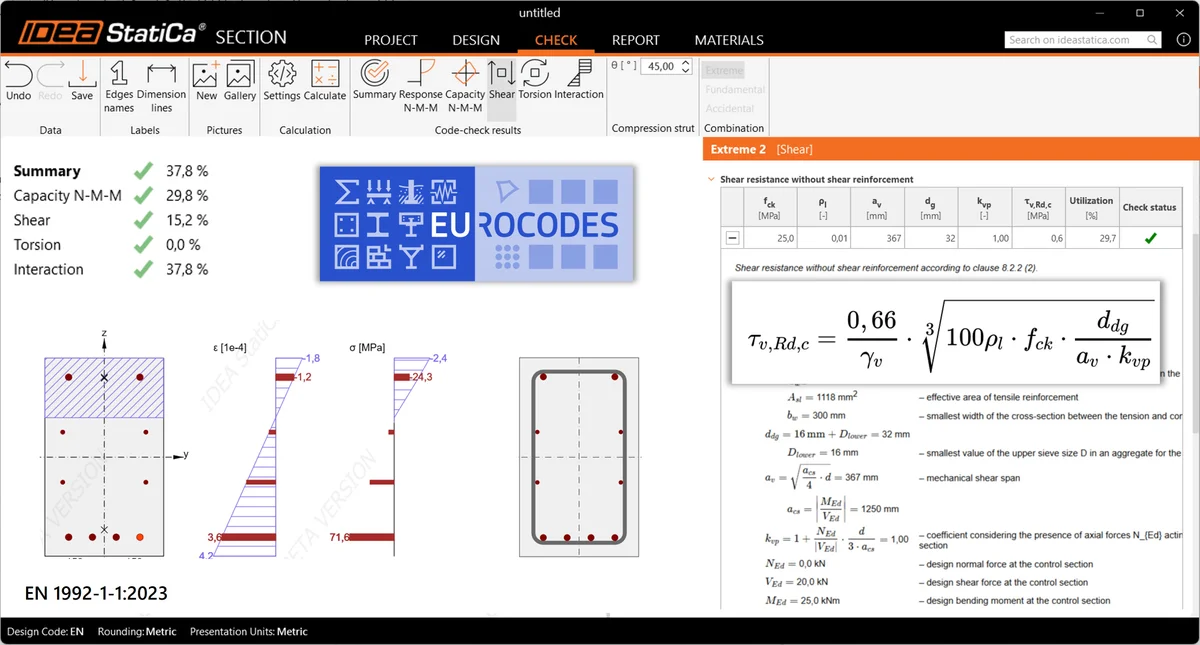


Every engineer who has checked a beam for shear knows the EN 1992-1-1 routine by heart: VRd,c from the empirical formula, then stirrups and the strut with cot θ between 1 and 2.5. FprEN 1992-1-1, the final draft of the second-generation Eurocode 2, keeps the truss but replaces most of what feeds it. The question we hear most often is simple: Will my sections pass or fail differently?
To answer it with numbers rather than impressions, we ran both codes side by side through the same calculation engine and engaged the parameters that matter: reinforcement ratio, shear slenderness, member depth, axial force, concrete class, and strut angle. For the default testing case, the two codes land within one percentage point. Change one parameter, though, and the gap can reach 30 % or more in either direction.
Key takeaways
- Without shear reinforcement, the FprEN 1992-1-1 resistance depends on MEd/VEd. Across the sensitivity study, the FprEN/EN ratio runs from 0.86 to 1.20. Short shear spans and very low or very high ρl gain. Slender members with ordinary reinforcement lose up to ab out 14%.
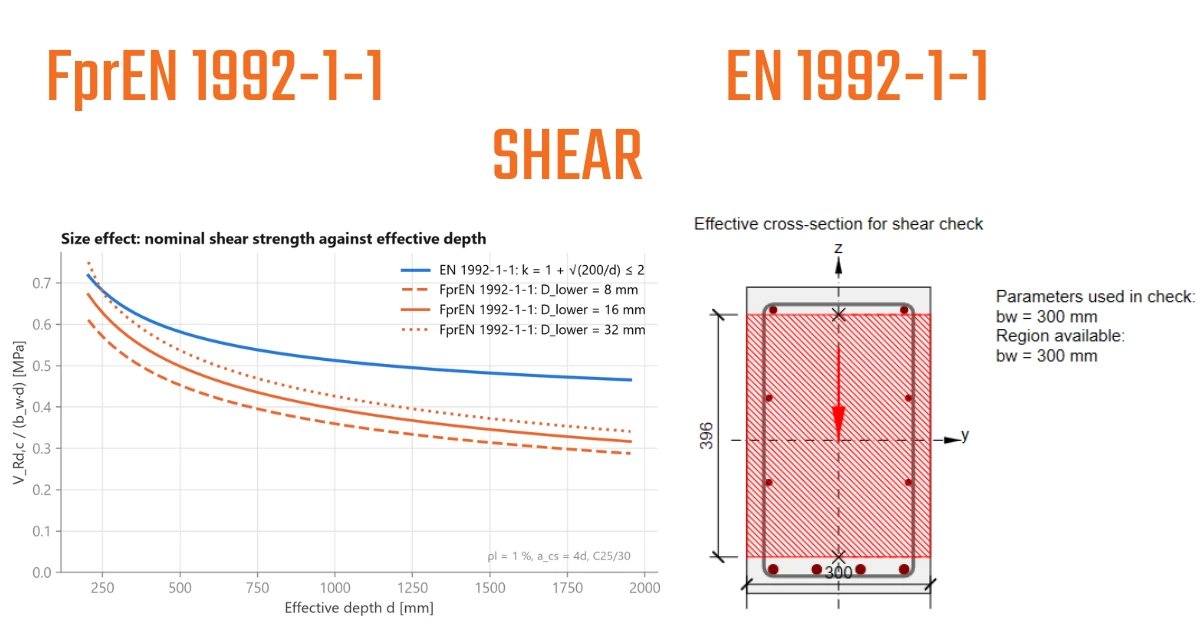
- The size effect of the section is much stronger in FprEN 1992-1-1. At d ≈ 2 m the nominal shear strength is 32 % below the EN 1992-1-1 value.
- Axial force acts differently. FprEN 1992-1-1 is far more lenient for tension and more conservative for moderate compression.
- Stirrups use the same formula in both codes. Results differ only through the permitted strut angle, which in FprEN 1992-1-1 depends on axial force and ductility class.
- The strut check changed the most. With the strain-dependent ν, the FprEN 1992-1-1 VRd,max is about 30 % higher for steep struts and up to 58 % lower for flat struts.
Two models for one check
EN 1992-1-1 calculates the concrete contribution with the empirical expression (6.2.a). It uses a size factor k = 1 + √(200/d) ≤ 2, the reinforcement ratio capped at 2 %, and an additive axial-stress term k1σcp. The section only sees VEd, never the moment that comes with it.
FprEN 1992-1-1 works in shear stress, τEd = VEd/(bw·z). It compares this with a resistance rooted in the critical shear crack theory:
τRd,c = (0.66/γV)·(100·ρl·fck·ddg/d)1/3 ≥ τRd,c,min (8.27), (8.20)
Three new inputs enter here. The aggregate-dependent roughness ddg replaces the size factor. The shear slenderness acs = |MEd/VEd| ≥ d shortens the effective depth for short spans (8.29)–(8.30). The factor kvp (8.31) brings in the axial force. For members with stirrups, the truss stays, but the strength reduction factor ν can follow the chord strains (8.45) instead of being a fixed number.
The test case
All results come from two hand-calculation scripts, one per code, written in the same structure. The FprEN 1992-1-1 script has been compared against IDEA StatiCa Section. Both are ported to an interactive viewer, and the port reproduces the scripts to machine precision. The reference section is the one you see below. Every study changes one parameter while keeping the rest constant. The testing case is a very simple rectangular section (school example) that can be calculated simply by hand, and the response of the section for Normal force + Bending moment in plane. The detailing rules have not been passed for this test case.
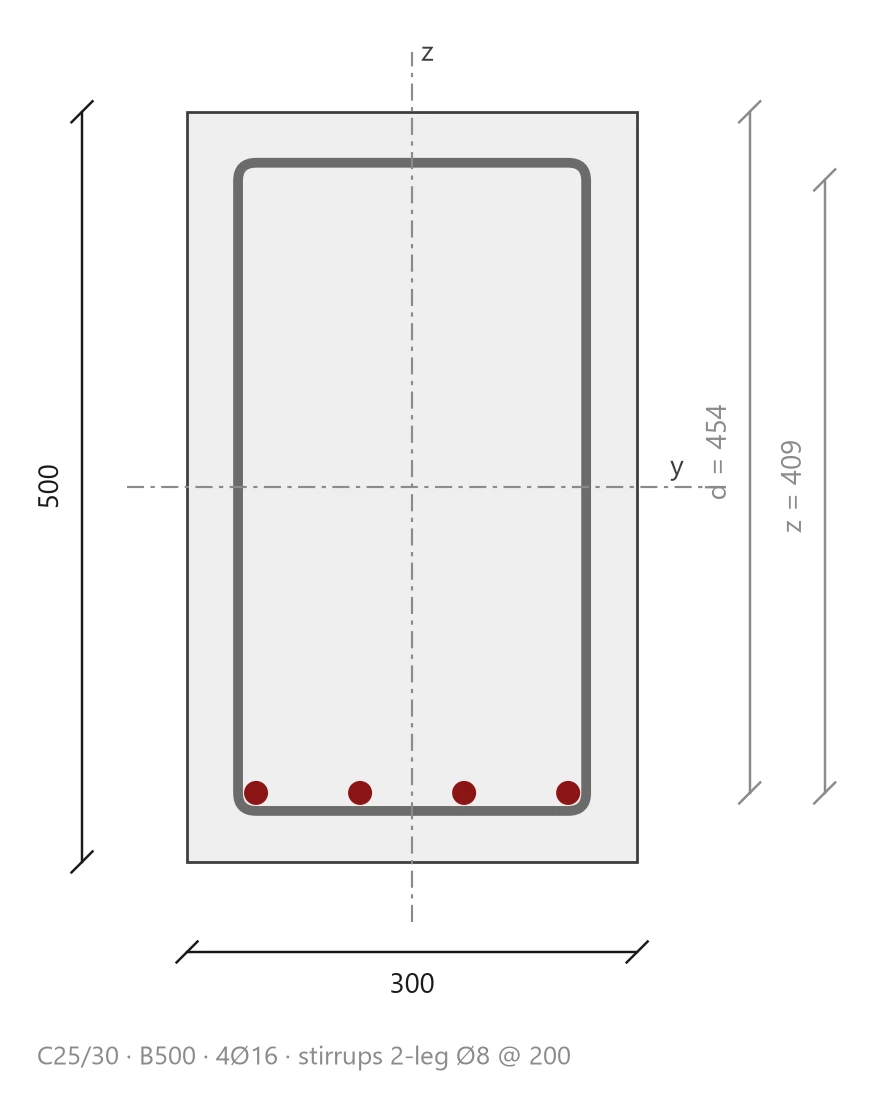
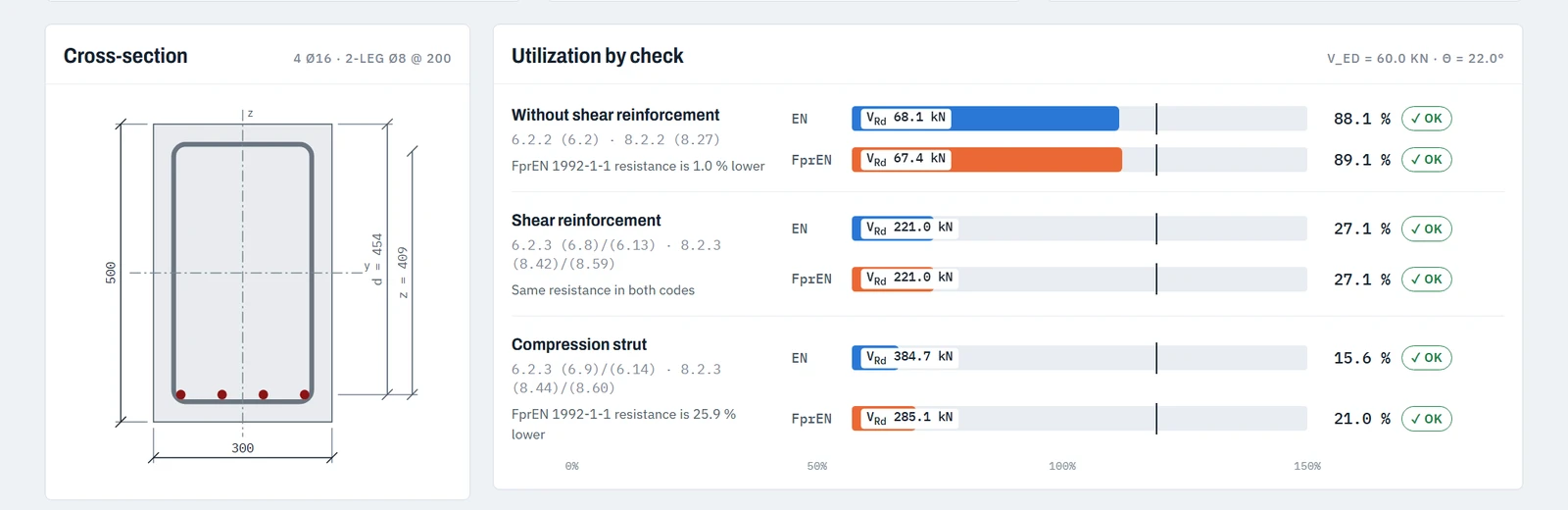
Fig. 1 Reference section (up) and the comparison viewer used for all studies (bottom). The viewer shows utilization charts per check, a summary, and the clause-by-clause values.
| Check (VEd = 60 kN, MEd = 50 kNm, NEd = −10 kN, θ = 22°) | EN 1992-1-1 | FprEN 1992-1-1 |
| Without shear reinforcement | 68.1 kN · 88.1 % | 67.4 kN · 89.1 % |
| Shear reinforcement | 221.0 kN · 27.1 % | 221.0 kN · 27.1 % |
| Compression strut | 384.7 kN · 15.6 % | 285.1 kN · 21.0 % |
The base case already hints at the pattern. The concrete check and the stirrups agree. The strut does not: fcd drops from 16.67 to 14.17 MPa with ktc = 0.85, and ν falls from 0.54 to 0.47 at this strut angle.
Members without shear reinforcement
Shear slenderness is the new first-order parameter
In EN 1992-1-1 the moment at the section has no influence on VRd,c. In FprEN 1992-1-1 it does. At ρl = 1 % the EN 1992-1-1 code gives 80.9 kN for any moment. The FprEN 1992-1-1 code gives 83.2 kN for acs = 1.5d, 73.7 kN for 3d and 70.0 kN for 6d.
In general, as the moment contribution increases, the bearing capacity in shear decreases.
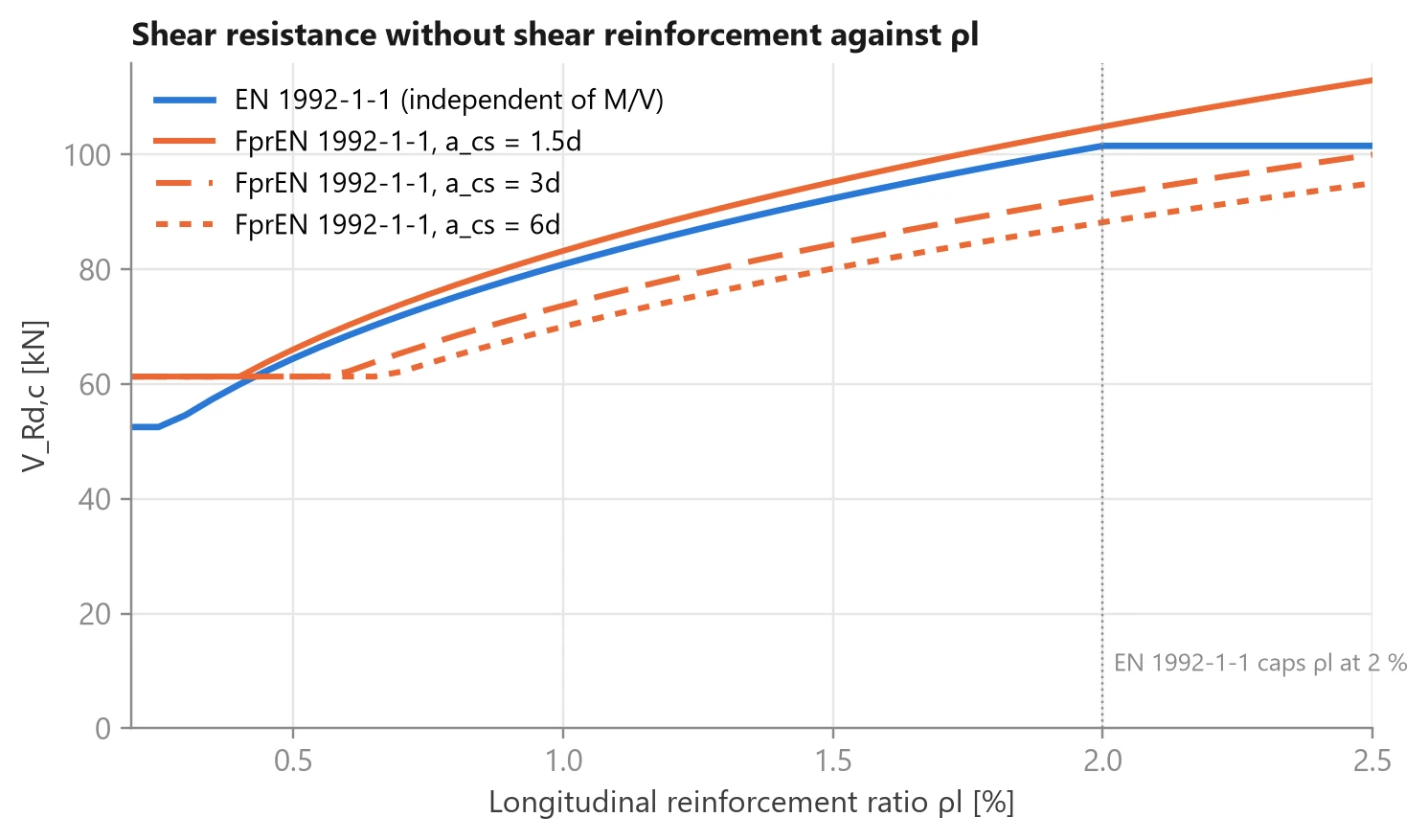
Fig. 2 VRd,c against the longitudinal reinforcement ratio. EN 1992-1-1 is one curve; FprEN 1992-1-1 splits by shear slenderness. EN 1992-1-1 stops gaining above ρl = 2 %.
The ratio map shows where each code is more generous. Across ρl = 0.25–2.5 % and acs/d = 1–8, the ratio of FprEN 1992-1-1 to EN 1992-1-1 resistance ranges from 0.86 to 1.20. The new code rewards short shear spans (below about 1.7d), very low reinforcement where the minimum governs, and ρl above 2 %. For the typical slender beam with ordinary reinforcement, it is up to about 14 % more conservative.
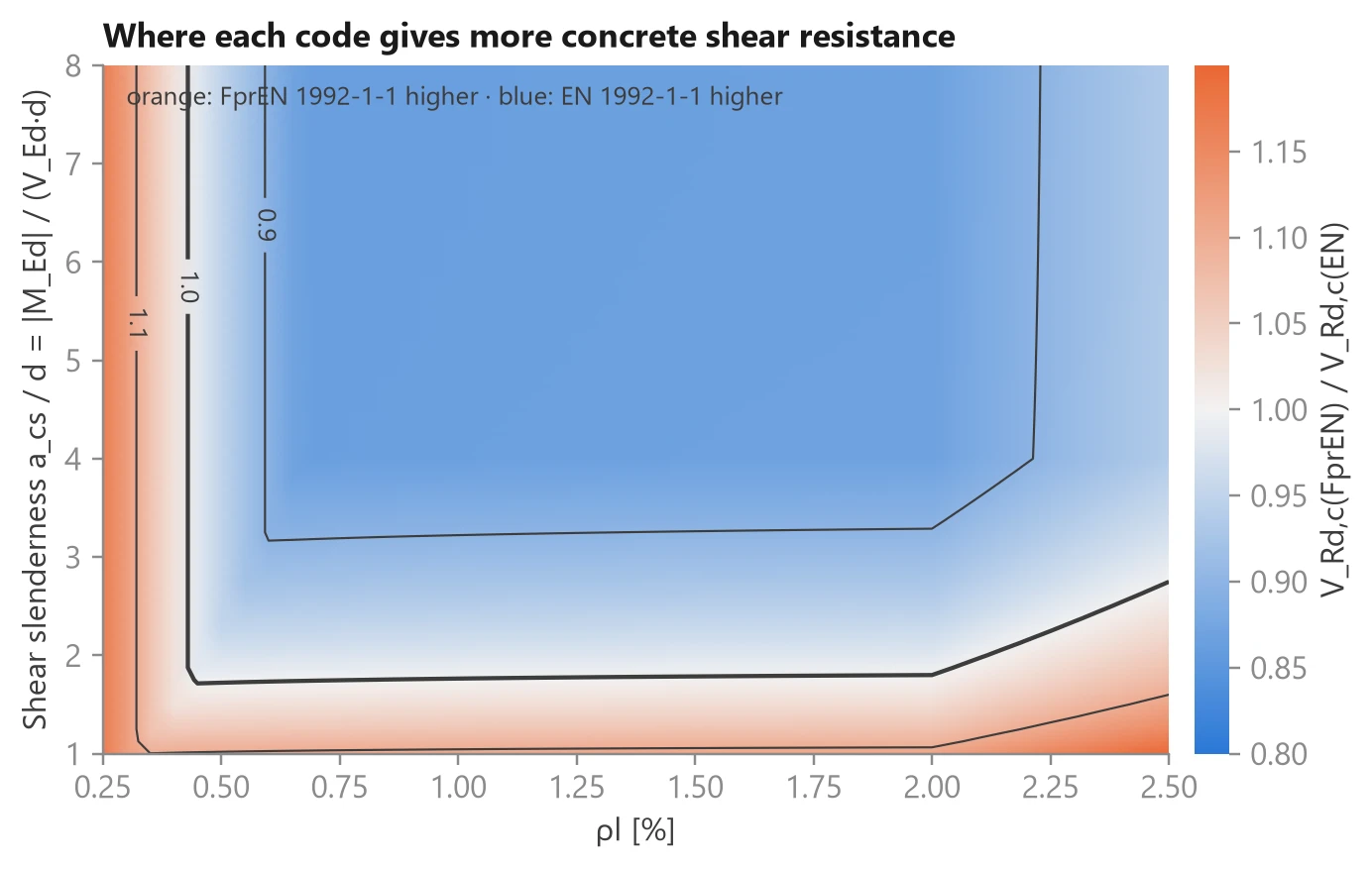
Fig. 3 VRd,c(FprEN)/VRd,c(EN) over ρl and shear slenderness. Orange areas favour FprEN 1992-1-1, blue areas favour EN 1992-1-1. Base section, C25/30, Dlower = 16 mm.
Deep members: a much stronger size effect
The EN 1992-1-1 factor k flattens out quickly. The FprEN 1992-1-1 term (ddg/d)1/3 keeps falling. At d = 204 mm, the difference is 6 %. It grows to 18 % at d = 704 mm, 25 % at 1204 mm and 32 % at 1954 mm. Transfer slabs, foundation beams and deep walls are where the new code will bite first. The aggregate size now matters too: a coarser mix (Dlower = 32 mm) recovers part of the loss, and an 8 mm mix loses more.
The higher the section, the lower the bearing capacity.
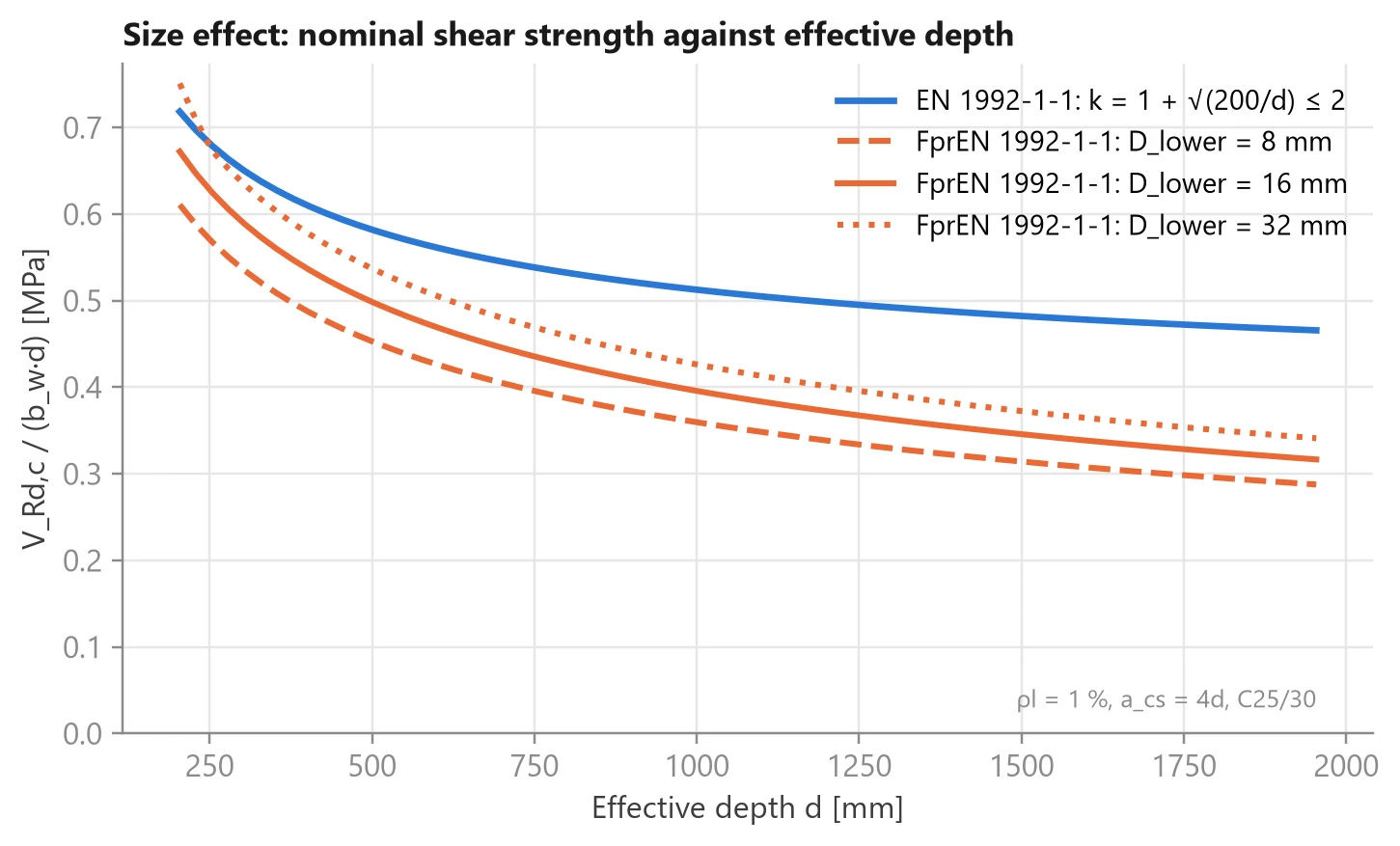
Fig. 4 Nominal shear strength VRd,c/(bwd) against effective depth, ρl = 1 %, acs = 4d.
Axial force: the two codes move in opposite directions
EN 1992-1-1 adds 0.15·σcp to the resistance, which makes it linear in the axial stress and unforgiving in tension. FprEN 1992-1-1 scales the effective depth with kvp, so the effect depends on the ratio NEd/VEd. For our case (VEd = 100 kN, acs = 3d) and an axial tension of −2 MPa, FprEN 1992-1-1 gives 66.5 kN against 38.6 kN in EN 1992-1-1. That is 72 % more. At +3 MPa compression, the order flips: 92.3 kN against 140.8 kN, 34 % less. Very high compression brings them together again, because EN 1992-1-1 caps σcp at 0.2fcd.
** Tension is a negative sign, compression is a positive sign (Eurorocode approach to σcp).
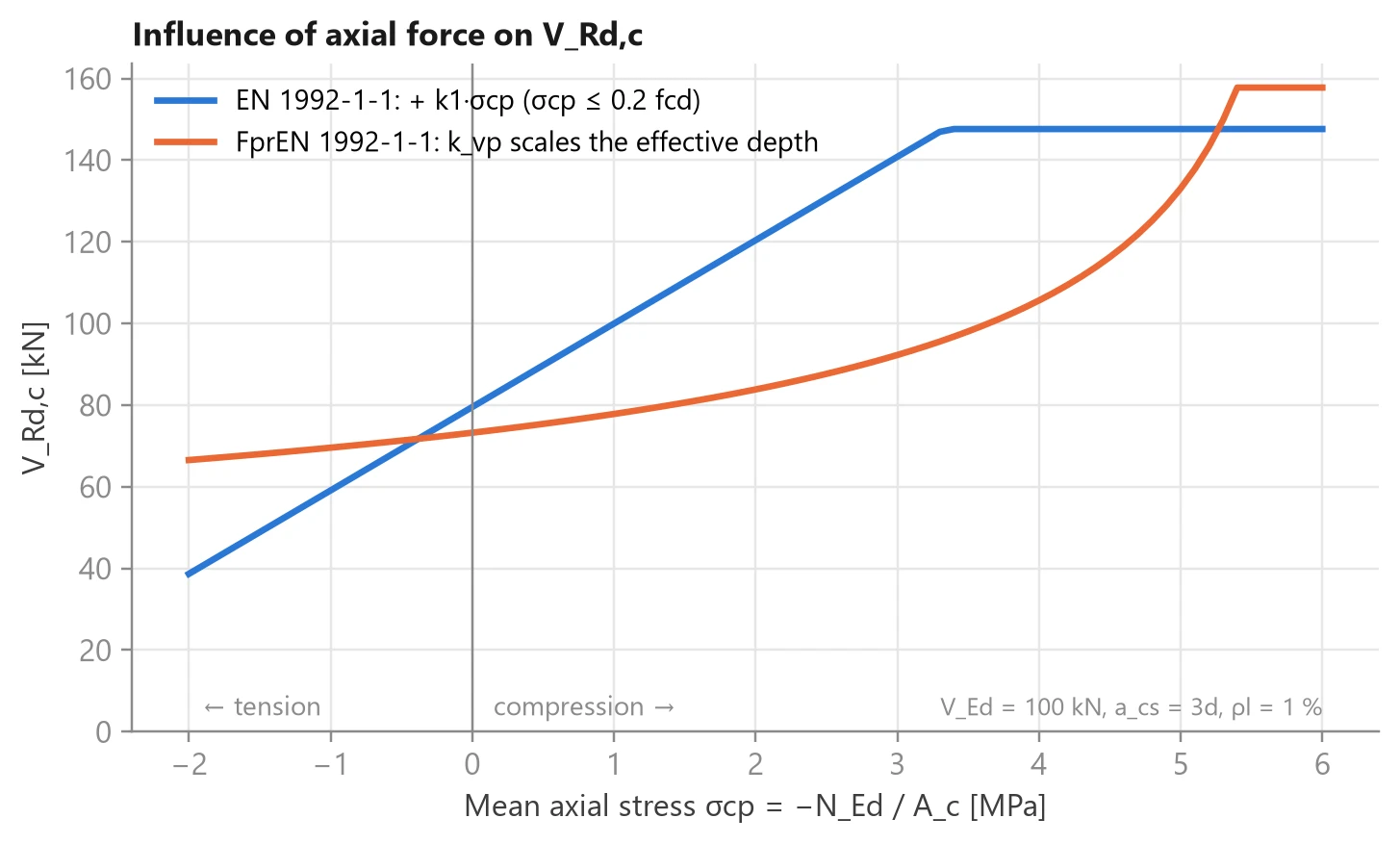
Fig. 5 VRd,c against the mean axial stress. Tension to the left, compression to the right.
Concrete class
For C12/15 to C60/75, the FprEN 1992-1-1 VRd,c of a slender member is consistently about 13 % lower (C25/30: 70.1 against 80.9 kN). Above C60 the code reduces ddg, so the FprEN 1992-1-1 curve almost stops rising: at C90/105 it is 20 % below EN 1992-1-1.
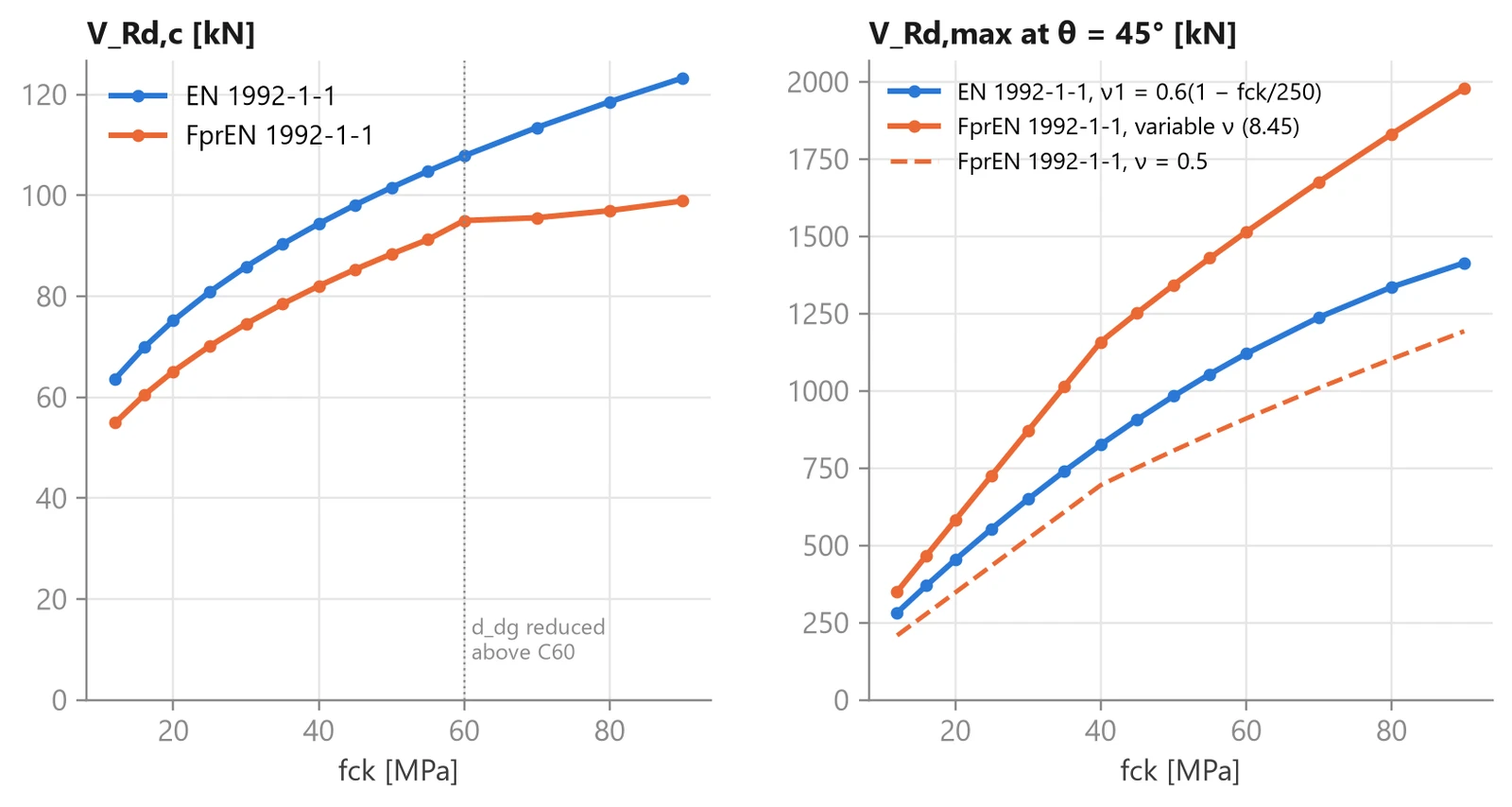
Fig. 6 Left: VRd,c against fck (ρl = 1 %, acs = 4d). Right: VRd,max at θ = 45° with the EN 1992-1-1 ν1, the FprEN 1992-1-1 variable ν and the constant ν = 0.5.
Members with shear reinforcement
Stirrups: same formula, different angles
The stirrup resistance is the same truss expression in both codes, VRd,s = Asw/s·z·fywd·cot θ. With the same z and θ, both codes give identical numbers, as in our base case. The difference lies in which θ you may choose. EN 1992-1-1 allows 1 ≤ cot θ ≤ 2.5 regardless of the loading. FprEN 1992-1-1 raises the limit to 3.0 for significant compression. It lowers it in tension (2.5 − 0.1·NEd/|VEd|) and cuts it by 20 % for ductility class A reinforcement.
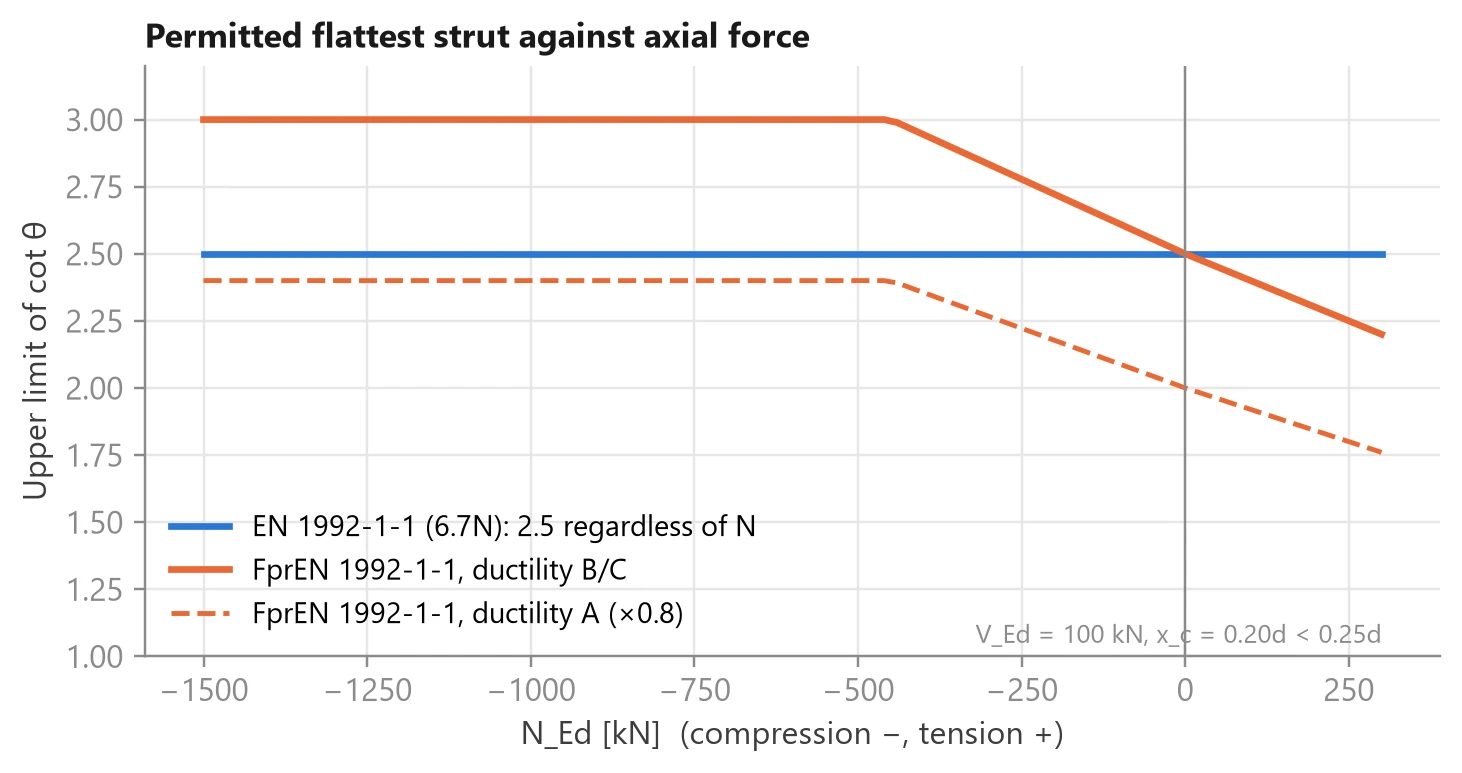
Fig. 7 Upper limit of cot θ against axial force (VEd = 100 kN). Between 2.5 and 3.0 the code allows interpolation; the linear interpolation on σcp is our script's interpretation.
The strut: the largest single change
With constant ν = 0.5, the FprEN 1992-1-1 strut is uniformly about 22 % weaker than EN 1992-1-1 in our case, mainly through ktc. The variable ν of (8.45) changes the picture. ν depends on the mean chord strain εx and on cot²θ, so steep struts benefit and flat struts are penalised. At cot θ = 1 the FprEN 1992-1-1 VRd,max is 724.8 kN against 553.8 kN (+31 %). At cot θ = 2.5 it is 279.9 kN against 381.9 kN (−27 %). The two curves cross near θ = 30°.
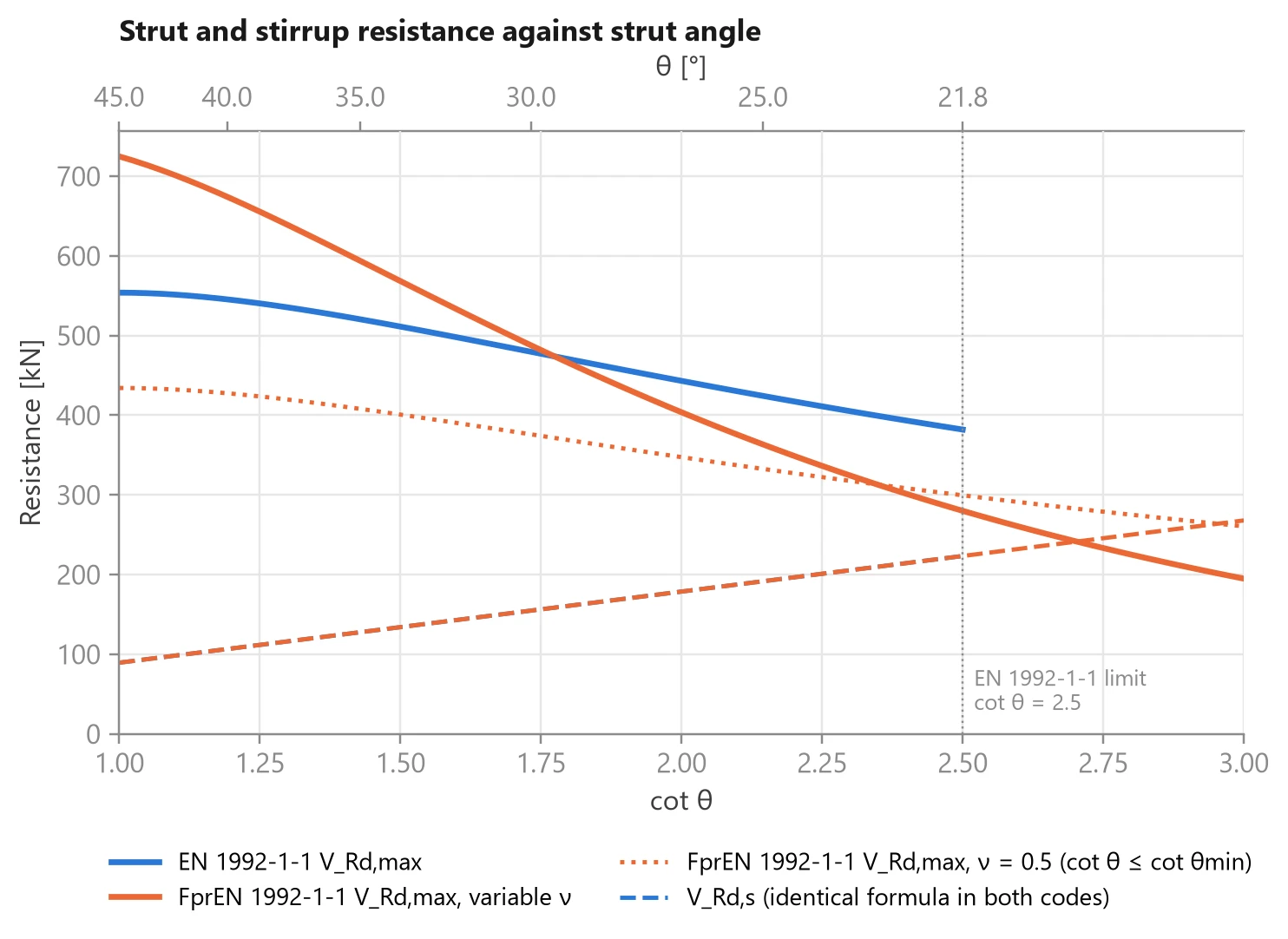
Fig. 8 VRd,max and VRd,s against cot θ for the base section. The VRd,s lines of the two codes coincide.
Because ν follows the chord strains, the bending moment now influences the strut. In EN 1992-1-1 the moment plays no role. In FprEN 1992-1-1, at θ = 21.8° and VEd = 150 kN, ν varies between 0.27 and 0.38 against the EN 1992-1-1 value of 0.54, so VRd,max is 40–58 % lower. ν is lowest at both ends of the moment range. At small moments the shear-induced chord force puts the compression chord into tension. At large moments the tension chord strain grows. One practical consequence: if the compression chord goes into tension and the section has no top reinforcement, ν drops to zero, so model the top bars.
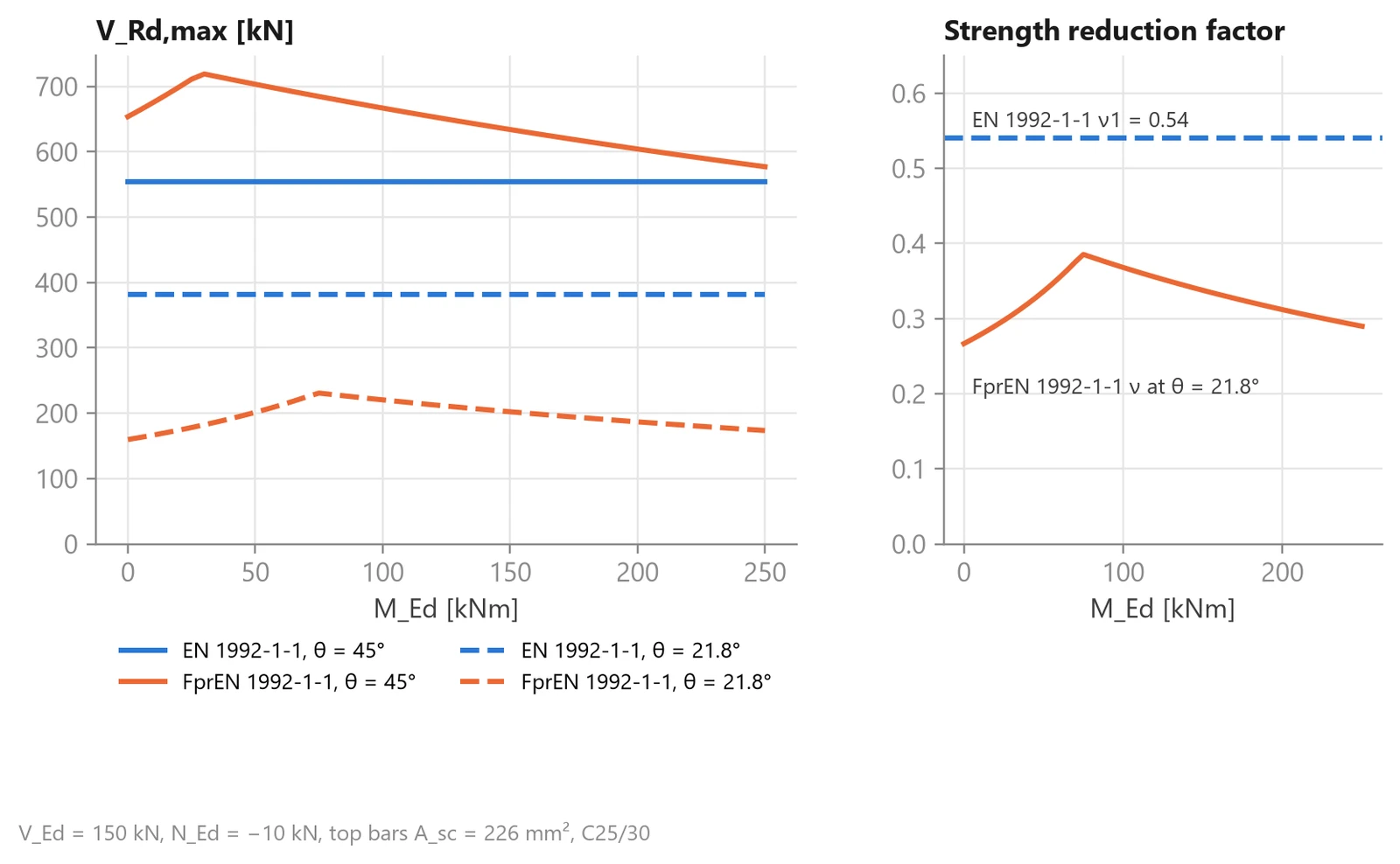
Fig. 9 VRd,max (left) and the strength reduction factor (right) against MEd. Top bars 2Ø12 included.
What it means for the design capacity
Designers do not check a fixed θ. They choose the angle that gives the highest resistance. For each shear reinforcement ratio we therefore took the θ that maximises min(VRd,s; VRd,max). Three regions appear:
- Lightly reinforced webs (ρw ≈ 0.08 %). The two codes match within the cot θ limits (107 kN). FprEN 1992-1-1 gains 21 % (129 kN) only if you use the clause 8.2.3(7) option to exceed cot θmin with variable ν.
- Moderately reinforced webs (ρw ≈ 0.4 %). FprEN 1992-1-1 is 14 % lower (379 against 439 kN), because the optimum angle is now limited by the weaker flat strut.
- Heavily reinforced webs (ρw ≥ 1 %). The strut governs at θ = 45°, where FprEN 1992-1-1 is 10–15 % higher (610–634 against 554 kN).
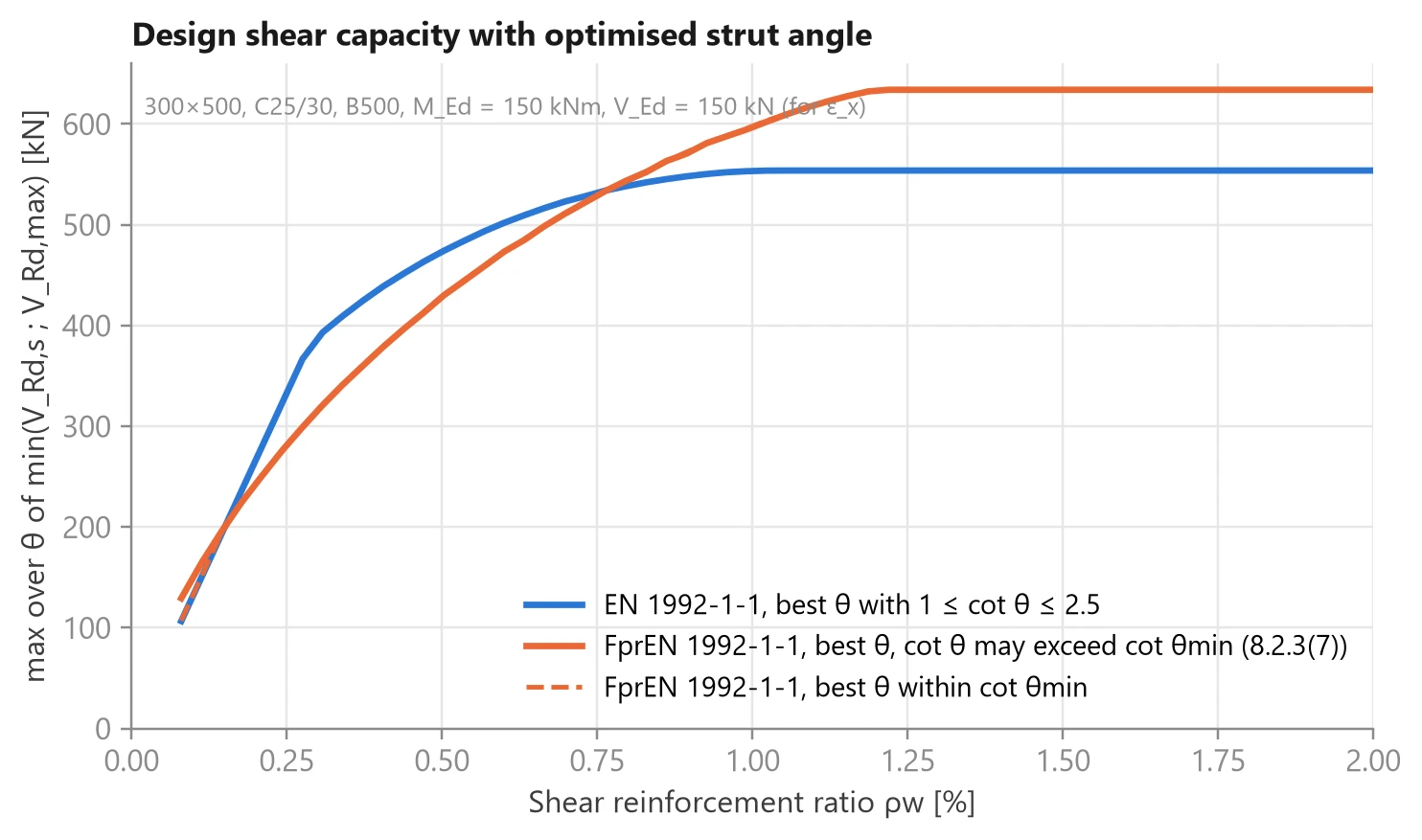
Fig. 10 Design shear capacity with the optimal strut angle against ρw. MEd = 150 kNm and VEd = 150 kN.
Deviation map
| Check | Driver | FprEN 1992-1-1 relative to EN 1992-1-1 |
| VRd,c | Shear slenderness acs/d | 0.86 … 1.20 overall · up to −14 % slender, ordinary ρl |
| VRd,c | Effective depth | −6 % at 0.2 m … −32 % at 2 m |
| VRd,c | Axial tension (−2 MPa) | +72 % |
| VRd,c | Axial compression (+3 MPa) | −34 % |
| VRd,c | Concrete class C12–C60 / C90 | −13 % / −20 % |
| VRd,s | Same θ | identical |
| VRd,s | Permitted cot θ | 3.0 compression · 2.5 no axial force · 2.2 tension · ×0.8 class A |
| VRd,max | Steep strut, cot θ = 1 | +31 % (variable ν) · −22 % (ν = 0.5) |
| VRd,max | Flat strut, cot θ = 2.5 | −27 % … −58 % depending on MEd |
| Design capacity | ρw 0.4 % / ≥ 1 % | −14 % / +10 … 15 % |
What to watch in practice
- Pass on the internal forces, not only the shear. In FprEN 1992-1-1, MEd and NEd at the same section change both VRd,c and ν. A spreadsheet that only reads VEd is no longer enough.
- Review deep members first. Elements with d above about 700 mm and no stirrups will see the largest reductions.
- Do not reuse a flat θ out of habit. cot θ = 2.5 was often the economical choice under EN 1992-1-1. With variable ν it can make the strut govern, while a steeper angle may give more total capacity.
- Specify the aggregate. Dlower is now a design input for shear.
- Model the compression chord reinforcement. It enters εx whenever the chord is in tension.
Assumptions and limits
Rectangular RC section without prestressing. Recommended values of all Nationally Determined Parameters; National Annexes may change CRd,c, vmin, k1, the cot θ limits, γ factors and ktc. z = 0.9d; for FprEN 1992-1-1, xc = 0.20d and stirrup legs parallel to the shear force. For EN 1992-1-1, ν1 = ν from (6.6N) and αcw from σcp (6.11.aN); the alternatives ν1 = 0.6 and αcw = 1.0 are available in the viewer. Loads near supports, flanged sections, torsion and detailing minimums are outside the scope. The EN 1992-1-1 script was checked clause by clause against EN 1992-1-1 but has not yet been compared with IDEA StatiCa Section. The percentages describe this family of sections and are not general factors.
Try the new Eurocode on your own sections
IDEA StatiCa Section BETA designs reinforced concrete sections at the ultimate limit state to FprEN 1992-1-1. Load your sections, compare the results with your current practice, and tell us where the new code surprises you.
Read about the transition to the 2nd generation of Eurocodes →
Sources
- EN 1992-1-1, clauses 2.4.2.4, 3.1.6, 6.2.2, 6.2.3.
- FprEN 1992-1-1, clauses 4.3, 5.1, 8.2.1–8.2.3.